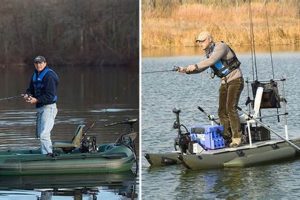
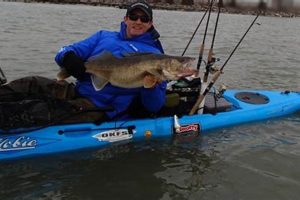
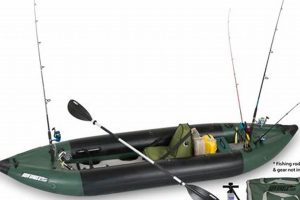
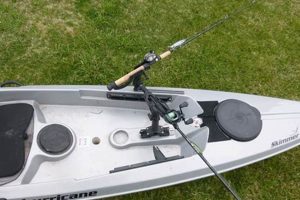
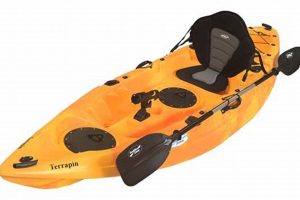
A compact, manually powered aquatic propulsion device offers anglers increased maneuverability and stealth while fishing from a small, human-powered boat. These devices are typically lightweight and easily stowed, allowing for hands-free fishing when desired. They are often used in shallow water, areas with dense vegetation, or situations where minimal disturbance of the water is advantageous for attracting fish.
Quiet operation is a key advantage of these tools, enabling anglers to approach fish without startling them with the noise of a motorized vessel or even a traditional paddle. This quiet approach is especially valuable in shallow waters or when targeting easily spooked species. Further, these devices provide a high degree of control, allowing for precise adjustments to position and drift. Historically, anglers have utilized various forms of manual propulsion, but modern designs prioritize portability, efficiency, and durability for the dedicated kayak angler.
This article will further explore the advantages of human-powered propulsion for kayak fishing, including discussions on various blade designs, materials, and techniques for maximizing efficiency and stealth on the water. Specific use cases and recommended equipment for different fishing environments will also be covered.
Tips for Effective Kayak Fishing Paddle Use
Maximizing the benefits of a kayak fishing paddle requires understanding proper techniques and selecting appropriate equipment. The following tips provide guidance for improved efficiency, stealth, and overall fishing success.
Tip 1: Choose the Right Paddle Length. Paddle length should be determined by factors including kayak width, angler height, and paddling style. A paddle that is too long or too short can lead to inefficient paddling and potential strain.
Tip 2: Utilize a Feathering Angle. Adjusting the angle between paddle blades reduces wind resistance on the blade out of the water, improving paddling efficiency and reducing fatigue. Experiment to find the optimal feathering angle for individual preferences and conditions.
Tip 3: Employ a High-Angle Paddle Stroke. A high-angle paddle stroke is generally preferred for kayak fishing, offering greater maneuverability and control compared to a low-angle touring stroke. Keep the paddle shaft relatively vertical and close to the kayak.
Tip 4: Master the Silent Stroke. Minimize splashing and noise by smoothly entering and exiting the water with the paddle blade. This quiet approach is crucial for not disturbing fish, especially in shallow water.
Tip 5: Practice Bracing Techniques. Learn low and high bracing techniques to maintain stability in challenging conditions, such as windy weather or when fighting a fish.
Tip 6: Consider Blade Shape and Material. Paddle blade shape and material influence performance. Shorter, wider blades offer greater power for maneuvering, while longer, narrower blades are better suited for speed. Durable, lightweight materials like fiberglass or carbon fiber are preferable.
Tip 7: Regularly Inspect and Maintain the Paddle. Check the paddle shaft and blades for wear and tear. Tighten any loose connections and clean the paddle after each use to ensure optimal performance and longevity.
By implementing these tips, anglers can significantly improve their paddling technique and enhance their overall kayak fishing experience. Effective paddle use translates to increased efficiency, greater stealth, and ultimately, more opportunities for a successful catch.
These practical tips offer a strong foundation for kayak anglers looking to refine their skills. The following conclusion will summarize the core advantages of utilizing a specialized paddle and reinforce its integral role in successful kayak fishing.
1. Silent Propulsion

Silent propulsion is a defining characteristic of kayak fishing hand paddles, offering a significant advantage over other methods of kayak propulsion. Conventional paddles, even when used skillfully, create surface disturbances and noise that can spook fish, especially in shallow, clear water. Motorized kayaks, while efficient for covering distance, introduce substantial noise pollution that disrupts the natural underwater environment and alerts fish to the angler’s presence. A hand paddle, in contrast, allows for near-silent movement through the water. The smaller blade size and controlled movements minimize disturbance, enabling anglers to approach fish undetected and significantly increase their chances of a successful catch. This is particularly crucial when targeting wary species or fishing in heavily pressured waters.
Consider a scenario in which an angler pursues bonefish on a shallow, sunlit flat. The slightest sound can send these notoriously spooky fish scattering. A hand paddle allows the angler to subtly adjust position and maintain a stealthy approach, keeping the kayak within casting range without alarming the fish. Similarly, in a slow-moving river targeting trout, the quiet operation of a hand paddle prevents the transmission of vibrations through the kayak hull, vibrations that would otherwise telegraph the angler’s presence downstream. This advantage translates to more opportunities for presenting lures or bait naturally and increasing the likelihood of enticing a strike.
The practical significance of silent propulsion in kayak fishing cannot be overstated. It directly influences an angler’s ability to get closer to fish, particularly in environments where noise and disturbance are detrimental to success. While other factors such as lure presentation and fishing technique remain important, the ability to move quietly and maintain a low profile offers a distinct advantage, making hand paddles a valuable tool for anglers seeking to maximize their effectiveness on the water.
2. Precise Maneuvering

Precise maneuvering is essential for successful kayak fishing, enabling anglers to position themselves effectively for casting, presentation, and fish fighting. A kayak fishing hand paddle offers distinct advantages in achieving this level of control, surpassing the capabilities of traditional paddles and motors in specific situations. Its compact size and direct, immediate response provide nuanced control over kayak movement, allowing for subtle adjustments and maintaining optimal position in dynamic fishing environments.
- Micro-Adjustments in Current:
Maintaining precise position in flowing water is often challenging. Hand paddles excel in this scenario, enabling minute adjustments to counteract current drift and hold the kayak in a specific location relative to structure or cover. This is particularly valuable when fishing seams, eddies, or other current breaks where fish often concentrate. Traditional paddles, while effective for general propulsion, lack the finesse required for these subtle corrections. Motors, on the other hand, can be too powerful and disruptive for such delicate maneuvers.
- Stealthy Approach to Structure:
Approaching fish-holding structure without spooking wary fish requires careful control. A hand paddle allows anglers to silently and precisely navigate around logs, rocks, and vegetation, minimizing disturbance and maximizing the chances of a successful presentation. The quiet operation and controlled movement provide a significant advantage over the broader strokes of a traditional paddle or the noise and water displacement of a motor.
- Controlled Drifting:
Maintaining a controlled drift is often key to effective fishing presentations. Hand paddles facilitate subtle adjustments to drift speed and direction, allowing anglers to cover water methodically and present lures or bait naturally. This fine-tuned control is crucial in techniques like drift fishing or float fishing, where maintaining the correct presentation angle and speed is paramount.
- Navigating Tight Quarters:
Kayak anglers frequently encounter tight spaces, such as narrow creeks, mangrove tunnels, or areas choked with vegetation. A hand paddle provides the maneuverability necessary to navigate these challenging environments effectively. The short strokes and precise control allow for quick adjustments and tight turns, enabling access to areas often unreachable with a longer paddle or a motor.
The ability to execute precise maneuvers contributes significantly to angling success. The kayak fishing hand paddle enhances this capability, offering a degree of control that often surpasses traditional paddles and motors in specific fishing scenarios. By facilitating subtle adjustments, quiet movement, and enhanced maneuverability, these specialized paddles provide a distinct advantage, empowering anglers to effectively position themselves for optimal presentations and maximize their chances of hooking and landing fish.
3. Shallow Water Access
Shallow water environments often hold significant appeal for kayak anglers, providing habitat for a variety of fish species and offering unique fishing opportunities. Access to these areas, however, can be limited by propulsion methods. Traditional paddles, while versatile, require sufficient depth for effective use, and motorized kayaks, while capable of navigating shallows, often create excessive noise and disturbance, potentially spooking fish. Kayak fishing hand paddles offer a distinct advantage in these scenarios, enabling access to extremely shallow areas while maintaining stealth and minimizing environmental impact.
Consider the pursuit of redfish in saltwater marshes. These shallow, often vegetated areas are prime redfish habitat, but navigating them with a conventional paddle can be challenging due to the limited depth and the risk of entanglement. Motorized kayaks are often impractical due to noise and the potential for propeller damage. A hand paddle, however, allows anglers to quietly and efficiently propel their kayaks through shallow water, accessing prime fishing locations without disturbing the environment or alerting wary fish. Similarly, in freshwater environments, hand paddles enable anglers to navigate shallow creeks, backwaters, and flooded timber, areas often inaccessible to other propulsion methods. This expanded access opens up new fishing opportunities and allows anglers to target species that inhabit these shallow, often productive waters.
The ability to access shallow water expands fishing opportunities and contributes significantly to the versatility of kayak fishing. Kayak hand paddles facilitate this access while minimizing disturbance and maximizing stealth. This capability is particularly valuable in environments where fish are easily spooked or where traditional propulsion methods are impractical. By enabling anglers to explore these often-overlooked areas, hand paddles contribute to a more comprehensive and successful kayak fishing experience. The quiet operation and precise control they offer create minimal disturbance, preserving the delicate balance of these shallow-water ecosystems while simultaneously maximizing angling opportunities.
4. Increased Stealth

Stealth is a cornerstone of successful angling, particularly in kayak fishing where close proximity to the water amplifies any disturbance. A kayak fishing hand paddle contributes significantly to increased stealth, offering distinct advantages over other propulsion methods. Its quiet operation and precise control minimize noise and water displacement, allowing anglers to approach fish undetected and enhance their chances of a successful catch.
- Reduced Noise Pollution:
Unlike motorized kayaks or even traditional paddles, hand paddles produce minimal noise. The absence of splashing, whirring motors, or paddle drips creates a significantly quieter approach, crucial for not alarming fish, especially in shallow or clear water. This reduced noise pollution allows anglers to maintain a low profile and get closer to their target species.
- Minimized Water Displacement:
The smaller blade size and controlled movements of a hand paddle create less water displacement compared to traditional paddles or motors. This subtle action reduces pressure waves and vibrations that can travel through the water and alert fish to the angler’s presence. Minimizing these disturbances allows for a more natural and less intrusive approach, increasing the likelihood of fish remaining in the area and taking the bait or lure.
- Controlled Approach to Fish:
Hand paddles offer precise control over kayak movement, enabling anglers to make subtle adjustments and maintain ideal positioning without creating excessive disturbance. This controlled approach allows for careful navigation through complex environments, such as shallow flats or weed beds, without spooking fish. The ability to maneuver quietly and precisely enhances angling effectiveness, particularly in situations where fish are easily startled.
- Low-Profile Presentation:
The compact size and quiet operation of a hand paddle contribute to a lower-profile presentation overall. This allows anglers to blend in with the surrounding environment and avoid creating a large visual or auditory disturbance. Maintaining a low profile is particularly important when sight fishing or targeting wary species in clear water conditions.
The increased stealth offered by a kayak fishing hand paddle is a key advantage in many fishing scenarios. By reducing noise pollution, minimizing water displacement, and providing precise control, these specialized paddles empower anglers to approach fish undetected and increase their chances of a successful hookup. This enhanced stealth, combined with the maneuverability and shallow water access provided by hand paddles, contributes significantly to a more effective and rewarding kayak fishing experience.
5. Hands-Free Fishing Readiness
Hands-free fishing readiness represents a crucial aspect of kayak fishing, enabling anglers to react quickly to strikes, manage lines, and land fish effectively. A kayak fishing hand paddle facilitates this readiness by providing an alternative propulsion method that frees up both hands for essential fishing tasks. This seamless transition between paddling and fishing enhances angling efficiency and increases the likelihood of successful hookups and landings. Consider the scenario of a sudden strike while working a lure. With a traditional paddle, the angler would need to stow the paddle before addressing the fish, potentially losing valuable time and possibly the fish itself. A hand paddle allows for instantaneous reaction, enabling the angler to immediately set the hook and begin playing the fish without delay. This rapid response can be the difference between landing a trophy catch and losing it.
The practical significance of hands-free fishing readiness extends beyond simply reacting to strikes. It also allows for more efficient lure management, particularly in techniques like trolling or jigging where constant adjustments and manipulation of the line are required. Similarly, when landing a fish, having both hands available to control the rod, reel, and net is essential for a successful and safe outcome. A hand paddle ensures this readiness, facilitating a smooth and controlled landing process, minimizing the risk of losing the fish or damaging equipment. This seamless integration of propulsion and fishing action streamlines the entire angling process, enhancing both efficiency and enjoyment.
In summary, hands-free fishing readiness, facilitated by the use of a kayak fishing hand paddle, represents a crucial element of successful kayak angling. The ability to instantly transition from paddling to fishing and having both hands available for essential tasks enhances reaction time, improves lure management, and facilitates controlled fish landing. This enhanced readiness translates to increased efficiency, reduced lost opportunities, and a more rewarding experience on the water. The ability to react quickly and efficiently to changing fishing conditions, combined with the stealth and maneuverability offered by a hand paddle, contributes significantly to a more productive and enjoyable kayak fishing experience.
Frequently Asked Questions
This section addresses common inquiries regarding kayak fishing hand paddles, providing concise and informative responses to clarify potential uncertainties and enhance understanding of their functionality and benefits.
Question 1: How does a kayak fishing hand paddle compare to a traditional kayak paddle in terms of speed and efficiency?
While a traditional paddle is generally more efficient for covering long distances, a hand paddle prioritizes maneuverability and stealth over outright speed. It excels in short-distance adjustments and precise positioning, particularly in shallow water or areas requiring minimal disturbance.
Question 2: Are hand paddles suitable for all types of kayaks?
Hand paddles are generally compatible with most kayak types, but their effectiveness can vary depending on hull design and intended use. They are particularly well-suited for sit-on-top and smaller, more maneuverable kayaks used in fishing applications.
Question 3: What are the primary advantages of using a hand paddle for kayak fishing?
Key advantages include enhanced stealth, precise maneuvering in tight spaces, access to extremely shallow water, and immediate hands-free fishing readiness. These features contribute to a more effective and enjoyable fishing experience, especially in environments where stealth and precision are paramount.
Question 4: What materials are commonly used in the construction of kayak fishing hand paddles?
Common materials include durable plastics, fiberglass, and carbon fiber. Material choice influences paddle weight, durability, and performance. Lightweight, robust materials are generally preferred for their balance of strength and ease of use.
Question 5: How does one choose the appropriate size or style of hand paddle?
Paddle size and style selection depends on factors such as kayak width, angler hand size, and intended fishing style. Smaller blades offer greater maneuverability while larger blades provide more power. Anglers should consider these factors when selecting a paddle to ensure optimal performance and comfort.
Question 6: Are there any specific maintenance requirements for a kayak fishing hand paddle?
Regular rinsing with fresh water after each use helps prevent corrosion and maintain paddle performance. Inspecting the paddle for any signs of wear or damage and addressing any issues promptly will ensure longevity and reliable performance.
Understanding the advantages and limitations of kayak fishing hand paddles allows anglers to make informed decisions about their equipment and enhance their fishing experience. These FAQs provide a foundation for further exploration of specific paddle designs, techniques, and applications.
This concludes the FAQ section. The following section will offer a concluding summary of the key benefits and considerations discussed throughout this article.
Conclusion
This exploration of kayak fishing hand paddles has highlighted their significance in enhancing angling effectiveness. Quiet operation facilitates a stealthy approach, minimizing disturbance and maximizing opportunities for close-range presentations. Precise maneuverability allows navigation through complex environments and strategic positioning in dynamic currents or around structure. Shallow water access opens up new fishing grounds often inaccessible to other propulsion methods. The inherent hands-free fishing readiness ensures immediate response to strikes and efficient management of lines and tackle. These combined advantages contribute significantly to a more productive and immersive kayak fishing experience.
Adoption of a kayak fishing hand paddle represents a strategic advantage, empowering anglers to approach their sport with enhanced precision and finesse. As kayak fishing continues to evolve, embracing specialized equipment like the hand paddle unlocks new possibilities for exploring diverse waters and pursuing target species with greater efficiency and success. Careful consideration of paddle design, materials, and techniques further optimizes performance, aligning individual paddling style with specific fishing environments and target species. Ultimately, the kayak fishing hand paddle stands as a testament to the angler’s pursuit of continuous improvement and the ongoing quest for a deeper connection with the aquatic world.