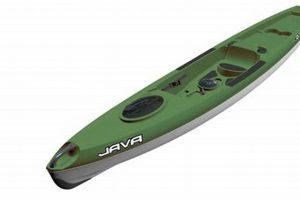
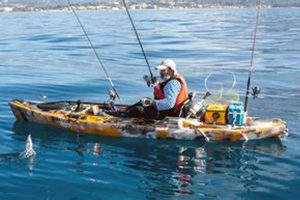
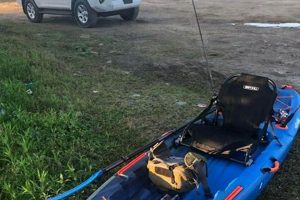
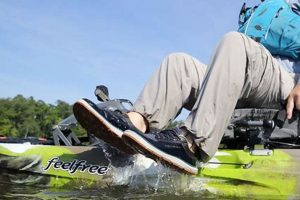
Gear designed to enhance angler experiences on kayaks encompasses a wide range of accessories. These products are typically mounted onto existing hardware or dedicated slots and can include rod holders, fish finders, anchors, crates, and specialized storage for tackle and other equipment. For instance, a GPS-enabled fish finder helps locate schools, while a well-placed rod holder frees hands for paddling and other tasks. These additions transform a standard kayak into a dedicated fishing platform.
The utility of such enhancements improves angling efficiency and safety. By securing equipment and providing readily accessible tools, these accessories allow anglers to focus on fishing. A stable, well-organized kayak offers a safer environment, especially in challenging conditions. Historically, kayak fishing involved minimal gear, but the advent of specialized equipment significantly expanded the possibilities, allowing anglers to explore more diverse waters and target a wider range of species.
This article will explore various types of gear enhancements for kayaks, considering factors such as material, installation, and compatibility with different kayak models. Further sections will address maintenance, safety considerations, and recommended practices for selecting appropriate equipment.
Essential Tips for Kayak Fishing Enhancements
Careful consideration of equipment choices and installation practices is crucial for a safe and productive fishing experience. The following tips provide guidance for optimizing kayak setups.
Tip 1: Prioritize Stability: Excessive weight or improperly balanced gear compromises stability. Distribute weight evenly and consider lower mounting positions to maintain a low center of gravity.
Tip 2: Compatibility is Key: Ensure chosen accessories are compatible with the specific kayak model and its existing hardware. Improper installations can damage the kayak or create safety hazards.
Tip 3: Secure Installations are Paramount: Use appropriate mounting hardware and follow manufacturer instructions precisely to ensure accessories are securely fastened to the kayak. Regularly inspect attachments for wear and tear.
Tip 4: Minimize Clutter: Keep essential gear within easy reach while minimizing clutter. Overcrowding reduces mobility and increases the risk of entanglement.
Tip 5: Plan for Accessibility: Position frequently used accessories, such as rod holders and pliers, within convenient reach. This enhances efficiency and minimizes disruptive movements.
Tip 6: Consider Water Conditions: Adapt equipment choices to anticipated water conditions. Calm lakes require different setups than fast-moving rivers or open ocean environments.
Tip 7: Regular Maintenance Enhances Longevity: Rinse equipment with fresh water after each use, particularly in saltwater environments. Periodically inspect and lubricate moving parts.
Adhering to these guidelines ensures a functional and safe kayak fishing experience. Optimized setups improve angling efficiency and contribute to a more enjoyable time on the water.
By understanding these principles and choosing appropriate equipment, anglers can transform their kayaks into efficient and enjoyable fishing platforms. The following section concludes this exploration of kayak fishing enhancements.
1. Rod Holders

Rod holders constitute a critical component of fishing kayak attachments, playing a pivotal role in enhancing angling efficiency and safety. They provide secure storage and quick access to fishing rods, freeing hands for paddling, landing fish, and other essential tasks. Understanding the nuances of rod holder selection and placement significantly impacts the overall fishing experience.
- Types and Mounting Options
Rod holders vary in design, material, and mounting mechanisms. Flush-mount holders integrate seamlessly into the kayak’s surface, while adjustable holders offer flexibility in rod positioning. Track-mounted systems allow for customization and repositioning. Selecting the appropriate type depends on the kayak’s structure, fishing style, and individual preferences. Examples include adjustable rod holders for trolling and flush-mount holders for sight casting.
- Placement and Ergonomics
Strategic placement of rod holders optimizes accessibility and minimizes interference with paddling and other activities. Positioning holders within easy reach allows for effortless retrieval and stowage of rods. Considerations include the angler’s reach, paddling stroke, and the types of fish being targeted. For instance, positioning rod holders behind the angler is suitable for trolling, while side-mounted holders are beneficial for casting.
- Material and Durability
Rod holders are typically constructed from durable materials such as plastic, aluminum, or stainless steel. Corrosion resistance is a crucial factor, especially in saltwater environments. High-quality materials ensure longevity and reliable performance, even under demanding conditions. Stainless steel holders offer superior corrosion resistance compared to aluminum options, but may add weight.
- Rod Security and Safety
Securely holding rods prevents loss or damage in rough conditions or during fish fights. Features such as adjustable straps or locking mechanisms further enhance rod security. A well-secured rod minimizes the risk of entanglement and ensures the rod remains readily available when needed. For example, a locking mechanism prevents rod loss in turbulent waters.
Proper rod holder selection and installation are essential for optimizing a fishing kayak setup. By carefully considering these facets, anglers can create an efficient and organized fishing platform that enhances both performance and enjoyment on the water. The interplay between rod holder choice and other fishing kayak attachments contributes significantly to a streamlined and successful fishing experience.
2. Fish Finders

Fish finders represent a significant advancement in fishing kayak attachments, providing anglers with real-time underwater insights. These electronic devices utilize sonar technology to locate fish, map underwater structures, and determine water depth, significantly enhancing angling effectiveness. Integrating a fish finder into a kayak setup requires careful consideration of various factors that influence performance and usability.
- Transducer Types and Mounting
Transducers, the sonar-emitting components of fish finders, come in various forms, each with specific mounting requirements. Transom-mount transducers attach to the kayak’s stern, while through-hull transducers require permanent installation. Portable transducers offer flexibility for temporary setups. Selecting the appropriate transducer depends on the kayak’s construction, desired performance, and portability needs. Kayak anglers often favor portable or transom-mount transducers for ease of installation and removal. Through-hull transducers, while offering optimal performance, may not be suitable for all kayak types.
- Display Options and Interpretation
Fish finder displays range from basic grayscale units to advanced color displays with high-resolution imaging. Interpreting the information displayed, such as arches, lines, and depth readings, allows anglers to identify fish, underwater structures, and bottom composition. Choosing a display with appropriate clarity and features depends on individual needs and fishing style. A basic grayscale unit suffices for identifying fish presence and depth, while advanced color displays provide detailed information about bottom structure and fish size.
- Power and Battery Considerations
Fish finders require a dedicated power source, typically a 12-volt battery. Battery capacity and power consumption influence the duration of use. Optimizing power usage and selecting appropriate battery size is crucial for extended fishing trips. Modern fish finders offer power-saving modes to extend battery life. Calculating estimated power consumption based on fishing trip duration helps determine the required battery capacity.
- Integration with Other Kayak Attachments
Integrating a fish finder into a kayak setup requires careful consideration of its placement relative to other attachments. Ensuring the display is easily visible and accessible while maintaining an uncluttered cockpit enhances efficiency and safety. Proper cable management and secure mounting prevent interference with paddling and other activities. For example, mounting the fish finder display near the rod holders allows for quick glances at the screen without disrupting fishing activities.
Fish finders play a crucial role in optimizing a fishing kayak setup. Understanding the intricacies of transducer selection, display interpretation, power management, and integration with other attachments ensures anglers can effectively utilize this technology to enhance their fishing experience. The strategic combination of a fish finder with other essential kayak attachments creates a powerful platform for locating and catching fish.
3. Anchors

Anchors represent a crucial component within the broader category of fishing kayak attachments, serving to secure a kayak’s position in a chosen fishing spot. This capability is particularly important in environments with currents, wind, or where precise boat control is essential for targeting specific fish or structures. The cause-and-effect relationship is clear: deploying an anchor prevents drift, allowing anglers to focus on fishing rather than constantly repositioning the kayak. For example, when fishing in a river, an anchor maintains the kayak’s position upstream of a promising eddy, maximizing fishing time in the target zone. Similarly, in a lake, an anchor allows precise positioning over a submerged reef or drop-off.
Various anchor types cater to different kayak fishing scenarios. Folding grapnel anchors excel in rocky or weedy bottoms, while lightweight fluke or mushroom anchors are suited to sandy or muddy substrates. Anchor size and rode (line) length must be appropriate for the kayak’s size and the expected conditions. An insufficiently sized anchor or short rode may fail to hold in strong currents or winds, leading to drift and potentially hazardous situations. Practical application requires understanding these factors and selecting the correct anchor system for the specific fishing environment. Deploying and retrieving anchors efficiently also contributes to a streamlined fishing process, maximizing time spent with lines in the water. For instance, using an anchor trolley system allows for adjustment of the anchor’s position relative to the kayak, facilitating controlled drifts or maintaining optimal angle for fishing.
Proper anchor selection and deployment are vital for successful kayak fishing. Challenges can include anchor fouling, difficulty retrieving anchors in deep water or strong currents, and potential damage to sensitive underwater habitats. Addressing these challenges involves choosing appropriate anchor types and retrieval methods, along with practicing responsible anchoring techniques. Understanding the interplay between anchors and other fishing kayak attachments, such as rod holders and fish finders, contributes to a holistic approach to kayak fishing, ensuring efficiency, safety, and respect for the aquatic environment. This integrated perspective allows anglers to maximize their time on the water and fully enjoy the experience.
4. Crates and Storage

Crates and other storage solutions play an integral role in the effectiveness of fishing kayak attachments. They provide organized storage for tackle, tools, safety gear, and other essential items, directly impacting both safety and efficiency on the water. A well-organized kayak allows for quick access to necessary equipment, minimizing distractions and maximizing fishing time. Conversely, a cluttered kayak presents safety hazards, impedes movement, and increases the likelihood of lost or damaged gear. For example, a readily accessible first-aid kit stored in a dedicated compartment becomes crucial in case of injury, while a misplaced knife or lure can create dangerous situations. Similarly, having fishing tackle organized within labeled compartments within a crate facilitates efficient lure changes and prevents tangles, directly affecting fishing success.
Various crate types and storage systems cater to diverse kayak fishing needs. Milk crates offer a cost-effective and customizable solution, while purpose-built tackle crates provide specialized compartments and secure storage for sensitive equipment. Dry bags protect essential items from water damage, and mounting systems, such as gear tracks and straps, secure crates and other storage solutions to the kayak. Understanding the interplay between storage solutions and kayak stability is crucial. Improperly secured or overloaded crates can compromise balance and maneuverability, particularly in challenging conditions. Distributing weight evenly within the kayak and utilizing secure attachment methods ensures safe and efficient operation. Practical application involves selecting appropriate storage solutions based on individual needs, fishing style, and kayak capacity. Consider factors such as the types of tackle being used, the environment being fished, and the overall weight capacity of the kayak when making decisions about storage.
Effective storage solutions are essential for maximizing the utility of fishing kayak attachments. Challenges can include limited space, securing items in rough conditions, and maintaining organization over extended trips. Addressing these challenges requires careful planning, utilizing appropriate storage containers, and employing secure mounting techniques. Integrating storage considerations into the overall design of a fishing kayak setup contributes significantly to a safe, efficient, and enjoyable fishing experience. Understanding the impact of storage on other attachments, such as rod holders and fish finders, reinforces the interconnected nature of kayak fishing equipment, emphasizing the importance of a holistic approach to gear selection and organization.
5. Safety Equipment

Safety equipment constitutes a critical subset of fishing kayak attachments, inextricably linked to angler well-being. The cause-and-effect relationship between safety gear and a positive outcome in emergencies is undeniable. A life vest, for instance, provides essential buoyancy in the event of capsizing, significantly increasing the chances of survival. Similarly, a whistle or signaling device facilitates communication and location in distress situations. Carrying a first-aid kit allows for immediate treatment of minor injuries, preventing complications. These examples underscore the importance of safety equipment as an integral component of fishing kayak attachments, impacting the overall safety and preparedness of the angler. Practical significance lies in the understanding that safety equipment is not merely an accessory, but a critical investment in personal well-being.
Further analysis reveals the interconnectedness of safety equipment with other fishing kayak attachments. For example, a properly secured paddle leash prevents loss of the primary means of propulsion in rough conditions, complementing the function of a life vest. Mounting a knife within easy reach becomes crucial for cutting fishing line or other entanglements, particularly in emergencies. Storing safety equipment within readily accessible compartments in crates or dry bags ensures quick retrieval when needed, reinforcing the integrated nature of a well-equipped fishing kayak. Practical application involves not just carrying safety gear, but also practicing its use and ensuring its proper functioning. Regularly inspecting life vests for wear and tear, testing signaling devices, and replenishing first-aid supplies contribute to a proactive approach to safety.
In summary, safety equipment plays a non-negotiable role in fishing kayak setups. Challenges may include complacency, limited storage space, and the perceived inconvenience of carrying certain items. However, prioritizing safety through thoughtful selection, proper storage, and regular maintenance of safety equipment mitigates potential risks. Integrating safety considerations into the broader context of fishing kayak attachments underscores the crucial balance between functionality and personal well-being. This holistic perspective fosters a culture of preparedness and responsibility, enhancing the overall fishing experience.
6. Paddles and Leashes
Paddles and leashes represent essential components within the broader context of fishing kayak attachments. A direct cause-and-effect relationship exists between paddle availability and kayak control. The paddle serves as the primary means of propulsion and maneuvering, directly impacting the angler’s ability to navigate, position the kayak effectively for fishing, and respond to changing conditions. A lost or damaged paddle significantly compromises safety and fishing effectiveness, especially in challenging environments like strong currents or open water. For instance, if a paddle slips overboard without a leash, retrieving it becomes difficult, potentially creating a hazardous situation. Conversely, a secure and readily available paddle allows for immediate corrective action in unexpected circumstances, such as strong gusts of wind or encounters with obstacles.
Further analysis reveals the interplay between paddles, leashes, and other fishing kayak attachments. A well-designed paddle, paired with an appropriate leash, enhances the overall functionality of the fishing kayak setup. It allows anglers to maintain precise boat control while deploying or retrieving anchors, fighting fish, or navigating complex shorelines. For example, a paddle with a comfortable grip and efficient blade design reduces fatigue during long paddling sessions, while a secure leash ensures the paddle remains within reach even during demanding maneuvers. Consider the scenario of landing a large fish: a readily available paddle allows for quick adjustments in kayak position, preventing capsizing or line entanglement. This interconnectedness highlights the practical significance of understanding the role of paddles and leashes within the broader context of fishing kayak attachments.
In summary, paddles and leashes are indispensable elements of a well-equipped fishing kayak. Challenges may include selecting the appropriate paddle length and blade type for individual needs, choosing a durable and reliable leash, and ensuring proper leash attachment to prevent interference with paddling. Addressing these considerations reinforces the importance of paddles and leashes, not merely as accessories, but as critical safety and performance-enhancing components within the broader system of fishing kayak attachments. This integrated perspective promotes a holistic approach to kayak fishing, maximizing efficiency, safety, and enjoyment on the water.
7. Mounting Hardware
Mounting hardware forms the crucial link between fishing kayak attachments and the kayak itself. A direct cause-and-effect relationship exists between the quality and proper installation of mounting hardware and the security and functionality of attached accessories. Securely mounted rod holders, fish finders, and other attachments contribute directly to angler safety and efficient fishing practices. Conversely, inadequate hardware or improper installation can lead to equipment failure, potentially creating hazardous situations. For example, a poorly mounted rod holder may break under the strain of a fighting fish, resulting in lost gear and potential injury. Similarly, a loose fish finder mount can lead to damage of the device or create a navigation hazard. The practical significance of robust mounting hardware lies in ensuring the reliability and longevity of fishing kayak attachments, directly impacting the overall safety and success of the fishing experience.
Further analysis reveals the interconnected nature of mounting hardware and other fishing kayak attachments. The choice of mounting hardware influences the placement and adjustability of accessories. Track systems, for instance, offer versatility in positioning rod holders and other gear, while fixed mounts provide a more permanent solution. Compatibility between mounting hardware and specific kayak models is crucial. Using incorrect hardware can damage the kayak’s structure or compromise its stability. Consider the scenario of installing a heavy fish finder on a lightweight kayak using inadequate mounting hardware. The stress on the kayak’s hull could lead to cracks or structural weakness. Practical application involves careful selection of appropriate hardware based on the weight and function of the attachment, the kayak’s construction, and the intended fishing environment. Proper installation techniques, including the use of appropriate sealant and fasteners, further contribute to a secure and durable setup.
In summary, mounting hardware represents a critical, albeit often overlooked, aspect of fishing kayak attachments. Challenges include choosing the right hardware for specific applications, ensuring proper installation, and maintaining the integrity of the mounting system over time. Addressing these challenges reinforces the importance of high-quality mounting hardware and meticulous installation practices as essential components of a safe and effective fishing kayak setup. This understanding promotes a holistic approach to kayak outfitting, emphasizing the interconnectedness of all components and the critical role of mounting hardware in ensuring their functionality and safety. Neglecting this aspect can compromise the entire system, potentially leading to equipment failure, decreased fishing effectiveness, and increased risk.
Frequently Asked Questions about Fishing Kayak Enhancements
This section addresses common inquiries regarding optimizing kayak setups for fishing.
Question 1: How does one choose appropriate enhancements for a specific fishing style?
Enhancement selection depends on the targeted species and fishing environment. Trolling requires different equipment than still-water angling. Researching species-specific techniques and considering the water conditions helps determine appropriate gear.
Question 2: What weight capacity should be considered when adding enhancements?
Kayak weight capacity encompasses the combined weight of the angler, gear, and all attachments. Exceeding this limit compromises stability and safety. Consult the manufacturer’s specifications and calculate the total weight before adding enhancements.
Question 3: Can enhancements be installed on any kayak model?
Compatibility varies depending on kayak design and construction. Some kayaks have dedicated mounting points, while others require aftermarket installation solutions. Consulting the kayak manufacturers guidelines and seeking expert advice ensures proper installation and avoids damage.
Question 4: What maintenance is required for various fishing enhancements?
Regular maintenance prolongs the lifespan of equipment. Rinsing with fresh water after each use, especially in saltwater environments, prevents corrosion. Periodic inspection and lubrication of moving parts maintain functionality. Specific maintenance requirements vary depending on the material and type of enhancement.
Question 5: How does one balance stability and functionality when adding enhancements?
Distribute weight evenly throughout the kayak and position heavier items lower to maintain a low center of gravity. Avoid excessive additions that could compromise stability or maneuverability. Prioritize essential enhancements and avoid unnecessary clutter.
Question 6: What safety precautions should be taken when using fishing enhancements?
Always prioritize safety by wearing a personal flotation device and carrying essential safety equipment. Ensure enhancements are securely mounted and regularly inspected for wear and tear. Exercise caution when navigating in challenging conditions and avoid overloading the kayak.
Understanding these aspects of kayak enhancements contributes significantly to a safer and more productive fishing experience. Careful planning and informed decision-making are paramount.
The following section concludes this comprehensive guide to kayak fishing attachments.
Fishing Kayak Attachments
This exploration of fishing kayak attachments has highlighted their crucial role in transforming a standard kayak into a specialized fishing platform. From rod holders and fish finders to anchors, crates, and safety equipment, each component contributes to improved angling efficiency, safety, and overall enjoyment on the water. Proper selection, installation, and maintenance of these attachments are essential for maximizing their benefits and ensuring a positive fishing experience. The analysis has emphasized the interconnectedness of these components, underscoring the importance of a holistic approach to kayak outfitting. Balancing functionality with stability and safety remains paramount, requiring careful consideration of weight distribution, kayak capacity, and individual fishing style.
Ultimately, the effectiveness of fishing kayak attachments hinges on informed decision-making and a commitment to responsible kayaking practices. Continuous learning, adaptation to specific fishing environments, and adherence to safety guidelines contribute to a rewarding and sustainable approach to kayak fishing. The future of kayak angling promises further innovation in attachment design and functionality, empowering anglers to explore new waters and pursue their passion with enhanced efficiency and safety.