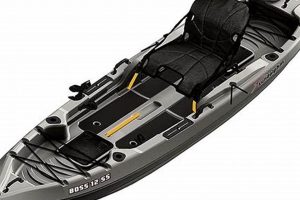
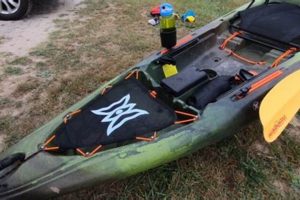
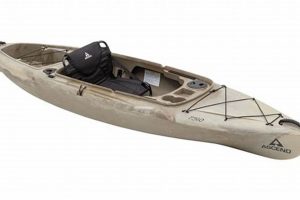
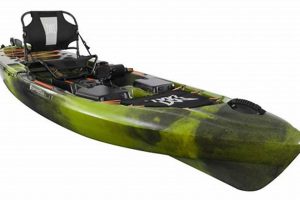
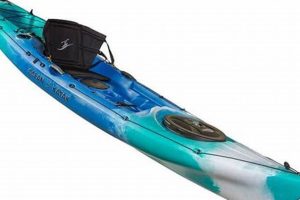
Compact sonar devices designed for small watercraft provide anglers with real-time information about water depth, bottom structure, and fish locations. These units typically feature a transducer that emits sonar pulses and receives echoes, which are then interpreted and displayed on a screen. A portable unit suited for kayak use might be mounted using a suction cup or specialized bracket.
Locating fish efficiently is crucial for successful angling. These specialized electronics offer a significant advantage by providing underwater insights that would otherwise be unavailable. This allows anglers to target specific areas, increasing their chances of a catch and reducing wasted time and effort. Historically, anglers relied on intuition, experience, and visual cues. Modern technology allows even novice kayak anglers to access detailed information about the underwater environment, democratizing access to this once-exclusive knowledge.
This article will further explore various aspects of these devices, including selection criteria, installation methods, popular models, and effective utilization techniques. It will also cover relevant accessories and maintenance tips to ensure optimal performance and longevity.
Tips for Utilizing Sonar on a Kayak
Effective use of sonar devices on kayaks requires consideration of specific factors related to the kayak’s size and mobility. The following tips offer guidance for maximizing the benefits of these tools.
Tip 1: Transducer Placement is Key: Optimal transducer placement avoids interference from the kayak’s hull and maximizes sonar signal clarity. Placement near the stern, slightly submerged, often proves effective. Experimentation is crucial to finding the ideal location on a specific kayak model.
Tip 2: Power Management is Essential: Kayak sonar units typically rely on battery power. Conserving battery life through brightness adjustments and utilizing power-saving modes extends operational time on the water.
Tip 3: Understanding Sonar Readings Takes Practice: Interpreting sonar readings accurately requires practice and understanding of how different bottom structures, fish, and vegetation appear on the display. Beginners should consult user manuals and online resources to familiarize themselves with common sonar patterns.
Tip 4: Consider Kayak-Specific Mounting Solutions: Specialized mounts designed for kayaks offer stability and security for sonar units. These mounts often incorporate features like adjustable arms and quick-release mechanisms for added convenience.
Tip 5: Interference Can Occur: Electrical interference from other onboard electronics can sometimes affect sonar performance. Ensure proper grounding and separation of electrical components to minimize potential issues.
Tip 6: Regular Maintenance Ensures Accuracy: Periodic cleaning of the transducer and checking cable connections prevents signal degradation and ensures accurate readings over time.
Tip 7: Safety First: Ensure the sonar unit and its cabling are securely mounted and do not interfere with paddling or other essential kayak operations.
By following these tips, anglers can significantly enhance their kayak fishing experience through improved fish finding capabilities and a more informed understanding of the underwater environment. This translates to increased efficiency, higher catch rates, and a more enjoyable time on the water.
These practical tips provide a foundation for effective sonar use, leading to a more rewarding and successful fishing experience from a kayak. The subsequent sections will delve into specific product recommendations and advanced techniques.
1. Portability

Portability is a critical factor when selecting sonar devices for sit-on-top kayaks due to the inherent limitations on space and weight capacity. A compact and easily transportable unit simplifies the logistics of kayak fishing, allowing anglers to focus on the fishing experience rather than equipment management.
- Size and Weight
Smaller, lighter units are easier to handle and position on a kayak. Consider the overall dimensions and weight of the unit, including the display head and transducer. Compact designs minimize interference with paddling and other onboard activities. For example, a unit weighing over a kilogram might be cumbersome compared to a lightweight alternative.
- Power Source and Battery Life
Portable sonar units typically operate on battery power. Longer battery life reduces the need for frequent recharging or battery swaps, extending fishing time. Consider battery capacity and power consumption rates when evaluating different models. External rechargeable battery packs can further enhance portability.
- Carrying Case and Storage
A dedicated carrying case or protective bag simplifies transport and safeguards the unit during storage. Look for cases designed to accommodate the display head, transducer, cables, and other accessories. Durable, water-resistant cases offer added protection in challenging environments.
- Ease of Installation and Removal
Quick and easy installation and removal are essential for efficient setup and breakdown. Look for units with simple mounting systems and clearly labeled connections. Quick-release mechanisms allow for rapid deployment and removal when transitioning between fishing locations or storing the kayak.
Prioritizing portability ensures a seamless integration of sonar technology with the kayak fishing experience. A portable unit enhances convenience and allows anglers to maximize their time on the water, ultimately increasing the likelihood of a successful fishing trip.
2. Mounting Options
Secure and stable mounting is crucial for effective fish finder operation on a sit-on-top kayak. The dynamic nature of kayak fishing, with constant movement and potential exposure to water, necessitates robust mounting solutions that ensure consistent sonar performance and prevent equipment damage.
- Track Systems
Kayaks equipped with track systems offer versatile mounting points for fish finder displays and transducers. These tracks, typically running along the gunwales or near the seat, allow for adjustable positioning and secure attachment using compatible mounts. A track-mounted system provides flexibility for optimizing transducer placement and screen visibility.
- Suction Cup Mounts
Suction cup mounts offer a convenient and temporary mounting solution for smooth surfaces. These mounts are suitable for displays and transducers and provide a relatively quick setup. However, their stability can be affected by surface texture and water conditions. Periodically checking the suction cup’s adhesion is crucial for preventing accidental detachment.
- Through-Hull Transducer Mounting
Through-hull transducers offer optimal sonar performance by eliminating interference from the kayak’s hull. This mounting method requires drilling a hole through the hull for transducer installation, offering a permanent and highly effective solution. Careful consideration of transducer placement and proper sealing are essential for preventing leaks.
- Bracket Mounts
Various bracket mounts are designed specifically for kayak use, accommodating different hull shapes and mounting locations. These brackets often incorporate adjustable arms and swivel mechanisms for precise positioning of the display head. Selecting a durable, corrosion-resistant bracket ensures long-term reliability in harsh marine environments.
Careful consideration of mounting options ensures optimal fish finder performance and longevity. Selecting the most suitable mounting method depends on factors such as kayak design, fishing style, and desired level of permanence. A stable and secure mounting solution contributes significantly to a productive and enjoyable kayak fishing experience.
3. Power Source
Power source selection significantly impacts the functionality and operational duration of kayak-mounted sonar devices. These units typically rely on external batteries due to the impracticality of integrated power systems in most kayak designs. Battery choice influences both the duration of use and the overall weight and portability of the setup. Lead-acid batteries offer high capacity but are heavier, while lithium-ion batteries provide a lighter alternative with generally longer lifespans, although at a higher initial cost. The required power output depends on the specific sonar model; higher-powered units generally consume more energy. Consideration of anticipated fishing trip duration is essential for selecting an appropriately sized battery. For example, a multi-day fishing expedition necessitates a higher capacity battery or a strategy for recharging while on the water, such as utilizing a portable solar panel system. Inadequate power supply can lead to premature termination of the fishing trip or the inability to utilize the sonar effectively.
Beyond battery type and capacity, efficient power management practices further extend operational time. Minimizing screen brightness when not crucial and utilizing power-saving modes, if available, conserves battery life. Regularly checking battery status ensures awareness of remaining power and prevents unexpected shutdowns. Connecting the sonar unit directly to the battery, rather than through other onboard electronics, minimizes power loss due to voltage drops. Understanding the power consumption characteristics of the chosen sonar model and adopting appropriate power management strategies ensures uninterrupted fish finding capabilities throughout the fishing excursion. Neglecting these aspects can compromise the effectiveness of the sonar unit and limit its potential to enhance fishing success.
In summary, reliable power delivery is crucial for successful sonar operation on a kayak. Careful selection of battery type and capacity, combined with effective power management techniques, maximizes operational time and ensures consistent functionality. Understanding the interplay between power source and sonar performance is essential for optimizing the effectiveness of these electronic tools and maximizing their contribution to a successful kayak fishing experience. This understanding translates to more informed decisions regarding battery selection and management, ultimately contributing to a more rewarding and productive time on the water.
4. Transducer Type
Transducer selection significantly influences the effectiveness of fish finding systems deployed on sit-on-top kayaks. The transducer, responsible for transmitting and receiving sonar signals, must be compatible with the kayak’s structure and the intended fishing environment. Different transducer types offer varying performance characteristics regarding mounting options, signal frequency, and cone angle, impacting data accuracy and overall utility.
Common transducer types include transom-mount, through-hull, and in-hull. Transom-mount transducers, often chosen for their ease of installation, attach to the kayak’s stern. However, their performance can be affected by turbulence and aeration. Through-hull transducers, offering optimal signal clarity, require permanent installation through the kayak’s hull. In-hull transducers, placed inside the hull against the bottom, avoid external protrusions but may sacrifice some sensitivity due to signal attenuation through the hull material. Consider a scenario where an angler seeks to identify bottom-hugging fish in shallow, weedy waters. A high-frequency transducer with a narrow cone angle, possibly a through-hull model for optimal signal clarity, proves more effective than a low-frequency, wide-angle transducer better suited for deeper, open-water applications. Another scenario involves trolling in deeper waters for pelagic species. Here, a lower-frequency transducer with a wider cone angle offers better coverage and depth penetration, potentially in a transom-mount configuration for easier installation.
Understanding the relationship between transducer type, kayak structure, and fishing environment is crucial for informed decision-making. Selecting an inappropriate transducer type can result in suboptimal sonar performance, hindering fish identification and impacting overall fishing success. Careful consideration of these factors allows anglers to maximize the benefits of their sonar investment and enhance their on-the-water experience. This knowledge translates to more effective use of sonar technology, leading to improved fishing outcomes and a more comprehensive understanding of underwater environments.
5. Display Clarity
Display clarity is paramount for effective utilization of fish finders, particularly in the challenging visual conditions often encountered while kayak fishing. Direct sunlight, glare, and water spray can significantly impede screen visibility, rendering a fish finder ineffective regardless of its technical capabilities. A clear, easily readable display allows for quick interpretation of crucial information, such as depth, bottom structure, fish location, and water temperature, enabling informed decisions regarding lure presentation and fishing strategy. Consider a scenario where an angler is using a fish finder with a low-resolution, dim display. Even if the unit detects fish, difficulty in discerning the on-screen information might lead to missed opportunities. Conversely, a bright, high-resolution display allows for immediate identification of fish and bottom structure, even in bright sunlight or choppy water, maximizing the angler’s chances of success.
Several factors contribute to display clarity. Screen resolution dictates the level of detail displayed; higher resolution allows for sharper distinction between fish, structure, and other underwater features. Screen size affects overall visibility; larger displays are generally easier to read, particularly from a distance, but can also be more cumbersome on a compact kayak. Color displays often enhance the visual differentiation between various sonar readings, making it easier to interpret complex information. Backlighting and contrast adjustments further improve visibility in varying light conditions. Some units offer specialized screen coatings to minimize glare and reflections. The choice of display characteristics should align with the typical fishing environment and the angler’s visual acuity.
Prioritizing display clarity when selecting a fish finder for a sit-on-top kayak directly impacts its practical utility. A clear, easily readable display enhances situational awareness, enabling more efficient fishing and increasing the likelihood of success. Understanding the factors contributing to display clarity empowers anglers to make informed decisions and choose a unit that optimizes on-the-water performance. This consideration ultimately translates to a more productive and enjoyable fishing experience, maximizing the value of the sonar investment.
6. Target Species

Target species significantly influence the selection and utilization of fish finders for sit-on-top kayaks. Different species exhibit varying behavioral patterns and occupy diverse habitats, necessitating specific sonar capabilities for effective detection and targeting. Consideration of target species informs decisions regarding transducer frequency, cone angle, and display features, maximizing the fish finder’s utility and increasing angling success. For instance, anglers pursuing bottom-dwelling species like catfish or flounder in shallow, murky waters benefit from higher-frequency transducers with narrower cone angles, providing detailed bottom structure resolution and precise fish location identification. Conversely, targeting pelagic species such as tuna or mackerel in deeper offshore environments necessitates lower-frequency transducers with wider cone angles for greater depth penetration and broader coverage. Understanding the target species’ typical habitat and behavior allows anglers to tailor sonar settings and interpret readings more effectively, leading to more efficient fishing practices.
Practical examples further illustrate this connection. When seeking crappie suspended in deep brush piles, a fish finder with down-imaging or side-imaging capabilities, coupled with a higher-frequency transducer, allows anglers to visualize the structure and pinpoint fish within its complex contours. Similarly, locating schooling baitfish near the surface requires a different approach, potentially utilizing a high-frequency transducer with a narrow cone angle to isolate the baitfish schools from surface clutter and identify larger predatory fish lurking nearby. Matching sonar capabilities to target species optimizes the effectiveness of the fish finder, transforming it from a general depth sounder into a specialized tool for targeted species acquisition. Failure to consider target species during fish finder selection can lead to suboptimal performance and missed opportunities.
In summary, aligning fish finder capabilities with target species is essential for maximizing angling success from a sit-on-top kayak. Understanding the relationship between target species, transducer characteristics, and sonar features empowers anglers to choose and utilize their electronics more effectively. This targeted approach improves fish detection, enhances situational awareness, and ultimately contributes to a more rewarding and productive fishing experience. Ignoring the influence of target species can hinder fish finding efforts, limiting the potential benefits of sonar technology and potentially compromising the overall fishing outcome.
Frequently Asked Questions
This section addresses common inquiries regarding the selection and utilization of sonar devices specifically for sit-on-top kayaks.
Question 1: What is the typical price range for kayak fish finders?
Prices vary significantly based on features, brand, and transducer type. Basic models start around $100, while advanced units with GPS, mapping, and networking capabilities can exceed $1000. Careful consideration of budget and required features informs selection.
Question 2: Are all kayak fish finders waterproof?
Most units designed for kayak use possess a degree of water resistance, but not all are fully waterproof. Checking the manufacturer’s specifications regarding Ingress Protection (IP) ratings confirms the level of water resistance. Proper mounting and protection from direct water exposure prolong unit lifespan.
Question 3: Can a fish finder be used in both freshwater and saltwater?
Many units function in both environments. However, the transducer type often dictates performance in specific water conditions. Certain transducers excel in freshwater, while others are designed for saltwater use. Compatibility should be confirmed before purchase.
Question 4: How does kayak movement affect sonar readings?
Excessive kayak movement, particularly rocking or rapid turning, can introduce noise and inaccuracies into sonar readings. Maintaining stability while utilizing the fish finder improves data accuracy. Specific transducer types, such as through-hull models, minimize the impact of kayak movement.
Question 5: Is professional installation recommended for kayak fish finders?
While professional installation offers advantages for complex setups, many kayak anglers successfully install their units independently. Clear instructions and readily available online resources simplify the installation process for most models. Through-hull transducer installations might require specialized expertise.
Question 6: How frequently should fish finder software be updated?
Manufacturers periodically release software updates to improve performance, add features, and address potential issues. Regularly checking the manufacturer’s website for updates and following the recommended update procedures ensures optimal fish finder functionality.
Addressing these common questions provides a foundational understanding of key considerations for choosing and utilizing kayak fish finders effectively. Informed decisions based on individual needs and fishing preferences lead to enhanced on-the-water experiences and improved fishing outcomes.
This concludes the frequently asked questions section. The following section will provide practical tips and techniques for maximizing fish finder performance.
Conclusion
Effective utilization of sonar devices designed for sit-on-top kayaks significantly enhances angling opportunities. Careful consideration of factors such as transducer selection, mounting options, power sources, display clarity, and target species ensures optimal performance and maximizes the return on investment. Understanding the interplay of these elements allows anglers to leverage technology effectively, transforming a kayak into a highly efficient fishing platform. From portable units for casual fishing to advanced systems for serious anglers, the available technology caters to a broad spectrum of needs and budgets.
Technological advancements continue to refine sonar capabilities, offering increasingly sophisticated tools for underwater exploration. As these technologies evolve, anglers gain deeper insights into fish behavior and habitat, leading to more sustainable fishing practices and a greater appreciation for the aquatic environment. The informed angler, equipped with appropriate sonar technology and a thorough understanding of its application, stands poised for greater success and a more enriching connection with the underwater world.