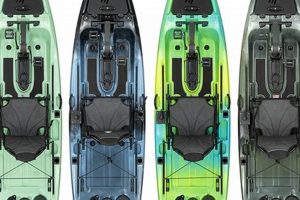
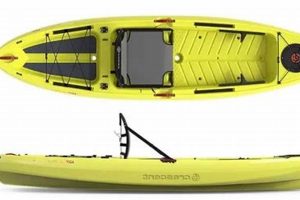
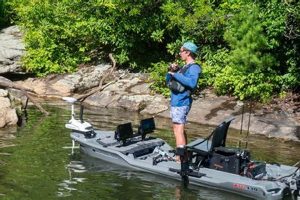
This specific type of watercraft is designed for anglers, offering a compact and maneuverable platform for accessing various fishing locations, from calm lakes to slow-moving rivers. The “11” typically designates an approximate length of eleven feet, suggesting a balance between stability and ease of transport.
A vessel of this nature provides several advantages to the fishing enthusiast. Its relatively small size allows navigation through shallow waters and tight spaces inaccessible to larger boats. The design often prioritizes stability, a crucial feature for anglers standing while casting or reeling in their catch. Furthermore, such kayaks are often constructed from lightweight materials, facilitating transport and portability. Over time, these smaller, specialized vessels have evolved to meet the growing demand for efficient and adaptable fishing platforms.
The following sections will delve deeper into the specific features, advantages, and considerations relevant to selecting and utilizing this type of watercraft for a successful fishing experience.
Tips for Kayak Fishing Success
Effective angling from a kayak requires preparation and technique. These tips offer guidance for maximizing success on the water.
Tip 1: Prioritize Stability: Weight distribution is critical. Keep the center of gravity low and balanced. Practice entering and exiting the kayak in shallow water to build confidence and avoid capsizing.
Tip 2: Master Paddle Strokes: Efficient paddling conserves energy and allows precise maneuvering. Learn basic strokes like the forward stroke, reverse stroke, and sweep stroke for controlled movement.
Tip 3: Choose Appropriate Gear: Select rods, reels, and tackle suited for the target species and the kayak’s limited space. Rod holders and tackle organizers are essential for maintaining order and accessibility.
Tip 4: Plan Your Route: Research potential fishing spots and water conditions beforehand. Consider wind direction, currents, and tides to optimize fishing time and ensure a safe return.
Tip 5: Practice Casting Techniques: Adapt casting motions to the kayak’s confined space. Practice shorter, more controlled casts to avoid tangling lines or hooking the kayak itself.
Tip 6: Emphasize Safety: Always wear a personal flotation device (PFD). Carry a whistle, signaling device, and communication tools in case of emergencies. Inform someone of your fishing plans and estimated return time.
Tip 7: Respect the Environment: Practice catch-and-release whenever possible. Properly dispose of fishing line and other waste to preserve the natural environment.
By following these guidelines, anglers can enhance their on-the-water experience and improve their chances of a successful and enjoyable fishing trip.
These practical tips provide a foundation for successful kayak angling. The following section will explore further essential equipment considerations and advanced techniques.
1. Hull Design

Hull design significantly influences a fishing kayak’s performance, dictating stability, speed, maneuverability, and tracking. For a vessel like the Stealth 11, optimized hull characteristics are essential for navigating diverse water conditions and maximizing fishing success. Understanding the nuances of hull design empowers informed decisions regarding kayak selection and utilization.
- Stability
Stability is paramount, especially for anglers who prefer standing while casting or reeling. A wider, flatter hull generally provides greater initial stability, resisting tipping. However, this can compromise maneuverability. A narrower hull, conversely, offers enhanced agility but requires more balance. The Stealth 11’s specific hull design seeks to balance these factors, offering sufficient stability for fishing activities while maintaining reasonable maneuverability.
- Tracking
Tracking refers to a kayak’s ability to maintain a straight course. A longer, narrower hull with a defined keel line typically tracks better, requiring fewer corrective strokes. A shorter, wider hull tends to be more easily influenced by wind and currents, demanding more frequent adjustments to maintain direction. The Stealth 11’s hull design must consider tracking performance for efficient paddling over longer distances.
- Speed and Efficiency
Hull shape affects speed and paddling efficiency. A streamlined, displacement hull, often found in longer touring kayaks, efficiently cuts through the water, maximizing speed with minimal effort. A flatter, planing hull, more common in recreational kayaks, provides stability but creates greater drag, requiring more effort to achieve the same speed. The Stealth 11’s design likely prioritizes a balance between speed and stability, catering to the needs of anglers.
- Maneuverability
Maneuverability is crucial for navigating tight spaces, shallow waters, and complex shorelines. A shorter, wider hull with a rocker (upward curve at the bow and stern) turns more easily, facilitating quick changes in direction. A longer, narrower hull requires more effort to turn but offers superior tracking in open water. The Stealth 11’s hull design must balance maneuverability with stability and tracking performance to provide optimal versatility for fishing applications.
These interconnected elements of hull design significantly impact the Stealth 11’s overall performance. Selecting a kayak with a hull design tailored to specific fishing needs whether prioritizing stability for stand-up fishing, maneuverability for navigating tight creeks, or speed for covering larger distances enhances the overall fishing experience.
2. Length and Width

The Stealth 11 fishing kayak’s length and width directly influence its performance characteristics, impacting stability, maneuverability, and speed. The “11” designation typically signifies an approximate length of eleven feet. This length offers a balance between maneuverability in tighter waterways and efficient tracking across open water. A shorter kayak turns more readily, while a longer kayak maintains a straighter course. The width, often unspecified in the name, plays a crucial role in stability. A wider kayak provides a more stable platform, particularly advantageous for stand-up fishing, while a narrower kayak enhances speed and efficiency, albeit with reduced stability. For example, a wider Stealth 11 model might be preferred for fishing calm lakes and ponds where stability is paramount, whereas a slightly narrower version might suit rivers or coastal areas where maneuverability and speed are more critical. The interplay between these dimensions dictates the kayak’s suitability for specific fishing environments and techniques.
Consider the practical implications of these dimensional choices. A wider, more stable Stealth 11 allows anglers to confidently stand and cast, improving sight lines and casting range. This stability is particularly beneficial in calmer waters where the risk of capsizing is minimized. However, this added stability often comes at the cost of maneuverability and speed. Navigating narrow creeks or swiftly changing currents becomes more challenging. Conversely, a narrower Stealth 11 excels in navigating confined spaces and swiftly changing water conditions. Its reduced width allows for quicker turns and more efficient paddling, enabling anglers to cover greater distances with less effort. However, this design compromises stability, making stand-up fishing more precarious, especially in choppy waters. Therefore, understanding the relationship between length, width, and intended use is paramount for maximizing on-the-water performance.
Selecting the appropriate Stealth 11 model requires careful consideration of the target fishing environment and preferred angling style. Prioritizing stability necessitates a wider hull, sacrificing some maneuverability and speed. Favoring agility and speed requires a narrower design, potentially compromising stability. The optimal balance between these competing characteristics ultimately depends on the angler’s individual needs and preferences. Understanding this interplay between length, width, and intended application is crucial for informed decision-making and a successful fishing experience.
3. Weight Capacity

Weight capacity represents a critical factor influencing the performance and safety of a stealth 11 fishing kayak. This specification designates the maximum combined weight of the angler, gear, and any additional cargo the kayak can safely support. Exceeding this limit compromises stability, maneuverability, and ultimately, safety, increasing the risk of capsizing or structural damage. A kayak’s weight capacity must align with the anticipated load to ensure optimal performance and safe operation. Consider an angler equipped with fishing rods, tackle boxes, a cooler, and personal items. Calculating the combined weight of these items is essential for determining the appropriate kayak weight capacity.
Understanding the practical implications of weight capacity is crucial for informed decision-making. A kayak exceeding its specified weight capacity sits lower in the water, reducing freeboard and increasing the risk of water ingress. This lower profile impacts paddling efficiency and maneuverability, making the kayak sluggish and more difficult to control. Furthermore, exceeding the weight capacity compromises stability, making the kayak more susceptible to tipping, particularly in challenging conditions such as wind, waves, or currents. For example, an angler exceeding the weight limit might experience difficulty maintaining balance while casting or reeling, increasing the likelihood of capsizing. Conversely, selecting a kayak with ample weight capacity ensures sufficient freeboard, maintaining maneuverability and stability even with a full load of gear. This enhanced performance translates to a safer and more enjoyable fishing experience.
Selecting a stealth 11 fishing kayak with appropriate weight capacity requires careful assessment of individual needs and anticipated loads. Anglers carrying substantial gear, including larger tackle boxes, heavier coolers, or specialized fishing equipment, require a kayak with a higher weight capacity. Conversely, anglers prioritizing lightweight portability and minimalist gear can opt for a kayak with a lower weight capacity, potentially sacrificing some stability and load-bearing potential. Ultimately, understanding the relationship between weight capacity, performance, and safety empowers informed decisions, leading to a more successful and enjoyable fishing experience. Neglecting this crucial factor can compromise stability, maneuverability, and safety, potentially leading to hazardous situations on the water.
4. Propulsion System

Propulsion systems significantly influence a stealth 11 fishing kayak’s performance, affecting speed, efficiency, and maneuverability. Common propulsion methods include traditional paddle power and pedal-driven systems. Paddle propulsion, utilizing a double-bladed paddle, offers simplicity, affordability, and shallow-water accessibility. However, it requires continuous upper body effort, potentially limiting fishing focus and endurance. Pedal-driven systems, employing either propeller or fin designs, allow hands-free operation, enabling simultaneous fishing and propulsion. This facilitates techniques like trolling or maintaining position in currents. However, pedal drives add complexity, weight, and cost, potentially limiting portability and shallow-water access. For example, a stealth 11 equipped with a pedal drive excels in open water or scenarios requiring sustained movement, while a paddle-powered version offers greater versatility in shallows or confined spaces.
The choice of propulsion system profoundly impacts the fishing experience. Paddle propulsion demands physical exertion, potentially leading to fatigue, especially during extended trips or challenging conditions. This physical demand can detract from the focus required for successful angling. Conversely, pedal drives conserve energy and allow continuous, hands-free movement, enabling anglers to cover greater distances and maintain optimal fishing positions. This enhanced mobility expands fishing opportunities, allowing access to areas otherwise difficult to reach by paddle power. However, pedal-driven systems increase the kayak’s overall weight, potentially making transport and launching more challenging. Furthermore, their underwater components can restrict navigation in extremely shallow water or areas with submerged obstacles. Consider a stealth 11 used for trolling; a pedal drive offers significant advantages, maintaining a consistent speed and freeing hands for fishing. Alternatively, a paddle-powered stealth 11 excels in shallow-water sight fishing, allowing precise maneuvering and silent approach.
Selecting the appropriate propulsion system for a stealth 11 hinges on individual fishing styles, target environments, and physical capabilities. Paddle propulsion offers versatility, affordability, and simplicity, ideal for anglers prioritizing maneuverability and shallow-water access. Pedal drives provide hands-free operation, enhanced speed, and sustained mobility, benefiting anglers targeting open water or requiring continuous movement. Considering these factors alongside individual needs and preferences ensures an informed decision, maximizing fishing efficiency and enjoyment. Ultimately, the ideal propulsion system complements the angler’s approach, maximizing the stealth 11’s capabilities and enhancing the overall fishing experience.
5. Storage Options
Ample and well-designed storage options are integral to the functionality of a stealth 11 fishing kayak. These specialized vessels cater to anglers who require designated spaces for rods, reels, tackle boxes, safety gear, and personal items. Insufficient or poorly planned storage compromises efficiency, organization, and safety, hindering access to essential equipment and potentially creating hazardous on-the-water situations. Dedicated storage compartments, such as rod holders, tackle trays, and dry hatches, maximize space utilization and maintain order, crucial in the confined environment of a kayak. Consider a scenario where an angler needs to quickly access a specific lure or piece of safety equipment; efficient storage facilitates immediate retrieval, minimizing disruption and maximizing fishing time. Conversely, inadequate storage leads to cluttered decks, tangled lines, and difficulty locating essential gear, potentially compromising safety and diminishing the overall fishing experience.
Practical examples illustrate the significance of well-designed storage. Recessed rod holders secure rods during transport and allow quick deployment when encountering a promising fishing spot. Watertight hatches protect sensitive electronics, such as fish finders or GPS units, from splashes and submersion. Tackle trays organize lures, hooks, and other small items, preventing tangling and facilitating efficient selection. Furthermore, strategically placed bungee cords secure larger items like coolers or dry bags, maximizing deck space and preventing gear from shifting during movement. These features collectively contribute to a more organized, efficient, and ultimately, safer fishing experience. For instance, readily accessible safety gear, like a bilge pump or signaling device, becomes crucial in emergency situations, highlighting the practical significance of well-planned storage solutions.
Effective storage solutions directly correlate with enhanced fishing performance and safety. Organized storage streamlines workflows, enabling anglers to focus on fishing rather than managing equipment. Accessibility of essential gear improves response times in critical situations, enhancing safety. Moreover, well-designed storage maximizes space utilization, crucial in the limited confines of a stealth 11 fishing kayak. Challenges arise when storage options are inadequate or poorly designed, leading to compromised efficiency, safety risks, and a diminished overall fishing experience. Therefore, prioritizing kayaks with ample, well-designed storage solutions is paramount for maximizing functionality, safety, and enjoyment on the water.
Frequently Asked Questions
This section addresses common inquiries regarding the stealth 11 fishing kayak, providing concise and informative responses to facilitate informed decision-making.
Question 1: What differentiates a stealth 11 fishing kayak from recreational kayaks?
Specific design features distinguish fishing kayaks. These include specialized storage for rods, reels, and tackle; enhanced stability for casting and reeling; and often, features like rod holders, anchor trolleys, and transducer mounts. These adaptations cater specifically to the needs of anglers.
Question 2: How is stability affected by the kayak’s width and hull design?
Wider kayaks generally offer greater initial stability, reducing the likelihood of tipping. Hull design also plays a crucial role. A flatter hull enhances stability, while a more rounded or V-shaped hull prioritizes speed and maneuverability. The stealth 11 typically balances these factors to provide suitable stability for fishing activities.
Question 3: What factors determine the appropriate weight capacity for individual needs?
Combined weight of the angler, gear, and any additional cargo dictates the necessary weight capacity. Exceeding the manufacturer’s specified limit compromises stability and safety. Accurately assessing anticipated loads is crucial for selecting a kayak with sufficient capacity.
Question 4: What are the advantages and disadvantages of pedal-powered versus paddle propulsion?
Pedal drives offer hands-free operation, facilitating fishing while maintaining position or trolling. However, they add complexity, weight, and cost. Paddle propulsion provides simplicity, affordability, and shallow-water accessibility, but demands continuous physical effort. The optimal choice depends on individual fishing styles and target environments.
Question 5: What key storage features should one consider when evaluating a fishing kayak?
Essential storage features include dedicated rod holders, tackle storage compartments, dry hatches for electronics and valuables, and secure areas for larger items like coolers or dry bags. Well-designed storage maximizes space utilization, maintains organization, and enhances efficiency on the water.
Question 6: How does the length of a stealth 11 fishing kayak affect its maneuverability and tracking performance?
Shorter kayaks generally offer enhanced maneuverability in tight spaces and turns, while longer kayaks excel in tracking, maintaining a straight course over longer distances. The eleven-foot length of the stealth 11 aims to balance these characteristics, providing suitable performance in various water conditions.
Careful consideration of these frequently asked questions facilitates informed purchasing decisions, ensuring the selected stealth 11 fishing kayak aligns with individual needs, preferences, and intended usage.
This FAQ section provides foundational knowledge. Further research into specific models and features is recommended for a comprehensive understanding.
Conclusion
Careful evaluation of the stealth 11 fishing kayak reveals a specialized vessel designed for angling pursuits. Considerations encompassing hull design, length and width, weight capacity, propulsion system, and storage options collectively influence its performance and suitability for diverse fishing environments. Understanding these interconnected elements empowers informed decision-making, ensuring alignment between kayak characteristics and individual angler requirements. Balancing stability, maneuverability, speed, and storage capacity optimizes the on-the-water experience, contributing to both efficiency and enjoyment. Choosing a well-equipped and appropriately sized stealth 11 provides a platform for successful and rewarding fishing excursions.
Ultimately, successful angling hinges on a combination of skill, preparation, and appropriate equipment. A thoughtfully chosen stealth 11 fishing kayak, tailored to individual needs and target environments, becomes an invaluable tool, enhancing angling opportunities and fostering a deeper connection with the aquatic world. Further exploration of specific models, features, and user experiences provides a comprehensive understanding, empowering informed decisions and maximizing on-the-water success.