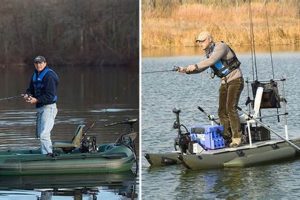
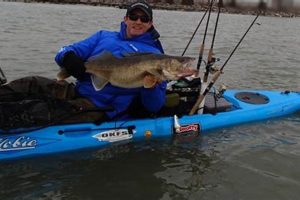
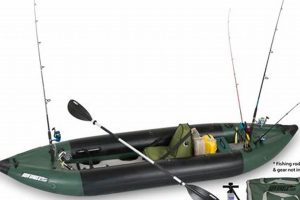
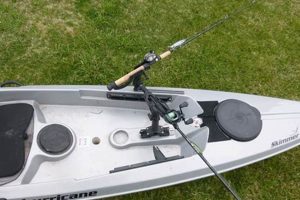
A specialized net designed for use in kayaks assists anglers in securely bringing their catch onboard. These nets are typically smaller and more compact than those used in other fishing disciplines, often featuring a teardrop or triangular shape for easier maneuvering in confined spaces. Features like telescoping handles and foldable hoops further enhance their portability and practicality within a kayak’s limited space. A durable, lightweight construction, often using materials like aluminum or composite for the handle and coated nylon or rubber for the netting, is essential for both performance and longevity in a marine environment.
Bringing a hooked fish aboard a kayak presents unique challenges due to the vessel’s instability and the angler’s limited movement. A properly designed net provides a safe and efficient method for securing the catch, minimizing the risk of fish loss, line breakage, or even capsizing. This specialized equipment is essential for preserving the well-being of both the angler and the fish, ensuring a humane catch-and-release process and reducing the likelihood of injury from hooks or struggling fish. Historically, kayak anglers may have employed makeshift solutions or adapted nets intended for other purposes, but the development of specialized designs has significantly improved both efficiency and safety in this increasingly popular fishing style.
This article will further explore key features to consider when selecting an appropriate net, along with best practices for its effective deployment and care. Topics covered will include net material and construction, handle length and design, hoop shape and size, and proper techniques for landing various fish species from a kayak.
Tips for Effective Kayak Fishing Net Usage
Proper net deployment and selection are critical for successful kayak fishing. These tips offer guidance on optimizing net use for a safe and efficient fishing experience.
Tip 1: Choose the Right Net: Net size and shape should be appropriate for the target fish species. Smaller nets are suitable for panfish and trout, while larger, deeper nets are needed for larger game fish. Consider a teardrop or triangular shape for maneuverability in a kayak’s confined cockpit.
Tip 2: Opt for a Telescoping Handle: A telescoping handle offers adjustable reach and compact storage, essential features in a kayak. Choose a length that allows comfortable netting while maintaining balance.
Tip 3: Prioritize a Secure Netting Material: Knotless, rubberized or coated nylon netting minimizes harm to fish and prevents hooks from becoming entangled. This is particularly crucial for catch-and-release fishing.
Tip 4: Practice Proper Netting Technique: Lead the fish over the net and scoop it up headfirst. Avoid chasing the fish with the net, as this can spook it and prolong the landing process.
Tip 5: Secure the Net When Not in Use: Utilize a leash or magnetic net holder to prevent loss and keep the net readily accessible while fishing. Ensure the net is stowed safely and won’t interfere with paddling or other equipment.
Tip 6: Regularly Inspect and Maintain the Net: Rinse the net with freshwater after each use to remove saltwater and debris. Check for any damage to the netting or handle and repair or replace as needed.
Tip 7: Consider a Floating Net: A floating net offers an added layer of security, preventing loss should it be dropped overboard.
Implementing these tips will contribute significantly to an angler’s success and safety while kayak fishing. Selecting the right net and using it correctly enhances efficiency and minimizes the risk of fish loss or injury.
By understanding these practical considerations, anglers can better equip themselves for a rewarding and responsible kayak fishing experience. The following section will offer concluding thoughts on the essential role of the fishing net in modern kayak angling.
1. Portability

Portability is a paramount consideration when selecting a landing net for kayak fishing. The confined nature of a kayak’s cockpit necessitates equipment that is compact, easy to stow, and readily accessible. A cumbersome net hinders maneuverability and presents safety risks. Careful evaluation of a net’s portability features is essential for optimizing fishing efficiency and overall experience.
- Collapsed Length and Storage:
The length of the net when fully collapsed directly impacts storage within a kayak. Shorter collapsed lengths allow for easier stowage under seats, behind gear, or within rod holders. For example, a net with a telescoping handle that collapses to 24 inches offers significantly more storage flexibility than a fixed-length 48-inch net. Efficient storage maximizes available space for other essential gear and minimizes clutter that could interfere with paddling or fishing.
- Weight:
Net weight contributes to overall kayak load and can influence balance and handling. Lighter nets, often constructed from materials like aluminum or carbon fiber, minimize strain during repeated deployment and retrieval. A heavy net can fatigue the angler and become unwieldy, particularly in challenging conditions. The difference between a 1-pound net and a 2-pound net, while seemingly small, can be noticeable over extended fishing trips.
- Deployment Mechanism:
The ease and speed of net deployment are crucial in the dynamic environment of kayak fishing. Nets with quick-release mechanisms or simple unfolding designs allow for rapid deployment when a fish is brought alongside. Fumbling with complicated latches or tangled netting can result in lost fish and frustration. A net that can be quickly and easily deployed with one hand provides a significant advantage.
- Attachment and Security:
Securely attaching the net to the kayak prevents loss and ensures it remains readily accessible. Integrated clips, leashes, or magnetic holders keep the net within reach while preventing it from drifting away or becoming entangled in other equipment. A secure attachment system provides peace of mind and allows the angler to focus on fishing rather than worrying about losing essential gear.
These facets of portability collectively determine a landing net’s suitability for kayak fishing. A well-designed, portable net seamlessly integrates into the kayak environment, enhancing efficiency and minimizing disruption. Prioritizing portability contributes directly to a safer, more enjoyable, and ultimately more successful fishing experience.
2. Durability

A landing net’s durability is paramount in the demanding environment of kayak fishing. Constant exposure to saltwater, UV radiation, and physical stress necessitates robust construction. A durable net ensures reliable performance over extended use, minimizing the risk of failure at critical moments. Understanding the factors contributing to net durability informs purchasing decisions and promotes responsible equipment maintenance.
- Frame Construction:
The frame material and construction significantly influence a net’s overall strength and resistance to bending or breakage. Aluminum frames offer a balance of lightweight and strength, while reinforced composites provide enhanced durability. Welded joints are generally stronger and more resistant to corrosion than riveted or glued connections. A robust frame withstands the stress of landing larger fish and accidental impacts against the kayak or other gear. Choosing a frame constructed from high-quality materials with robust joinery ensures long-term reliability.
- Netting Material:
The netting itself must resist tearing, abrasion, and rot. Rubberized or coated nylon netting offers superior durability compared to standard nylon, particularly in saltwater environments. Knotless netting further enhances strength and prevents hooks from snagging. A durable net material minimizes the risk of fish escaping during landing and prolongs the net’s lifespan. Selecting appropriate netting material is crucial for both successful fishing and environmental responsibility, as damaged nets can contribute to marine debris.
- Handle Durability:
Telescoping handles should feature robust locking mechanisms and corrosion-resistant materials. Handles constructed from anodized aluminum or fiberglass composites offer superior durability compared to plastic or painted metal. A durable handle ensures reliable extension and retraction, preventing collapse under load. Handles should also be resistant to bending or breaking under stress, providing consistent performance throughout repeated use and storage. The handle is often a point of stress during fish landing, emphasizing the need for robust construction.
- Corrosion Resistance:
Kayak fishing nets are frequently exposed to saltwater, a highly corrosive environment. All metal components, including the frame, handle, and hardware, should be treated or constructed from corrosion-resistant materials. Anodized aluminum, stainless steel, and specialized coatings protect against saltwater damage, extending the net’s lifespan. Regular rinsing with freshwater after each use further mitigates corrosion. Neglecting corrosion resistance can lead to premature failure and compromise the net’s structural integrity.
Careful consideration of these durability factors ensures the landing net remains a reliable tool throughout numerous fishing excursions. Investing in a durable net minimizes the risk of equipment failure during critical moments, contributing to both successful fishing and a responsible approach to equipment maintenance and environmental impact. A well-maintained, durable net becomes a trusted companion for the kayak angler, ensuring years of reliable service.
3. Net size
Net size is a critical factor influencing the effectiveness of a landing net for kayak fishing. Appropriate net dimensions directly correlate with the ability to securely land target fish species. An improperly sized net can lead to increased fish loss, potential harm to the fish, and added frustration for the angler. Selecting the correct net size requires careful consideration of the target species, the kayak’s stability, and the angler’s experience level.
Matching net size to target species ensures efficient and humane capture. A small net suitable for panfish or trout proves inadequate for landing larger species like bass or salmon. Attempting to land a large fish in a small net risks damaging the fish, breaking the net, or losing the fish altogether. Conversely, using an excessively large net for smaller fish can be cumbersome and difficult to maneuver within a kayak’s limited space. For example, a net with a 18-inch hoop diameter is generally suitable for smaller fish up to 12 inches in length, while larger species may require a hoop diameter of 24 inches or more. Balancing net size with the anticipated size of the target species optimizes landing efficiency and minimizes potential harm.
Net size selection also impacts kayak stability, a crucial factor in safe and successful angling. A large net, especially when laden with a heavy fish, can destabilize a kayak if not handled carefully. This is particularly relevant in challenging conditions such as wind or current. Anglers must consider the combined weight of the net and potential catch in relation to their kayak’s stability. Prioritizing a smaller, lighter net minimizes the risk of capsizing and enhances overall safety. Furthermore, a smaller net’s reduced water resistance during retrieval simplifies the landing process, particularly for less experienced anglers. The interplay between net size and kayak stability underscores the need for thoughtful equipment selection tailored to specific fishing conditions and angler skill level. Selecting an appropriately sized net ultimately contributes to a safer, more efficient, and more rewarding kayak fishing experience.
4. Handle Length

Handle length is a crucial factor influencing the effectiveness and safety of a landing net in kayak fishing. Appropriate handle length allows anglers to reach the water and securely net fish while maintaining balance and control within the confined space of a kayak. An improperly sized handle can compromise both efficiency and safety, leading to missed catches, potential capsizing, or injury.
The ideal handle length depends on several factors, including kayak width, fishing style, and target species. Wider kayaks generally necessitate longer handles to reach the water’s edge. Anglers targeting larger fish or those employing techniques requiring extended reach also benefit from longer handles. Conversely, excessively long handles can be cumbersome and difficult to manage within the kayak’s limited space, particularly in challenging conditions. For example, a kayak angler fishing for larger species from a sit-on-top kayak might require a handle length between 36 and 48 inches, while a shorter handle, 24 to 30 inches, would be more suitable for smaller fish or use in a narrower sit-inside kayak. Selecting the correct handle length ensures efficient net deployment and minimizes the risk of overreaching and losing balance.
Telescoping handles offer versatility, allowing anglers to adjust the handle length according to specific needs. This adaptability proves beneficial in varying fishing scenarios and accommodates different kayak designs. However, telescoping mechanisms must be robust and reliable to prevent accidental collapse under load. Furthermore, handle material and grip design contribute to overall comfort and control. Cork or EVA foam grips enhance grip security, particularly in wet conditions, while durable aluminum or composite construction ensures long-term reliability. Careful consideration of these factors ensures safe and efficient net deployment, contributing significantly to a successful and enjoyable kayak fishing experience. Balancing handle length with kayak dimensions, fishing style, and target species optimizes functionality and minimizes risk, allowing anglers to focus on the task at hand.
5. Material Type

Material selection significantly impacts a landing net’s performance, durability, and longevity in kayak fishing. Specific material properties influence resistance to corrosion, weight, strength, and overall functionality in a marine environment. Careful consideration of material type ensures appropriate net selection for intended use and contributes to responsible equipment maintenance.
- Handle Material:
Common handle materials include aluminum, fiberglass composites, and occasionally wood or plastic. Aluminum offers a balance of lightweight and corrosion resistance, making it a popular choice. Fiberglass composites provide enhanced strength and durability but can be more expensive. Wood, while aesthetically pleasing, requires meticulous maintenance to prevent rot and water damage. Plastic handles, while often the most affordable, generally lack the strength and durability required for demanding kayak fishing applications. The choice of handle material directly impacts the net’s overall weight, balance, and resistance to bending or breakage under stress.
- Hoop Material:
Hoop materials often mirror those used for handles, with aluminum and composites being the most prevalent. Aluminum offers lightweight and corrosion resistance, while composites provide superior strength and rigidity, crucial for maintaining hoop shape under load. The hoop material influences the net’s overall weight and its ability to withstand impacts against the kayak, rocks, or other obstacles encountered during fishing. A strong, resilient hoop ensures consistent performance and minimizes the risk of warping or breakage, which could compromise net functionality.
- Netting Material:
Netting material choices typically include nylon, coated nylon, and rubber. Standard nylon offers affordability but is susceptible to abrasion and can absorb water, increasing weight and drying time. Coated nylon provides enhanced abrasion resistance and water repellency, improving durability and minimizing odor retention. Rubber netting offers superior durability and fish-friendliness, reducing harm to the fish’s slime coat and minimizing hook entanglement. However, rubber netting can be heavier and more expensive than nylon alternatives. The choice of netting material directly impacts fish safety, net longevity, and ease of maintenance.
- Hardware and Fasteners:
Corrosion-resistant hardware, such as stainless steel screws, rivets, and other fasteners, is essential for maintaining structural integrity in saltwater environments. Lower-quality materials quickly succumb to corrosion, compromising the net’s strength and longevity. High-quality stainless steel or anodized aluminum components ensure reliable performance over extended use, minimizing the need for frequent replacements and reducing the risk of component failure at critical moments. Selecting corrosion-resistant hardware contributes significantly to the net’s overall durability and long-term functionality.
The careful selection of materials for each component of a landing net directly impacts its performance and longevity in kayak fishing. Prioritizing durable, corrosion-resistant materials ensures reliable functionality in demanding marine environments and contributes to a responsible approach to equipment maintenance. Choosing appropriate materials based on intended use and target species optimizes the net’s effectiveness, enhancing both angler success and fish safety.
6. Hoop Shape

Hoop shape significantly influences a landing net’s effectiveness and maneuverability in the specialized context of kayak fishing. The confined cockpit of a kayak presents unique challenges for net deployment and retrieval, necessitating hoop designs that optimize efficiency and minimize interference with other equipment or the angler’s movements. Specific hoop shapes offer distinct advantages and disadvantages in this environment, impacting factors such as ease of use, fish control, and overall net performance.
- Teardrop Shape:
The teardrop shape, characterized by a wider opening that tapers towards the handle, facilitates scooping fish from the water while requiring minimal clearance within the kayak. This design proves particularly advantageous when landing fish alongside the kayak, where space is limited. The tapered end also aids in guiding the fish into the net, minimizing escape opportunities. Teardrop-shaped hoops are frequently chosen by kayak anglers targeting smaller to medium-sized fish where quick, precise netting is essential.
- Triangular Shape:
Similar to the teardrop, the triangular hoop offers a wide opening for efficient scooping while maintaining a compact profile. The angled sides of the triangle provide additional rigidity and strength, making this shape well-suited for handling larger, more powerful fish. The triangular shape also offers excellent maneuverability in tight spaces, facilitating quick net deployment and retrieval without sacrificing structural integrity. Kayak anglers targeting larger game fish often prefer the triangular shape for its balance of strength and maneuverability.
- Round Shape:
Traditional round hoops, while common in other fishing disciplines, can be less practical in kayak fishing due to their larger profile and potential for interference. However, larger round hoops offer the advantage of a wider catching area, which can be beneficial for landing larger fish or for anglers with less experience. Their symmetrical shape also provides balanced water resistance during retrieval. While less common than teardrop or triangular shapes in kayak fishing, round hoops can be a viable option for specific applications where a larger catching area is prioritized over maneuverability in tight quarters.
- Folding Hoops:
Folding hoops offer enhanced portability and storage convenience, a significant advantage in the limited space of a kayak. These hoops typically feature hinged sections that allow them to be folded flat for storage, minimizing bulk and maximizing available space for other essential gear. While offering significant storage advantages, folding hoops must be robust and reliably lock into place during use to prevent accidental collapse. This feature enhances portability without compromising functionality, making it a valuable consideration for kayak anglers prioritizing space efficiency.
Hoop shape directly impacts a landing net’s effectiveness and suitability for kayak fishing. Selecting an appropriate hoop shape based on target species, kayak dimensions, and personal preference enhances both efficiency and safety. The choice between teardrop, triangular, round, or folding designs reflects the angler’s prioritization of maneuverability, fish control, and portability within the unique constraints of kayak fishing. By understanding the advantages and disadvantages of each shape, kayak anglers can make informed decisions that contribute to a more successful and enjoyable fishing experience.
7. Ease of use

Ease of use is paramount when considering a landing net for kayak fishing. The dynamic environment and inherent instability of a kayak demand a net that deploys quickly, handles effortlessly, and stows securely without hindering the angler’s movements or compromising balance. A cumbersome or difficult-to-manage net can lead to missed catches, tangled lines, and even potentially dangerous situations. The net’s design and features directly impact its usability and overall effectiveness in this specialized fishing context. For example, a net with a complicated locking mechanism or a stiff, unwieldy handle can impede rapid deployment, increasing the likelihood of losing a hooked fish. Conversely, a net with a smooth, quick-release mechanism and a comfortable, ergonomic handle allows for swift, one-handed operation, maximizing landing efficiency and minimizing disruption.
Several factors contribute to a landing net’s ease of use in a kayak. A lightweight design minimizes fatigue during repeated deployment and retrieval, while a compact, collapsible frame facilitates efficient storage and accessibility. Features such as a telescoping handle with a secure locking mechanism, a non-tangling net material, and a secure attachment point on the kayak further enhance usability. Furthermore, the net’s hoop shape and size influence maneuverability within the confined cockpit of a kayak. A teardrop or triangular hoop design generally offers superior maneuverability compared to a traditional round hoop, allowing for easier navigation in tight spaces. Consider a scenario where an angler hooks a feisty fish near submerged vegetation. A net with a snag-resistant, rubberized netting material will glide smoothly through the obstacles, whereas a traditional nylon net might become entangled, hindering the landing process and potentially jeopardizing the catch. The practical implications of these design considerations become readily apparent in real-world fishing scenarios.
Prioritizing ease of use when selecting a landing net for kayak fishing ultimately contributes to a safer, more efficient, and more enjoyable angling experience. A well-designed, user-friendly net seamlessly integrates into the kayak fishing workflow, minimizing distractions and allowing anglers to focus on the task at hand. The interplay between design, functionality, and the dynamic environment of kayak fishing underscores the importance of selecting a net that is not only effective but also intuitive and easy to operate. This careful selection process minimizes potential complications and maximizes the likelihood of a successful and rewarding fishing trip.
Frequently Asked Questions
This section addresses common inquiries regarding landing nets specifically designed for kayak fishing. The information provided aims to clarify key considerations and guide informed purchasing decisions.
Question 1: What is the ideal net size for kayak fishing?
Optimal net size depends on the target fish species and kayak dimensions. Smaller nets (18-24 inch hoop) suffice for panfish and trout in smaller kayaks. Larger game fish or wider kayaks necessitate larger nets (24-36 inch hoop) for efficient, safe landing. Consider the balance between net size and maneuverability within the kayak’s confined space.
Question 2: Are telescoping handles recommended for kayak nets?
Telescoping handles are highly recommended due to their adjustable length and compact storage. They offer adaptable reach and convenient stowage within limited kayak space. Choose a robust locking mechanism to prevent accidental collapse under load.
Question 3: What netting material is best suited for kayak fishing?
Rubberized or coated nylon netting is generally preferred. These materials minimize harm to the fish, resist tangling, and offer enhanced durability in saltwater environments compared to standard nylon. Knotless construction further reduces hook snags and promotes fish safety.
Question 4: How should a landing net be stored in a kayak?
Secure storage prevents loss and ensures easy access. Utilize a leash, magnetic net holder, or designated storage compartment to keep the net readily available while preventing interference with paddling or other equipment. Consider the net’s collapsed dimensions when planning storage solutions.
Question 5: What are the key features of a durable kayak fishing net?
Durability hinges on robust construction and corrosion-resistant materials. Look for a sturdy frame (aluminum or composite), reinforced netting (rubber or coated nylon), and corrosion-resistant hardware (stainless steel or anodized aluminum). Regular rinsing with freshwater after each use prolongs lifespan.
Question 6: How does hoop shape affect net performance in a kayak?
Teardrop or triangular hoops are generally preferred for kayak fishing. These shapes offer efficient scooping in confined spaces compared to round hoops, facilitating quick net deployment and retrieval without compromising fish control. Folding hoops enhance portability but require robust locking mechanisms.
Careful consideration of these factors contributes to informed decisions regarding landing net selection and optimized usage within the specialized context of kayak fishing. Choosing appropriate gear enhances both safety and fishing success.
The subsequent section will delve into specific product recommendations based on various kayak fishing styles and target species.
Landing Net for Kayak Fishing
Effective utilization of a landing net specifically designed for kayak fishing significantly enhances angler success and promotes responsible fishing practices. This article has explored the multifaceted aspects of such nets, emphasizing the critical interplay between design, material selection, and practical application within the unique constraints of a kayak’s confined environment. Key considerations include portability, durability, net size, handle length, material type, hoop shape, and ease of use. Each factor contributes to the net’s overall effectiveness and influences the angler’s ability to safely and efficiently land their catch. Prioritizing these elements ensures optimal net performance and minimizes potential complications during the crucial landing phase.
The proper selection and deployment of a landing net contribute significantly to the overall kayak fishing experience. Investing in a high-quality, purpose-built net demonstrates a commitment to both angling success and the ethical treatment of fish. As kayak fishing continues to grow in popularity, understanding the nuances of specialized equipment like landing nets becomes increasingly important for ensuring both angler safety and the sustainability of this rewarding pastime. Careful consideration of the factors outlined herein empowers anglers to make informed decisions that enhance their fishing endeavors and contribute to the preservation of aquatic ecosystems.