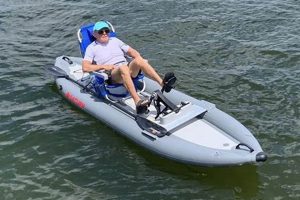
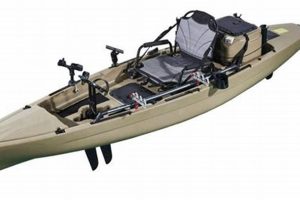
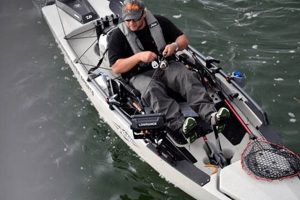
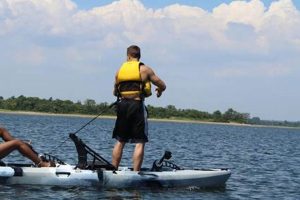
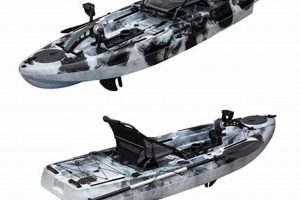
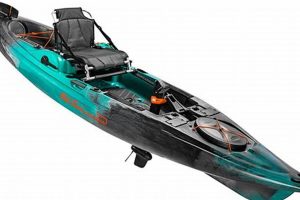
A hands-free propulsion method for kayaks designed for angling, this technology employs foot pedals connected to a propeller or fin system beneath the waterline. This allows anglers to maneuver their vessel efficiently and quietly, keeping their hands free for casting and reeling. Imagine a kayak gliding almost silently across a lake, propelled solely by the rhythmic motion of the angler’s feet. This imagery encapsulates the core functionality of this technology.
Quiet operation is crucial for stealthy approach in fishing, minimizing disturbance to fish. Furthermore, the hands-free nature allows for continuous fishing, even while navigating. This contrasts sharply with traditional paddle kayaks, where propulsion and fishing activities must alternate. The evolution from paddles to pedal-powered systems has significantly enhanced the angling experience, granting greater efficiency and control. This advancement provides a demonstrable advantage in various fishing scenarios, particularly in areas with current or wind.
This foundation provides a springboard for further exploration. Topics such as different types of underwater propulsion systems, factors to consider when selecting a suitable setup, and maintenance considerations will be examined in detail.
Tips for Selecting and Using Pedal-Driven Fishing Kayaks
Choosing and utilizing a pedal-driven fishing kayak effectively requires careful consideration of various factors. The following tips offer guidance for maximizing the benefits of this technology.
Tip 1: Consider Water Conditions. Different propulsion systems perform better in specific environments. Fin drives excel in shallow water and over vegetation, while propeller systems offer greater speed in open water. Assess typical fishing locations to determine the most appropriate drive type.
Tip 2: Prioritize Stability. Pedal kayaks tend to be wider and more stable than traditional paddle kayaks. However, stability varies between models. Look for a kayak with a stable hull design, especially when fishing in rough conditions or standing to cast.
Tip 3: Evaluate Maintenance Requirements. Regular maintenance is essential for optimal performance. Consider the ease of maintenance and the availability of replacement parts when selecting a system. Fin drives often require less maintenance than propeller systems.
Tip 4: Assess Seat Comfort and Adjustability. Long hours on the water necessitate a comfortable and supportive seat. Ensure the seat offers adequate adjustability to accommodate individual preferences and fishing styles.
Tip 5: Factor in Storage Capacity. Ample storage is essential for carrying fishing gear, safety equipment, and personal belongings. Consider the size and location of storage compartments and ensure they meet individual needs.
Tip 6: Practice Deploying and Retrieving the Drive. Familiarize oneself with the deployment and retrieval mechanisms of the chosen system before venturing onto the water. This ensures smooth operation and minimizes potential difficulties.
Tip 7: Test the Kayak Before Purchasing. Whenever possible, test different models on the water to assess their stability, maneuverability, and overall comfort. This hands-on experience provides invaluable insights for making an informed decision.
By considering these tips, anglers can select a pedal-driven fishing kayak tailored to their specific needs and fishing style, enhancing their overall experience and maximizing their success on the water.
These practical considerations pave the way for informed decision-making, leading to a concluding overview of the significance of choosing the right system.
1. Hands-free Propulsion
Hands-free propulsion stands as a defining characteristic of fishing kayak pedal drive systems. This feature fundamentally alters the angling experience by decoupling boat control from paddling. The direct consequence is the angler’s ability to maintain constant fishing readiness. Consider a scenario where a fish strikes while an angler is paddling a traditional kayak. The angler must first position the paddle, then grab the rod, potentially losing precious seconds and the opportunity. Pedal-driven systems eliminate this issue, allowing for immediate reaction to strikes and significantly increasing hook-up rates.
The importance of hands-free propulsion extends beyond simply reacting to strikes. It allows for techniques like trolling or drift fishing to be executed with greater precision. An angler can maintain a desired speed and direction using foot pedals, while simultaneously manipulating lures or bait. This level of control is particularly advantageous in challenging conditions like wind or current. Imagine navigating a river while maintaining a specific presentation of a lure – a difficult, if not impossible, feat with a paddle kayak. Hands-free propulsion grants anglers this capability, opening up new tactical possibilities.
The practical significance of understanding the link between hands-free propulsion and fishing kayak pedal drive systems is substantial. It empowers anglers to choose equipment tailored to their fishing style and target species. Recognizing the efficiency gains and tactical advantages offered by hands-free control enables informed decisions that ultimately lead to a more productive and enjoyable angling experience.
2. Increased Fishing Efficiency

Increased fishing efficiency represents a significant advantage offered by pedal-driven kayak systems. This enhancement stems from the seamless integration of propulsion and fishing activities, allowing anglers to maximize their time on the water. The following facets illustrate how these systems contribute to greater productivity:
- Continuous Fishing Opportunity
Traditional paddle kayaks necessitate alternating between paddling and fishing. This interruption breaks the fishing rhythm and can cause missed opportunities. Pedal drives eliminate this disruption, enabling continuous fishing even while maneuvering. Consider an angler working a shoreline structure. With a pedal drive, they can maintain a consistent retrieve while simultaneously adjusting position to cover the most productive water. This uninterrupted focus translates directly to more casts and increased chances of success.
- Precise Boat Control
Maintaining precise boat position is often crucial for successful fishing. Whether holding steady in a current, subtly adjusting position along a weed line, or following a specific depth contour, pedal drives offer unparalleled control. This precision allows anglers to present lures or bait with optimal effectiveness, increasing the likelihood of attracting and hooking fish. For example, an angler can use the pedals to maintain a slow, steady drift across a submerged point, ensuring consistent lure presentation in the strike zone.
- Reduced Fatigue
Paddling, particularly over long distances or against wind and current, can be physically demanding. Fatigue can impact an angler’s focus and reaction time, diminishing fishing effectiveness. Pedal drives reduce physical exertion, allowing anglers to conserve energy and maintain concentration throughout the fishing trip. This sustained focus can be particularly crucial during extended outings or tournaments.
- Stealth and Approach
Approaching fish without spooking them is often essential, particularly in shallow water or when targeting wary species. Paddle strokes can create noise and surface disturbance, alerting fish to the angler’s presence. Pedal drives, particularly fin-driven systems, operate much more quietly, allowing for a stealthier approach. This minimized disturbance increases the likelihood of getting within casting range undetected, significantly improving the chances of a successful presentation.
These facets collectively demonstrate the significant contribution of pedal-driven systems to increased fishing efficiency. By optimizing boat control, reducing fatigue, and maximizing fishing time, these systems enhance angling productivity and contribute to a more successful and enjoyable experience on the water.
3. Enhanced Maneuverability

Enhanced maneuverability represents a key advantage of fishing kayak pedal drive systems, directly impacting an angler’s ability to navigate effectively and position the kayak optimally for fishing. This capability differentiates pedal-driven kayaks from traditional paddle kayaks, offering greater precision and control in various on-the-water scenarios.
- Precise Position Adjustment
Subtle adjustments in position are often crucial for successful fishing. Whether holding position in a current, maintaining a precise distance from a weed bed, or maneuvering through tight quarters, pedal drives offer superior control. Consider an angler fishing a drop-off. Minute adjustments enabled by a pedal drive allow the angler to maintain the optimal depth for lure presentation without disrupting the fishing rhythm.
- Navigation in Challenging Conditions
Wind and current can significantly impede kayak control, making precise navigation difficult with traditional paddles. Pedal drives provide greater power and control, allowing anglers to maintain course and position effectively even in challenging conditions. Imagine navigating a swift river or a windy estuary; pedal drives offer the necessary control to hold position or maneuver effectively, maximizing fishing opportunities.
- Hands-Free Boat Control
The hands-free nature of pedal drives contributes significantly to maneuverability. Anglers can adjust position or maintain heading while simultaneously managing fishing rods and tackle, increasing efficiency and responsiveness. For instance, an angler fighting a fish can use the pedals to steer the kayak and avoid obstacles without compromising control of the rod.
- Quick Turning and Maneuvering
Pedal drives offer greater responsiveness compared to paddles, allowing for quicker turns and more agile maneuvering. This capability is particularly advantageous when navigating tight spaces, pursuing moving fish, or reacting quickly to changing conditions. Consider navigating through a maze of mangrove roots or quickly repositioning to intercept schooling fish; the responsiveness of a pedal drive is invaluable.
These facets of enhanced maneuverability, facilitated by pedal drive systems, collectively contribute to a more effective and controlled fishing experience. The ability to precisely position the kayak, navigate challenging conditions, maintain hands-free control, and execute quick maneuvers provides a significant advantage in various fishing scenarios, ultimately maximizing angling success.
4. Quiet Operation
Quiet operation represents a critical advantage of fishing kayak pedal drive systems, particularly in shallow water or when targeting wary species. Noise disruption can spook fish, impacting fishing success. Traditional paddle kayaks, by their nature, create surface disturbance and splashing sounds with each stroke. This noise can travel considerable distances underwater, alerting fish to the angler’s presence. Pedal-driven systems, particularly those utilizing fins, offer a significant reduction in noise output. The underwater propulsion mechanism operates beneath the surface, minimizing surface disturbance and splashing. This quieter operation allows anglers to approach fish more stealthily, increasing the likelihood of getting within casting range undetected.
Consider a scenario where an angler is targeting bonefish on a shallow flat. These fish are notoriously spooky, and the slightest noise can send them scattering. A traditional paddle kayak would likely spook the fish long before the angler gets within casting distance. However, a kayak equipped with a quiet pedal drive allows the angler to approach stealthily, maximizing the chances of a successful presentation. Similarly, in freshwater environments, stealth is crucial when targeting bass or trout in clear, shallow waters. The reduced noise signature of a pedal drive can be the difference between a successful outing and an empty creel.
The practical significance of quiet operation in fishing kayak pedal drive systems lies in its direct impact on fishing success. By minimizing noise pollution, these systems enhance an angler’s ability to approach fish undetected, increasing opportunities for successful presentations and ultimately maximizing catch rates. This advantage underscores the importance of considering noise output when selecting a propulsion system, particularly for anglers targeting easily spooked species or fishing in shallow, clear water environments. Understanding this connection empowers anglers to make informed decisions that align with their fishing style and target species.
5. Variable Underwater Propulsion

Variable underwater propulsion constitutes a crucial aspect of fishing kayak pedal drive systems, encompassing the diverse mechanisms employed to translate human power into boat movement. Understanding the nuances of these systems, from propeller-based designs to fin drives, is essential for informed decision-making. Selecting the appropriate propulsion system significantly impacts performance characteristics, influencing maneuverability, speed, and suitability for specific fishing environments.
- Propeller-Based Systems
Propeller systems utilize a submerged propeller, similar to those found on motorboats, to generate thrust. These systems typically offer higher top-end speeds, making them well-suited for covering larger distances or navigating open water. However, propellers are more susceptible to entanglement in vegetation or shallow water obstacles. Consider a scenario involving trolling for offshore species: a propeller system provides the necessary speed and power for covering extensive areas. Conversely, in shallow, weedy environments, a propeller system’s susceptibility to fouling can become a significant hindrance.
- Fin-Driven Systems
Fin drives employ underwater fins that move in an oscillating pattern to propel the kayak. These systems excel in shallow water and vegetated areas due to their weedless design. While generally offering lower top-end speeds compared to propellers, fin drives provide exceptional maneuverability and are less prone to damage from underwater obstructions. Imagine navigating a shallow marsh teeming with vegetation: a fin drive allows for unimpeded movement, whereas a propeller system would likely become entangled. This advantage makes fin drives ideal for inshore fishing and navigating complex environments.
- Pedal Gear Ratios and Resistance Adjustment
Many pedal drive systems offer variable gear ratios or resistance adjustments, allowing anglers to fine-tune the pedaling experience. Lower gear ratios provide easier pedaling, ideal for maintaining slow speeds or navigating against currents. Higher gear ratios offer increased speed but require greater effort. Adjustable resistance allows for customization based on individual preferences and physical capabilities. This variability empowers anglers to optimize their pedaling cadence and exertion level based on fishing conditions and personal comfort.
- Impact on Maneuverability and Efficiency
The choice of underwater propulsion directly influences maneuverability and efficiency. Propeller systems generally offer greater speed but may sacrifice maneuverability in tight spaces. Fin drives, while typically slower, excel in maneuverability and shallow water navigation. Consider the difference between navigating open water versus a narrow, winding creek. A propeller system might be ideal for the former, while a fin drive proves superior for the latter. Understanding these trade-offs is crucial for selecting the most effective propulsion system for a given fishing environment.
The diverse characteristics of variable underwater propulsion systems directly influence the overall performance and suitability of a fishing kayak. Careful consideration of these factors, including the intended fishing environment, desired speed, and maneuverability requirements, is paramount for maximizing angling effectiveness and enjoyment on the water. By understanding the nuances of propeller systems, fin drives, and available adjustments, anglers can select the optimal propulsion method tailored to their specific needs and fishing style.
Frequently Asked Questions
This section addresses common inquiries regarding fishing kayak pedal drive systems, providing concise and informative responses to facilitate informed decision-making.
Question 1: What are the primary advantages of a pedal drive system over traditional paddles?
Pedal drive systems offer hands-free propulsion, enabling continuous fishing while maneuvering. This translates to increased fishing efficiency and reduced fatigue. Enhanced maneuverability, particularly in wind or current, provides access to prime fishing locations. Quieter operation minimizes disturbance to fish, increasing stealth. These advantages collectively contribute to a more productive and enjoyable angling experience.
Question 2: How do propeller-based systems differ from fin drives?
Propeller systems generally provide higher speeds, making them suitable for open water and covering larger distances. Fin drives excel in shallow water and vegetated areas due to their weedless design and enhanced maneuverability. Propellers are more susceptible to entanglement, while fins are more resistant to damage from underwater obstructions.
Question 3: What maintenance is typically required for a pedal drive system?
Regular rinsing with fresh water after each use is crucial, especially in saltwater environments. Periodic lubrication of moving parts and inspection for wear and tear are essential. Specific maintenance requirements vary depending on the manufacturer and model; consulting the owner’s manual is recommended.
Question 4: Are pedal drive systems difficult to install or remove?
Most modern pedal drive systems are designed for relatively easy installation and removal. Specific procedures vary between manufacturers, but generally involve securing the drive unit to designated mounting points on the kayak hull. Consulting the manufacturer’s instructions provides detailed guidance.
Question 5: What is the typical lifespan of a pedal drive system?
Lifespan varies based on usage, maintenance, and environmental conditions. With proper care and regular maintenance, a pedal drive system can last for several years. Factors such as saltwater exposure and frequency of use can influence longevity.
Question 6: Can pedal kayaks be used in shallow water?
Pedal kayaks, particularly those equipped with fin drives, are generally well-suited for shallow water navigation. Fin drives are less prone to entanglement in vegetation and bottom contact compared to propeller systems. However, it’s crucial to exercise caution and avoid dragging the drive unit over submerged obstacles.
Understanding these key aspects of fishing kayak pedal drive systems empowers informed choices, aligning equipment selection with individual angling needs and preferences. Thorough research and consideration of these factors contribute to a more rewarding and productive on-the-water experience.
Moving forward, practical advice for selecting the right system based on individual fishing styles will be explored.
Fishing Kayak Pedal Drive Systems
Fishing kayak pedal drive systems represent a significant advancement in kayak angling technology. This exploration has highlighted the core benefits: hands-free propulsion, increased fishing efficiency, enhanced maneuverability, quiet operation, and the adaptability offered by variable underwater propulsion systems. From the advantages of continuous fishing opportunities to the nuances of propeller versus fin drives, the multifaceted nature of these systems has been examined. Understanding these elements empowers anglers to make informed decisions, optimizing equipment choices based on individual needs and fishing styles.
The evolution of kayak fishing continues. As technology progresses, refinements and innovations in pedal drive systems are inevitable. Anglers seeking to maximize their on-the-water effectiveness should carefully consider the benefits and features offered by these systems. The informed selection of a fishing kayak pedal drive system can significantly enhance angling experiences, contributing to greater success and enjoyment on the water. Diligent research and a thorough understanding of these systems empower anglers to harness the full potential of modern kayak fishing technology.