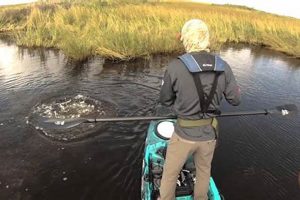
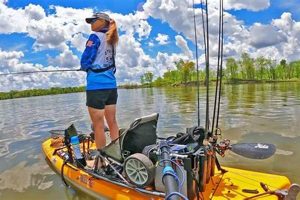
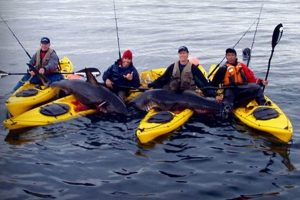
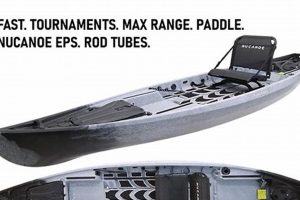
This specific type of watercraft designates a small, human-powered vessel designed for angling activities. Characteristically lightweight and maneuverable, it offers a stable platform for casting and reeling in fish. The designated length suggests a compact design suitable for smaller bodies of water and easier transport.
Compact vessels of this nature provide anglers with access to shallow waters and secluded fishing spots often unreachable by larger boats. Their portability and ease of use make them an attractive option for both novice and experienced fishermen. Historically, small fishing boats have played a crucial role in sustenance and recreational fishing, evolving from simple dugout canoes to the modern, specialized designs available today. This evolution reflects the ongoing pursuit of improved stability, maneuverability, and angler comfort.
Further exploration will delve into the specific features, advantages, and potential drawbacks of this size and style of fishing kayak, including materials, construction, and suitability for various fishing environments. This information will empower potential users to make informed decisions when selecting a watercraft suited to their individual needs and fishing preferences.
Tips for Utilizing a 10-Foot Fishing Kayak
Effective use of a compact fishing kayak maximizes angler success and safety. The following tips offer guidance for optimizing the experience on the water.
Tip 1: Stability Enhancement: Distributing weight evenly is crucial for maintaining balance. Centering gear and avoiding sudden movements minimizes the risk of capsizing.
Tip 2: Paddle Selection: Choosing an appropriately sized paddle is essential for efficient propulsion and reduced fatigue. Paddle length should be determined by factors such as torso height and kayak width.
Tip 3: Pre-Trip Planning: Researching potential fishing locations beforehand allows for informed decisions regarding launch points, water conditions, and prevailing weather patterns. Checking local regulations is also advised.
Tip 4: Safety Precautions: Wearing a personal flotation device is paramount for safety. Carrying essential safety equipment, such as a whistle and signaling devices, is strongly recommended.
Tip 5: Anchor Considerations: Utilizing a lightweight anchor system suited to smaller watercraft allows anglers to maintain position in desired fishing areas.
Tip 6: Efficient Gear Storage: Organizing fishing gear strategically within the kayak’s storage compartments maximizes space and accessibility. Prioritizing frequently used items facilitates smooth retrieval.
Tip 7: Proper Launching and Landing Techniques: Practicing smooth entry and exit techniques minimizes the risk of instability and potential damage to the kayak.
Adherence to these guidelines contributes to a safer and more productive fishing experience. Careful planning and mindful execution enhance overall enjoyment and success on the water.
By considering these aspects, anglers can fully appreciate the versatility and advantages offered by this type of watercraft.
1. Compact Size
Compact size represents a defining characteristic of the ascend 10ft fishing kayak, significantly influencing its portability, maneuverability, and suitability for specific environments. This reduced length allows for easier transport and storage compared to larger kayaks. Transporting a 10-foot kayak on a car roof rack or in a truck bed presents fewer logistical challenges than managing a longer, heavier vessel. Storage in garages or limited spaces also benefits from the compact dimensions. This attribute expands accessibility to diverse waterways, particularly smaller rivers, creeks, ponds, and protected coastal areas, often inaccessible to larger watercraft. Maneuverability within these confined environments is enhanced by the shorter length, allowing for nimble navigation through tight turns and shallow waters.
The compact size also influences the kayak’s overall weight, typically resulting in a lighter vessel. This reduced weight facilitates easier handling during launching, landing, and portaging. Solo anglers, in particular, benefit from the manageable weight when transporting the kayak to and from the water. However, compact size can also present limitations regarding storage capacity and stability compared to larger kayaks. Careful consideration of gear requirements and individual balance capabilities is necessary. For example, anglers planning extended trips with substantial equipment might find the limited storage space restrictive. Similarly, individuals seeking exceptional stability might prefer a wider, longer kayak design. Choosing the appropriate kayak size involves balancing the advantages of compactness with potential trade-offs in storage and stability.
In summary, the compact size of the ascend 10ft fishing kayak presents significant advantages regarding portability, maneuverability, and access to restricted waterways. However, understanding the potential limitations related to storage capacity and stability remains crucial for informed decision-making. Ultimately, selecting the appropriate kayak size depends on individual needs, fishing style, and target environments. A thorough assessment of these factors ensures a balanced approach, maximizing the benefits of compact size while mitigating potential drawbacks.
2. Fishing-Specific Design

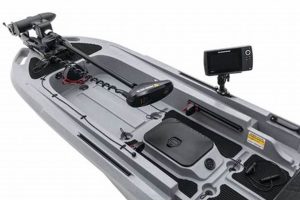
Fishing-specific design distinguishes this kayak from recreational or touring models. Features directly supporting angling activities represent key differentiators. Rod holders, often strategically positioned for easy access and diverse fishing techniques, are a common inclusion. These specialized holders secure rods, freeing hands for other tasks like paddling, baiting hooks, or landing fish. Tackle storage compartments, designed to accommodate lures, lines, and other fishing essentials, contribute to organized and efficient gear management. These compartments often feature waterproof seals or designs to protect sensitive equipment from moisture. Furthermore, integrated mounting points or rails allow for customization with fish finders, GPS units, and other electronic accessories enhancing angling success. Such integrated systems contribute to a streamlined and ergonomic fishing experience.
Consider, for example, an angler targeting bass in a shallow lake. The ability to quickly switch between different rods rigged with specific lures, facilitated by conveniently placed rod holders, becomes a significant advantage. Similarly, readily accessible tackle storage streamlines lure changes and minimizes disruptions during active fishing. A stable platform, often achieved through hull design or outriggers, further enhances casting accuracy and overall fishing comfort. These specialized features contribute directly to increased fishing efficiency and enjoyment. Conversely, a standard recreational kayak lacks these purpose-built features, potentially hindering an angler’s performance and overall experience.
Understanding the nuances of fishing-specific design empowers informed purchasing decisions. Evaluating the type, placement, and accessibility of rod holders, tackle storage, and mounting points allows anglers to select kayaks aligned with their specific fishing styles and needs. This informed approach optimizes on-the-water performance and contributes to a more productive and enjoyable fishing experience. Recognizing the practical significance of these design elements underscores the value proposition of a dedicated fishing kayak over a general-purpose recreational model.
3. Ascend Brand
Ascend represents a specific brand within the broader market of fishing kayaks. This brand association signifies a particular design philosophy, manufacturing process, and quality standard. Understanding the Ascend brand’s characteristics is crucial for evaluating the “ascend 10ft fishing kayak” within its proper context. The brand’s reputation for durability, stability, and affordability, for instance, directly influences perceptions of the 10-foot fishing kayak model. Consumers often associate specific brand attributes with individual products. A brand known for robust construction, for example, lends credibility to claims of kayak durability. Conversely, a brand associated with budget-friendly products might raise questions about material quality or feature sets.
Examining real-world examples illustrates this connection. If Ascend, hypothetically, emphasizes stability in its marketing and design, potential buyers might reasonably expect the 10-foot model to exhibit enhanced stability features. This expectation influences purchasing decisions, particularly among anglers prioritizing stability for specific fishing techniques or physical limitations. Similarly, established brand warranties or customer service reputations contribute to consumer confidence. A comprehensive warranty, for example, might alleviate concerns about potential manufacturing defects or long-term durability. Conversely, negative brand perceptions based on past performance or customer service issues could deter potential buyers, regardless of a specific model’s features.
In summary, “Ascend brand” is not merely a label; it represents a complex set of attributes influencing consumer perceptions and purchasing decisions related to the “ascend 10ft fishing kayak.” Understanding this connection allows for informed evaluation of the product’s potential strengths and weaknesses within the broader market context. Recognizing the brand’s established reputation for specific qualitiesbe it durability, stability, or affordabilityprovides a crucial framework for assessing the 10-foot model’s value proposition and overall suitability for individual angling needs. This informed approach empowers consumers to make choices aligned with their priorities and expectations.
4. Ten-foot length

Ten-foot length defines a critical dimension of the ascend 10ft fishing kayak, directly influencing its performance characteristics and suitability for specific applications. This length represents a balance between maneuverability and tracking performance. Shorter kayaks generally offer enhanced maneuverability in tight spaces, while longer kayaks tend to track straighter over distance. A ten-foot length positions the ascend kayak within the compact segment, favoring agility in smaller rivers, creeks, and ponds, while still providing reasonable tracking in open water. Consider navigating a narrow, winding creek; a shorter kayak allows for easier turning and obstacle avoidance compared to a longer, less responsive vessel.
The ten-foot length also impacts storage capacity and weight. Compared to larger kayaks, ten-foot models typically offer less storage space for gear and equipment. This characteristic requires anglers to prioritize essential items and potentially limit the duration of fishing trips. However, the reduced length generally contributes to lower overall weight, simplifying transport and handling, particularly for solo anglers. Imagine loading a kayak onto a car roof rack; a lighter, ten-foot kayak presents a less challenging task than a heavier, twelve-foot model. This ease of transport expands accessibility to remote fishing locations.
In summary, the ten-foot length of the ascend fishing kayak presents a compromise between maneuverability, tracking, storage capacity, and weight. This length prioritizes agility in confined waterways and ease of transport, making it well-suited for anglers targeting smaller bodies of water and prioritizing portability. Understanding this length’s influence on performance characteristics empowers informed decision-making, ensuring alignment between kayak selection and individual angling needs. Recognizing these practical implications optimizes kayak utilization and enhances the overall fishing experience.
5. Portability

Portability represents a significant advantage of the ascend 10ft fishing kayak, directly influencing its accessibility and usability. The kayak’s compact ten-foot length and relatively lightweight construction facilitate transportation and storage. Unlike larger vessels requiring trailers or specialized lifting equipment, this kayak can often be transported on a standard car roof rack or even carried short distances by a single individual. This ease of transport expands fishing location accessibility, allowing anglers to reach remote ponds, smaller rivers, and secluded shorelines often inaccessible to larger boats. Consider, for example, an angler seeking to fish a small mountain lake accessible only by a narrow, unpaved road. The portability of the ascend 10ft kayak allows access to such locations, expanding fishing opportunities beyond the limitations of larger watercraft.
Furthermore, portability simplifies storage requirements. The kayak’s compact size allows for convenient storage in garages, sheds, or even apartments, eliminating the need for dedicated boat slips or large storage facilities. This convenience contributes to the kayak’s overall practicality, reducing logistical barriers to entry for individuals with limited storage space. For urban dwellers with limited storage options, this portability becomes a crucial factor influencing kayak ownership and usage. The ease of storage also allows for quick deployment, facilitating spontaneous fishing trips and maximizing opportunities to capitalize on favorable weather conditions or fishing seasons. The ability to quickly load and unload the kayak reduces preparation time and encourages more frequent on-the-water excursions.
In summary, portability significantly enhances the ascend 10ft fishing kayak’s appeal. Ease of transport and storage expands access to diverse fishing locations and simplifies logistical considerations. This characteristic contributes to the kayak’s overall practicality, making it a versatile option for anglers seeking convenient access to the water. Understanding the practical significance of portability underscores its value within the context of fishing kayak selection and contributes to a more informed purchasing decision. This awareness allows anglers to prioritize features aligned with their individual needs and logistical constraints, ultimately enhancing their overall fishing experience.
6. Stability
Stability represents a critical performance characteristic of the ascend 10ft fishing kayak, directly influencing angler safety, comfort, and fishing effectiveness. This attribute refers to the kayak’s resistance to tipping or capsizing, particularly during activities like casting, reeling, and landing fish. Several factors contribute to kayak stability, including hull design, width, and weight distribution. Wider hulls generally provide greater initial stability, reducing the likelihood of tipping during static activities. However, excessive width can negatively impact maneuverability. Hull design features, such as chines or pontoon-style hulls, can enhance secondary stabilityresistance to tipping once the kayak is leaned. Proper weight distribution within the kayak further contributes to overall stability, minimizing the risk of imbalance caused by shifting gear or sudden movements. Consider an angler standing to cast in a narrow, unstable kayak; the risk of capsizing increases significantly. Conversely, a stable platform allows for confident casting and retrieval, maximizing fishing effectiveness and safety.
The practical implications of stability become particularly apparent during on-the-water activities. A stable kayak provides a secure platform for casting, allowing anglers to focus on fishing technique rather than maintaining balance. This enhanced stability is crucial when fighting larger fish, as sudden movements or shifts in weight can destabilize a less stable kayak. Landing a fish, often involving leaning over the side of the kayak, also requires a stable platform to minimize the risk of capsizing. Moreover, stability contributes to angler comfort, especially during longer fishing trips. A stable kayak reduces fatigue associated with constantly correcting balance, allowing anglers to focus on enjoying the experience. Imagine spending hours in a wobbly kayak; fatigue and discomfort detract from the overall fishing experience. Conversely, a stable kayak promotes relaxation and enjoyment, enhancing overall satisfaction.
In summary, stability is a fundamental aspect of the ascend 10ft fishing kayak’s performance, directly influencing safety, comfort, and fishing effectiveness. Understanding the factors contributing to stability, such as hull design, width, and weight distribution, empowers informed decision-making and promotes safe kayaking practices. Recognizing the practical implications of stabilityenhanced casting accuracy, safer fish landing, and increased angler comfortunderscores its significance within the context of fishing kayak selection and overall on-the-water experience. This awareness allows anglers to prioritize stability alongside other performance characteristics, ensuring a balanced and enjoyable fishing experience.
7. Maneuverability

Maneuverability represents a critical performance attribute of the ascend 10ft fishing kayak, directly influencing its suitability for various fishing environments and techniques. This characteristic describes the kayak’s responsiveness to paddle input and its ability to navigate complex waterways effectively. Understanding the factors contributing to maneuverabilityhull design, length, and water conditionsinforms appropriate kayak selection and usage.
- Navigating Tight Spaces
The kayak’s compact ten-foot length enhances its ability to navigate narrow creeks, shallow coves, and obstacle-filled waterways. Shorter kayaks require less effort to turn and maneuver compared to longer vessels, proving advantageous when exploring confined areas rich in fish-holding structure. Imagine navigating a densely vegetated marsh; a highly maneuverable kayak allows anglers to access secluded pockets and precisely target fish-holding cover.
- Tracking Performance
While maneuverability prioritizes turning ability, tracking performance refers to the kayak’s ability to maintain a straight course. The ten-foot length offers a balance between maneuverability and tracking, suitable for navigating both confined spaces and open water. A kayak that tracks well minimizes the need for constant corrective strokes, conserving energy during longer paddles. Consider traversing a large lake; efficient tracking reduces fatigue and allows anglers to cover greater distances.
- Influence of Water Conditions
Water conditions, including current and wind, significantly impact maneuverability. A kayak’s hull design influences its performance in varying conditions. A shallow-draft hull might be more maneuverable in shallow, weedy environments but less stable in windy, open water. Understanding the interplay between hull design and anticipated water conditions is crucial for selecting a kayak suited to the target fishing environment. For example, a kayak designed for river fishing might prioritize maneuverability in current over stability in open water.
- Impact on Fishing Techniques
Maneuverability directly influences fishing techniques. A highly maneuverable kayak allows anglers to precisely position themselves for optimal casting angles, critical for techniques like sight fishing or targeting specific structure. Quickly changing position to follow moving fish or adjust to changing wind conditions becomes easier with a responsive kayak. Consider pursuing schooling fish; a maneuverable kayak allows anglers to maintain optimal casting positions and maximize catch opportunities.
In summary, maneuverability represents a multifaceted performance characteristic influenced by design, conditions, and fishing techniques. The ascend 10ft fishing kayaks design prioritizes agility in confined spaces, offering a balance between maneuverability and tracking performance. Understanding these characteristics allows anglers to make informed decisions regarding kayak selection and usage, optimizing their on-the-water experience and enhancing fishing success. The ability to effectively maneuver the kayak expands fishing opportunities and contributes to a more engaging and productive angling experience.
Frequently Asked Questions
This section addresses common inquiries regarding 10-foot fishing kayaks, providing concise and informative responses to facilitate informed decision-making.
Question 1: What weight capacity can a typical 10-foot fishing kayak accommodate?
Weight capacity varies depending on the specific model and manufacturer, but generally ranges between 250 and 350 pounds. Exceeding the specified weight limit can compromise stability and safety. Consulting manufacturer specifications is crucial.
Question 2: Are 10-foot kayaks suitable for ocean fishing?
While some 10-foot kayaks are designed for protected coastal waters or calm bays, they are generally not recommended for open ocean conditions. Larger kayaks offer enhanced stability and seaworthiness required for challenging offshore environments.
Question 3: How does one transport a 10-foot kayak?
Transporting a 10-foot kayak is typically achievable using a standard car roof rack system. Securing the kayak properly with straps and ensuring adequate clearance is essential. Alternatively, some individuals transport smaller kayaks in truck beds or dedicated kayak trailers.
Question 4: What essential safety gear is recommended for kayak fishing?
Essential safety gear includes a personal flotation device (PFD), a whistle, signaling devices (such as a mirror or flare), and a first-aid kit. Checking weather conditions before embarking and informing someone of the planned fishing location are also crucial safety precautions.
Question 5: What are the advantages of a sit-on-top versus a sit-inside kayak for fishing?
Sit-on-top kayaks offer enhanced stability and ease of entry and exit, particularly beneficial for anglers who anticipate frequent casting or landing fish. Sit-inside kayaks provide greater protection from the elements and often feature more storage space.
Question 6: How does one choose the appropriate paddle length for a 10-foot kayak?
Appropriate paddle length depends on factors like torso height, kayak width, and paddling style. Consulting paddle sizing charts provided by manufacturers or seeking guidance from experienced kayakers is recommended.
Careful consideration of these frequently asked questions, combined with thorough product research, empowers informed purchasing decisions and enhances the overall kayaking experience.
Further exploration of specific kayak models and features is recommended before making a final selection.
Conclusion
Exploration of the ascend 10ft fishing kayak reveals a specialized vessel designed for angling activities. Compact dimensions prioritize maneuverability and portability, facilitating access to smaller waterways often inaccessible to larger craft. Fishing-specific features, including rod holders and tackle storage, enhance angling efficiency. Careful consideration of stability, weight capacity, and intended usage remains crucial for informed selection. Understanding the interplay between design features, performance characteristics, and individual angler needs informs optimal kayak utilization.
Selection of appropriate fishing equipment profoundly impacts angling success and overall enjoyment. Thorough research, informed decision-making, and adherence to safety guidelines contribute to a rewarding and sustainable fishing experience. Continued exploration of evolving kayak designs and fishing techniques promises further enhancement of on-the-water experiences.