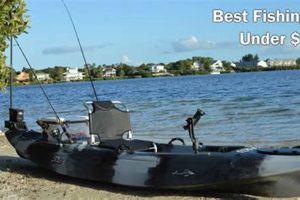
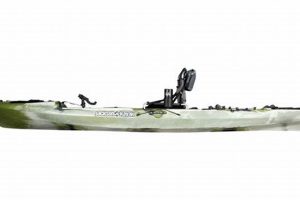
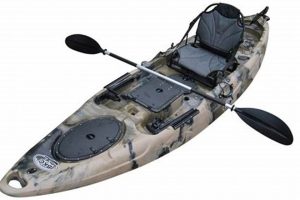
Selecting the optimal rod length for fly fishing from a kayak involves considering the vessel’s size and stability, the targeted fish species, and the casting environment. A shorter rod, typically between 7 and 9 feet, often proves advantageous due to the confined space and lower casting angles inherent to kayak fishing. For example, a 7-foot, 4-weight rod might be ideal for targeting panfish in small ponds, while a 9-foot, 8-weight rod could be better suited for larger game fish in open water.
Appropriate rod length enhances casting accuracy and line control, minimizing backcasts that might snag on overhanging branches or the kayak itself. This contributes significantly to a more efficient and enjoyable fishing experience, particularly in challenging environments. Historically, longer rods were favored, but the rise in kayak fishing’s popularity has driven the development and adoption of shorter, more specialized rods designed for this specific application. This shift reflects the growing understanding of how equipment choice impacts success and enjoyment in specialized fishing disciplines.
The following sections will explore the factors influencing rod selection in greater detail, covering rod weight, action, materials, and recommended lengths for various species and fishing conditions. Further discussion will also address the interplay of rod length with line choice and casting techniques specifically for kayak anglers.
Tips for Choosing a Fly Rod for Kayak Fishing
Selecting an appropriate fly rod significantly impacts success and enjoyment while fishing from a kayak. Consider these essential tips to optimize equipment choice.
Tip 1: Prioritize Shorter Lengths: Rods between 7 and 9 feet generally offer optimal maneuverability within a kayak’s confined space. Shorter rods facilitate casting in tight quarters and reduce the risk of snagging on overhanging obstacles or the kayak itself.
Tip 2: Match Rod Weight to Target Species: Lighter rods (3-6 weight) are suitable for smaller fish like panfish and trout, while heavier rods (7-9 weight) are necessary for larger species such as bass, salmon, or saltwater fish.
Tip 3: Consider Rod Action: Faster action rods provide greater casting distance and power, while slower action rods offer more delicate presentations and better control with lighter tippets. A moderate action often strikes a good balance for kayak fishing.
Tip 4: Factor in Kayak Size and Stability: Smaller, less stable kayaks benefit from shorter rods to maintain balance and control during casting and retrieval. Larger, more stable kayaks offer more flexibility in rod length.
Tip 5: Practice Casting Techniques: Develop a compact and efficient casting stroke suited to the limited space in a kayak. Sidearm and roll casts often prove advantageous.
Tip 6: Account for Fishing Environment: Fishing in tight, overgrown streams necessitates shorter rods, while open water or saltwater environments may allow for slightly longer options.
Tip 7: Evaluate Rod Materials: Graphite rods offer sensitivity and lightweight performance, while fiberglass rods provide durability. Consider the trade-offs between weight, sensitivity, and cost.
Careful consideration of these factors will result in a rod choice that enhances casting accuracy, improves fish-fighting control, and maximizes overall fishing enjoyment from a kayak.
By understanding the nuances of rod selection, anglers can significantly improve their chances of success and fully appreciate the unique challenges and rewards of kayak fishing. The following concluding section offers final recommendations and reinforces the importance of selecting the right gear.
1. Maneuverability

Maneuverability represents a critical factor influencing fly rod selection for kayak angling. The confined nature of a kayak’s cockpit restricts casting motions and necessitates careful rod handling. Shorter rods, typically between 7 and 9 feet, significantly enhance maneuverability by allowing for more compact casting strokes and reducing the risk of collision with the kayak or surrounding obstacles. Longer rods, while potentially advantageous for casting distance in open areas, become cumbersome and unwieldy within the limited space of a kayak. Consider a scenario where an angler targets bass near overhanging branches. A shorter rod allows precise casts beneath the branches, whereas a longer rod increases the likelihood of snagging, hindering presentation and potentially disturbing the target area.
The impact of rod length on maneuverability extends beyond casting. Shorter rods facilitate more efficient line management and fish fighting within the kayak’s confines. When a hooked fish makes a sudden run or jump, a shorter rod allows for quicker adjustments and reduces the risk of losing balance or leverage. For instance, landing a large trout in a fast-flowing river from a kayak requires precise rod control to guide the fish away from obstacles and into the net. A shorter rod grants the angler greater dexterity and responsiveness in these critical moments. Conversely, a longer rod may hinder the angler’s ability to react quickly, increasing the chance of the fish breaking free.
Prioritizing maneuverability through appropriate rod length selection optimizes angling performance and overall enjoyment on the water. While casting distance can be a consideration, maneuverability within the kayak’s limited space frequently overrides the need for extended reach. Understanding this principle allows anglers to select equipment that maximizes their control, efficiency, and ultimately, their chances of success. This careful balance between rod length, casting performance, and kayak-specific constraints underscores the importance of informed equipment choices for specialized fishing applications.
2. Casting Distance

Casting distance, while a desirable attribute in fly fishing, presents specific considerations within the context of kayak angling. Longer rods generally generate greater casting distance due to increased leverage and line control. However, the confined space of a kayak often limits the full potential of longer rods. Backcasts, especially, pose challenges as they require ample clearance behind the angler, a commodity often lacking in a kayak. Furthermore, longer rods can compromise accuracy and control in tight quarters, negating the benefits of increased casting distance. Consider a scenario where an angler attempts a long cast from a kayak in a narrow stream. The extended rod length might hinder accurate placement of the fly near a submerged log where fish are likely holding.
The relationship between casting distance and optimal rod length for kayak fishing necessitates a nuanced approach. While longer rods inherently possess greater casting potential, practical limitations arise from the kayak’s restricted environment. Prioritizing maneuverability and accuracy often outweighs the need for maximizing casting distance. Shorter rods, typically in the 7-9 foot range, provide a balance between manageable length and adequate casting reach within a kayak’s confines. For example, targeting redfish in shallow saltwater flats from a kayak might require longer casts to reach feeding fish. However, a moderately longer rod (8-9 feet) paired with appropriate casting techniques will likely prove more effective than a cumbersome 10-foot rod that compromises accuracy and line control.
Successful kayak angling necessitates adapting casting techniques and equipment choices to the unique constraints of the environment. While maximum casting distance offers advantages in certain situations, prioritizing shorter, more manageable rods generally enhances accuracy, control, and overall fishing effectiveness from a kayak. This adaptation underscores the importance of evaluating equipment choices in relation to the specific challenges and opportunities presented by kayak fishing.
3. Accuracy

Accuracy in fly casting represents a critical determinant of success, particularly within the specialized context of kayak fishing. The confined nature of a kayak amplifies the importance of precise fly placement, as opportunities for repositioning or correcting errant casts are often limited. Selecting the appropriate rod length directly influences casting accuracy, impacting an angler’s ability to present flies effectively to target fish.
- Rod Length and Line Control
Shorter rods generally offer enhanced line control, facilitating precise casts and minimizing the likelihood of overshooting or undershooting the target. The reduced swing weight of shorter rods allows for finer adjustments during the casting stroke, promoting accuracy, especially in close-quarters situations common in kayak fishing. For example, presenting a dry fly delicately to a rising trout beneath overhanging branches necessitates precise line control, a task readily achieved with a shorter, more manageable rod. Conversely, longer rods can become unwieldy in tight spaces, hindering accurate fly placement and potentially spooking wary fish.
- Kayak Stability and Casting Precision
Maintaining balance within a kayak plays a crucial role in casting accuracy. Shorter rods contribute to stability by reducing the angler’s center of gravity shift during casting motions. A stable casting platform promotes consistent and controlled movements, resulting in more accurate fly placement. Consider an angler targeting bonefish in shallow saltwater flats. A stable kayak platform, facilitated by a shorter rod, allows for precise presentations to cruising fish, maximizing opportunities for a successful hookup. Longer rods, with their increased leverage and swing weight, can compromise stability, especially when casting in windy conditions or when battling a strong fish.
- Casting Angles and Target Acquisition
Kayak fishing often necessitates casting at unconventional angles due to the angler’s seated position and the presence of obstacles near the water’s surface. Shorter rods facilitate these adjusted casting angles, enabling accurate fly delivery to targets that might be inaccessible with longer rods. For instance, presenting a streamer fly beneath a low-hanging dock requires a steep casting angle achievable with a shorter rod. Longer rods, designed for more traditional overhead casting, can prove cumbersome and ineffective in such situations.
- Wind Resistance and Fly Presentation
Wind presents a significant challenge to casting accuracy, particularly in exposed environments common in kayak fishing. Shorter rods, offering less surface area to wind resistance, maintain greater control and accuracy in breezy conditions. This characteristic proves particularly valuable when presenting lightweight flies or delicate dry flies, where wind drift can significantly impact accuracy. For example, casting a small nymph to a feeding trout in a windswept lake requires a rod capable of minimizing wind drift. Shorter rods offer an advantage in such scenarios, allowing for more accurate presentations despite challenging wind conditions.
The connection between rod length and casting accuracy in kayak fishing underscores the importance of selecting equipment tailored to the specific demands of this specialized angling discipline. Prioritizing maneuverability, stability, and adaptability through appropriate rod length selection significantly enhances accuracy, contributing directly to increased fishing success and overall enjoyment on the water. The examples provided illustrate how shorter rods consistently offer advantages in accuracy across a range of kayak fishing scenarios, from tight, overgrown streams to open saltwater flats.
4. Fish Control
Effective fish control represents a critical aspect of successful kayak fishing, directly influencing the ability to land hooked fish efficiently and safely. Rod length plays a significant role in this dynamic, affecting leverage, line management, and overall control during the fight. Understanding the relationship between rod length and fish control is essential for optimizing tackle choices and maximizing angling success from a kayak.
- Leverage and Lifting Power
Shorter rods, while potentially limiting casting distance, offer distinct advantages in terms of leverage and lifting power during a fight. The shorter length provides a mechanical advantage, allowing anglers to exert greater pressure on hooked fish, particularly important when extracting them from heavy cover or strong currents. Consider a scenario where a hooked fish seeks refuge beneath a submerged log. A shorter rod provides the leverage necessary to lift the fish over the obstacle and prevent it from breaking free. Conversely, longer rods sacrifice some lifting power due to their extended length, potentially prolonging the fight and increasing the risk of line breakage or hook dislodgement.
- Line Management in Close Quarters
The confined cockpit of a kayak necessitates efficient line management during a fight. Shorter rods facilitate this process by allowing anglers to maintain closer proximity to the fish and control line tension more effectively. This control proves particularly valuable when fighting strong fish that make sudden runs or jumps, minimizing slack line and preventing break-offs. For example, landing a feisty smallmouth bass in a fast-flowing river from a kayak requires precise line control to keep the fish from wrapping the line around rocks or other submerged structures. A shorter rod allows for quicker adjustments and more direct line management in these critical moments.
- Kayak Stability and Fish-Fighting Dynamics
Maintaining stability within a kayak during a fight is paramount, as unexpected movements can lead to capsizing or loss of control. Shorter rods contribute to stability by minimizing the angler’s center of gravity shift during the fight. This stability enhances control over the fish, allowing for smoother, more deliberate movements that reduce the risk of losing balance or leverage. For instance, battling a large salmon in open water from a kayak requires a stable platform to absorb the fish’s powerful runs and jumps. A shorter rod helps maintain balance and control throughout the fight, increasing the likelihood of a successful landing.
- Rod Angle and Pressure Application
Kayak fishing often requires fighting fish at unconventional angles due to the angler’s seated position and the proximity of the water’s surface. Shorter rods allow for greater flexibility in rod angle adjustments, enabling anglers to apply pressure more effectively and direct the fish away from obstacles. Consider a situation where a hooked fish attempts to dive beneath the kayak. A shorter rod allows the angler to quickly adjust the rod angle and maintain upward pressure, preventing the fish from gaining leverage and potentially breaking the line. Longer rods can limit flexibility in rod angle adjustments, hindering the angler’s ability to control the fish’s movements effectively.
The interplay between rod length and fish control in kayak fishing highlights the importance of selecting equipment optimized for the specific challenges and demands of this angling discipline. Shorter rods, while potentially sacrificing some casting distance, offer distinct advantages in leverage, line management, stability, and rod angle adjustments, ultimately enhancing fish control and increasing the likelihood of successful landings. This nuanced understanding of how rod length impacts fish-fighting dynamics empowers anglers to make informed equipment choices that maximize their control, efficiency, and overall success on the water.
5. Kayak Stability
Kayak stability represents a paramount concern in fly fishing, directly influencing angling effectiveness and overall safety. Selecting an appropriate fly rod length significantly impacts stability, affecting balance, casting control, and the ability to manage hooked fish. Understanding this interplay is crucial for optimizing equipment choices and ensuring a secure and productive fishing experience.
- Center of Gravity and Rod Length
Rod length directly influences an angler’s center of gravity within a kayak. Shorter rods minimize weight distribution away from the kayak’s centerline, promoting greater stability during casting and fish fighting. Longer rods, conversely, shift the center of gravity outward, increasing the risk of tipping or capsizing, especially when making dynamic casting motions or battling strong fish. Consider an angler casting in windy conditions. A shorter rod helps maintain a lower center of gravity, enhancing stability and reducing the likelihood of being blown off balance.
- Casting Mechanics and Balance
Casting from a kayak requires controlled movements to maintain balance and accuracy. Shorter rods facilitate smoother, more compact casting strokes, minimizing the potential for jerky movements that could compromise stability. Longer rods require wider casting arcs, increasing the risk of losing balance, particularly when casting in tight quarters or during challenging weather conditions. For example, casting to a rising fish near a submerged log necessitates precise, controlled movements. A shorter rod allows for greater precision and stability in such scenarios.
- Fish-Fighting Dynamics and Kayak Stability
Landing a hooked fish from a kayak presents unique challenges to stability. Strong fish exert significant force, potentially destabilizing the kayak and increasing the risk of capsizing. Shorter rods offer greater control over hooked fish, reducing the likelihood of sudden, destabilizing movements. Longer rods amplify the fish’s pulling force, making it harder to maintain balance and increasing the risk of being pulled overboard. Consider battling a large fish near strong currents. A shorter rod provides better leverage and control, enhancing stability and minimizing the risk of capsizing.
- Kayak Design and Rod Length Considerations
Kayak design significantly influences stability considerations related to rod length. Wider, flatter-bottomed kayaks offer greater inherent stability, allowing for more flexibility in rod length choices. Narrower, more performance-oriented kayaks require greater attention to stability, generally favoring shorter rods to minimize the risk of tipping. For example, fishing from a stable sit-on-top kayak might allow for the use of a slightly longer rod, whereas a narrow, lightweight fishing kayak demands a shorter rod for optimal stability.
The close relationship between kayak stability and fly rod length underscores the importance of a balanced approach to equipment selection. Prioritizing stability through the use of shorter rods generally enhances safety, improves casting control, and facilitates more effective fish fighting. This understanding empowers anglers to make informed decisions about rod length based on their individual kayak’s characteristics, the target species, and the prevailing fishing conditions. Failure to consider stability can compromise angling effectiveness and jeopardize safety, highlighting the critical role of this factor in successful kayak fishing.
6. Target Species
Target species significantly influence fly rod selection for kayak fishing. Different species present varying challenges related to size, fighting strength, and habitat, necessitating specific rod lengths for optimal performance. Understanding the relationship between target species and rod length is crucial for maximizing angling success and enjoyment.
- Smaller Species and Lighter Tackle
Smaller species such as panfish, trout in smaller streams, or sunfish typically require lighter tackle and shorter rods. Rods in the 6-8 foot range offer sufficient control and precision for delicate presentations with smaller flies and lighter tippets. These shorter rods also enhance maneuverability within the confined space of a kayak, allowing for efficient casting and line management in tight quarters. For example, targeting bluegill in a densely vegetated pond necessitates a shorter rod for accurate casts beneath overhanging branches. Attempting to use a longer rod in such an environment would hinder accuracy and increase the risk of snagging.
- Medium-Sized Species and Balanced Performance
Medium-sized species like bass, redfish, or smaller salmonids often necessitate a balance between casting distance and fish-fighting control. Rods in the 8-9 foot range provide adequate reach for covering water effectively while maintaining sufficient lifting power and control to manage stronger runs and jumps. This length proves versatile across a range of fishing environments, from open lakes to moderate-sized rivers. Consider an angler targeting striped bass in a tidal creek. A rod in this range allows for longer casts to reach feeding fish while maintaining the necessary backbone to handle their powerful runs.
- Larger Species and Increased Power
Larger, more powerful species such as largemouth bass, salmon, steelhead, or saltwater species like tarpon or bonefish demand heavier tackle and longer rods. Rods in the 9-10 foot range offer the necessary backbone and lifting power to control these strong fish, while the increased length aids in managing heavier lines and larger flies. These longer rods also prove beneficial in open water environments where longer casts are necessary to reach distant fish. For example, pursuing tarpon in shallow saltwater flats necessitates a longer, more powerful rod to handle their acrobatic jumps and powerful runs.
- Specialized Techniques and Species-Specific Considerations
Certain specialized techniques and species-specific considerations further influence rod length selection. For instance, fishing for bonefish on shallow flats often involves quick, accurate casts to tailing fish, favoring slightly shorter rods for enhanced responsiveness and line control. Conversely, streamer fishing for larger trout in deep rivers might necessitate a longer rod to achieve greater casting distance and mend line effectively. These specific scenarios highlight the importance of considering not only the target species but also the prevailing fishing conditions and employed techniques when selecting rod length.
Careful consideration of target species characteristics, combined with an understanding of kayak fishing dynamics, guides anglers toward selecting the most appropriate rod length. Balancing casting performance, fish-fighting control, and kayak maneuverability based on the target species ensures an optimized and enjoyable angling experience. The examples provided illustrate how rod length selection tailored to specific species significantly influences angling success across diverse fishing scenarios, from small ponds to open saltwater environments.
Frequently Asked Questions
This section addresses common inquiries regarding fly rod selection for kayak fishing, providing concise and informative responses to assist anglers in making informed equipment choices.
Question 1: What is the absolute best fly rod length for kayak fishing?
There is no single “best” length. Optimal rod length depends on several factors, including kayak size and stability, target species, fishing environment, and personal casting style. However, rods between 7 and 9 feet generally prove most suitable for kayak fishing due to their balance of maneuverability and casting performance.
Question 2: Are longer fly rods ever advantageous in a kayak?
While shorter rods are generally preferred, longer rods (9-10 feet) can be advantageous in specific situations, such as open water environments where longer casts are necessary to reach distant fish or when targeting larger, more powerful species that require increased lifting power and line control. However, maneuverability within the kayak becomes more challenging with longer rods.
Question 3: How does rod weight affect kayak fishing performance?
Rod weight refers to the rod’s lifting power and the weight of the fly line it is designed to cast effectively. Lighter rods (3-6 weight) are suitable for smaller fish and lighter flies, while heavier rods (7-9 weight and above) are necessary for larger species and heavier flies. Matching rod weight to the target species and fly size ensures balanced tackle and optimal performance.
Question 4: Can I use my standard fly rod for kayak fishing?
While technically possible, standard fly rods, often longer than 9 feet, may prove cumbersome and less effective in a kayak’s confined space. Shorter, specialized kayak fishing rods offer advantages in maneuverability, accuracy, and fish control. However, if adapting a longer rod, focusing on specialized casting techniques suited for smaller spaces is essential.
Question 5: How does rod action influence kayak fishing techniques?
Rod action describes the rod’s flex pattern during casting and fish fighting. Faster action rods bend primarily in the tip section, providing greater casting distance and power. Slower action rods bend throughout their length, offering better feel and control with lighter tippets. A moderate action often represents a good balance for kayak fishing, providing versatility across various fishing situations.
Question 6: What other factors should I consider when choosing a kayak fly rod?
Beyond length, weight, and action, consider factors such as rod material (graphite or fiberglass), handle design (for comfort and grip), and overall build quality. Prioritizing durability, corrosion resistance, and features specifically designed for kayak fishing ensures long-term performance and enjoyment.
Careful consideration of these factors ensures an informed decision regarding rod selection, contributing significantly to a more productive and enjoyable kayak fishing experience. Adapting equipment choices to the unique demands of kayak fishing maximizes efficiency and success on the water.
The next section will explore specific rod recommendations tailored to different kayak fishing scenarios and target species, providing practical guidance for anglers seeking to optimize their equipment choices.
Finding the Best Fly Rod Length for Kayak Fishing
Optimal fly rod length for kayak fishing hinges on a nuanced understanding of the interplay between vessel characteristics, target species, and fishing environment. Shorter rods, generally within the 7-9 foot range, offer distinct advantages in maneuverability, accuracy, and fish control within a kayak’s confined space. While longer rods provide increased casting distance, their practicality diminishes within the restricted confines of a kayak cockpit. Factors such as kayak stability, target species size and fighting strength, and the specific fishing environment all influence the ideal rod length selection. Careful consideration of these elements ensures a balanced approach to tackle selection, maximizing angling effectiveness and overall enjoyment on the water.
Successful kayak angling necessitates adapting equipment choices to the unique demands of this specialized pursuit. Prioritizing maneuverability and precision through appropriate rod length selection empowers anglers to navigate the challenges and capitalize on the opportunities presented by kayak fishing. This informed approach to equipment selection unlocks the full potential of this dynamic and rewarding angling discipline.