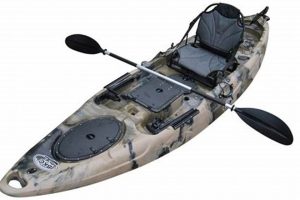
A budget-friendly vessel designed for angling, this type of watercraft offers an accessible entry point to kayak fishing. These kayaks are typically constructed from affordable materials like high-density polyethylene (HDPE) and often feature basic seating, storage, and rod holder configurations.
Affordable kayaks open up the sport of fishing from a kayak to a wider audience. The lower price point removes a significant barrier to entry, allowing more individuals to experience the unique advantages of kayak fishing, such as access to shallow waters and a stealthy approach to fish. While often simpler in design and features compared to higher-priced models, these kayaks can still provide a functional and enjoyable fishing platform.
Exploring the various aspects of these kayaks including construction materials, key features, and popular models will provide prospective buyers with the information necessary to make informed purchasing decisions. Further discussion will cover essential accessories, safety considerations, and maintenance tips for maximizing the lifespan and enjoyment of an affordable fishing kayak.
Tips for Selecting and Using a Budget-Friendly Fishing Kayak
Careful consideration of several factors contributes to a successful and enjoyable experience with an affordable fishing kayak.
Tip 1: Prioritize Stability over Speed. Wider, shorter hulls generally offer greater stability, a crucial factor for anglers, especially in moving water or when casting.
Tip 2: Evaluate Storage Capacity. Adequate storage for tackle, gear, and personal items is essential. Consider both open and closed storage options for different needs.
Tip 3: Inspect Rod Holders and Mounting Options. Ensure the kayak includes sufficient rod holders positioned for convenient access and trolling. Consider the availability of mounting points for fish finders and other accessories.
Tip 4: Research Weight Capacity. Select a kayak with a weight capacity that comfortably accommodates the angler’s weight, plus gear and potential catches. Exceeding the weight limit can compromise stability and performance.
Tip 5: Consider Seat Comfort and Adjustability. A comfortable seat is essential for longer fishing trips. Look for adjustable seating options that provide adequate back support.
Tip 6: Factor in Transportation and Storage. Consider the kayak’s length and weight concerning transportation and storage capabilities. Roof racks or trailers may be required for transport.
Tip 7: Test Paddle Before Purchasing, if Possible. If feasible, test paddling different models can provide valuable insights into stability, maneuverability, and overall comfort.
Adhering to these guidelines will facilitate the selection of a suitable budget-friendly fishing kayak that meets individual angling needs and promotes a safe and enjoyable on-the-water experience.
By carefully considering these factors, anglers can equip themselves with a cost-effective vessel that enhances their fishing experience.
1. Hull Material (HDPE)

High-Density Polyethylene (HDPE) plays a crucial role in the affordability and practicality of fishing kayaks priced under $400. HDPE’s inherent properties, including impact resistance, UV stability, and relative ease of manufacturing, contribute significantly to its prevalence in this price bracket. Rotational molding, a common manufacturing process for HDPE kayaks, allows for relatively low production costs, making it feasible to offer feature-rich kayaks at accessible price points. This material’s durability contributes to a longer lifespan, offering value to consumers. While HDPE kayaks might be slightly heavier than those constructed from higher-end materials, the weight difference is often negligible for shorter distances and manageable for most users.
The impact resistance of HDPE is particularly advantageous in a fishing kayak, protecting the hull from collisions with rocks, submerged logs, or other potential hazards encountered in various aquatic environments. This resilience translates to a lower likelihood of damage and repair costs, further reinforcing the value proposition. Furthermore, HDPE’s resistance to UV degradation ensures the kayak maintains its structural integrity and color over time, even with extended exposure to sunlight. This resistance contributes to the kayak’s longevity, an important consideration for budget-conscious consumers.
While alternative materials like fiberglass offer performance advantages in terms of speed and maneuverability, they typically come at a significantly higher cost. For anglers prioritizing affordability, HDPE provides a practical balance of durability, performance, and cost-effectiveness, making it a dominant material choice in the under $400 fishing kayak market. Choosing HDPE allows manufacturers to include desirable features like rod holders, storage compartments, and comfortable seating within a tighter budget constraint, ultimately providing a well-equipped fishing platform accessible to a wider range of anglers.
2. Weight Capacity

Weight capacity stands as a critical factor when selecting a fishing kayak, particularly within a budget of $400. This specification, often expressed in pounds or kilograms, represents the maximum combined weight the kayak can safely support, encompassing the angler’s weight, fishing gear, and any potential catch. Exceeding this limit compromises stability, potentially leading to capsizing or structural damage. Careful consideration of weight capacity ensures safe and effective use. For anglers of larger stature or those who carry substantial equipment, opting for a kayak with higher weight capacity is paramount. Neglecting this aspect can severely restrict usable storage space and create unsafe conditions on the water.
Budget-friendly kayaks often utilize design and material choices to maximize weight capacity while maintaining affordability. Wider hulls, for example, contribute to greater stability and increased load-bearing potential. However, this design choice may impact maneuverability and speed compared to narrower kayaks. Anglers must balance stability and performance based on individual needs and fishing styles. Understanding the relationship between weight capacity and hull design aids informed decision-making. For instance, an angler frequently fishing in calm, shallow waters might prioritize stability offered by a wider hull with higher weight capacity, whereas an angler fishing in open water or covering larger distances might favor a narrower, more maneuverable hull with a potentially lower weight capacity. Realistically assessing intended usage scenarios allows anglers to prioritize essential characteristics.
Ultimately, weight capacity acts as a fundamental constraint shaping the overall utility of a fishing kayak within a specific budget. Understanding this parameter and its implications empowers anglers to select a kayak that balances affordability with practical functionality and safety. A kayak with insufficient weight capacity limits the angler’s ability to carry necessary gear or safely land larger fish, ultimately detracting from the fishing experience. Conversely, choosing a kayak with appropriate weight capacity enhances safety, expands fishing possibilities, and maximizes the value of the investment.
3. Storage Options

Storage capacity significantly influences the practicality and overall fishing experience in kayaks priced under $400. Effective storage solutions enable anglers to carry essential gear, tackle, and personal items, contributing to a more organized and efficient outing. Kayaks within this price range offer diverse storage configurations, each with its own advantages and limitations. Understanding these variations allows anglers to select a kayak that aligns with individual needs and fishing styles.
- Tank Wells (Open Storage):
Tank wells, typically located at the bow or stern, offer readily accessible storage for larger items like tackle boxes, crates, and even small coolers. Bungee cords secure these items, preventing loss in rough conditions. While convenient, open storage exposes gear to the elements. Anglers utilizing tank wells should consider waterproof storage bags or boxes for sensitive equipment.
- Hatches (Sealed Storage):
Hatches provide protected, waterproof storage compartments ideal for electronics, wallets, and other items requiring shielding from water. These compartments, often integrated into the kayak’s hull, offer greater security against loss or damage compared to open storage. However, access might be less convenient than with tank wells. Kayaks under $400 might offer one or two hatch compartments, varying in size and location.
- Side Pockets (Small Item Storage):
Smaller pockets or pouches located along the sides of the kayak offer quick access to frequently used items like pliers, lures, or sunscreen. These compartments enhance organization and efficiency on the water, preventing the need to rummage through larger storage areas. While convenient, side pockets might offer limited storage volume.
- Rod Holders (Dedicated Storage):
Integrated rod holders, while primarily serving to secure fishing rods, also contribute to overall storage capacity, freeing up space within other compartments. Flush-mounted or adjustable rod holders allow anglers to keep rods readily accessible while maintaining a clear deck space. Kayaks in this price range typically include two or more rod holders.
The interplay between these various storage options dictates the overall utility of a fishing kayak, particularly at lower price points. Evaluating storage needs and preferences in conjunction with budget constraints empowers anglers to choose a kayak that maximizes functionality and enhances on-the-water experiences. Prioritizing storage type and capacity ensures anglers can carry necessary equipment and personal items, minimizing clutter and maximizing fishing efficiency.
4. Rod Holders

Rod holders constitute a critical component of fishing kayaks, especially in the under $400 price range, directly impacting functionality and angling success. These specialized fixtures secure fishing rods, enabling hands-free operation during various fishing activities. This feature allows anglers to manage lines, change lures, or handle other tasks without constantly gripping the rod. Furthermore, multiple rod holders enable trolling with several lines simultaneously, increasing the chance of catches. The presence and design of rod holders significantly influence a budget-friendly kayak’s overall value and fishing effectiveness.
Kayaks within this price range often feature molded-in rod holders, strategically positioned for accessibility and minimal interference with paddling. These integrated holders, typically constructed from the same durable plastic as the kayak’s hull, offer a cost-effective solution while ensuring sufficient strength and longevity. Some models may incorporate adjustable rod holders, allowing for personalized positioning based on fishing style and preference. For instance, angled rod holders facilitate trolling, while vertical holders suit still-fishing techniques. The inclusion of adjustable rod holders adds versatility to a budget-friendly kayak, accommodating diverse fishing needs and enhancing its overall utility.
The strategic placement and number of rod holders play a crucial role in maximizing fishing efficiency. A poorly positioned rod holder can hinder casting or obstruct paddling, while insufficient rod holders limit the number of lines deployable simultaneously. Careful consideration of rod holder configuration optimizes the fishing experience, particularly in budget-friendly kayaks where features are often streamlined. Understanding the impact of rod holder design and placement empowers anglers to select a kayak that balances affordability with essential functionality, ultimately enhancing their fishing success.
5. Seat Comfort

Seat comfort significantly impacts the overall fishing experience, particularly in kayaks priced under $400 where extended trips necessitate ergonomic design and adequate support. Discomfort can detract from fishing focus and curtail trip duration. Careful consideration of seat features within a budget context ensures prolonged angling enjoyment and optimal performance.
- Basic Seat Design
Many budget-friendly kayaks incorporate basic molded seats, often integrated directly into the hull. These seats, while typically less adjustable than higher-end options, offer fundamental support and can be sufficient for shorter fishing excursions. Padding levels vary; some models include thin foam padding while others rely solely on the contoured plastic. Supplemental cushions or aftermarket seat upgrades can enhance comfort levels.
- Adjustable Backrests
Some kayaks in this price range offer adjustable backrests, allowing anglers to customize the seat angle for optimal lumbar support. This feature can significantly improve comfort during prolonged fishing trips, reducing fatigue and strain. Adjustable backrests typically involve straps or buckles that modify the seatback position.
- Padding and Materials
Seat padding plays a critical role in comfort, particularly during extended periods on the water. Budget-friendly kayaks often utilize closed-cell foam padding, which provides adequate cushioning and resistance to water absorption. The thickness and density of the padding influence overall comfort and support levels.
- Elevated Seating
Elevated seating positions offer improved visibility and casting leverage, contributing to both comfort and fishing effectiveness. Some budget kayaks achieve this through seat design, raising the angler slightly above the hull. Elevated seats can also aid in entry and exit, a factor to consider for anglers with mobility concerns.
Selecting a comfortable seat within a budget requires careful consideration of these factors. Prioritizing features like adjustable backrests and adequate padding, even in lower-priced models, can greatly enhance the fishing experience, enabling longer, more enjoyable outings on the water.
6. Stability & Tracking
Stability and tracking are fundamental performance characteristics influencing a fishing kayak’s effectiveness, particularly in the under $400 price range. These interconnected attributes dictate how well the kayak resists tipping and maintains its intended course, impacting both safety and fishing success. Anglers frequently change positions, cast lines, and reel in catches; therefore, stability plays a crucial role in preventing capsizing. Effective tracking minimizes the need for constant course correction, conserving energy and allowing anglers to focus on fishing.
- Primary Stability
Primary stability refers to the kayak’s initial resistance to tipping when stationary or moving slowly. Wider hulls generally exhibit greater primary stability, providing a secure platform for casting and reeling. This is particularly important in calmer waters or when fishing from a seated position. Kayaks designed for fishing often prioritize primary stability to accommodate angler movements and gear adjustments.
- Secondary Stability
Secondary stability describes the kayak’s resistance to tipping at greater angles of lean, typically encountered during turns or rougher water conditions. Kayaks with rounded hulls tend to have higher secondary stability, allowing for more aggressive maneuvering without capsizing. Anglers fishing in moving water or engaging in techniques requiring quick turns benefit from enhanced secondary stability.
- Tracking Performance
Tracking describes the kayak’s ability to maintain a straight course with minimal paddling input. Longer kayaks with a defined keel or tracking fin generally track better than shorter, wider designs. Efficient tracking reduces fatigue and allows anglers to cover greater distances with less effort. Kayaks designed for open-water fishing often prioritize tracking performance.
- Hull Design Influence
Hull design significantly impacts both stability and tracking. Wider, flatter hulls maximize stability, while longer, narrower hulls with a keel or fin enhance tracking. Kayak manufacturers balance these factors to create designs suitable for specific fishing environments and styles. Budget-friendly kayaks often prioritize stability over speed, recognizing the importance of a secure platform for angling activities.
The interplay between stability and tracking determines a fishing kayak’s suitability for various conditions and fishing styles. Within the under $400 price range, manufacturers often prioritize stability for enhanced safety and angler confidence. However, understanding the relationship between these attributes and hull design empowers anglers to select a kayak that balances performance characteristics with budgetary constraints. Matching stability and tracking capabilities to anticipated fishing environments and techniques maximizes efficiency and enjoyment on the water.
7. Added Features

While core features like hull material, weight capacity, and storage options define the fundamental functionality of a fishing kayak under $400, added features differentiate models and enhance the overall angling experience. These supplementary features, while not essential, can significantly improve comfort, convenience, and fishing effectiveness. Careful consideration of these additions within a budget context allows anglers to maximize the value and utility of their kayak investment.
- Paddle Holders/Leashes
Paddle holders or leashes provide secure storage for the paddle when not in use, preventing loss and freeing up deck space. These simple additions enhance convenience and safety, particularly in situations requiring both hands, such as landing a fish or adjusting gear. Paddle holders can be integrated into the kayak’s hull or consist of aftermarket clips or straps. Leashes tether the paddle to the kayak, preventing it from drifting away if dropped.
- Anchor Trolley System
An anchor trolley system allows controlled deployment and positioning of an anchor from various points along the kayak. This feature enhances fishing precision, enabling anglers to maintain position in currents or wind. Anchor trolleys typically involve a series of rings and cleats mounted along the kayak’s gunwales, through which an anchor line is threaded. This system allows for adjustments in anchor position without relocating the kayak itself.
- Gear Tracks/Mounting Points
Gear tracks or mounting points offer versatile attachment options for accessories like fish finders, GPS units, cameras, or rod holders. These tracks, typically running along the gunwales or near the cockpit, provide standardized mounting platforms for various aftermarket accessories. This feature enhances customization, allowing anglers to personalize their kayak setup based on specific fishing needs.
- Rudders/Skegs
Rudders or skegs enhance tracking performance, especially in windy conditions or currents. A rudder, controlled by foot pedals, provides active steering control, while a skeg, a fixed fin deployed beneath the hull, improves directional stability. These additions reduce the need for constant corrective paddling, conserving energy and improving efficiency, particularly in open-water environments. While less common in budget-friendly kayaks, their presence can significantly improve tracking and maneuverability.
These added features, while not always standard in kayaks under $400, represent valuable additions that can significantly enhance the fishing experience. Careful consideration of these features during the selection process allows anglers to prioritize desired functionality and maximize their investment within a budget. Evaluating individual fishing needs and preferences against the availability of these features ensures optimal performance and enjoyment on the water.
Frequently Asked Questions
This section addresses common inquiries regarding fishing kayaks available within a $400 budget.
Question 1: What type of fishing is a sub-$400 kayak suitable for?
Kayaks in this price range are generally well-suited for calm waters such as lakes, ponds, and slow-moving rivers. They can be suitable for inshore saltwater fishing in protected bays or estuaries. Open ocean or fast-flowing river use is generally not recommended.
Question 2: Are these kayaks durable enough for regular use?
While typically constructed from durable HDPE, kayaks under $400 may utilize thinner materials compared to higher-end models. Proper care and maintenance are essential for maximizing lifespan. Avoiding dragging the kayak across rough surfaces and storing it properly protected from the elements contributes to longevity.
Question 3: What essential accessories should one consider purchasing alongside the kayak?
Essential accessories include a personal flotation device (PFD), a paddle, and a fishing rod. Additional considerations include a dry bag for personal items, an anchor, and a fishing rod leash. A bilge pump can be helpful for managing water accumulation in the kayak.
Question 4: What are the key differences between a fishing kayak and a recreational kayak within this price range?
Fishing kayaks typically feature specialized features such as rod holders, storage compartments designed for tackle, and sometimes anchor trolley systems. Recreational kayaks prioritize comfort and maneuverability for general paddling, often lacking these fishing-specific features.
Question 5: Can one install a fish finder on a kayak under $400?
Many kayaks in this price range offer mounting points or gear tracks that accommodate fish finder installation. Ensure compatibility between the chosen fish finder model and the kayak’s mounting system before purchasing. Battery power and transducer placement require consideration during installation.
Question 6: How does one transport a kayak under $400?
Roof racks are the most common transportation method. Some smaller kayaks might fit inside a truck bed or van. Specialized kayak trailers are available but represent an additional expense. Always secure the kayak properly during transport, regardless of the method used.
Careful consideration of these frequently asked questions clarifies common concerns regarding budget-friendly fishing kayaks, facilitating informed purchasing decisions and promoting safe and enjoyable on-the-water experiences.
Further sections will explore specific models and provide in-depth reviews to aid in the selection process.
Fishing Kayak Under $400
Exploring the landscape of fishing kayaks available under $400 reveals a balance between affordability and functionality. Careful consideration of factors such as hull material (HDPE), weight capacity, storage options, rod holders, seat comfort, stability, tracking, and added features empowers informed purchasing decisions. While budgetary constraints may necessitate certain compromises, focusing on essential features ensures a worthwhile investment. Prioritizing stability and storage capacity often proves beneficial for anglers seeking a practical and enjoyable fishing platform.
The availability of fishing kayaks within this price range democratizes access to the sport, enabling a wider audience to experience the unique advantages of kayak angling. Understanding the nuances of available features and their impact on performance empowers informed decision-making, leading to a satisfying and productive on-the-water experience. Continued innovation in kayak design and manufacturing promises further advancements in affordability and performance, expanding opportunities for anglers seeking cost-effective access to this rewarding pursuit.