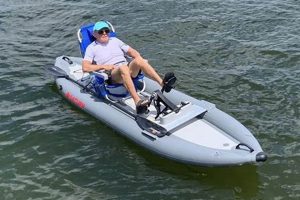
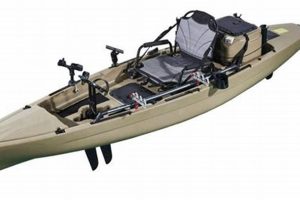
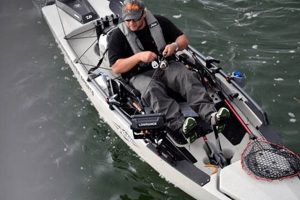
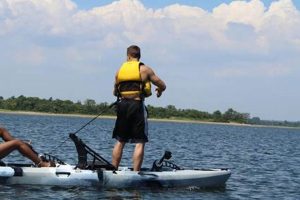
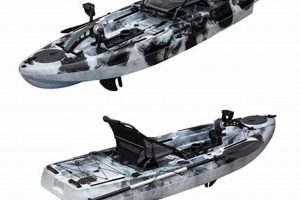
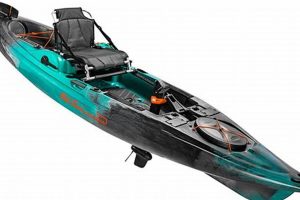
High-quality pedal-powered kayaks designed for angling offer hands-free operation, enabling anglers to cast, reel, and manage their equipment with greater ease and efficiency. These specialized watercraft often incorporate features like rod holders, tackle storage, and even livewells, enhancing the fishing experience. An ideal example would be a stable, durable kayak with a sophisticated pedal drive system allowing for effortless maneuverability and precise positioning in various water conditions.
The hands-free nature of these kayaks presents a significant advantage over traditional paddle kayaks, allowing for more focused fishing. This design promotes improved casting accuracy and quicker reaction time to bites, ultimately increasing fishing success. Historically, fishing kayaks relied solely on paddles, limiting an angler’s ability to multitask. The introduction and refinement of pedal-drive systems have revolutionized the sport, providing enhanced control and maneuverability previously unavailable. This evolution has broadened the horizons of kayak angling, enabling exploration of more diverse waters and pursuit of a wider range of fish species.
This article will delve into the key features that distinguish superior pedal-powered fishing kayaks, including drive systems, hull design, stability, and integrated accessories. Further exploration will encompass factors influencing selection, such as budget, target fish species, and intended fishing environment.
Tips for Selecting a Pedal-Powered Fishing Kayak
Choosing the right pedal-powered fishing kayak requires careful consideration of various factors to ensure optimal performance and enjoyment on the water. The following tips offer guidance through the selection process.
Tip 1: Prioritize Stability: Hull design significantly influences stability. Wider, flatter hulls provide greater initial stability, crucial for casting and reeling while seated. A kayak designed for open water may prioritize speed over stability, making it less suitable for fishing.
Tip 2: Evaluate Propulsion Systems: Consider the type of pedal drive propeller or fin and its suitability for the intended fishing environment. Fin drives excel in shallow water and areas with vegetation, while propeller drives offer higher speeds in open water.
Tip 3: Assess Storage Capacity: Ample storage for tackle, rods, and personal gear is essential. Consider the location and accessibility of storage compartments and their ability to keep items dry and secure.
Tip 4: Consider Seat Comfort and Adjustability: Long hours on the water necessitate a comfortable and supportive seat. Look for adjustable features to customize seating position for optimal comfort and paddling efficiency.
Tip 5: Factor in Weight Capacity: Ensure the kayak’s weight capacity accommodates the angler’s weight, along with gear and potential catch. Exceeding the capacity compromises stability and performance.
Tip 6: Research Material and Durability: Kayak construction materials impact weight, durability, and price. Polyethylene is a popular choice for its durability and affordability, while higher-end models may utilize lighter, more robust materials.
Tip 7: Test Before Purchasing (If Possible): A test drive provides invaluable insight into a kayak’s performance and suitability. Pay attention to stability, maneuverability, and comfort levels.
Careful evaluation of these elements ensures anglers select a vessel that enhances their fishing experience, offering stability, efficiency, and convenient access to essential equipment. This leads to greater comfort and ultimately, increased fishing success.
By understanding these considerations and applying them to individual needs and fishing styles, anglers can confidently choose the ideal pedal-powered fishing kayak for their pursuits. The subsequent sections will further explore specific models and brands available in the market.
1. Stability

Stability is a paramount concern when selecting a pedal-powered fishing kayak. A stable platform is essential for various on-the-water activities, including casting, reeling, landing fish, and even standing to sight-cast in certain models. Compromised stability not only hinders fishing effectiveness but also poses safety risks, particularly in challenging conditions.
- Initial Stability vs. Secondary Stability
Initial stability refers to a kayak’s resistance to tipping when at rest, while secondary stability describes its ability to remain upright when leaned. Wider, flatter hulls generally offer higher initial stability, ideal for calmer waters and stationary fishing. Kayaks with a more rounded or V-shaped hull may exhibit lower initial stability but provide greater secondary stability, making them suitable for rougher conditions and dynamic movements.
- Hull Design and Stability
Hull design significantly influences stability. Pontoon-style hulls provide exceptional initial stability, enabling anglers to stand comfortably. Catamaran designs offer similar stability characteristics. Traditional V-shaped hulls, while less stable initially, offer superior tracking and performance in open water. The choice depends on the angler’s preferred fishing style and environment.
- Impact of Weight Distribution on Stability
Proper weight distribution plays a crucial role in maintaining stability. Evenly distributing gear and ensuring a low center of gravity enhances stability. Incorrect weight distribution can compromise balance and increase the risk of capsizing. Consider using dry bags or storage compartments to organize gear effectively.
- Stability Enhancements and Features
Certain features can enhance a kayak’s stability. Outriggers and stabilizers provide added support, especially for anglers who prefer to stand. Wider platforms and adjustable seats also contribute to increased stability. Understanding these features and their impact allows for informed decision-making during the selection process.
Choosing a fishing pedal kayak with appropriate stability characteristics is critical for safety and fishing success. Evaluating the interplay between hull design, weight distribution, and stability enhancements ensures anglers can select a vessel that matches their individual needs and intended fishing environments. This promotes confident and effective angling, enhancing the overall on-the-water experience.
2. Propulsion System

The propulsion system is a defining feature of the best fishing pedal kayaks, directly impacting performance and fishing effectiveness. Efficient and reliable propulsion allows anglers to cover more water, position themselves strategically, and maintain optimal presentation while fishing. Understanding the nuances of various propulsion systems is crucial for selecting a kayak that aligns with specific fishing needs and environments.
- Pedal-Drive Mechanisms
Pedal-driven systems provide hands-free propulsion, enabling anglers to focus on fishing. Common mechanisms include propeller-based systems and fin drives. Propeller drives offer speed and efficiency in open water, while fin drives excel in shallow water and areas with vegetation, as they are less susceptible to fouling. The choice depends on the primary fishing environment.
- Gear Ratios and Efficiency
Gear ratios within the pedal drive impact speed and effort. Higher gear ratios provide greater speed, while lower ratios prioritize power for navigating currents or maneuvering in challenging conditions. Efficient gear systems minimize energy expenditure, allowing for longer fishing trips without fatigue. Analyzing gear ratios helps determine the system’s suitability for specific fishing scenarios.
- Maintenance and Durability
Propulsion system maintenance and durability are essential considerations for long-term performance. Sealed bearings and corrosion-resistant materials contribute to longevity and reduced maintenance requirements. Understanding the maintenance needs of a specific system allows for informed decisions and ensures reliable operation over time.
- Reverse Functionality
The ability to pedal in reverse provides enhanced maneuverability, particularly in tight spaces or around structure. Reverse functionality allows for precise positioning and quick adjustments without resorting to paddles, optimizing fishing efficiency. This feature is particularly valuable in rivers or areas with complex navigation.
The propulsion system is integral to the overall performance of a fishing pedal kayak. Careful consideration of drive mechanisms, gear ratios, maintenance requirements, and reverse functionality ensures anglers select a kayak that aligns with their fishing style and target environment. A well-chosen propulsion system enhances fishing effectiveness by maximizing maneuverability, efficiency, and ultimately, time spent fishing.
3. Storage Capacity

Ample and well-designed storage is a critical factor distinguishing top-tier fishing pedal kayaks. The ability to carry essential gear, tackle, and personal items directly impacts fishing success and overall comfort on the water. Insufficient storage leads to compromised organization, limited carrying capacity, and potentially unsafe conditions due to loose items shifting during movement.
Consider the scenario of an angler targeting multiple species requiring different rod and tackle setups. A kayak with dedicated rod holders, tackle storage compartments, and a dry hatch for personal belongings allows for efficient transitions between fishing techniques. Conversely, limited storage may necessitate leaving essential gear behind, restricting fishing versatility. Kayaks with integrated storage solutions, such as recessed tackle trays and sealed compartments, offer superior organization and protection against water damage, crucial for preserving valuable equipment. Practical examples include kayaks with forward-facing rod holders for easy access while trolling and rear-facing storage for larger items like tackle boxes or coolers. Dedicated storage for safety gear, like a first-aid kit and signaling devices, further underscores the importance of well-planned storage solutions.
Optimized storage solutions enhance the fishing experience by streamlining access to equipment, maximizing carrying capacity, and ensuring safe and organized transport of essential gear. This directly contributes to increased fishing efficiency and enjoyment on the water. Evaluating storage capacity and design is essential for selecting a fishing pedal kayak that meets the demands of various fishing styles and environments. The connection between adequate storage and a positive fishing experience is undeniable, highlighting the significance of this aspect within the broader context of selecting a high-quality fishing kayak.
4. Seat Comfort

Seat comfort is integral to the definition of a “best fishing pedal kayak,” directly influencing angler endurance and focus. Extended periods on the water necessitate a supportive and adjustable seating system. An uncomfortable seat leads to fatigue, back pain, and reduced concentration, ultimately compromising fishing effectiveness. Conversely, a well-designed seat allows anglers to maintain optimal posture and comfort, promoting focus on fishing rather than physical discomfort. Consider the difference between a basic molded plastic seat and an adjustable, padded seat with lumbar support. The latter significantly enhances comfort, allowing for longer, more productive fishing trips. This distinction highlights the critical connection between seat comfort and overall fishing performance.
Several factors contribute to seat comfort. Adjustable features, such as backrest angle and seat height, allow for customization based on individual preferences and physical characteristics. High-quality padding and breathable materials enhance comfort and prevent pressure points, particularly during prolonged use. Ergonomic design considerations, such as lumbar support and contoured seating surfaces, promote proper posture and minimize strain. For example, a kayak seat with adjustable lumbar support accommodates different back shapes, reducing fatigue and enhancing long-term comfort. Understanding these elements allows anglers to evaluate seat quality and its contribution to overall fishing experience.
Prioritizing seat comfort when selecting a fishing pedal kayak directly translates to improved on-the-water performance and enjoyment. Reduced fatigue allows for longer fishing sessions and greater responsiveness to fish strikes. Enhanced comfort promotes focus, contributing to better decision-making and increased fishing success. Therefore, seat comfort is not merely a convenience but a crucial element that distinguishes superior fishing kayaks. Investing in a kayak with a comfortable and adjustable seating system significantly enhances the overall fishing experience, emphasizing its importance in defining the “best” fishing pedal kayak.
5. Weight Capacity

Weight capacity is a critical factor in defining a “best fishing pedal kayak,” directly impacting safety and performance. A kayak’s weight capacity represents the maximum combined weight of the angler, gear, and any potential catch it can safely carry. Exceeding this limit compromises stability, maneuverability, and freeboardthe distance between the waterline and the deckincreasing the risk of capsizing. Consider an angler planning a multi-day fishing trip with camping gear and provisions. Selecting a kayak with adequate weight capacity ensures safe and stable navigation, even with a fully loaded vessel. Conversely, exceeding the weight capacity can lead to a dangerously low freeboard, increasing susceptibility to swamping and capsizing, especially in rough conditions.
Understanding the relationship between weight capacity and kayak performance is crucial. A kayak operating near its maximum capacity sits lower in the water, increasing drag and reducing speed and maneuverability. This is particularly relevant in challenging conditions such as strong currents or wind. Furthermore, exceeding weight capacity can strain the hull and components, potentially leading to damage or premature wear. For example, a kayak overloaded with fishing gear may experience reduced responsiveness to steering inputs, hindering precise navigation in tight spaces or around obstacles. Therefore, choosing a kayak with ample weight capacity is essential for maintaining optimal performance and ensuring a safe and enjoyable fishing experience.
Careful consideration of weight capacity is essential for responsible kayak selection. Accurately estimating the combined weight of all intended cargo, including gear, supplies, and potential catch, is paramount. Choosing a kayak with a weight capacity that comfortably exceeds this estimated total ensures safe and efficient operation in various conditions. This proactive approach safeguards against stability issues, performance limitations, and potential safety hazards, ultimately contributing to a more positive and successful fishing experience. Neglecting weight capacity can have serious consequences, highlighting its fundamental role in defining the “best” fishing pedal kayak.
6. Hull Design
Hull design is a critical determinant of performance in fishing pedal kayaks, influencing stability, speed, maneuverability, and tracking. Optimal hull design contributes significantly to a positive fishing experience by enabling efficient navigation, precise positioning, and confident handling in various water conditions. Understanding the nuances of hull design empowers informed decision-making when selecting a kayak suited to specific fishing needs and environments.
- Hull Shape and Stability
Hull shape directly affects stability. Wider, flatter hulls offer greater initial stability, ideal for calmer waters and stationary fishing. These designs provide a secure platform for casting, reeling, and landing fish. Conversely, narrower, V-shaped hulls, while less stable initially, offer superior tracking and speed, making them suitable for covering longer distances and navigating open water or currents. Pontoon hulls provide exceptional stability, even allowing for stand-up fishing, but may sacrifice maneuverability. The optimal hull shape depends on the angler’s priorities and intended fishing environment.
- Length and Waterline Length
Kayak length and waterline length influence speed and tracking. Longer kayaks generally track straighter and glide more efficiently, covering greater distances with less effort. However, shorter kayaks offer enhanced maneuverability, making them advantageous in tight spaces, such as navigating through mangroves or around docks. Waterline length, specifically the portion of the hull in contact with the water, directly impacts speed. A longer waterline generally translates to higher potential speed.
- Chines and Tracking
Chines, the longitudinal edges where the hull sides meet the bottom, play a crucial role in tracking and stability. Hard chines provide sharper turning and enhanced maneuverability, while soft chines offer smoother tracking and increased stability. The presence and configuration of chines influence how a kayak responds to paddle strokes or pedal input, directly affecting its handling characteristics.
- Rocker and Maneuverability
Rocker refers to the curvature of the hull from bow to stern. Kayaks with significant rocker are more maneuverable, turning easily and handling waves more effectively. However, increased rocker can compromise tracking, requiring more effort to maintain a straight course. Flatter hulls with minimal rocker track exceptionally well but may be less responsive in turns. The desired degree of rocker depends on the intended fishing environment and maneuvering requirements.
Selecting a fishing pedal kayak with a well-designed hull is crucial for optimizing performance and achieving fishing success. Careful consideration of hull shape, length, chines, and rocker ensures anglers choose a kayak that aligns with their specific needs and fishing style. Understanding these elements and their impact on stability, speed, maneuverability, and tracking empowers informed decisions, ultimately leading to a more efficient and enjoyable fishing experience.
7. Durability
Durability is a crucial attribute of a best fishing pedal kayak, directly impacting its lifespan, performance, and overall value. A durable kayak withstands the rigors of regular use, including impacts, abrasion, and exposure to various environmental conditions. This resilience translates to long-term reliability, minimizing the need for repairs and replacements, and ensuring consistent performance over time. Investing in a durable kayak preserves its value and contributes to a more positive and worry-free fishing experience.
- Construction Materials
Kayak construction materials significantly influence durability. High-density polyethylene (HDPE) is a popular choice due to its impact resistance and affordability. Higher-end kayaks may utilize more robust materials like rotomolded polyethylene or thermoformed ABS, offering increased durability and resistance to UV degradation and abrasion. For instance, a kayak constructed with rotomolded polyethylene is less susceptible to cracking or deformation upon impact compared to a kayak made from lower-grade materials.
- Hardware and Fittings
Durable hardware and fittings are essential for long-term performance. Stainless steel components, including fasteners, rod holders, and rudder systems, offer superior corrosion resistance compared to less durable materials like aluminum or plastic. High-quality hardware ensures reliable operation and minimizes the risk of failures, contributing to the kayak’s overall longevity. For example, stainless steel rod holders withstand the corrosive effects of saltwater, maintaining their functionality over extended periods.
- UV Resistance
Exposure to ultraviolet (UV) radiation from sunlight can degrade kayak materials over time, leading to discoloration, cracking, and reduced structural integrity. Kayaks constructed with UV-resistant materials retain their color and strength, ensuring long-term performance and aesthetic appeal. Choosing a UV-resistant kayak is particularly important for anglers who frequently fish in sunny conditions. For instance, a kayak with enhanced UV protection maintains its structural integrity and color vibrancy even after prolonged exposure to sunlight.
- Manufacturing Processes
Manufacturing processes influence a kayak’s overall durability. Rotomolding, a process that creates a seamless, one-piece hull, offers superior strength and impact resistance compared to other construction methods. Properly executed manufacturing processes ensure consistent quality and minimize weak points, contributing to the kayak’s long-term durability. For example, a rotomolded hull is less likely to develop leaks or structural weaknesses over time compared to a hull constructed using multiple pieces joined together.
Durability is a defining characteristic of a best fishing pedal kayak, directly correlating with its long-term value and performance. Selecting a kayak constructed with durable materials, robust hardware, UV resistance, and utilizing proven manufacturing processes ensures reliable performance, minimizes maintenance requirements, and maximizes the return on investment. Prioritizing durability contributes to a positive ownership experience, allowing anglers to focus on fishing rather than equipment concerns. A durable kayak withstands the demands of regular use, providing consistent performance and enjoyment for years to come, solidifying its place as a “best” choice for discerning anglers.
Frequently Asked Questions
This section addresses common inquiries regarding the selection and use of high-quality pedal-powered fishing kayaks.
Question 1: What are the primary advantages of a pedal-powered fishing kayak over a traditional paddle kayak?
Pedal propulsion frees hands for fishing activities, enabling more efficient casting, reeling, and lure retrieval. Increased maneuverability and the ability to maintain position in currents or wind are additional benefits.
Question 2: How does one choose the correct pedal drive system (propeller vs. fin drive)?
Propeller drives excel in open water and offer higher speeds. Fin drives are better suited for shallow water, vegetation, and areas with potential obstacles, as they are less prone to fouling.
Question 3: What factors influence kayak stability, and why is stability important for fishing?
Hull design, width, and weight distribution affect stability. A stable platform is crucial for casting, fighting fish, and ensuring angler safety, especially in challenging conditions.
Question 4: How does one determine the appropriate weight capacity for a fishing kayak?
Calculate the combined weight of the angler, all gear, and potential catch. Select a kayak with a weight capacity that comfortably exceeds this total to ensure safe and optimal performance.
Question 5: What maintenance is typically required for a pedal-powered fishing kayak?
Regular rinsing with fresh water after each use, especially in saltwater environments, is essential. Periodic lubrication of moving parts and inspection of the pedal drive system are also recommended.
Question 6: What features should one prioritize when choosing a fishing kayak seat?
Prioritize adjustability, comfortable padding, and adequate lumbar support. A comfortable seat reduces fatigue and enhances focus during long fishing trips.
Careful consideration of these frequently asked questions provides a foundation for informed decision-making during the kayak selection process. Addressing these common concerns ensures anglers choose a vessel that aligns with individual needs and promotes a positive fishing experience.
The next section will delve into specific recommended models of fishing pedal kayaks, catering to various budgets and fishing styles.
Conclusion
Optimal selection hinges on a comprehensive understanding of key features. Stability, propulsion systems, storage capacity, seat comfort, weight capacity, hull design, and durability collectively define superior pedal-powered fishing kayaks. Careful evaluation of these elements, coupled with consideration of individual fishing styles and target environments, empowers informed purchasing decisions. Prioritizing these features ensures anglers acquire a vessel optimized for performance, comfort, and longevity.
Investing in a premium, purpose-built pedal-powered fishing kayak significantly enhances the angling experience. Optimized performance, increased comfort, and extended fishing range translate to greater success on the water. Strategic selection based on a thorough understanding of critical features ultimately yields a rewarding and enriching investment for the discerning angler.