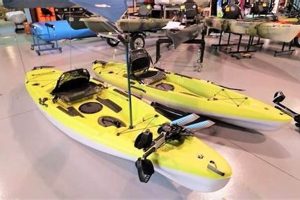
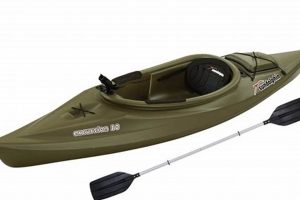
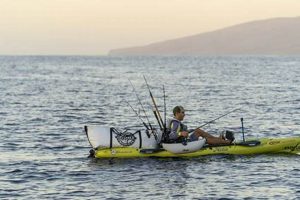
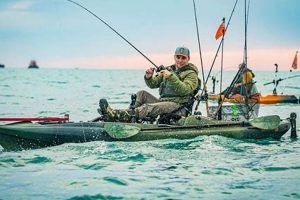
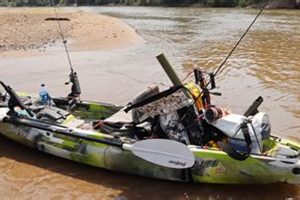
A kayak designed for angling, typically measuring approximately 3 meters, offers a stable and maneuverable platform for casting lines and reeling in catches. These vessels often feature specialized storage for tackle and equipment, along with rod holders and other fishing-specific accessories. A typical example might include a sit-on-top design for easy entry and exit, helpful for anglers dealing with fish and gear.
Vessels of this size provide a balance between portability and on-the-water performance. Their compact nature facilitates transport and storage, while their length offers sufficient stability and tracking for navigating various waterways, from ponds and lakes to slow-moving rivers and calm coastal areas. This size has become increasingly popular due to the growing accessibility of personal watercraft and the desire for versatile, human-powered fishing experiences.
This exploration of compact fishing vessels will further examine key features, including hull design, materials, and essential accessories. Subsequent sections will also cover topics such as choosing the right paddle, essential safety equipment, and popular fishing techniques best suited for this type of watercraft.
Tips for Selecting and Using a Compact Fishing Kayak
Choosing and utilizing a smaller fishing kayak effectively involves careful consideration of several factors to ensure optimal performance and safety on the water.
Tip 1: Consider Hull Design: Different hull designs offer varying stability and maneuverability. A flatter hull provides greater initial stability, beneficial for casting and reeling, while a V-shaped hull tracks more efficiently in open water but can feel less stable initially.
Tip 2: Evaluate Weight Capacity: Ensure the kayak’s weight capacity accommodates the angler’s weight, plus all gear and potential catches. Exceeding the limit compromises stability and performance.
Tip 3: Choose Appropriate Paddles: Paddle length should be tailored to the paddler’s height and the kayak’s width. A properly sized paddle enhances efficiency and reduces fatigue.
Tip 4: Prioritize Safety Gear: Essential safety equipment includes a personal flotation device (PFD), a whistle, and a visual distress signal. Navigation lights are recommended for low-light conditions.
Tip 5: Plan Fishing Locations Carefully: Compact kayaks are best suited for calmer waters. Avoid areas with strong currents, significant boat traffic, or challenging weather conditions.
Tip 6: Organize Tackle and Gear: Utilize onboard storage compartments and consider additional accessories like tackle boxes and rod holders to keep gear organized and accessible. Distributing weight evenly maintains balance and stability.
Tip 7: Practice Basic Kayak Maneuvers: Before venturing out, practice paddling, turning, and recovering from a capsize in a controlled environment. This builds confidence and enhances on-the-water safety.
By adhering to these guidelines, anglers can enhance their fishing experience and ensure safe and successful outings on the water. Proper planning and equipment selection contribute significantly to enjoyable and productive kayak fishing.
These tips provide a solid foundation for selecting and utilizing a compact fishing kayak. The following conclusion will reiterate the key benefits and considerations discussed throughout this article.
1. Length

Maneuverability, significantly influenced by length, dictates a kayak’s agility and responsiveness on the water. This characteristic is particularly crucial for fishing kayaks, where navigating tight spaces, approaching fishing spots precisely, and reacting quickly to fish behavior are essential for a successful outing. In the context of a 10-foot fishing kayak, length plays a pivotal role in defining its on-the-water performance.
- Navigating Tight Waterways:
Shorter kayaks, like the 10-foot models, excel in narrow creeks, shallow coves, and areas dense with vegetation. Their compact size allows for quicker turns and easier navigation through confined spaces, granting access to prime fishing locations often inaccessible to larger vessels. This advantage is particularly relevant in environments like mangrove tunnels or densely packed lily pads.
- Reacting to Fish Behavior:
The responsiveness of a 10-foot kayak allows anglers to react swiftly to fish activity. A sudden change in direction or a quick pursuit of a hooked fish requires immediate and precise maneuvering. The shorter length facilitates these rapid adjustments, increasing the chances of a successful catch and minimizing the risk of line breakage or fish escape.
- Precision in Approaching Fishing Spots:
Stealth and precision are often paramount when approaching fish. A 10-foot kayak’s maneuverability allows anglers to quietly and accurately position themselves for optimal casting, minimizing disturbance and maximizing the chances of attracting fish without spooking them. This controlled approach is especially valuable in clear, shallow waters.
- Transport and Storage Considerations:
While maneuverability is a key advantage, the shorter length of a 10-foot kayak also presents practical benefits for transport and storage. Its compact size makes it easier to load onto a vehicle, transport on a trailer, or store in a garage or shed, enhancing its overall convenience and accessibility.
The maneuverability afforded by a 10-foot length makes it a versatile choice for diverse fishing environments. While longer kayaks excel in open water and offer greater speed, the compact nature of a 10-foot kayak provides a distinct advantage in navigating complex or confined waterways, ultimately enhancing the angler’s ability to reach productive fishing locations and react effectively to fish behavior.
2. Width

Stability, significantly influenced by width, is a critical factor in kayak fishing, especially in smaller vessels like 10-foot models. A wider kayak generally offers greater initial stability, crucial for maintaining balance while casting, reeling, and landing fish. This stability is particularly important when standing to cast, a common practice in many fishing scenarios. Conversely, a narrower kayak, while potentially faster, can feel less stable, especially for anglers new to kayaking. The relationship between width and stability directly impacts angler comfort, safety, and overall fishing success.
Consider two hypothetical 10-foot kayaks: one 30 inches wide and another 36 inches wide. The wider kayak will provide a more stable platform, especially beneficial in choppy water or when dealing with a fighting fish. An angler is less likely to experience unsettling rocking or tipping. The narrower kayak, while potentially more maneuverable, will require more balance and core engagement, increasing the risk of capsizing, especially for less experienced paddlers. This difference in stability can significantly impact the angler’s confidence and ability to focus on fishing, rather than maintaining balance. Practical implications include the ability to comfortably stand and cast, retrieve gear from a tackle box, and land a fish without compromising stability.
Understanding the width-stability relationship is crucial when selecting a 10-foot fishing kayak. Prioritizing stability enhances safety and comfort, particularly for beginners or those fishing in challenging conditions. While some sacrifice in speed or maneuverability might occur with a wider hull, the increased stability often outweighs these trade-offs for fishing applications. Careful consideration of individual needs and intended fishing environments should guide the selection process, balancing stability with other performance characteristics. This informed approach leads to a more enjoyable and successful fishing experience.
3. Weight

Portability, directly influenced by weight, is a critical factor when considering a 10-foot fishing kayak. The ease of transporting the kayak to and from the water significantly impacts accessibility and overall convenience. Factors influencing weight include construction materials, hull design, and integrated features. Understanding the relationship between weight and portability is crucial for selecting a kayak suitable for individual needs and transportation capabilities.
- Transporting to and from the Water:
The weight of the kayak dictates how easily it can be transported. Lighter kayaks are easier to carry by hand, load onto a vehicle’s roof rack, or transport on a small trailer. Heavier kayaks may require assistance, specialized equipment, or limit transportation options. This factor is particularly relevant for individuals with physical limitations or those lacking vehicle-assisted transport.
- Launching and Landing:
Launching and landing a kayak also involve maneuvering its weight. Lighter kayaks are simpler to manage at the water’s edge, requiring less physical exertion. This ease of handling is particularly beneficial in challenging launch sites, such as steep banks or rocky shorelines.
- Storage Considerations:
Weight influences storage requirements. Lighter kayaks are easier to move and store, requiring less space and effort. This factor is important for individuals with limited storage space or those needing to maneuver the kayak up stairs or into tight storage areas.
- Impact of Materials and Design:
Kayak weight is directly related to construction materials and design. Lighter materials like rotomolded polyethylene or composites contribute to a lighter overall weight, while heavier materials and complex designs increase the total weight. Understanding the trade-offs between weight, durability, and cost is essential for informed decision-making.
In the context of a 10-foot fishing kayak, portability is a significant advantage. The relatively compact size contributes to a generally manageable weight, making transport and storage more convenient compared to larger kayaks. However, variations in materials and design can still result in significant weight differences within this size category. Careful consideration of individual transportation capabilities and storage limitations is crucial for selecting a 10-foot fishing kayak that balances portability with other desired performance characteristics.
4. Hull Design

Hull design significantly influences a kayak’s tracking ability, which refers to its tendency to maintain a straight course. In the context of a 10-foot fishing kayak, tracking affects paddling efficiency and the angler’s ability to cover distances effectively. Different hull designs offer varying degrees of tracking performance, each with advantages and disadvantages for specific fishing environments and paddling styles. Understanding these variations is essential for selecting a kayak suited to individual needs and intended uses.
- Displacement Hulls:
Displacement hulls, characterized by a pointed bow and a distinct V-shape, excel in tracking. They efficiently cut through the water, minimizing lateral movement and maintaining a straight course with minimal effort. This design is advantageous for covering longer distances or paddling in currents. However, displacement hulls can feel less stable initially, particularly in choppy water, requiring more core engagement for balance. In a 10-foot fishing kayak, a displacement hull might be preferred for anglers targeting open water or those frequently paddling against light currents.
- Planing Hulls:
Planing hulls, featuring a flatter bottom and a wider beam, prioritize stability over tracking. They are designed to rise up and plane on the surface of the water at higher speeds, providing enhanced stability and maneuverability. However, planing hulls tend to be less efficient for straight-line paddling, requiring more corrective strokes to maintain a straight course. In a 10-foot fishing kayak, a planing hull might be favored for anglers prioritizing stability for stand-up fishing or those operating in calmer waters where precise tracking is less critical.
- Modified Hulls:
Many 10-foot fishing kayaks utilize modified hull designs, combining elements of displacement and planing hulls to achieve a balance between tracking and stability. These designs often incorporate a shallow V-shape or a multi-chine hull to enhance tracking while maintaining reasonable stability. This compromise allows for efficient paddling while providing sufficient stability for fishing activities. The specific characteristics of a modified hull will vary depending on the manufacturer and the intended use of the kayak.
- Impact of Length and Width:
Hull design interacts with length and width to influence tracking. In a 10-foot kayak, the shorter length can make tracking more challenging, especially in windy conditions. A wider hull, while enhancing stability, can further reduce tracking efficiency. Therefore, manufacturers often incorporate design features, such as a pronounced keel or tracking channels, to compensate for these factors and improve the kayak’s ability to maintain a straight course. These design adaptations are crucial for optimizing the performance of a 10-foot fishing kayak.
Selecting the appropriate hull design for a 10-foot fishing kayak depends on the angler’s priorities and the intended fishing environment. Prioritizing tracking efficiency benefits anglers covering longer distances or paddling in currents, while prioritizing stability enhances comfort and safety, particularly in choppy water or when standing to fish. Understanding the nuances of different hull designs enables informed decision-making, ensuring optimal performance and a more enjoyable fishing experience.
5. Capacity
Gear storage capacity is a defining characteristic of fishing kayaks, directly impacting their practicality and effectiveness. In the context of a 10-foot fishing kayak, storage capacity considerations are amplified due to the limited space inherent in smaller vessels. Effective gear management is crucial for maintaining a balanced and organized kayak, ensuring access to essential equipment without compromising stability or maneuverability. Understanding the interplay between kayak size and storage capacity is essential for informed purchase decisions and optimal on-the-water performance.
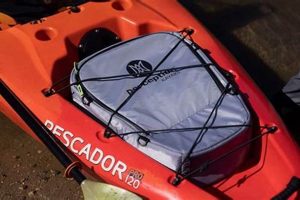
Dedicated storage compartments, such as hatches, tank wells, and side pockets, are common features in fishing kayaks. Their size, placement, and accessibility influence their utility. A larger rear tank well can accommodate a crate or cooler, while smaller hatches and side pockets are suitable for tackle boxes, tools, and personal items. Rod holders, often integrated into the kayak’s design, provide secure storage and quick access to fishing rods. The strategic placement of these storage features minimizes interference with paddling and casting. For example, recessed rod holders prevent lines from tangling during paddling, while strategically positioned hatches maintain easy access even when seated. A poorly designed storage system can lead to frustration, wasted time searching for gear, and potential safety hazards due to an unbalanced kayak.
Effective utilization of limited space is paramount in a 10-foot fishing kayak. Prioritizing essential gear and employing organizational strategies, like dry bags and tackle organizers, maximizes storage efficiency. Weight distribution also plays a critical role in stability and performance. Distributing heavier items lower in the kayak and evenly across its width enhances balance and prevents tipping. Understanding weight capacity limitations is crucial for both safety and performance. Overloading a kayak compromises stability and maneuverability, increasing the risk of capsizing. Considering gear storage needs in conjunction with kayak size and weight capacity is fundamental for a safe and productive fishing experience.
6. Features
Specialized features directly influence the fishing functionality of a 10-foot kayak, transforming a basic paddling platform into a dedicated angling vessel. These features enhance efficiency, convenience, and overall fishing success. Consider rod holders, a ubiquitous feature in fishing kayaks. Flush-mounted rod holders secure rods parallel to the hull, minimizing interference while paddling or navigating tight spaces. Adjustable rod holders offer versatility for different fishing techniques, accommodating trolling, casting, and still-fishing. Tracks, typically located along the gunwales, allow for customizable placement of accessories, such as rod holders, fish finders, and camera mounts. This adaptability tailors the kayak’s setup to individual preferences and specific fishing scenarios. Integrating these features directly enhances the angler’s ability to focus on fishing rather than managing equipment. A well-designed fishing kayak seamlessly integrates these features, optimizing functionality without compromising stability or maneuverability. For example, recessed storage compartments prevent gear from interfering with paddling strokes, while strategically placed rod holders offer easy access without obstructing casting movements. The practical significance of these design considerations is readily apparent on the water, where efficient gear management and unobstructed movement translate directly into increased fishing success.
Further enhancing fishing functionality are features like integrated live wells and bait tanks. Live wells maintain the health and vitality of caught fish, crucial for tournament fishing or preserving bait for later use. Bait tanks provide easy access to live bait, streamlining the baiting process and minimizing disruption during fishing. Additional considerations include paddle parks or clips, securing the paddle during fishing, and anchor trolleys, enabling controlled drift fishing. These features, while seemingly minor, significantly enhance the overall fishing experience by streamlining processes and minimizing distractions. Practical applications of these functionalities include maintaining bait freshness during long fishing trips, efficiently managing multiple rods without tangling lines, and maintaining a controlled drift in flowing water. The thoughtful integration of these features transforms a basic kayak into a specialized fishing platform, optimizing efficiency and maximizing the angler’s potential for success.
The efficacy of a 10-foot fishing kayak hinges upon the seamless integration and thoughtful design of specialized features. Balancing functionality with stability and maneuverability is crucial for optimal performance. While individual feature preferences vary based on fishing style and target species, the core principle remains: enhancing fishing functionality directly translates to a more productive and enjoyable angling experience. Overlooking these crucial design elements can compromise the kayak’s effectiveness as a fishing platform, hindering an angler’s ability to maximize their potential on the water. Therefore, careful consideration of fishing-specific features is paramount when selecting a 10-foot fishing kayak, ensuring the vessel is not merely a mode of transportation but a fully integrated and effective fishing tool.
Frequently Asked Questions
This section addresses common inquiries regarding 10-foot fishing kayaks, providing concise and informative responses to facilitate informed decision-making.
Question 1: What are the advantages of a 10-foot fishing kayak compared to longer models?
Maneuverability in tight spaces, ease of transport and storage, and generally lower cost are key advantages. Shorter lengths excel in navigating narrow waterways and require less storage space.
Question 2: Are 10-foot kayaks suitable for ocean fishing?
While generally suited for calmer waters like lakes and slow-moving rivers, some 10-foot models designed for stability can handle protected coastal areas or bays in calm conditions. Open ocean use is generally discouraged due to potential safety concerns related to size and stability in rougher waters.
Question 3: What is the typical weight capacity of a 10-foot fishing kayak?
Weight capacity varies depending on the model and manufacturer, typically ranging from 250 to 350 pounds. It’s crucial to verify the manufacturer’s specified capacity to ensure safe operation and avoid exceeding limits.
Question 4: What features should one look for in a 10-foot fishing kayak?
Essential features include rod holders, storage compartments for tackle and gear, and a comfortable seating system. Additional features like anchor trolleys, rudders, and integrated fish finders enhance functionality depending on individual fishing styles and preferences.
Question 5: How does one choose between a sit-on-top and a sit-inside 10-foot fishing kayak?
Sit-on-top kayaks offer superior stability and easier entry/exit, beneficial for anglers frequently entering and exiting the water or fishing in warmer climates. Sit-inside kayaks provide better protection from the elements and offer a drier ride in colder conditions, but can be more challenging to recover from a capsize.
Question 6: What safety precautions should be taken when using a 10-foot fishing kayak?
Always wear a personal flotation device (PFD), carry a whistle and visual distress signals, and inform someone of your fishing plans, including location and expected return time. Checking weather conditions before embarking and avoiding navigation in hazardous conditions are crucial safety practices.
Addressing these common queries clarifies key aspects of 10-foot fishing kayaks. Selecting a suitable kayak requires careful consideration of individual needs, intended use, and local waterway conditions. Prioritizing safety considerations ensures an enjoyable and secure fishing experience.
The following section will delve into advanced techniques for maximizing fishing success from a 10-foot kayak.
10 Foot Fishing Kayak
Compact fishing kayaks, approximately 10 feet in length, offer a unique balance of maneuverability, portability, and affordability. This exploration has highlighted the importance of hull design considerations, emphasizing the interplay between stability, tracking, and maneuverability. Weight considerations affect portability and ease of transport, while storage capacity and specialized features like rod holders and integrated tackle storage directly impact fishing functionality. Understanding these elements allows for informed selection based on individual angler needs and intended fishing environments. From navigating tight waterways to accessing shallow coves, compact kayaks provide a specialized platform for diverse fishing experiences.
The continued evolution of kayak design and technology promises further refinement of these compact fishing platforms. Careful consideration of the factors discussedhull design, weight, storage, and specialized featuresempowers anglers to select the optimal vessel for their specific needs and maximize their on-the-water success. Ultimately, the 10-foot fishing kayak represents a versatile and accessible gateway to a more intimate and engaging connection with the aquatic environment.