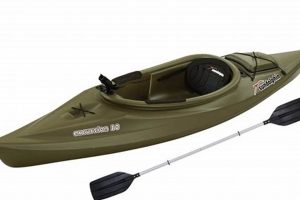
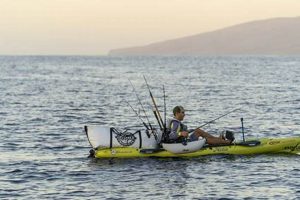
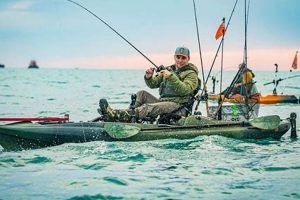
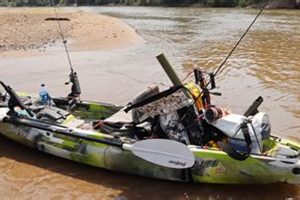
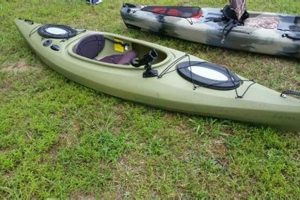
A customized arrangement of equipment and accessories on a kayak designed for angling optimizes performance and enhances the fishing experience. This includes rod holders, fish finders, tackle storage, anchors, and other specialized gear strategically placed for efficient use and angler comfort. An example might involve positioning rod holders within easy reach, mounting a fish finder for optimal viewing, and organizing tackle within readily accessible compartments.
An optimized configuration contributes significantly to angling success and enjoyment. Efficient placement of equipment minimizes wasted time and effort, allowing anglers to focus on fishing. Convenient access to essential tools and gear enhances responsiveness to changing fishing conditions, improving the chances of a successful catch. Furthermore, a comfortable and well-organized setup reduces fatigue and promotes prolonged fishing sessions. While kayaks have long been used for fishing, the development of specialized equipment and accessories specifically for this purpose has revolutionized the sport, allowing anglers to reach previously inaccessible fishing grounds and personalize their experience.
The following sections will delve into the key aspects of configuring a kayak for angling, covering essential equipment choices, optimal placement strategies, and customization techniques for various fishing styles and environments.
Tips for an Effective Kayak Fishing Configuration
Optimizing a kayak for fishing requires careful consideration of equipment choices and placement strategies. The following tips provide guidance for creating a personalized and effective setup.
Tip 1: Prioritize Stability: Kayak stability is paramount, especially when fishing. Consider kayak width and hull design, opting for wider, flatter hulls for enhanced stability, particularly in calmer waters. Shorter kayaks offer greater maneuverability, while longer kayaks track better in open water.
Tip 2: Strategic Rod Holder Placement: Rod holders should be positioned within easy reach, allowing for quick access and efficient retrieval. Anglers often prefer two to four rod holders, enabling diverse fishing techniques.
Tip 3: Optimize Tackle Storage: Efficient tackle organization is crucial. Utilize waterproof tackle boxes and storage bags to protect gear from moisture and organize lures and terminal tackle for quick access. Consider labeling compartments for efficient retrieval.
Tip 4: Integrate a Fish Finder: A fish finder significantly enhances fishing success. Choose a model suited to kayak fishing and mount it within clear view for easy monitoring. Ensure adequate battery power and transducer placement for optimal performance.
Tip 5: Secure Essential Safety Gear: Safety equipment, including a personal flotation device (PFD), whistle, and signaling devices, are essential. Store them within easy reach and ensure they meet regulatory requirements.
Tip 6: Plan for Anchor Deployment: An anchor system is essential for maintaining position in current or wind. Consider a lightweight, easily deployable anchor and appropriate anchor trolley system for efficient positioning.
Tip 7: Customize for Fishing Style: Adapt the configuration to the specific fishing style. Trolling requires different rod holders and equipment placement compared to casting or jigging. Customize the setup based on target species and fishing techniques.
By carefully considering these tips, anglers can create an efficient and personalized setup that enhances both performance and enjoyment on the water.
These considerations contribute to not only a more successful fishing experience, but also a safer and more enjoyable one. The concluding section will summarize key principles and offer final recommendations for a successful kayak fishing adventure.
1. Stability

Stability forms a cornerstone of an effective fishing kayak setup, directly influencing angler safety, comfort, and fishing success. A stable platform allows anglers to cast, reel, and land fish without compromising balance, especially crucial when handling larger fish or fishing in challenging conditions such as windy weather or moving water. Compromised stability can lead to capsizing, equipment loss, and potentially dangerous situations. For instance, standing to cast in a less stable kayak presents significant risks, while a stable platform allows for more confident and controlled standing or leaning movements. The relationship between stability and setup hinges on several factors, including kayak hull design (e.g., pontoon, sit-on-top, sit-inside), kayak width, and weight distribution. A wider kayak generally offers greater initial stability, while proper weight distribution further enhances balance.
Consider the practical implications: an angler attempting to hook a large fish in a narrow, unstable kayak faces a far greater risk of capsizing compared to an angler in a wider, more stable platform. Similarly, navigating through choppy water requires a kayak with inherent stability. Understanding the impact of stability on kayak fishing setup empowers informed decisions regarding kayak selection and equipment configuration. Customizing a kayak with outriggers or stabilizers can enhance stability but may impact maneuverability. Thus, anglers must balance stability needs with desired fishing style and water conditions. For example, an angler fishing in calm lakes or rivers may prioritize maneuverability over extreme stability, whereas an angler fishing in open ocean conditions will prioritize stability above all else.
In summary, stability is not merely a desirable characteristic but a fundamental requirement of a safe and effective fishing kayak setup. Kayak selection, equipment placement, and individual angling practices all influence stability. Understanding these interconnected factors empowers anglers to configure their kayaks for optimal stability and enhance their overall fishing experience. Failing to prioritize stability can significantly compromise not only fishing success but also angler safety, highlighting the critical link between stability considerations and overall setup effectiveness.
2. Rod Holder Placement

Rod holder placement is integral to a functional fishing kayak setup. Effective placement optimizes angling efficiency and safety, directly influencing casting, retrieval, and overall fishing success. Strategic positioning minimizes line tangling, facilitates quick access to rods, and reduces the risk of accidental loss or damage. For example, placing rod holders within easy reach of the dominant hand enables rapid reaction to strikes, while positioning holders at varying angles allows for diverse fishing techniques such as trolling, casting, and jigging. Incorrect placement can lead to frustration, tangled lines, and potentially lost fish, highlighting the direct correlation between rod holder positioning and angling effectiveness.
Several factors influence optimal rod holder placement. Kayak width, fishing style, and the number of rods used contribute to placement decisions. A wider kayak offers more flexibility, while a narrower kayak requires more strategic positioning to avoid interference. Anglers employing multiple rods must consider spacing to prevent tangling. Furthermore, specific fishing techniques necessitate tailored placement; trolling requires rod holders angled towards the stern, while casting and jigging benefit from holders positioned closer to the angler. Understanding these nuances allows anglers to customize their setups for maximum efficiency. For instance, a kayak angler specializing in trolling might position holders further back and angled to minimize line drag, while a kayak angler focused on casting might position holders closer and more upright for quicker access.
Effective rod holder placement significantly contributes to a streamlined and productive kayak fishing experience. By considering factors such as kayak dimensions, fishing style, and the number of rods utilized, anglers can optimize their setup for efficiency and enjoyment. Careful planning and strategic placement not only enhance fishing success but also minimize frustration and maximize time spent actively fishing. The interplay between rod holder placement and overall kayak configuration directly impacts angling outcomes, emphasizing the importance of this often-overlooked aspect of kayak fishing setup.
3. Tackle Organization

Efficient tackle organization is a critical component of a successful fishing kayak setup. A well-organized system directly impacts fishing efficiency, reducing time spent searching for specific lures or tools and maximizing time spent actively fishing. Disorganized tackle leads to frustration, wasted time, and potentially missed opportunities. Consider the scenario: a school of fish appears, but the angler spends precious minutes rummaging through a cluttered tackle box, missing the opportune moment. A streamlined system allows for quick lure changes and adjustments, crucial for adapting to changing fishing conditions and fish behavior. This connection between tackle organization and fishing success underscores its importance within the broader context of kayak fishing setup.
Several factors influence optimal tackle organization. Available storage space, fishing style, and target species dictate organizational strategies. Limited kayak storage necessitates compact and efficient solutions, such as waterproof tackle boxes and bags designed specifically for kayak fishing. Different fishing styles require varying tackle assortments; a fly fisherman requires different organizational strategies compared to a bass angler. Furthermore, targeting specific species often necessitates specialized lures and tools, further influencing organizational choices. For example, an angler targeting saltwater species requires corrosion-resistant tackle boxes and specific lure types, while a freshwater angler might organize based on lure size or color. These nuances demonstrate the practical significance of adapting tackle organization to individual fishing needs and kayak constraints. Labeling storage compartments with content descriptions further enhances efficiency, enabling rapid retrieval without extensive searching.
Effective tackle organization contributes significantly to a productive and enjoyable kayak fishing experience. A well-planned system minimizes frustration, maximizes fishing time, and enhances responsiveness to changing conditions. By considering factors such as available space, fishing style, and target species, anglers can develop customized organizational strategies tailored to their specific needs. The impact of efficient tackle organization extends beyond mere convenience; it directly influences fishing success and overall enjoyment on the water. A well-organized kayak reflects a well-prepared angler, ready to capitalize on opportunities and maximize their time on the water. This understanding underscores the vital role of tackle organization within a comprehensive fishing kayak setup.
4. Fish finder integration

Fish finder integration represents a significant advancement in fishing kayak setups, transforming how anglers locate and target fish. Integrating a fish finder into a kayak setup provides real-time underwater insights, enhancing fishing efficiency and success. This technology allows anglers to identify fish-holding structures, determine water depth and temperature, and track fish movement, offering a significant advantage over traditional methods. Understanding the nuances of fish finder integration is crucial for maximizing its benefits within a comprehensive kayak fishing setup.
- Transducer Placement and Type
Transducer selection and placement significantly influence fish finder performance. Different transducer types (e.g., transom mount, through-hull, trolling motor mount) offer varying performance characteristics. Choosing the appropriate transducer and mounting it correctly ensures accurate readings and optimal signal clarity. For example, a through-hull transducer provides the cleanest signal but requires hull modification. A transom-mount transducer offers easier installation but may be susceptible to interference from turbulence. Correct placement avoids signal interference and maximizes sonar effectiveness. Incorrect placement can result in inaccurate readings or complete signal loss, hindering the fish finder’s utility.
- Display Selection and Mounting
Fish finder display selection and mounting impact usability and effectiveness. Screen size, resolution, and mounting location influence visibility and ease of interpretation. Mounting the display within clear view, protected from glare and water spray, ensures optimal viewing in varying light conditions. A larger, higher-resolution display provides greater detail but requires more space and power. Mounting options include RAM mounts, track systems, and custom installations. Choosing the right display and mounting solution ensures convenient access to crucial information without obstructing kayak operation.
- Power Management
Power management is critical for sustained fish finder operation. Fish finders consume power, impacting battery life. Using a dedicated battery or incorporating a power management system ensures sufficient power for extended fishing trips. Calculating power consumption and choosing appropriate battery capacity prevents unexpected power loss, especially crucial during longer outings. Integrating a battery level indicator provides real-time power status, allowing anglers to monitor usage and avoid depletion. Effective power management ensures uninterrupted fish finder operation throughout the fishing session.
- Interpretation and Application
Effective fish finder utilization requires understanding sonar readings and applying the information to fishing strategies. Interpreting depth contours, identifying fish-holding structures, and tracking fish movement allows anglers to make informed decisions about lure selection, retrieval techniques, and fishing location. Simply having a fish finder does not guarantee success; understanding how to interpret the data and apply it strategically maximizes its value. For example, identifying a thermocline or a school of baitfish allows anglers to target specific depths or areas, significantly increasing the likelihood of success.
These interconnected aspects of fish finder integration contribute significantly to a comprehensive and effective fishing kayak setup. By considering transducer selection, display mounting, power management, and data interpretation, anglers can maximize the benefits of fish finder technology. Effective fish finder integration transforms the kayak into a sophisticated fishing platform, enhancing angling success and overall enjoyment on the water. The strategic use of a fish finder not only improves fish-finding capabilities but also contributes to a more informed and engaging fishing experience, highlighting the integral role of fish finder integration within a modern kayak fishing setup.
5. Safety Equipment

Safety equipment constitutes a critical aspect of a responsible fishing kayak setup. Prioritizing safety enhances angler well-being and preparedness for unforeseen circumstances. Integrating appropriate safety equipment ensures a secure and enjoyable fishing experience, mitigating potential risks associated with the aquatic environment. Neglecting safety protocols can lead to severe consequences, underscoring the essential role of safety equipment within a comprehensive kayak fishing setup.
- Personal Flotation Device (PFD)
A properly fitted PFD is paramount for kayak fishing safety. PFDs provide buoyancy in the event of capsizing or accidental immersion, significantly increasing survival chances. Choosing a comfortable, kayak-specific PFD allows for unrestricted movement while paddling and fishing. State and local regulations often mandate PFD usage, emphasizing its legal and ethical importance. Inflatable PFDs offer greater comfort but require regular inspection and maintenance. Neglecting to wear a PFD can have life-threatening consequences, especially in cold water or challenging conditions.
- Signaling Devices
Signaling devices, including whistles, flares, and mirrors, enable communication in emergencies. These tools attract attention and facilitate rescue operations, proving invaluable in situations such as capsizing, becoming lost, or encountering medical emergencies. A whistle attached to the PFD allows for immediate signaling. Flares and mirrors provide long-range visibility, enhancing the chances of being spotted by rescuers. Carrying multiple signaling devices increases redundancy and preparedness for various scenarios. Regularly checking the functionality of signaling devices ensures effectiveness when needed.
- First-Aid Kit
A well-stocked first-aid kit addresses minor injuries and provides essential supplies until professional medical assistance is available. Kayak fishing presents unique risks, including hook injuries, cuts, and exposure to the elements. A waterproof first-aid kit containing bandages, antiseptic wipes, pain relievers, and other essential supplies allows for immediate treatment of minor injuries. Regularly checking and replenishing the kit ensures adequate preparedness for common fishing-related injuries. Addressing minor injuries promptly prevents complications and enhances overall safety.
- Communication Devices
Communication devices, such as VHF radios or waterproof cell phones, enable contact with emergency services or other boaters in case of distress. Reliable communication facilitates rapid response to emergencies, enhancing safety and providing peace of mind. VHF radios offer direct communication with the Coast Guard and other vessels, while waterproof cell phones provide a backup communication option. Ensuring devices are charged and readily accessible maximizes their effectiveness during critical situations. Communicating planned fishing locations and estimated return times further enhances safety protocols.
Integrating these safety precautions into a fishing kayak setup demonstrates a commitment to responsible angling practices. Prioritizing safety not only protects anglers from potential harm but also enhances the overall fishing experience. A well-equipped kayak instills confidence, allowing anglers to focus on fishing knowing they are prepared for unforeseen circumstances. The cumulative effect of these safety measures creates a safer and more enjoyable on-the-water experience, reinforcing the critical link between safety equipment and a responsible fishing kayak setup.
Frequently Asked Questions about Kayak Fishing Setups
Addressing common queries regarding kayak fishing setups provides clarity and facilitates informed decision-making. The following FAQs offer practical insights into optimizing kayak configurations for angling.
Question 1: How does kayak stability influence setup choices?
Kayak stability significantly impacts equipment placement and overall setup. A stable platform allows for more versatile configurations, including standing while fishing. Less stable kayaks necessitate prioritizing balance and may restrict certain equipment choices or placements.
Question 2: What factors determine optimal rod holder placement?
Optimal rod holder placement depends on fishing style, kayak width, and the number of rods used. Anglers frequently prioritize easy access and minimal line interference. Trolling setups typically require rear-facing holders, while casting setups benefit from forward-facing positions.
Question 3: How can limited storage space be effectively managed?
Effective tackle organization maximizes limited storage. Waterproof tackle boxes, specialized kayak crates, and storage bags optimize space utilization. Prioritizing essential gear and employing space-saving techniques minimizes clutter and maximizes efficiency.
Question 4: What are the key considerations for fish finder integration?
Fish finder integration requires careful consideration of transducer type and placement, display size and mounting location, and power management strategies. Selecting appropriate components and ensuring proper installation maximizes fish finder effectiveness.
Question 5: What essential safety equipment should be included in every setup?
Essential safety equipment includes a properly fitted PFD, signaling devices (whistle, flares, mirror), a first-aid kit, and communication devices (VHF radio or waterproof cell phone). Prioritizing safety enhances preparedness for unforeseen circumstances.
Question 6: How can one adapt a kayak setup for different fishing styles?
Adapting a kayak setup involves adjusting equipment choices and placement to suit specific fishing techniques. Trolling requires different rod holder configurations and equipment compared to casting or jigging. Customizing the setup enhances efficiency and effectiveness for various fishing styles.
Understanding these frequently asked questions empowers informed decisions regarding kayak fishing setups. Prioritizing stability, efficient organization, and safety considerations contributes significantly to a successful and enjoyable fishing experience.
The subsequent section provides practical tips and illustrative examples of successful kayak fishing setups, further enhancing understanding and facilitating personalized configurations.
Fishing Kayak Setup
A well-planned fishing kayak setup is integral to a successful and enjoyable angling experience. This exploration has highlighted key aspects of customization, emphasizing the importance of stability, efficient equipment placement, and appropriate safety precautions. Strategic rod holder positioning, organized tackle storage, and integrated fish finder technology contribute significantly to maximizing fishing efficiency and success. Prioritizing safety through appropriate equipment and preparedness ensures a secure and responsible approach to kayak fishing.
Effective configuration transforms a standard kayak into a personalized fishing platform, optimized for individual needs and preferences. Adaptability remains crucial, as fishing styles and environmental conditions necessitate adjustments to equipment choices and placement strategies. Continuous refinement of one’s fishing kayak setup, informed by experience and evolving best practices, unlocks the full potential of this dynamic and rewarding angling discipline.