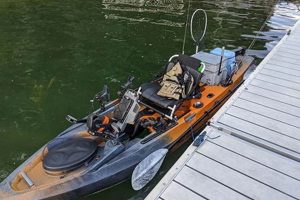
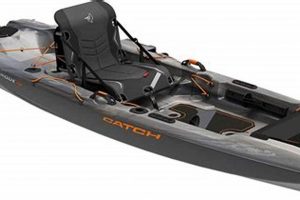
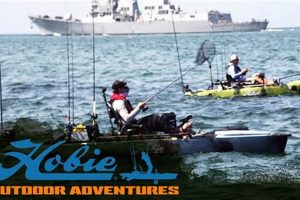
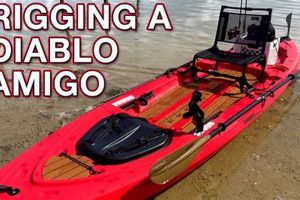
This vessel represents a specific model of fishing kayak designed for anglers. It combines a stable platform with pedal-driven propulsion for hands-free fishing. The “130” likely designates the approximate length in inches, influencing maneuverability and storage considerations. “Hydryve II” suggests a proprietary pedal-drive system, possibly an updated version offering improved performance or features. The combination of these elements targets anglers seeking efficient and convenient movement on the water.
Pedal-powered kayaks offer significant advantages for fishing. Anglers can maintain position and navigate quietly, crucial for approaching fish without disturbance. Freeing hands from paddling allows for constant lure retrieval and immediate hooksets. This specific model likely incorporates features like rod holders, storage compartments, and a comfortable seating system to enhance the fishing experience. Such advancements in kayak design contribute to the growing popularity of kayak fishing, providing increased access and a closer connection to the sport.
This article will further explore the specifications, performance, and user experiences associated with this particular kayak model. Topics covered will include an in-depth analysis of its features, a comparison with similar models, and a discussion of ideal fishing environments and techniques suited to its capabilities.
Tips for Utilizing Pedal-Driven Fishing Kayaks
Maximizing the advantages of a pedal-driven fishing kayak requires an understanding of its capabilities and strategic operation. The following tips offer guidance for enhancing on-the-water performance and fishing success.
Tip 1: Master Pedal Control: Practice smooth, consistent pedaling to maintain a steady speed and minimize disturbance. Varying cadence allows for precise adjustments to position and drift.
Tip 2: Optimize Seat Positioning: Proper seat adjustment promotes comfort and efficient pedaling. Ensure correct leg extension and back support for prolonged use.
Tip 3: Plan Navigation Strategically: Chart fishing locations and routes beforehand, accounting for wind, current, and potential obstacles. Utilize GPS and mapping tools for efficient navigation.
Tip 4: Employ Stealth Tactics: Leverage the quiet propulsion of a pedal drive to approach fishing areas discreetly. Avoid sudden movements or noises that could spook fish.
Tip 5: Maximize Hands-Free Fishing: Utilize rod holders and other accessories to keep hands free for casting, retrieving, and handling fish while maintaining control of the kayak.
Tip 6: Prioritize Safety Precautions: Always wear a personal flotation device and carry essential safety equipment. Inform someone of your fishing plans, including location and expected return time.
Tip 7: Regular Maintenance: Adhere to the manufacturer’s recommended maintenance schedule for the pedal drive system and other components. Regular cleaning and lubrication ensure optimal performance and longevity.
Implementing these strategies can significantly enhance the effectiveness and enjoyment of fishing from a pedal-driven kayak. Proper preparation and mindful operation contribute to a more productive and safer experience on the water.
By incorporating these tips, anglers can fully realize the potential of their pedal-driven kayak and elevate their fishing endeavors. The following section will provide concluding remarks and reiterate key takeaways for maximizing performance and safety.
1. Pedal-Powered Propulsion
Pedal-powered propulsion represents a significant advancement in kayak fishing, offering distinct advantages over traditional paddle kayaks. This technology is central to the functionality and appeal of the Catch 130 Hydryve II fishing kayak, enabling efficient, hands-free operation on the water.
- Enhanced Fishing Efficiency:
Pedal drives free hands for casting, retrieving lures, and fighting fish, maximizing fishing time and responsiveness. This feature is particularly beneficial for techniques requiring precise lure manipulation or quick hooksets. The continuous propulsion allows anglers to maintain position and cover water efficiently, even in challenging conditions such as currents or wind.
- Stealth and Reduced Disturbance:
Unlike paddling, which can create surface noise and vibrations, pedal drives operate more quietly. This reduced disturbance minimizes the impact on fish behavior, increasing the likelihood of successful approaches and presentations. In shallow water or environments with skittish fish, this stealth advantage can be crucial.
- Improved Boat Control and Maneuverability:
Pedal-powered kayaks offer precise control over speed and direction, allowing anglers to navigate tight spots, hold position in current, and make subtle adjustments to their approach. The ability to maneuver efficiently enhances fishing effectiveness and allows for exploration of diverse habitats.
- Reduced Physical Strain:
Utilizing leg muscles for propulsion reduces strain on the upper body compared to paddling, allowing for longer fishing trips with less fatigue. This physical benefit can be particularly significant for anglers with shoulder or back issues. Consistent power output over extended periods contributes to increased overall fishing time and enjoyment.
These combined advantages of pedal-powered propulsion contribute significantly to the Catch 130 Hydryve II fishing kayak’s suitability for a range of fishing styles and environments. This technology transforms the on-the-water experience, enhancing both efficiency and enjoyment for anglers.
2. Stability and Maneuverability

Stability and maneuverability are critical performance characteristics influencing a fishing kayak’s effectiveness. These factors directly impact an angler’s ability to maintain balance, navigate various water conditions, and execute fishing techniques effectively. Understanding the interplay between these attributes within the context of the Catch 130 Hydryve II fishing kayak is essential for evaluating its suitability for diverse fishing scenarios.
- Primary Stability:
Primary stability refers to a kayak’s resistance to tipping when sitting still or moving slowly. A wider hull generally contributes to greater primary stability, providing a secure platform for casting, retrieving, and landing fish. The Catch 130 Hydryve II, with its likely wider hull design compared to touring kayaks, prioritizes initial stability for anglers engaging in fishing activities requiring a stable base.
- Secondary Stability:
Secondary stability describes a kayak’s stability at higher angles of lean, such as when turning or encountering waves. This characteristic becomes crucial when navigating challenging conditions or executing quick maneuvers. Information regarding the Catch 130 Hydryve II’s secondary stability would illuminate its suitability for rougher waters or techniques requiring dynamic boat control. A moderate level of secondary stability likely balances maneuverability with a reassuring degree of stability for diverse fishing situations.
- Tracking and Turning Performance:
Tracking refers to a kayak’s ability to maintain a straight course, while turning performance dictates how efficiently it changes direction. The hull design, including length and keel features, influences these attributes. Details regarding the Catch 130 Hydryve II’s hull characteristics would provide insight into its tracking and turning capabilities. Efficient tracking minimizes effort required for covering distance, while responsive turning allows for navigation through complex environments and precise adjustments to fishing position.
- Influence of Length and Width:
The Catch 130’s length, likely around 130 inches, suggests a balance between stability and maneuverability. Longer kayaks generally track better in open water but can be less maneuverable in tight spaces. The kayak’s width further contributes to its overall stability. A wider platform enhances initial stability but can compromise maneuverability and speed. The precise dimensions influence the Catch 130 Hydryve II’s performance characteristics, making it suitable for specific fishing environments and techniques.
Evaluating the Catch 130 Hydryve II’s stability and maneuverability provides valuable insights into its performance profile. Understanding these characteristics in relation to intended fishing environments and techniques is essential for anglers selecting a kayak that aligns with their specific needs and preferences. Further investigation into user experiences and expert reviews can provide additional perspectives on the kayak’s on-the-water performance.
3. Fishing-Specific Features
Dedicated features tailored for angling differentiate fishing kayaks from recreational models. These integrated elements enhance convenience, efficiency, and overall fishing success. Examining the fishing-specific features of the Catch 130 Hydryve II fishing kayak provides crucial insight into its practicality and suitability for diverse angling pursuits.
- Rod Holders:
Purpose-built rod holders secure fishing rods, allowing anglers to manage multiple lines or keep rods readily accessible while performing other tasks. Flush-mounted rod holders minimize interference with casting and paddling, while adjustable rod holders accommodate various rod lengths and fishing styles. The number, type, and placement of rod holders on the Catch 130 Hydryve II contribute significantly to its fishing functionality.
- Storage Compartments:
Secure storage compartments protect tackle, gear, and personal items from the elements. Dry storage compartments safeguard electronics and other sensitive items. The size, accessibility, and configuration of storage compartments on the Catch 130 Hydryve II influence its capacity for carrying essential equipment and supplies for extended fishing trips. Specialized compartments designed for tackle boxes or other fishing-specific gear enhance organization and efficiency on the water.
- Gear Tracks and Mounting Points:
Integrated gear tracks and mounting points provide versatile options for attaching accessories such as fish finders, GPS units, cameras, and other equipment. These adaptable systems allow anglers to customize their kayak setup based on individual preferences and target species. The availability and placement of these features on the Catch 130 Hydryve II enhance its adaptability and expand its functionality for diverse fishing scenarios.
- Anchor Trolley System:
An anchor trolley system enables controlled anchoring from various positions on the kayak, crucial for maintaining position in current or wind. This system allows anglers to adjust anchor position without leaving the seated position, enhancing fishing efficiency and stability. The presence and design of an anchor trolley system on the Catch 130 Hydryve II influence its suitability for fishing in environments requiring precise boat control.
These integrated features collectively contribute to the Catch 130 Hydryve II’s effectiveness as a fishing platform. Evaluating the presence, design, and functionality of these features provides valuable insights into the kayak’s suitability for specific fishing styles and environments. A comprehensive understanding of these fishing-specific attributes empowers anglers to make informed decisions based on their individual needs and preferences.
4. Durability and Construction

Durability and construction directly influence a fishing kayak’s lifespan and ability to withstand the rigors of on-the-water use. Material selection, construction techniques, and overall design contribute to a kayak’s resilience against impacts, abrasion, UV exposure, and other environmental factors. Evaluating these aspects provides crucial insights into the long-term value and performance of the Catch 130 Hydryve II fishing kayak.
Common kayak construction materials include high-density polyethylene (HDPE), rotomolded plastic, and composites like fiberglass or carbon fiber. HDPE offers excellent impact resistance and durability, while rotomolded plastic provides a seamless, one-piece construction resistant to leaks. Composites offer lighter weight and increased stiffness but can be more susceptible to damage from impacts. The specific material used in the Catch 130 Hydryve II significantly impacts its overall durability, weight, and performance characteristics. Understanding the material properties and construction methods employed provides valuable insights into the kayak’s long-term resilience and suitability for various fishing environments. For example, a kayak constructed from thicker HDPE might be more suitable for rocky rivers, while a lighter composite construction might be preferable for calm lakes.
Beyond material selection, construction techniques such as welding, molding, and lamination influence a kayak’s structural integrity. Reinforced areas, particularly in high-stress zones like the hull and deck, enhance resistance to impacts and deformation. Examining the construction details of the Catch 130 Hydryve II, including hull thickness, seam construction, and reinforcement methods, provides further insights into its overall durability and ability to withstand long-term use. Well-constructed seams, robust hull design, and strategically placed reinforcements contribute to a more resilient and reliable vessel, capable of withstanding the demands of diverse fishing environments. A thorough understanding of these factors empowers informed purchasing decisions and ensures long-term satisfaction with the kayak’s performance and durability.
5. Target Fishing Environments
Determining suitable fishing environments for the Catch 130 Hydryve II fishing kayak requires careful consideration of its design, features, and performance characteristics. Matching the kayak’s capabilities to the intended environment ensures optimal performance, safety, and overall fishing success. Factors such as water conditions, prevailing winds, and target species influence environment suitability.
- Calm Lakes and Ponds:
Calm lakes and ponds provide ideal conditions for leveraging the Catch 130 Hydryve II’s stability and pedal-powered propulsion. The absence of significant currents or waves allows for precise boat control and efficient navigation. Anglers can utilize the hands-free operation for techniques requiring delicate presentations or frequent lure changes, targeting species such as bass, panfish, and trout. The stable platform enhances casting accuracy and hooksets, maximizing fishing effectiveness in these tranquil environments.
- Slow-Moving Rivers and Streams:
Slow-moving rivers and streams present opportunities for utilizing the Hydryve II’s maneuverability and pedal drive for upstream or downstream travel. The relatively calm water conditions allow for controlled drifting and precise positioning near structure or cover. Anglers can target species like catfish, smallmouth bass, and various riverine species. The pedal drive facilitates maintaining position in light currents, freeing hands for fishing. However, navigating faster currents or rapids might exceed the kayak’s capabilities and present safety concerns.
- Coastal Bays and Estuaries:
Protected coastal bays and estuaries offer sheltered environments suitable for the Catch 130 Hydryve II, provided conditions remain relatively calm. The pedal drive allows for efficient exploration of these expansive areas, and the stable platform facilitates fishing in moderate tidal currents. Anglers can target species such as redfish, speckled trout, and flounder. However, venturing into open ocean or exposed coastal areas with significant wave action or strong currents would likely exceed the kayak’s design limitations and compromise safety.
- Reservoirs and Large Ponds:
Larger reservoirs and ponds present expanded fishing opportunities, where the Catch 130 Hydryve II’s pedal drive facilitates covering greater distances and exploring diverse habitats. The stable platform provides a comfortable base for fishing in open water or near shoreline structures. Anglers can effectively target various species, including bass, crappie, and walleye. However, prevailing wind conditions and potential wave action on larger bodies of water should be considered when planning fishing trips. Strong winds can significantly impact boat control and present challenges for managing a pedal-driven kayak.
Careful consideration of these target environments and their specific conditions ensures optimal utilization of the Catch 130 Hydryve II fishing kayak. Matching the kayak’s capabilities to the intended environment maximizes fishing effectiveness, enhances safety, and contributes to a more enjoyable on-the-water experience. Prioritizing safety and adhering to manufacturer recommendations regarding suitable operating conditions remains paramount for responsible kayak usage.
Frequently Asked Questions
This section addresses common inquiries regarding the Catch 130 Hydryve II fishing kayak, providing concise and informative responses to assist potential users in making informed decisions.
Question 1: What differentiates the Hydryve II pedal system from other pedal-drive kayaks?
Specific details regarding the Hydryve II system’s unique features, such as propulsion efficiency, maintenance requirements, and performance in various water conditions, require further investigation through manufacturer resources or expert reviews. Comparisons with competing pedal-drive systems can provide additional insights into potential advantages or disadvantages.
Question 2: What is the maximum weight capacity of the Catch 130 Hydryve II?
Weight capacity information is crucial for determining safe operating limits and ensuring optimal performance. Consulting manufacturer specifications provides precise weight capacity data, including considerations for combined angler weight, gear, and other onboard items. Exceeding weight capacity can compromise stability and performance.
Question 3: How user-friendly is the Hydryve II system for deployment and stowage?
Practical considerations regarding the pedal drive system’s ease of use are essential for evaluating its suitability for diverse fishing scenarios. Information regarding deployment and stowage procedures, including potential challenges in shallow water or during transport, can be obtained through product demonstrations, user reviews, or manufacturer resources.
Question 4: What are the recommended maintenance procedures for the Hydryve II system?
Regular maintenance ensures optimal performance and prolongs the lifespan of the pedal-drive system. Manufacturer guidelines provide specific maintenance schedules and procedures, including lubrication, cleaning, and inspection of critical components. Adhering to these recommendations contributes to the long-term reliability and efficiency of the Hydryve II system.
Question 5: Is the Catch 130 Hydryve II compatible with aftermarket accessories?
Compatibility with aftermarket accessories expands customization options for enhancing fishing functionality. Information regarding compatible fish finders, GPS units, rod holders, and other accessories can be obtained through manufacturer resources or by consulting with retailers specializing in kayak fishing equipment. Ensuring compatibility before purchasing accessories avoids potential integration issues.
Question 6: What transportation and storage considerations are relevant for the Catch 130 Hydryve II?
Due to its size and weight, transporting and storing the kayak requires appropriate planning and equipment. Roof racks, trailers, or specialized kayak carts facilitate transportation. Storage options include garages, sheds, or designated outdoor spaces. Manufacturer specifications provide dimensions and weight information for determining appropriate transportation and storage solutions. Considering these logistical aspects ensures convenient and safe handling of the kayak.
Addressing these frequently asked questions provides valuable insights for potential buyers considering the Catch 130 Hydryve II fishing kayak. Thorough research and consideration of individual needs and preferences remain crucial for informed decision-making.
The following section will offer concluding remarks and summarize key takeaways regarding the Catch 130 Hydryve II fishing kayak.
Conclusion
This exploration of the Catch 130 Hydryve II fishing kayak encompassed key aspects relevant to prospective owners. Analysis of features, including the pedal-powered propulsion system, stability and maneuverability characteristics, fishing-specific design elements, durability considerations, and target fishing environments, provides a comprehensive overview of this specialized vessel. Understanding these interconnected elements allows anglers to assess its suitability for individual needs and preferences.
Potential purchasers are encouraged to conduct further research, including seeking expert reviews, user feedback, and manufacturer specifications, to gain a deeper understanding before making an informed decision. Careful consideration of these factors empowers anglers to select equipment optimally suited for their fishing style, target species, and preferred environments, ultimately contributing to a more rewarding and successful on-the-water experience. The evolving landscape of fishing kayak technology necessitates diligent evaluation and informed choices to maximize enjoyment and effectiveness on the water.