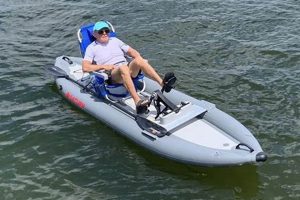
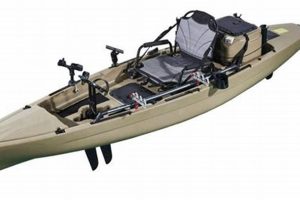
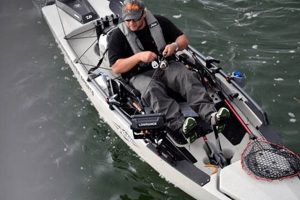
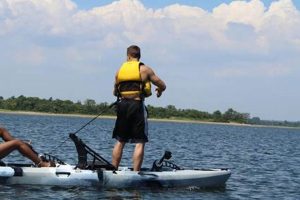
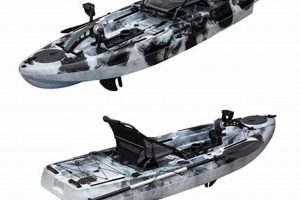
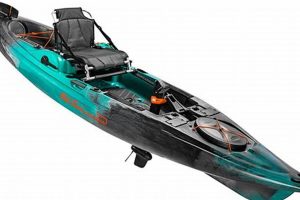
A two-person kayak designed for angling, propelled by a hands-free pedal system, offers a unique blend of stability, speed, and fishability. This design allows anglers to cover more water efficiently, maintain precise positioning, and keep their hands free for casting and reeling, unlike traditional paddle kayaks. The foot-powered propulsion offers a distinct advantage in various fishing environments, from calm lakes to flowing rivers.
The evolution of human-powered watercraft for fishing has led to designs prioritizing efficiency and practicality. The hands-free nature of pedal-driven systems provides a significant advantage, enabling anglers to focus on the fishing experience rather than paddling. This type of watercraft opens up new possibilities for anglers, allowing them to access previously challenging fishing spots and spend more time actively fishing. The stability inherent in these larger platforms also contributes to a more comfortable and secure fishing experience, particularly in challenging conditions.
This article will delve further into the specific features, advantages, and considerations related to selecting and using such a vessel, offering a comprehensive guide for both novice and experienced anglers. Topics to be covered include propulsion system variations, hull designs, fishing-specific features, and maintenance considerations.
Tips for Utilizing Pedal-Driven Tandem Fishing Kayaks
Optimizing the use of a two-person, pedal-powered fishing kayak involves understanding key operational and safety considerations. These tips will enhance fishing success and overall experience on the water.
Tip 1: Coordinate Paddling and Pedaling: While primarily propelled by pedals, paddles remain essential for maneuvering in tight spaces or shallow water. Synchronized paddling and pedaling maximizes efficiency and control.
Tip 2: Distribute Weight Evenly: Proper weight distribution is crucial for stability. Gear should be balanced throughout the vessel, considering the combined weight of anglers and equipment.
Tip 3: Plan Routes Carefully: Prioritize safety by researching water conditions, currents, and potential hazards. Sharing planned routes with others ensures awareness of intended locations.
Tip 4: Utilize Anchor and Drift Sock Effectively: Maintaining position in desired fishing areas requires strategic use of anchors or drift socks, particularly in currents or windy conditions.
Tip 5: Practice Launching and Landing: Mastering launching and landing techniques minimizes the risk of capsizing or damage. Practice in calm, shallow water before venturing into more challenging environments.
Tip 6: Employ Proper Safety Equipment: Life vests, signaling devices, and a first-aid kit are essential safety items. Adhering to local regulations and anticipating potential emergencies enhances safety.
Tip 7: Regular Maintenance Enhances Performance: Regularly rinsing the kayak and pedal drive with fresh water, especially after saltwater use, prevents corrosion and ensures optimal performance. Inspecting and lubricating moving parts will prolong the life of the drive system.
Following these guidelines will enhance safety, improve efficiency, and maximize the enjoyment of tandem fishing kayak excursions. Preparation and mindful operation contribute to a successful and rewarding experience.
These practical tips provide a foundation for safe and effective utilization of a pedal-driven tandem fishing kayak. The subsequent conclusion will reiterate key takeaways and offer final recommendations.
1. Two-Person Capacity

The defining characteristic of a tandem fishing kayak is its two-person capacity, a feature that significantly impacts the overall fishing experience. This design facilitates shared excursions, enhances safety, and offers unique advantages for specific fishing styles and situations.
- Shared Experiences:
Tandem kayaks allow anglers to share the experience with a friend, family member, or fishing partner. This shared experience enhances camaraderie, provides opportunities for learning and teaching, and can contribute to a more enjoyable and memorable outing. Sharing a kayak can also be beneficial for anglers with varying levels of experience, allowing for mentorship and support on the water.
- Enhanced Safety:
In remote locations or challenging conditions, having two people in a kayak can enhance safety. Assistance is readily available in case of an emergency, equipment malfunction, or unexpected weather changes. The combined effort of two paddlers also provides additional power and stability in challenging currents or windy conditions.
- Specialized Fishing Styles:
Certain fishing styles, such as trolling or using large fishing nets, benefit from the two-person configuration. One angler can control the kayak’s movement while the other manages lines, nets, or other equipment. This division of labor allows for greater efficiency and focus on specific fishing techniques.
- Weight Capacity and Gear Storage:
Tandem kayaks typically have a higher weight capacity compared to single-person kayaks, allowing for more gear and equipment to be carried. This is particularly advantageous for longer trips or specialized fishing techniques requiring additional gear. The increased storage space also contributes to a more organized and efficient fishing experience.
The two-person capacity of a tandem fishing kayak thus offers multiple benefits, from shared experiences to enhanced safety and practicality. These advantages, when combined with the pedal-drive system, create a versatile and powerful platform for a range of fishing styles and environments. Careful consideration of these factors allows anglers to maximize the potential of tandem kayaks for a more rewarding and productive fishing experience.
2. Fishing-Focused Design
A fishing-focused design distinguishes specialized fishing kayaks from recreational models. This design philosophy prioritizes features that enhance angling effectiveness, efficiency, and overall experience. In the context of a two-person, pedal-powered fishing kayak, this translates to integrated features designed to optimize the angling experience for two individuals while maintaining the vessel’s performance and stability.
Several key design elements contribute to this specialization. Recessed rod holders offer secure storage and quick access during active fishing. Dedicated tackle storage compartments keep essential gear organized and within reach. Often, these kayaks feature integrated mounting points for fish finders, GPS units, and other electronic accessories crucial for locating fish and navigating waterways. Wider, more stable hulls accommodate the movement and weight shifts associated with casting and reeling, while strategically placed footrests and adjustable seating contribute to angler comfort during long hours on the water. Furthermore, features like livewells or bait tanks maintain the viability of caught fish or live bait.
Consider a scenario where two anglers are trolling for large fish. The stability of the platform, combined with strategically placed rod holders and integrated storage for tackle and tools, allows both anglers to manage multiple lines effectively. The hands-free propulsion afforded by the pedal drive allows for precise boat control and adjustments to trolling speed, maximizing fishing success. The thoughtful integration of these features directly contributes to a more productive and enjoyable fishing experience, illustrating the practical significance of a fishing-focused design.
The synergy between a fishing-focused design and the capabilities of a two-person, pedal-driven kayak creates a specialized platform for anglers. This design philosophy prioritizes functionality and practicality, enhancing fishing efficiency and comfort. Understanding these design considerations allows for informed decisions when selecting a tandem fishing kayak suited to specific angling needs and preferences.
3. Hands-free Propulsion

Hands-free propulsion, specifically through a pedal drive system, represents a significant advancement in kayak fishing, particularly within the context of tandem configurations. This innovative approach directly addresses the inherent limitations of traditional paddle-powered kayaks, offering a range of benefits that enhance fishing effectiveness, efficiency, and overall experience. The most immediate advantage is the liberation of hands, allowing anglers to focus entirely on fishing techniques, such as casting, retrieving lures, and fighting fish, without the constant interruption of paddling. This continuous engagement significantly increases fishing time and responsiveness to bites, crucial factors in successful angling. Furthermore, pedal drives offer a distinct advantage in maintaining position or slow trolling, particularly in currents or windy conditions, tasks challenging to accomplish with paddles alone. This level of control is particularly valuable in specific fishing scenarios, like targeting structure or working a defined drift.
Consider a scenario where two anglers are fishing in a river with a moderate current. A traditional paddle kayak requires constant paddling to maintain position and fishing presentation. In contrast, the pedal drive system in a tandem fishing kayak allows anglers to effortlessly maintain position and control the boats drift, freeing their hands to focus entirely on fishing. This is especially advantageous when presenting lures or bait in a specific current seam or eddy. Similarly, in a lake environment, the hands-free nature of the pedal drive enables precise and quiet maneuvering around weed beds or other fish-holding structures without disturbing the water or spooking fish, a significant advantage over paddling. These practical examples illustrate the direct impact of hands-free propulsion on fishing success.
The integration of hands-free propulsion in tandem fishing kayaks represents a paradigm shift in kayak fishing, offering tangible benefits for both novice and experienced anglers. This technology directly addresses the inherent limitations of traditional paddle kayaks, allowing for greater fishing efficiency, enhanced control, and an overall more productive and enjoyable experience. The ability to maintain position, cover more water, and dedicate full attention to fishing techniques significantly improves the angler’s ability to target and catch fish, solidifying the importance of this innovation within the evolution of fishing kayak design. This advantage is further amplified in tandem configurations, where the shared workload of pedaling and the combined fishing effort can lead to exceptional results.
4. Enhanced Stability
Stability is a critical performance characteristic in any kayak, but it takes on heightened significance in the context of tandem fishing kayaks equipped with pedal drives. The increased size and weight capacity of these vessels, combined with the dynamic movements associated with fishing activities, necessitate a design that prioritizes stability to ensure a safe and effective fishing experience. Enhanced stability contributes directly to angler confidence, comfort, and the ability to perform essential fishing tasks without compromising balance or safety. This discussion will explore the key factors contributing to enhanced stability in these specialized kayaks.
- Hull Design:
The hull design plays a pivotal role in a kayak’s stability. Tandem fishing kayaks often feature wider, flatter hulls, sometimes incorporating a pontoon-style design, to provide a larger displacement and lower center of gravity. This wider footprint creates greater initial stability, resisting tipping and providing a secure platform, even when anglers shift their weight for casting or landing fish. Consider, for example, the difference between a narrow, performance-oriented kayak designed for speed and a wider, more stable fishing kayak. The latter sacrifices some speed for significantly improved stability, a crucial trade-off for fishing applications.
- Weight Distribution:
Proper weight distribution is crucial for maximizing stability in any tandem kayak. Distributing weight evenly throughout the hull, including anglers, gear, and any catches, minimizes the risk of tipping. Integrated storage compartments and strategically placed seating arrangements aid in achieving optimal weight balance. For example, placing heavier items lower in the hull and distributing gear evenly fore and aft can significantly enhance stability. This principle becomes even more critical in tandem kayaks, where the combined weight of two anglers and their equipment adds to the complexity of weight management.
- Center of Gravity:
A lower center of gravity contributes significantly to a kayak’s stability. Tandem fishing kayaks are designed with this principle in mind, often featuring lower seating positions and strategically placed ballast. The pedal drive system itself, being located low in the hull, can contribute to lowering the center of gravity, further enhancing stability. Imagine a tightrope walker using a long pole for balance. The pole lowers their center of gravity, making it easier to maintain balance. Similarly, a lower center of gravity in a kayak improves its resistance to tipping.
- Stability in Motion:
While initial stability is important, secondary stabilitythe kayak’s ability to resist tipping when leanedis equally crucial, particularly in tandem fishing kayaks. The hull design, combined with the inherent stability of the pedal drive system, contributes to predictable and manageable secondary stability. This allows anglers to lean comfortably for casting, retrieving, and fighting fish without fear of capsizing. For example, an angler leaning over the side to net a fish will experience a more stable and controlled lean in a well-designed tandem fishing kayak compared to a less stable platform.
These factors work in concert to provide the enhanced stability essential for a safe and successful fishing experience in a tandem kayak with a pedal drive. The combination of a well-designed hull, proper weight distribution, a low center of gravity, and predictable secondary stability allows anglers to focus on fishing with confidence, knowing that their platform provides a secure and balanced foundation, even during dynamic fishing activities. This inherent stability is a defining characteristic of these specialized kayaks, setting them apart from recreational models and significantly enhancing their effectiveness as fishing platforms.
5. Increased Maneuverability

Maneuverability is a critical performance attribute in fishing kayaks, impacting access to fishing grounds and the ability to position effectively. Tandem fishing kayaks, despite their larger size, benefit significantly from the integration of pedal-drive systems, achieving increased maneuverability compared to traditional paddle-driven counterparts. This enhancement stems from several key factors. The hands-free nature of pedal propulsion allows for continuous, fine-tuned adjustments to direction and speed, enabling precise navigation through complex environments such as shallow water, tight channels, or areas with submerged obstacles. Unlike paddling, which requires alternating strokes and repositioning the paddle, pedal drives offer immediate and consistent propulsion, enabling quicker turns and more controlled movements. This responsiveness is crucial for navigating challenging waterways and reacting swiftly to changing fishing conditions.
Consider navigating a shallow, winding creek choked with fallen branches. A paddle-driven tandem kayak requires significant effort and coordination to maneuver effectively, often necessitating awkward paddle strokes and potentially disrupting the fishing environment. In contrast, a pedal-driven tandem kayak allows for precise control, enabling anglers to navigate tight turns and avoid obstacles with minimal disturbance. The continuous, hands-free propulsion enables immediate course corrections and precise positioning, maintaining fishing presentation and minimizing disruption to the surrounding environment. Similarly, when fishing in windy conditions, the consistent power delivery of a pedal drive allows for more effective maneuvering and position holding compared to the intermittent propulsion of paddles, enhancing fishing efficiency and comfort.
Enhanced maneuverability in tandem fishing kayaks equipped with pedal drives expands fishing opportunities, allowing access to previously inaccessible areas and facilitating precise boat control in challenging conditions. This advantage translates to more effective fishing strategies, reduced effort navigating complex waterways, and ultimately, a more productive and enjoyable angling experience. The combination of size, stability, and maneuverability offered by these specialized kayaks opens up new possibilities for anglers seeking to explore a wider range of fishing environments with greater efficiency and control. This improved maneuverability directly contributes to the versatility and effectiveness of these platforms, solidifying their position as a valuable tool for serious anglers.
6. Elevated Fishing Experience
An elevated fishing experience represents a core objective for many anglers, and the tandem fishing kayak with pedal drive contributes significantly to achieving this goal. This connection stems from the synergistic interplay of several key factors: enhanced efficiency, increased access, shared experience, and improved comfort. By eliminating the need for constant paddling, pedal drives free anglers to focus entirely on the fishing process, increasing casting time, improving lure presentation, and allowing for quicker reactions to bites. This enhanced efficiency translates directly to increased fishing opportunities and potentially higher catch rates. Furthermore, the stability and maneuverability offered by these kayaks expand access to diverse fishing environments, from shallow creeks to open water, allowing anglers to explore a wider range of habitats and target various species. The tandem configuration adds a social dimension, facilitating shared experiences and fostering camaraderie on the water.
Consider two anglers targeting different species in a varied environment. One angler might focus on casting lures near submerged structures, while the other trolls deeper water. The tandem kayak’s stability accommodates both styles simultaneously, while the pedal drive allows for precise boat control and independent movement without disturbing each other’s fishing techniques. The shared experience enhances the overall enjoyment, while the efficiency and versatility of the platform contribute to a more successful and rewarding outing. Similarly, fishing in challenging conditions, such as wind or current, becomes significantly more manageable and enjoyable with a pedal-driven tandem kayak. The hands-free propulsion allows anglers to maintain position and focus on fishing, rather than struggling against the elements, leading to a more relaxed and productive experience.
The elevated fishing experience achievable with a tandem fishing kayak and pedal drive represents a significant advancement in angling technology. The combination of efficiency, access, shared experience, and comfort contributes to a more rewarding and productive time on the water. While factors such as weather and fish behavior remain outside direct control, the selection of appropriate equipment plays a crucial role in maximizing fishing success and enjoyment. Understanding the connection between these specialized kayaks and the pursuit of an elevated fishing experience empowers anglers to make informed decisions and optimize their approach, ultimately leading to more memorable and fulfilling fishing adventures. This connection highlights the evolution of fishing kayak design and its focus on enhancing the overall angling experience, moving beyond basic functionality to prioritize comfort, efficiency, and the shared enjoyment of the sport.
Frequently Asked Questions
This section addresses common inquiries regarding tandem fishing kayaks equipped with pedal drives, providing concise and informative responses to facilitate informed decision-making.
Question 1: What are the primary advantages of a pedal drive over traditional paddles in a tandem fishing kayak?
Pedal drives offer hands-free propulsion, enabling continuous fishing while maintaining boat control and position. This advantage enhances fishing efficiency and allows for quicker reactions to bites, particularly advantageous in currents or windy conditions.
Question 2: How does the stability of a tandem fishing kayak compare to a single-person kayak?
Tandem fishing kayaks generally offer greater stability due to their wider hulls and increased length. This stability is crucial for accommodating the movement of two anglers and their gear, enhancing safety and comfort, especially in rougher water.
Question 3: Are tandem fishing kayaks with pedal drives significantly heavier and more difficult to transport than single kayaks?
Tandem kayaks are inherently larger and heavier. However, specialized trailers and rooftop carriers facilitate transport. Weight considerations should be factored into purchasing decisions, considering available transportation methods and physical capabilities.
Question 4: What maintenance is required for a pedal drive system in saltwater environments?
Regular rinsing with fresh water after each use is crucial to prevent corrosion. Periodic lubrication and inspection of moving parts are also recommended to ensure optimal performance and longevity.
Question 5: Can a tandem fishing kayak with a pedal drive be effectively maneuvered in shallow water or tight spaces?
While longer than single kayaks, pedal-driven tandem kayaks offer excellent maneuverability due to the precise control afforded by the pedal system. This allows for navigation in relatively shallow water and tight spaces, expanding fishing access.
Question 6: What safety precautions should be considered when using a tandem fishing kayak with a pedal drive?
Standard safety practices for kayaking apply, including wearing personal flotation devices, carrying communication devices, and informing someone of planned routes. Understanding local regulations and water conditions is essential for safe operation.
Careful consideration of these frequently asked questions provides a foundation for informed decisions regarding the selection and utilization of tandem fishing kayaks equipped with pedal drives. Understanding the advantages, limitations, and operational aspects contributes to a safer, more efficient, and ultimately more rewarding fishing experience.
The following conclusion will summarize key takeaways and offer final recommendations regarding tandem fishing kayaks with pedal drives.
Conclusion
This exploration of tandem fishing kayaks with pedal drives has highlighted their significant advantages for anglers. Key benefits include enhanced stability, increased maneuverability, and hands-free propulsion, allowing for dedicated fishing engagement. The two-person capacity facilitates shared experiences and enhanced safety, while the fishing-focused design integrates features tailored for angling efficiency. These characteristics combine to deliver an elevated fishing experience, expanding access to diverse environments and optimizing fishing techniques. Considerations regarding weight, transport, and maintenance remain relevant factors in the selection and ownership process.
The evolution of fishing kayak design continues to prioritize efficiency, functionality, and angler experience. Tandem fishing kayaks with pedal drives represent a significant advancement in this evolution, offering a powerful platform for anglers seeking to maximize their time on the water. Careful consideration of individual needs and preferences, coupled with an understanding of these specialized kayaks’ capabilities, will guide anglers toward informed decisions and contribute to successful and rewarding fishing pursuits.