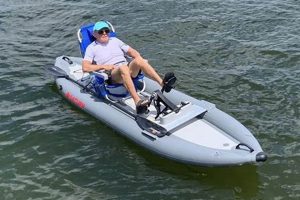
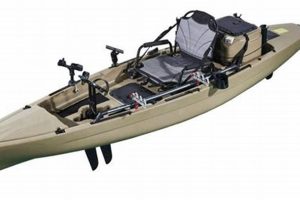
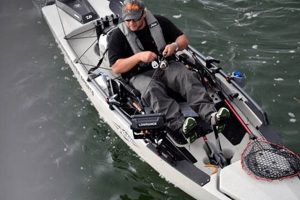
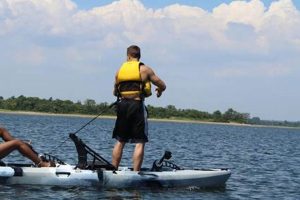
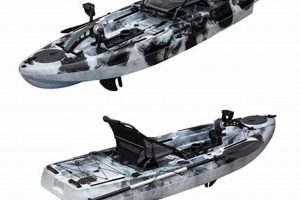
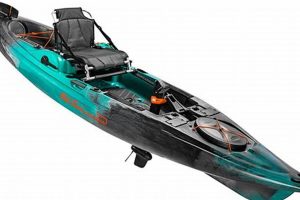
This style of watercraft offers an open-deck design, providing anglers with enhanced stability and maneuverability. The integrated pedal system allows for hands-free propulsion, leaving anglers free to focus on casting, reeling, and landing their catch. This design typically features specialized storage compartments and mounting points for fishing gear.
The elevated vantage point afforded by this type of kayak offers improved visibility for spotting fish and navigating shallow waters. The hands-free propulsion system allows for greater fishing efficiency and reduces fatigue, enabling longer excursions. These design elements have significantly advanced the sport of kayak fishing, providing anglers with a comfortable and effective platform. The evolution from paddle-powered kayaks to pedal-driven versions has increased accessibility and opened up new possibilities for anglers of all skill levels.
The following sections will delve deeper into specific features, advantages, and considerations for selecting and utilizing this increasingly popular style of fishing kayak. Topics will include stability and performance characteristics, popular manufacturers and models, essential accessories, and safety guidelines.
Tips for Selecting and Using Pedal-Driven Fishing Kayaks
Choosing and effectively utilizing a pedal-powered fishing kayak requires careful consideration of various factors. These tips offer guidance for maximizing the fishing experience.
Tip 1: Consider Hull Design: Kayak hull design significantly impacts stability and maneuverability. A wider, flatter hull offers greater stability, ideal for calmer waters and stand-up fishing. A longer, narrower hull provides better tracking and speed, suitable for covering larger distances.
Tip 2: Evaluate Pedal Drive Systems: Different pedal systems offer varying performance characteristics. Fin-based systems are efficient for speed and tracking, while propeller systems excel in shallow water and maneuverability. Assess individual needs and fishing environments.
Tip 3: Prioritize Comfort and Adjustability: Seat comfort and adjustability are crucial for long fishing trips. Ensure adequate back support and adjustability to accommodate individual preferences.
Tip 4: Assess Storage Capacity and Layout: Ample storage is essential for carrying fishing gear and supplies. Consider the location, accessibility, and watertightness of storage compartments.
Tip 5: Inspect Weight Capacity and Stability: Carefully assess the kayak’s weight capacity to ensure it can accommodate the angler, gear, and potential catch. Prioritize stability, especially when planning to stand and fish.
Tip 6: Practice Deployment and Retrieval: Practice deploying and retrieving the kayak from various launch points. Familiarization with these procedures ensures a smooth and safe experience.
Tip 7: Understand Local Regulations and Water Conditions: Adhere to all local regulations regarding fishing and watercraft operation. Thoroughly assess water conditions before embarking on any fishing trip.
By considering these factors, anglers can select the appropriate pedal-driven fishing kayak and maximize its potential, enhancing their overall fishing experience.
Further exploration of these topics and specific models will follow in the subsequent sections of this article.
1. Hands-Free Fishing
Hands-free fishing represents a significant advantage offered by pedal-driven kayaks. The ability to propel the vessel without using paddles frees the angler’s hands for critical fishing tasks. This direct connection between pedal propulsion and hands-free fishing enhances casting accuracy, improves line control, and facilitates quicker reactions to strikes. Consider a scenario where an angler hooks a powerful fish; the hands-free operation allows for immediate and effective control of the rod and reel, minimizing the risk of line breakage or the fish escaping. This advantage becomes particularly crucial in challenging conditions, such as strong currents or windy environments, where maintaining precise boat control and simultaneously managing fishing gear would be significantly more difficult with traditional paddles.
This feature is not merely a convenience; it fundamentally changes the fishing experience. Anglers can employ more complex techniques, such as fly fishing or trolling multiple lines, which would be challenging or impossible while simultaneously paddling. The freedom to manipulate lures, adjust tackle, and land fish without the interruption of paddling enhances efficiency and increases the likelihood of success. For instance, an angler can quickly change lures to adapt to changing fish behavior or adjust bait presentation without losing position or disrupting the fishing process.
Hands-free fishing, facilitated by pedal-driven kayaks, allows for greater focus and responsiveness, leading to a more dynamic and rewarding angling experience. While mastery of fishing techniques remains essential, the pedal-powered platform amplifies the angler’s capabilities and maximizes their potential for success. This advancement in kayak fishing technology opens up new possibilities and addresses the inherent limitations of traditional paddle-driven kayaks. The ability to dedicate full attention to the fishing process undoubtedly contributes to increased catches and overall fishing enjoyment.
2. Elevated Stability

Elevated stability is a critical characteristic of sit-on-top fishing kayaks, particularly those equipped with pedal drives. This inherent stability contributes significantly to angler safety and fishing effectiveness. The following facets explore the factors contributing to this enhanced stability and its implications for the angler.
- Center of Gravity
The sit-on-top design places the angler’s center of gravity higher than in traditional sit-inside kayaks. While this might seem counterintuitive, the wider beam and open deck of these kayaks compensate for the higher center of gravity, resulting in a stable platform. The ability to distribute weight evenly across the deck further enhances stability. Consider an angler standing to cast; the wider base of support provided by the sit-on-top design allows for greater balance and reduces the risk of capsizing.
- Wider Hull Design
Many sit-on-top fishing kayaks feature a wider hull design compared to recreational kayaks. This wider beam increases the kayak’s initial stability, resisting tipping and providing a secure platform. This design characteristic is particularly important in rough water or when encountering unexpected wakes. For example, navigating through choppy conditions requires a stable platform to maintain balance and prevent capsizing. The wider hull contributes significantly to this stability, allowing the angler to navigate challenging waters with greater confidence.
- Secondary Stability
Beyond initial stability, secondary stability refers to a kayak’s ability to resist capsizing when leaned or tilted. Sit-on-top fishing kayaks often exhibit strong secondary stability due to their hull design and the angler’s higher seating position. This characteristic allows for confident maneuvering and leaning, particularly important when fighting a fish or reaching for gear. Imagine an angler leaning over the side to net a fish; the secondary stability prevents the kayak from capsizing, ensuring a safe and successful retrieval.
- Stand-Up Fishing
The inherent stability of sit-on-top fishing kayaks facilitates stand-up fishing. This elevated position provides improved visibility for spotting fish, enhances casting range, and allows for greater leverage when fighting fish. The stable platform provided by the kayak’s design is essential for maintaining balance while standing, enabling the angler to effectively utilize this advantageous fishing technique. While stand-up fishing requires practice and balance, the stability of the kayak platform is a crucial contributing factor.
These elements contribute to the enhanced stability of sit-on-top fishing kayaks, enabling anglers to fish confidently in various conditions and utilize techniques such as stand-up fishing that require a secure and balanced platform. This stability not only enhances fishing effectiveness but also contributes significantly to angler safety, making these kayaks a popular choice for both novice and experienced anglers.
3. Enhanced Maneuverability

Maneuverability represents a critical performance characteristic in fishing kayaks, directly influencing an angler’s ability to navigate diverse water environments and effectively target fish. Pedal-driven, sit-on-top kayaks offer distinct advantages in maneuverability compared to traditional paddle-powered kayaks, owing to their propulsion system and hull design. This enhanced maneuverability translates to greater precision in positioning, improved navigation in challenging waters, and ultimately, increased fishing success.
- Hands-Free Control:
Pedal propulsion eliminates the need for paddles, freeing the angler’s hands for precise boat control using a rudder system. This hands-free operation allows for quick adjustments to direction and precise positioning in tight spots, such as navigating through dense vegetation or along a rocky shoreline. Consider a scenario where an angler needs to quickly change direction to avoid an obstacle or precisely position the kayak for an optimal casting angle; the hands-free control afforded by the pedal drive enables immediate and precise adjustments without the need to switch between paddling and steering.
- Shallow Water Navigation:
Many pedal-drive systems, particularly those utilizing propeller-based propulsion, excel in shallow water. Unlike fin-based systems that require a certain depth for effective operation, propeller systems can function in extremely shallow water, allowing anglers to access areas inaccessible to traditional kayaks or deeper-draft boats. This capability is invaluable for targeting species that inhabit shallow flats, backwaters, or protected estuaries. For example, accessing shallow, weed-choked areas where fish often congregate becomes possible with a propeller-driven pedal kayak.
- Precise Positioning in Current:
Maintaining position in moving water, such as rivers or tidal flows, is crucial for effective fishing. Pedal-driven kayaks offer precise control, enabling anglers to hold position against the current or maneuver subtly within a specific flow pattern. This precise positioning is essential for techniques like drift fishing or targeting specific structure within a current. Consider an angler fishing in a river; the pedal drive allows for maintaining a controlled drift along a seam or holding steady near a submerged log where fish are likely to ambush prey.
- Quick Turning and Tracking:
The combination of rudder steering and pedal propulsion allows for quick turns and responsive tracking. This agility is advantageous when pursuing actively feeding fish or maneuvering in confined spaces. The kayak can respond quickly to changes in fish behavior or adjust to navigate around obstacles, maximizing fishing opportunities. For instance, quickly repositioning the kayak to follow a school of fish or maneuver around a submerged rock becomes effortless and efficient.
The enhanced maneuverability of sit-on-top fishing kayaks equipped with pedal drives contributes significantly to their effectiveness as fishing platforms. The combination of hands-free control, shallow water capability, precise positioning, and responsive handling enables anglers to navigate diverse environments and maximize their fishing opportunities. This enhanced maneuverability translates to greater efficiency, improved access to prime fishing locations, and ultimately, a more rewarding and successful angling experience.
4. Increased Accessibility
Sit-on-top kayaks with pedal drives have broadened participation in kayak fishing by offering increased accessibility for individuals with diverse physical capabilities. These kayaks reduce physical demands and provide adaptable configurations, opening up opportunities for a wider range of anglers to enjoy the sport. The following facets elaborate on the specific ways these kayaks enhance accessibility.
- Reduced Physical Strain:
Pedal propulsion reduces the upper body strength and endurance required for traditional paddling. This makes kayak fishing feasible for individuals with limited upper body mobility or strength. Anglers with shoulder injuries, back problems, or other physical limitations can now enjoy extended fishing trips without the fatigue or strain associated with paddling. The transfer of exertion to the legs engages larger muscle groups, resulting in a more sustainable and less strenuous propulsion method.
- Ease of Entry and Exit:
The open deck of a sit-on-top kayak simplifies entry and exit compared to sit-inside kayaks. This is particularly beneficial for individuals with mobility limitations or balance concerns. The ease of transitioning in and out of the kayak reduces the risk of falls or injuries, promoting a safer and more comfortable experience. The open design also allows for quick adjustments and repositioning during fishing, increasing overall comfort and reducing the risk of discomfort or strain.
- Adaptive Seating and Positioning:
Many sit-on-top fishing kayaks offer adjustable seating systems and customizable configurations to accommodate individual needs. Anglers can adjust seat height, back support, and leg positioning for optimal comfort and support. This adaptability is crucial for individuals with specific physical requirements or those seeking enhanced comfort during long fishing trips. The availability of aftermarket accessories, such as specialized backrests or seat cushions, further expands customization options.
- Stability and Security:
The inherent stability of sit-on-top kayaks provides a secure platform for anglers of all abilities. This stability is particularly important for individuals with balance concerns or those new to kayaking. The wide, flat deck and lower center of gravity contribute to a stable and confidence-inspiring platform, reducing anxiety and increasing enjoyment on the water. This stability also facilitates stand-up fishing, further expanding fishing options for anglers who prefer an elevated casting position.
By reducing physical demands, simplifying entry and exit, offering adaptable seating, and providing a stable platform, sit-on-top fishing kayaks with pedal drives significantly enhance accessibility to the sport of kayak fishing. This inclusivity allows individuals with varying physical capabilities to experience the enjoyment and rewards of fishing from a kayak, promoting a more diverse and accessible angling community.
5. Efficient Propulsion
Efficient propulsion is a defining characteristic of sit-on-top fishing kayaks equipped with pedal drives. This system offers distinct advantages over traditional paddle-powered kayaks, impacting speed, endurance, and overall fishing effectiveness. The following facets explore the components and implications of this efficient propulsion system.
- Biomechanics and Power Delivery:
Pedal drives leverage the power of the legs, which possess larger muscle groups and greater endurance compared to the arms and shoulders. This biomechanical advantage translates to more efficient power delivery, allowing anglers to cover greater distances with less fatigue. The cyclical motion of pedaling also provides a smoother, more consistent propulsion compared to the intermittent strokes of paddling, resulting in a more stable and controlled movement through the water. This is particularly beneficial in challenging conditions such as strong currents or wind.
- Hydrodynamic Efficiency:
Modern pedal-drive systems, whether fin-based or propeller-driven, are designed for hydrodynamic efficiency. Fin systems, mimicking the propulsion of marine life, minimize drag and maximize thrust, resulting in efficient conversion of leg power into forward motion. Propeller systems, while potentially creating more drag at higher speeds, offer excellent low-speed control and maneuverability, particularly beneficial in shallow water or when navigating complex environments. The choice between fin and propeller systems depends on the specific fishing environment and angler preferences.
- Impact on Fishing Techniques:
Efficient propulsion directly enhances various fishing techniques. Trolling, for example, becomes significantly more effective with the consistent speed and precise control offered by pedal drives. Similarly, covering large expanses of water to locate fish becomes less time-consuming and physically demanding. The ability to maintain a controlled drift while fishing in current, or to quickly reposition the kayak to follow moving fish, are further examples of how efficient propulsion amplifies fishing effectiveness.
- Extended Range and Endurance:
The reduced physical exertion associated with pedal drives allows anglers to fish for longer periods and cover greater distances. This expanded range opens up new fishing opportunities, enabling exploration of distant shorelines, reefs, or offshore structures. The ability to fish for extended durations without experiencing significant fatigue contributes to a more enjoyable and productive fishing experience, particularly during multi-day excursions or tournaments.
Efficient propulsion, a hallmark of pedal-driven fishing kayaks, transforms the on-the-water experience. By optimizing biomechanics, leveraging hydrodynamic design, and reducing angler fatigue, these kayaks enhance fishing effectiveness and expand access to a wider range of fishing environments. This advancement in kayak technology allows anglers to focus more on the fishing itself, rather than the physical demands of propulsion, resulting in a more rewarding and successful angling experience.
Frequently Asked Questions
This section addresses common inquiries regarding pedal-driven, sit-on-top fishing kayaks, providing concise and informative responses to facilitate informed decision-making.
Question 1: What are the primary advantages of a pedal drive over a paddle?
Pedal drives offer hands-free propulsion, enabling simultaneous fishing and boat control. They also engage larger leg muscles, reducing fatigue and increasing range compared to paddling.
Question 2: Are pedal kayaks suitable for all water conditions?
While highly versatile, pedal kayaks are best suited for calmer waters, lakes, ponds, slow-moving rivers, and sheltered coastal areas. Extreme conditions, such as heavy surf or fast-flowing rapids, might present challenges.
Question 3: What maintenance is required for a pedal-drive system?
Regular rinsing with fresh water after each use is crucial, especially in saltwater environments. Periodic lubrication and inspection for wear and tear are also recommended to ensure optimal performance and longevity.
Question 4: How does the stability of a pedal fishing kayak compare to a traditional sit-inside kayak?
Sit-on-top fishing kayaks generally offer greater initial stability due to their wider beam and higher center of gravity. However, secondary stability can vary depending on hull design, and anglers should consider individual models and preferences.
Question 5: What factors should be considered when choosing between a fin-based and propeller-based pedal drive?
Fin drives excel in open water and offer efficient cruising. Propeller drives are advantageous in shallow water, vegetation, and offer superior maneuverability. Consider the primary fishing environment when making a selection.
Question 6: Are pedal kayaks significantly heavier than paddle kayaks, and how does this impact transportation?
Pedal kayaks are generally heavier due to the drive system. Transportation requires appropriate roof racks or trailers designed for heavier loads. Consider the weight and transportation logistics before purchase.
Careful consideration of these frequently asked questions empowers prospective buyers to evaluate the suitability of pedal-driven kayaks for their individual fishing needs and preferences. Understanding the advantages, limitations, and maintenance requirements ensures informed purchase decisions and contributes to a positive ownership experience.
The next section will offer a comprehensive overview of essential accessories and safety considerations for maximizing the utility and safety of pedal-driven fishing kayaks.
Sit-on-Top Fishing Kayaks with Pedals
This exploration of sit-on-top fishing kayaks with pedals has highlighted their transformative impact on the angling experience. From enhanced stability and maneuverability to efficient propulsion and increased accessibility, these kayaks offer distinct advantages. Hands-free fishing, facilitated by the pedal drive, allows for greater focus on fishing techniques and improved responsiveness. The elevated vantage point and open deck design contribute to enhanced sight fishing and stand-up casting. Efficient propulsion systems, whether fin or propeller-based, expand fishing range and reduce physical strain, opening up new possibilities for anglers of all abilities. Careful consideration of hull design, pedal systems, and individual needs ensures optimal kayak selection and maximizes the benefits of this evolving technology. Addressing frequently asked questions provides clarity regarding maintenance, suitability for different water conditions, and key decision-making factors.
The evolution of kayak fishing continues, with pedal-driven, sit-on-top kayaks representing a significant advancement in design and functionality. As technology progresses and innovation continues, anglers can anticipate further refinements and advancements in this specialized segment of the fishing industry. Careful consideration of individual needs, fishing styles, and target environments remains crucial for maximizing the benefits and enjoyment derived from these increasingly popular and effective fishing platforms. The future of kayak fishing promises further innovation and refinement, enhancing the angling experience and expanding access to this dynamic and rewarding pursuit.