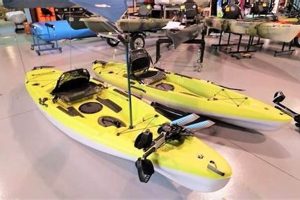
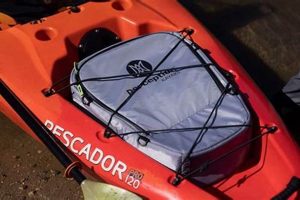
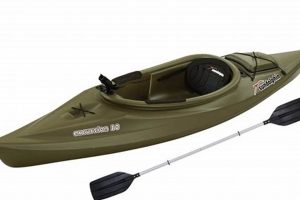
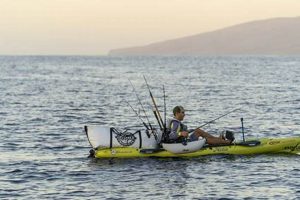
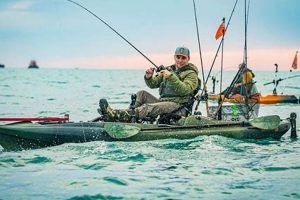
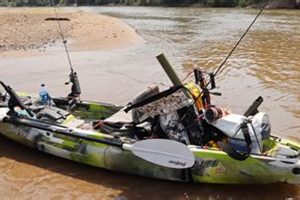
A kayak designed for fishing prioritizes stability, durability, and specialized features to ensure angler safety and success on the water. Such vessels often include features like high weight capacity, multiple rod holders, and ample storage for gear. A well-designed fishing kayak contributes to a secure and productive angling experience. For instance, a wider hull provides increased stability, reducing the risk of capsizing, especially in challenging conditions or when reeling in a large fish.
Prioritizing stability and specialized design in fishing kayaks has become increasingly critical as the sport grows in popularity. A secure and stable platform allows anglers to focus on fishing, enhancing their experience and reducing potential hazards. This focus on safety reflects a broader trend in recreational water sports towards improved equipment and practices. Historically, fishing kayaks were often adapted from general-purpose designs. Modern advancements, however, have led to purpose-built vessels that prioritize safety and performance-enhancing features specifically for anglers.
This discussion will delve into the key elements that contribute to a secure and efficient fishing kayak, exploring factors such as hull design, construction materials, and essential safety features. Furthermore, it will examine the evolution of these vessels and provide guidance on selecting the most appropriate craft based on individual needs and fishing styles.
Tips for Enhanced Safety in Fishing Kayaks
Careful consideration of various factors contributes significantly to a safe and enjoyable fishing kayak experience. These tips emphasize proactive measures and informed decision-making for enhanced on-water safety.
Tip 1: Check Weather Conditions: Prior to embarking on any fishing trip, thorough assessment of weather forecasts and water conditions is crucial. Avoid venturing out in strong winds, lightning storms, or hazardous conditions.
Tip 2: Wear a Personal Flotation Device (PFD): A properly fitted PFD should be worn at all times while on the water. This essential safety precaution can significantly increase chances of survival in the event of capsizing or unexpected emergencies.
Tip 3: Carry Essential Safety Gear: A waterproof bag containing a whistle, signaling mirror, first-aid kit, and communication device (e.g., VHF radio or waterproof cell phone) should be readily accessible. These items are vital in emergency situations.
Tip 4: Choose a Stable Kayak Design: Opt for wider, flatter-hulled kayaks for increased stability, especially in challenging conditions or when standing to cast. Consider kayaks specifically designed for fishing, prioritizing stability.
Tip 5: Distribute Weight Evenly: Proper weight distribution within the kayak is crucial for maintaining balance and preventing capsizing. Distribute gear evenly and avoid overloading the vessel.
Tip 6: Inform Someone of Your Plans: Always inform someone of your fishing plans, including your intended location, estimated return time, and emergency contacts. This ensures someone is aware of your whereabouts and can alert authorities if necessary.
Tip 7: Practice Self-Rescue Techniques: Familiarize oneself with self-rescue techniques specific to kayaks, such as re-entry methods. Practicing these maneuvers in calm water can prove invaluable in an emergency.
Adhering to these safety precautions enhances angler preparedness and contributes to a more secure and enjoyable fishing experience. Prioritizing safety enables anglers to focus on the sport with greater confidence.
By embracing these practices, individuals can significantly reduce risks associated with kayak fishing and contribute to a safer overall experience on the water. The subsequent conclusion will reiterate these critical safety points and offer final recommendations for responsible angling practices.
1. Stability

Stability forms a cornerstone of safety in fishing kayaks. A stable platform minimizes the risk of capsizing, a critical concern, particularly when engaging with larger fish, navigating challenging water conditions, or standing to cast. This stability is directly influenced by factors like hull design, kayak width, and weight distribution. Wider, flatter hulls generally offer greater initial stability, making them suitable for calmer waters and stand-up fishing. Conversely, longer, narrower hulls prioritize speed and tracking, potentially sacrificing some stability. The effective center of gravity, influenced by weight distribution within the kayak, also plays a significant role. Uneven distribution can compromise stability and increase capsize risk. For example, an angler shifting weight suddenly to one side during a cast can destabilize a narrow-hulled kayak, highlighting the practical importance of understanding stability principles.
Consider the scenario of landing a large fish. A stable kayak provides a secure platform to manage the struggle, reducing the likelihood of an angler being pulled overboard. Similarly, in rough waters or windy conditions, a stable kayak maintains its course more effectively, lessening the risk of capsizing due to wave action or wind gusts. Understanding the relationship between hull design and stability allows anglers to choose kayaks suited to their intended fishing environments and styles. A kayak designed for ocean fishing, for instance, will typically prioritize stability over maneuverability, given the potential for unpredictable wave action.
In summary, stability is paramount for safe kayak fishing. It directly influences the ability to manage various on-water challenges, from reeling in catches to navigating turbulent conditions. A thorough understanding of the factors influencing stability, combined with informed decision-making regarding kayak selection and weight distribution, significantly enhances angler safety and promotes a more confident and enjoyable experience. Neglecting these considerations can increase capsize risk, potentially leading to equipment loss, injury, or even graver consequences. Therefore, prioritizing stability when selecting and operating a fishing kayak is crucial for a secure and successful angling experience.
2. Hull Design

Hull design plays a crucial role in determining a fishing kayak’s performance and safety. Understanding the nuances of different hull types allows for informed decisions based on individual fishing styles and environmental conditions. The hull’s shape directly impacts stability, maneuverability, speed, and tracking, all critical factors for a secure and efficient fishing experience.
- Pontoon Hulls:
Characterized by two separate hulls connected by a platform, pontoon hulls provide exceptional stability, making them ideal for calmer waters and stand-up fishing. Their wide stance resists tipping, offering a secure platform for casting and reeling. This design, however, sacrifices maneuverability and speed compared to other hull types. Consider a fishing platform anchored in a shallow lake; the stable pontoon hull ensures anglers can fish comfortably without excessive rocking. However, navigating tight, winding streams or covering long distances would be less efficient with this design.
- Flat Bottom Hulls:
These hulls offer excellent primary stability, making them suitable for beginners and anglers prioritizing stability over speed. Their flat bottom provides a stable platform, particularly in calm waters, but can feel less stable in choppy conditions due to reduced secondary stability. They are often found in recreational kayaks used on lakes or slow-moving rivers. Imagine an angler fishing in a sheltered cove. The flat bottom hull provides a reassuringly stable base for casting and retrieving lures. However, encountering unexpected wakes from passing boats could lead to a less secure feel compared to a hull with more secondary stability.
- V-Shaped Hulls:
Designed for efficiency and speed, V-shaped hulls track well and cut through the water effectively. However, they offer less initial stability compared to flatter hulls. They are typically found in touring or sea kayaks designed for covering longer distances. Picture a kayak angler paddling across a large bay. The V-shaped hull allows them to efficiently cover the distance, maintaining a straight course even in light chop. However, this hull design requires more active balancing compared to a flatter hull, especially when stationary.
- Rounded Hulls:
Representing a compromise between stability and maneuverability, rounded hulls offer moderate performance in both areas. They are often found in recreational kayaks used in a variety of conditions. Envision an angler navigating a meandering river with moderate current. The rounded hull provides adequate stability while allowing for responsive turns and maneuverability around obstacles. This design strikes a balance, albeit without excelling in either stability or speed.
The selection of a hull design significantly impacts the overall safety and performance of a fishing kayak. Matching the hull type to the intended fishing environment and style is crucial for a secure and enjoyable experience. Prioritizing stability necessitates designs like pontoon or flat bottom hulls, while those seeking speed and efficiency may opt for V-shaped hulls. Ultimately, the safest hull design depends on individual needs and intended usage, with informed decision-making key to maximizing both safety and performance. Careful evaluation of these factors empowers anglers to choose kayaks best suited to their specific requirements and enhances their overall on-water experience.
3. Weight Capacity

Weight capacity is a critical factor in evaluating fishing kayak safety and performance. It represents the maximum combined weight of the angler, gear, and potential catch the kayak can safely support. Exceeding this limit compromises stability, increases the risk of capsizing, and can even lead to structural damage. Understanding and adhering to weight capacity guidelines is essential for a secure and enjoyable fishing experience.
- Total Weight vs. Maximum Capacity
Total weight encompasses everything brought onto the kayak, including personal weight, fishing gear, coolers, and any potential catch. Maximum capacity, specified by the manufacturer, represents the absolute upper limit the kayak can handle safely. It’s crucial to calculate total weight accurately and ensure it remains well below the maximum capacity to maintain stability and prevent overloading. For instance, a kayak with a 400-pound maximum capacity shouldn’t be loaded with 390 pounds, as this leaves minimal margin for unexpected weight shifts or the addition of a substantial catch. Operating consistently near the maximum capacity reduces the kayak’s freeboard, making it more susceptible to taking on water, further compromising stability and safety.
- Impact on Stability and Performance
Weight directly influences a kayak’s center of gravity and water displacement. Exceeding the weight capacity lowers the kayak in the water, reducing freeboard and increasing the risk of swamping. This lower center of gravity and reduced freeboard negatively impact stability, particularly in rough conditions or during sudden movements. Consider a heavily loaded kayak encountering choppy water; its low profile makes it more vulnerable to waves washing over the deck, potentially leading to capsizing. Conversely, a kayak operating well within its weight limit sits higher in the water, offering increased stability and maneuverability.
- Choosing the Right Capacity
Selecting a kayak with appropriate weight capacity requires careful consideration of anticipated loads. Anglers carrying substantial gear, targeting larger fish species, or planning extended trips should opt for kayaks with higher weight capacities. Conversely, lighter individuals fishing in calm waters with minimal equipment can safely choose kayaks with lower capacities. For example, an angler regularly targeting large saltwater species needs a kayak with a significantly higher weight capacity than someone fishing for panfish in a small pond. Choosing a kayak based solely on physical size without accounting for gear weight is a common oversight that can compromise both safety and performance.
- Weight Distribution
Even within the specified weight capacity, proper weight distribution is essential for maintaining stability. Concentrating heavy items at either end of the kayak can create instability, particularly in challenging conditions. Distributing weight evenly throughout the kayak, with heavier items placed lower and centrally, optimizes balance and performance. Imagine an angler placing a heavy tackle box at the bow of the kayak; this forward weight bias can make the kayak difficult to control, particularly in wind or current. Conversely, evenly distributing gear enhances tracking, maneuverability, and overall stability.
Weight capacity is inextricably linked to fishing kayak safety. Selecting a kayak with adequate capacity and maintaining proper weight distribution are crucial for stability, maneuverability, and preventing capsizing. Disregarding weight capacity guidelines compromises safety and jeopardizes the overall fishing experience. Choosing the right kayak based on realistic weight estimations, combined with diligent weight management practices, ensures a secure and enjoyable time on the water, allowing anglers to focus on fishing rather than battling instability.
4. Safety Features

Integral to the concept of a “safest fishing kayak” are specific safety features that enhance on-water security and mitigate potential risks. These features represent design elements and incorporated equipment that contribute directly to angler safety, enabling a more confident and enjoyable fishing experience. Careful consideration of these features during kayak selection is crucial for minimizing hazards and maximizing preparedness on the water.
- High Visibility Colors and Reflective Elements
Bright colors and reflective elements significantly improve kayak visibility in various conditions, including low light, fog, or open water. Enhanced visibility reduces the risk of collisions with other vessels, a critical safety concern, particularly in high-traffic areas. For example, a brightly colored kayak with reflective striping is more easily discernible by motorized boats, even in overcast conditions or at dusk. This increased visibility contributes significantly to accident prevention and enhances overall safety on the water.
- Multiple Secure Grab Handles
Strategically placed grab handles, securely attached to the kayak’s hull, provide crucial assistance in various situations, including self-rescue, re-entry after a capsize, and assisted rescues. Robust grab handles offer secure points for maneuvering the kayak, essential in challenging conditions or emergencies. Consider a scenario where an angler capsizes; well-placed grab handles facilitate re-entering the kayak, even in rough water, while also enabling others to assist in the rescue. Their presence is fundamental for effective self-rescue and external assistance, enhancing overall safety.
- Watertight Storage Compartments
Secure, watertight compartments protect essential gear from water damage, preserving vital equipment like communication devices, first-aid kits, and signaling devices. Maintaining dry gear is paramount in emergency situations, ensuring access to functioning tools when they are most needed. Imagine a situation where an angler needs to use a VHF radio to call for help; a watertight compartment ensures the radio remains dry and operational, enabling effective communication in a critical situation. This protection of essential equipment is a crucial aspect of preparedness and safety on the water.
- Built-in Rod Holders and Gear Tracks
Integrated rod holders and gear tracks secure fishing rods and other equipment, preventing loss and minimizing clutter within the kayak. Securely stored rods reduce the risk of entanglement and improve overall stability, allowing anglers to focus on fishing without the distraction of loose gear. Consider an angler navigating through dense vegetation; securely stored rods are less likely to snag on branches or debris, reducing the risk of capsizing or equipment damage. This organized and secure gear management contributes to a safer and more efficient fishing experience.
These safety features, while individually important, contribute collectively to the overall safety profile of a fishing kayak. Their presence enhances angler security, preparedness, and ability to respond effectively to unexpected situations. When evaluating fishing kayaks, prioritizing these safety features alongside stability, hull design, and weight capacity ensures a more informed decision-making process. A kayak equipped with comprehensive safety features provides a secure platform for enjoying the sport, allowing anglers to focus on fishing with enhanced confidence and peace of mind.
5. Construction Material
Construction material plays a pivotal role in determining a fishing kayak’s durability, performance, and ultimately, its safety. The chosen material directly influences the kayak’s resistance to impacts, UV degradation, abrasion, and overall longevity. These factors are critical for ensuring a secure and reliable vessel capable of withstanding the rigors of diverse fishing environments. Understanding the properties of various construction materials allows for informed decisions aligned with individual needs and intended usage.
Common materials include high-density polyethylene (HDPE), fiberglass, and thermoformed composites. HDPE, known for its impact resistance and affordability, makes it a popular choice for recreational fishing kayaks. Fiberglass kayaks offer higher performance in terms of speed and maneuverability, but often at a higher price point and with increased susceptibility to damage from impacts. Thermoformed composites represent a middle ground, balancing durability and performance characteristics. Consider a rocky coastline environment; an HDPE kayak is more likely to withstand scrapes and bumps against rocks compared to a fiberglass kayak, which could sustain cracks or fractures. This inherent material resilience directly contributes to the kayak’s long-term safety and usability.
Material selection impacts not only durability but also weight and maintenance requirements. HDPE kayaks are generally heavier than their fiberglass counterparts, potentially affecting portability and maneuverability. Fiberglass, while lighter, requires more meticulous maintenance to prevent gelcoat damage and maintain structural integrity. Thermoformed composites offer a balance between weight and maintenance needs. Understanding these trade-offs empowers informed decision-making, aligning material choice with individual priorities and usage scenarios. The connection between construction material and safety extends beyond initial durability; a well-maintained kayak, regardless of material, contributes to a safer on-water experience. Neglecting maintenance can lead to structural weakening, increasing the risk of failure in critical situations. Therefore, material selection should consider not only initial performance but also long-term maintenance requirements and their impact on sustained safety.
Frequently Asked Questions
This section addresses common inquiries regarding the selection and operation of fishing kayaks with a focus on safety. Clear and concise answers provide practical guidance for informed decision-making and enhanced on-water security.
Question 1: What makes a fishing kayak safe?
Key factors contributing to fishing kayak safety include stability, hull design, weight capacity, integrated safety features, and durable construction materials. A combination of these elements contributes to a secure and reliable platform for angling activities.
Question 2: Are sit-on-top kayaks safer than sit-inside kayaks for fishing?
Sit-on-top kayaks generally offer advantages in fishing scenarios due to self-bailing capabilities and easier re-entry after a capsize. Sit-inside kayaks, however, can provide greater protection from the elements in colder climates.
Question 3: How important is weight capacity when choosing a fishing kayak?
Weight capacity is crucial. Exceeding the manufacturer’s specified limit compromises stability and increases capsize risk. Accurate assessment of intended load, including angler weight, gear, and potential catch, is essential.
Question 4: What essential safety gear should one carry on a fishing kayak?
Essential safety gear includes a personal flotation device (PFD), whistle, signaling mirror, first-aid kit, communication device (VHF radio or waterproof cell phone), and a waterproof bag to protect these items.
Question 5: Are there specific safety considerations for fishing in different water conditions?
Yes, different water conditions present unique safety challenges. Calm lakes and rivers require less stability than open ocean or fast-flowing rivers. Wind, waves, and currents significantly influence kayak selection and operational safety procedures.
Question 6: How can one improve their fishing kayak safety skills?
Practicing self-rescue techniques, learning proper paddling strokes, and understanding weather patterns contribute significantly to improved safety skills. Formal kayak safety courses offer comprehensive instruction and enhance on-water preparedness.
Prioritizing safety through informed decision-making, appropriate equipment selection, and ongoing skill development ensures a more secure and enjoyable fishing kayak experience. Continuous learning and adaptation to specific environmental conditions are essential components of responsible angling practices.
The subsequent section will offer concluding remarks and summarize key takeaways for selecting the safest fishing kayak.
Safest Fishing Kayak
Selection of a fishing kayak prioritizing safety requires diligent consideration of multiple interconnected factors. Stability, influenced by hull design and weight distribution, forms the foundation of a secure on-water platform. Appropriate weight capacity, relative to anticipated load, prevents overloading and maintains performance integrity. Integrated safety features, such as high-visibility colors, grab handles, and watertight compartments, enhance preparedness and mitigate potential risks. Durable construction materials ensure longevity and resilience against environmental challenges. Understanding these elements empowers informed decision-making, aligning kayak choice with individual needs and intended usage.
Prioritizing safety in fishing kayak selection fosters a secure and enjoyable angling experience. Thorough evaluation of these critical elements contributes to informed decisions, promoting responsible practices and mitigating potential hazards. Continual emphasis on safety awareness and appropriate equipment selection ensures long-term enjoyment of the sport and promotes a culture of responsible on-water conduct.