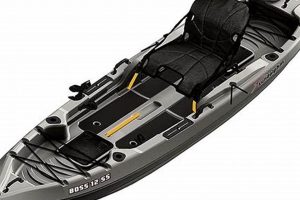
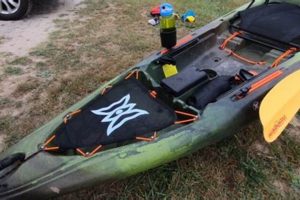
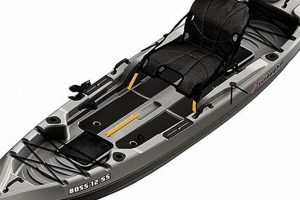
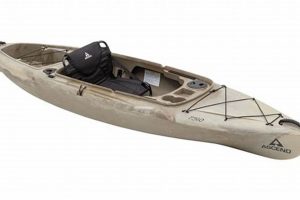
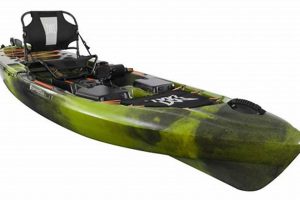
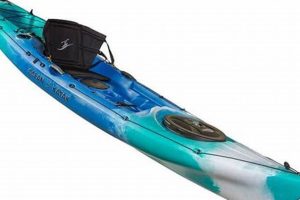
This specific model is a type of recreational watercraft designed for angling. It features a sit-on-top design, meaning the user is positioned above the hull, offering enhanced stability and easier access to the water. The 11.5-foot length provides a balance of maneuverability and tracking performance suitable for various water conditions. Constructed with fishing-specific features, it often includes rod holders, gear tracks, and storage compartments for tackle and equipment.
Sit-on-top kayaks offer several advantages for anglers. Their open design allows for greater freedom of movement and easier entry and exit compared to traditional sit-inside kayaks. This is particularly beneficial for anglers who may need to quickly adjust their position or re-enter the kayak after a swim. The stability of the platform also makes casting and landing fish more manageable. These vessels have become increasingly popular for recreational fishing due to their versatility and user-friendliness.
This discussion will further explore key features, performance characteristics, and considerations for selecting a fishing kayak suited to individual needs and preferences. Topics will include hull design, materials, stability, comfort, and essential accessories. The aim is to provide a comprehensive overview of factors influencing the selection and use of this type of watercraft for fishing.
Tips for Selecting and Using a Fishing Kayak
Choosing and utilizing a fishing kayak effectively involves careful consideration of various factors to ensure optimal performance and safety. The following tips offer guidance for maximizing the fishing experience.
Tip 1: Consider Water Conditions: Different hull designs perform better in specific environments. A shorter, wider hull offers greater stability in calm lakes and rivers, while a longer, narrower hull is better suited for open water or choppy conditions.
Tip 2: Evaluate Stability Needs: Anglers seeking a stable platform for standing and casting should prioritize kayaks with wider beams and flat bottoms. Those prioritizing speed and maneuverability may opt for slightly less stable designs.
Tip 3: Prioritize Comfort and Adjustability: A comfortable seat and adjustable footrests are crucial for longer fishing trips. Ensure the kayak offers adequate support and customization options for individual body types.
Tip 4: Assess Storage Capacity: Consider the amount and type of gear typically carried. Select a kayak with sufficient storage compartments, including dry storage for electronics and valuables.
Tip 5: Choose Appropriate Paddle Length: Paddle length depends on factors such as torso height, kayak width, and paddling style. Consult a paddling expert or retailer for guidance on selecting the correct size.
Tip 6: Practice Essential Safety Procedures: Always wear a personal flotation device (PFD) and carry essential safety equipment, including a whistle, signaling device, and first-aid kit. Familiarize oneself with basic paddling techniques and self-rescue procedures.
Tip 7: Research Local Regulations: Be aware of and adhere to all local regulations regarding kayak registration, permits, and fishing licenses.
By considering these factors, individuals can select and utilize a fishing kayak that enhances safety, comfort, and overall fishing success. Proper preparation contributes significantly to an enjoyable and productive experience on the water.
These tips provide a foundation for making informed decisions about fishing kayak selection and use. The subsequent conclusion will summarize key takeaways and reinforce the importance of thoughtful planning and preparation.
1. Sit-on-top Design

The sit-on-top design is a defining characteristic of the Perception Outlaw 11.5, fundamentally influencing its performance and suitability for fishing. This design distinguishes it from traditional sit-inside kayaks, offering distinct advantages and disadvantages for anglers.
- Enhanced Stability:
The sit-on-top configuration contributes to increased stability, particularly beneficial for activities like casting and landing fish. The higher center of gravity and wider hull design provide a more stable platform compared to sit-inside kayaks, reducing the likelihood of capsizing, especially in calmer waters. This enhanced stability is a key advantage for anglers seeking a secure and balanced fishing experience.
- Self-Bailing System:
Sit-on-top kayaks incorporate scupper holes that allow water to drain automatically, preventing water accumulation within the hull. This self-bailing feature is crucial for fishing in rougher conditions or when dealing with splashes and waves. It eliminates the need for manual bilge pumps and ensures the kayak remains buoyant and manageable, even in challenging environments.
- Ease of Entry and Exit:
The open design of sit-on-top kayaks simplifies entry and exit, a significant advantage for anglers who may need to quickly re-enter the kayak after a swim or adjust their position frequently. This accessibility makes them more user-friendly, especially for less experienced kayakers or those with mobility limitations. The ease of entry and exit also contributes to safety in emergency situations.
- Temperature Considerations:
While offering advantages in warmer climates, the open design of sit-on-top kayaks can expose users to greater temperature extremes. In colder conditions, anglers are more susceptible to wind and water chill, requiring appropriate clothing and gear. Conversely, direct sunlight can lead to overheating in hot weather. Anglers should consider these factors when choosing appropriate attire and planning trips.
These facets of the sit-on-top design contribute significantly to the Perception Outlaw 11.5’s suitability as a fishing platform. While the open design presents some temperature-related challenges, the enhanced stability, self-bailing capability, and ease of access make it a popular choice among anglers seeking a versatile and user-friendly fishing kayak.
2. Fishing-Specific Features
The Perception Outlaw 11.5 distinguishes itself through an array of features explicitly designed for angling. These integrated elements enhance functionality and cater to the specific needs of kayak anglers, contributing significantly to its appeal within the fishing community.
- Rod Holders:
Multiple rod holders, often including flush-mounted and adjustable varieties, allow anglers to securely store rods while paddling or preparing tackle. This keeps rods organized and readily accessible, crucial for efficient fishing. The positioning of these holders is strategically designed to minimize interference and maximize casting angles.
- Tackle Storage:
Dedicated compartments and storage wells, often with dry storage options, offer ample space for tackle boxes, bait, and other fishing essentials. These integrated storage solutions keep gear organized and protected from the elements, contributing to a clutter-free and efficient fishing experience.
- Gear Tracks:
Integrated gear tracks provide versatile mounting points for fish finders, GPS units, cameras, and other accessories. This adaptability allows anglers to customize their setup based on individual preferences and target species, enhancing the kayak’s versatility and functionality.
- Anchor Trolley System:
An anchor trolley system allows controlled anchoring from various positions on the kayak, enabling anglers to maintain position in currents or wind. This feature is essential for targeted fishing in specific locations, maximizing fishing effectiveness and control.
These fishing-specific features combine to create a highly functional and adaptable platform optimized for angling. The thoughtful integration of these elements significantly enhances the overall fishing experience, solidifying the Perception Outlaw 11.5’s position as a purpose-built fishing kayak. This focus on angler-specific needs distinguishes it from standard recreational kayaks, offering a dedicated and efficient platform for pursuing a variety of fish species in diverse aquatic environments.
3. Stability
Stability represents a critical performance attribute for fishing kayaks, directly influencing angler safety, comfort, and fishing effectiveness. The Perception Outlaw 11.5, designed specifically for angling, addresses stability through a combination of design elements contributing to a secure and balanced platform. The relatively wide hull and flat bottom enhance primary stability, resisting initial tipping, a crucial factor when casting, reeling, and landing fish. This inherent stability allows anglers to confidently shift weight and make quick movements without compromising balance. The sit-on-top design further contributes to stability by positioning the angler’s center of gravity higher, reducing the likelihood of capsizing. Consider an angler standing to cast in moderate chop; the inherent stability of this design instills confidence and allows for precise casts without the precariousness experienced in less stable kayaks.
Secondary stability, the kayak’s ability to recover from greater leans, also plays a significant role in overall performance. While the Outlaw 11.5 prioritizes primary stability for fishing activities, its secondary stability remains adequate for most on-water scenarios. For example, an angler unexpectedly encountering a wake or wave benefits from the hull designs ability to resist capsizing and maintain a degree of control, even when significantly tilted. This blend of primary and secondary stability contributes to a predictable and manageable on-water experience, instilling confidence and promoting safe angling practices. However, it’s crucial to recognize that stability can be affected by factors such as weight distribution, water conditions, and individual paddling techniques.
Understanding the stability characteristics of the Perception Outlaw 11.5 empowers anglers to make informed decisions about its suitability for their intended fishing environments and activities. While its design prioritizes a stable platform essential for fishing, acknowledging the interplay between primary and secondary stability, alongside external influencing factors, ensures realistic expectations and promotes safe paddling practices. This knowledge allows anglers to maximize their fishing effectiveness while prioritizing safety and comfort on the water.
4. Maneuverability

Maneuverability plays a crucial role in a fishing kayak’s effectiveness, dictating its ability to navigate various water conditions and access desired fishing spots. This characteristic is particularly relevant for the Perception Outlaw 11.5, influencing its suitability for different fishing environments and techniques. Understanding the factors contributing to its maneuverability provides valuable insights for anglers evaluating its performance capabilities.
- Hull Design:
The Outlaw 11.5s hull design strikes a balance between stability and maneuverability. Its moderate length (11.5 feet) and slightly rockered hull provide a blend of tracking performance and turning responsiveness. While not as nimble as shorter kayaks designed for tight maneuvering in creeks and rivers, it offers sufficient agility for navigating most fishing environments, including lakes, ponds, and slower-moving rivers. The hull design allows for efficient paddling while retaining the ability to change direction with relative ease.
- Water Conditions:
Maneuverability is influenced by prevailing water conditions. Calm, flat water allows for optimal responsiveness, enabling quick turns and precise adjustments in position. Conversely, strong winds or currents can significantly impact maneuverability, requiring greater effort to maintain desired course and position. Understanding the interplay between hull design and water conditions is essential for effective kayak control and safe navigation.
- Paddling Technique:
Efficient paddling techniques are crucial for maximizing maneuverability. Proper paddle strokes and body positioning contribute significantly to turning efficiency and directional control. Mastering sweep strokes and ruddering techniques allows for precise maneuvering in tight spaces or challenging currents. Conversely, inefficient paddling can hinder maneuverability, making it difficult to maintain desired course or execute quick turns.
- Weight Capacity and Distribution:
The kayak’s weight capacity and the distribution of weight within the hull influence its responsiveness and maneuverability. Exceeding the recommended weight capacity or uneven weight distribution can negatively impact tracking and turning performance. Proper weight distribution, with heavier items positioned lower and centrally, enhances stability and responsiveness, improving overall maneuverability.
Considering these factors provides a comprehensive understanding of the Perception Outlaw 11.5’s maneuverability characteristics. While its design prioritizes stability, it retains sufficient maneuverability for a range of fishing environments and scenarios. Understanding the interplay between hull design, water conditions, paddling technique, and weight distribution empowers anglers to optimize performance and navigate effectively while focusing on the fishing experience. This balanced approach to maneuverability contributes to the kayak’s versatility and suitability for diverse fishing applications.
5. Eleven and a half feet length

The 11.5-foot length of the Perception Outlaw kayak represents a deliberate design choice impacting performance characteristics relevant to kayak anglers. This length influences key aspects such as tracking, maneuverability, and storage capacity, affecting its suitability for various fishing environments and angling styles. The length contributes to a balance between straight-line tracking essential for covering distance efficiently and maneuverability required for navigating tighter spaces or changing direction quickly. Compared to shorter kayaks, the 11.5-foot length provides enhanced tracking, allowing anglers to paddle further with less effort, a significant advantage when traversing larger bodies of water or covering long distances to reach preferred fishing spots. Consider an angler paddling across a large lake; the increased length contributes to more efficient paddling and reduces fatigue over longer distances.
While the added length enhances tracking, it can slightly reduce maneuverability compared to shorter kayaks designed for navigating tight turns and obstacles common in rivers and streams. However, the Outlaw’s 11.5-foot length still allows for reasonable maneuverability in most fishing scenarios, particularly in open water or moderately flowing rivers. For example, navigating around weed beds or submerged structures requires a degree of maneuverability, and the kayak’s length allows for such adjustments while retaining sufficient tracking performance. Furthermore, the 11.5-foot length influences storage capacity. The longer hull generally provides more space for integrated storage compartments and gear tracks, allowing anglers to carry essential fishing equipment, including tackle boxes, rods, and other accessories. This increased storage capacity contributes to the kayak’s practicality and self-sufficiency for longer fishing trips.
The 11.5-foot length of the Perception Outlaw represents a design compromise balancing tracking performance, maneuverability, and storage capacity. This length makes it well-suited for a variety of fishing environments, particularly lakes, ponds, and slower-moving rivers, where moderate maneuverability and efficient tracking are prioritized. Understanding the impact of this length on performance characteristics allows anglers to make informed decisions based on individual fishing styles and target environments. The length contributes significantly to the kayak’s versatility as a fishing platform, allowing anglers to effectively explore various waterways while carrying necessary gear and maintaining efficient paddling performance.
6. Durable Construction
Durable construction is a critical factor influencing the lifespan and performance of the Perception Outlaw 11.5 sit-on-top fishing kayak. This attribute directly impacts its ability to withstand the rigors of on-water use, including impacts, abrasion, and exposure to the elements. A robust construction ensures long-term reliability and maintains performance over extended periods, contributing significantly to the kayak’s value and overall user experience.
- Material Selection:
High-density polyethylene (HDPE) is commonly used in kayak construction due to its impact resistance, durability, and UV resistance. HDPE can withstand impacts from rocks, logs, and other obstacles encountered in various aquatic environments. This material choice contributes to the kayak’s longevity and ability to maintain structural integrity over time, even with regular use in challenging conditions.
- Hull Thickness:
Hull thickness plays a crucial role in determining overall durability. A thicker hull offers greater resistance to punctures and impacts, enhancing the kayak’s ability to withstand collisions and abrasions. This structural integrity is particularly important in rocky or shallow environments where contact with submerged objects is more likely. The Outlaw’s hull thickness is optimized to balance durability with weight and performance.
- UV Resistance:
Exposure to sunlight can degrade kayak materials over time, leading to fading, cracking, and reduced structural integrity. UV-resistant coatings and additives protect the kayak from the damaging effects of prolonged sun exposure, preserving its appearance and structural integrity, ultimately extending its lifespan. This protection is crucial for kayaks frequently used in sunny climates.
- Manufacturing Processes:
Advanced rotational molding techniques contribute to uniform wall thickness and consistent material density, minimizing weak points and enhancing overall durability. This manufacturing process ensures structural integrity and reduces the likelihood of stress fractures or deformations, contributing to the kayak’s long-term reliability.
The durable construction of the Perception Outlaw 11.5 translates directly to a longer lifespan, reduced maintenance requirements, and sustained performance in demanding conditions. This robust build allows anglers to confidently navigate various waterways, knowing their kayak can withstand the rigors of regular use and exposure to the elements. This contributes significantly to the kayaks overall value and ensures reliable performance for extended periods, maximizing enjoyment and minimizing disruptions during fishing excursions.
7. Open Deck

The open deck design is a defining feature of sit-on-top kayaks, including the Perception Outlaw 11.5, significantly influencing its functionality and suitability for fishing applications. This design characteristic distinguishes it from traditional sit-inside kayaks, offering distinct advantages and influencing angler mobility, comfort, and overall fishing experience.
- Enhanced Accessibility:
The open deck allows for easy entry and exit, a significant advantage for anglers who may need to re-enter the kayak quickly after a swim or adjust their position frequently. This accessibility contributes to safety and convenience, particularly in dynamic fishing situations or for individuals with mobility limitations. Consider an angler needing to quickly adjust positioning to fight a hooked fish; the open deck facilitates such movements without the constraints of a closed cockpit.
- Increased Gear Storage:
The open deck provides greater flexibility for storing gear and equipment. Anglers can readily access and stow rods, tackle boxes, and other essentials directly on the deck, maximizing storage capacity and customizing gear arrangements based on individual preferences. This open design eliminates the limitations of enclosed storage compartments common in sit-inside kayaks, accommodating larger or irregularly shaped items.
- Improved Angler Mobility:
The unobstructed deck space allows anglers to easily shift position, stand up for casting, or maneuver within the kayak. This freedom of movement is essential for various fishing techniques and contributes to a more dynamic and adaptable fishing experience. An angler sight fishing in shallow water benefits significantly from the ability to stand and cast with enhanced visibility and range.
- Temperature Considerations:
While offering advantages in warmer climates, the open deck exposes anglers to the elements, requiring appropriate clothing and sun protection. In colder conditions, anglers are more susceptible to wind and water chill. Conversely, direct sunlight can lead to overheating in hot weather. These temperature considerations are essential factors influencing angler comfort and safety during extended fishing trips.
The open deck design of the Perception Outlaw 11.5 directly contributes to its suitability as a fishing platform. While requiring consideration of temperature-related factors, the enhanced accessibility, increased gear storage, and improved angler mobility make it a versatile and user-friendly option for various fishing styles and environments. This open design aligns with the demands of active kayak fishing, prioritizing angler movement and adaptability while enhancing the overall fishing experience.
Frequently Asked Questions
This section addresses common inquiries regarding the Perception Outlaw 11.5 sit-on-top fishing kayak, providing concise and informative responses to facilitate informed decision-making.
Question 1: What is the weight capacity of the kayak?
The weight capacity typically ranges between 425-500 lbs. depending on the model year and specific configuration. It’s crucial to verify the exact capacity for the specific model being considered.
Question 2: Is this kayak suitable for ocean use?
While designed primarily for lakes, ponds, and slow-moving rivers, the kayak can handle moderate ocean conditions, particularly in calmer bays or protected areas. However, caution is advised in rough seas or strong currents.
Question 3: What materials are used in its construction?
The kayak is typically constructed from high-density polyethylene (HDPE), a durable and UV-resistant material known for its impact resistance and longevity in various weather conditions.
Question 4: How does the kayak perform in windy conditions?
Due to its sit-on-top design and higher center of gravity, the kayak can be susceptible to wind drift. Use of a rudder or drift anchor can improve tracking and control in windy conditions.
Question 5: What is included with the kayak purchase?
Standard inclusions vary depending on the retailer and specific model but generally include the kayak hull, seat, and paddle. Additional accessories like rod holders or storage compartments may be integrated or sold separately.
Question 6: Can this kayak accommodate a trolling motor?
Some models of the Perception Outlaw 11.5 are designed for trolling motor compatibility and include pre-installed mounting points or integrated systems. It’s important to verify motor compatibility with the specific model being considered.
Addressing these frequently asked questions clarifies key aspects of kayak selection and use. This information assists potential users in evaluating the Perception Outlaw 11.5 based on individual needs and intended applications, promoting informed purchasing decisions and enhancing overall user satisfaction.
The following conclusion summarizes key takeaways and offers final considerations for those interested in acquiring the Perception Outlaw 11.5 sit-on-top fishing kayak.
Conclusion
This exploration of the Perception Outlaw 11.5 sit-on-top fishing kayak reveals a watercraft designed with angler-specific needs in mind. Key features such as the sit-on-top design, fishing-specific additions, and focus on stability contribute to its suitability for diverse fishing environments. The balance between maneuverability and tracking performance, coupled with durable construction, positions this kayak as a reliable option for anglers seeking a dedicated fishing platform. Understanding the interplay of design elements, performance characteristics, and potential limitations empowers informed purchasing decisions. Factors such as length, weight capacity, and open deck design contribute significantly to the kayak’s overall versatility and adaptability for various fishing styles and preferences.
Careful consideration of individual needs, target fishing environments, and desired performance characteristics remains paramount in kayak selection. The Perception Outlaw 11.5 presents a compelling option within the fishing kayak market, offering a blend of stability, functionality, and durability. Potential users are encouraged to research further and compare available options to determine the most appropriate kayak for specific angling requirements and desired on-water experiences. Continued exploration of kayak features and performance attributes empowers informed choices and contributes to enhanced enjoyment and success on the water.