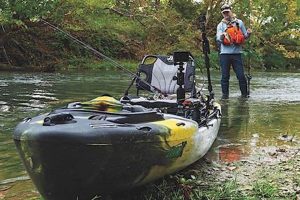
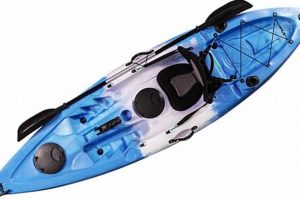
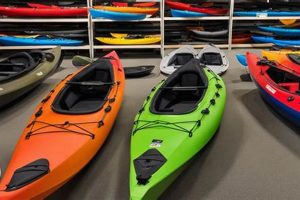
Fishing kayaks equipped with integrated livewells offer anglers the capability to maintain the health and vitality of their catch. These specialized tanks, often incorporated into the kayak’s hull, circulate water to keep fish alive and fresh for later release or consumption. An example includes a sit-on-top fishing kayak with a built-in, aerated livewell positioned behind the angler’s seat.
The ability to keep catches lively provides numerous advantages, including preserving fish for tournament weigh-ins, allowing for selective harvesting, and promoting ethical catch-and-release practices. This feature represents a significant advancement in kayak fishing, offering a level of convenience and fish care previously unavailable in smaller vessels. Historically, keeping fish alive on kayaks required cumbersome, makeshift solutions. The integration of livewells has streamlined the process, contributing to the growing popularity of kayak angling.
Further exploration will cover topics such as the different types of livewell systems available, factors to consider when selecting a kayak with this feature, proper livewell maintenance, and best practices for ensuring fish health and survival.
Tips for Utilizing Kayaks with Livewells
Effective use of a kayak’s livewell system ensures fish health and maximizes angling success. The following tips offer guidance on proper livewell operation and maintenance.
Tip 1: Pre-Trip Preparation: Prior to each fishing trip, the livewell should be thoroughly cleaned and inspected for leaks or damage. Adding a commercially available livewell treatment can help maintain water quality.
Tip 2: Proper Filling: Fill the livewell with water from the fishing location. This acclimates the fish to the ambient temperature and minimizes stress.
Tip 3: Oxygenation is Key: Ensure adequate oxygenation using either a built-in aerator, a portable bubbler, or periodic water changes. Oxygen levels are crucial for fish survival.
Tip 4: Minimize Handling: Handle fish gently and minimize air exposure when transferring them to the livewell. A wetted net or hand further reduces stress.
Tip 5: Appropriate Capacity: Avoid overcrowding the livewell. Fish require sufficient space to move comfortably and reduce competition for oxygen.
Tip 6: Regular Monitoring: Periodically check the livewell’s water temperature and clarity. Adjust as needed to maintain optimal conditions for the species being kept.
Tip 7: Post-Trip Care: After each trip, completely drain and clean the livewell. Allow it to dry thoroughly to prevent the growth of mold or mildew.
Adhering to these practices promotes responsible fishing and increases the likelihood of fish survival, whether for later release or consumption.
These considerations offer valuable insights into responsible and effective livewell usage, paving the way for a successful and ethical fishing experience.
1. Kayak Stability

Kayak stability is paramount when incorporating a livewell, particularly for anglers targeting larger or more active species. The added weight of water and fish within the livewell alters the kayak’s center of gravity, potentially impacting stability. A less stable kayak becomes more susceptible to tipping or capsizing, especially during maneuvers such as landing a fish, reaching for gear, or navigating choppy water. For example, a kayak with a higher center of gravity due to a raised livewell will be less stable than one with a lower center of gravity. The shifting weight of fish within the livewell further contributes to this dynamic instability. Selecting a kayak designed for stability, such as those with wider hulls or outriggers, becomes crucial when incorporating a livewell.
The interplay between kayak stability and livewell capacity presents practical considerations. A larger livewell, while offering the advantage of holding more fish, necessitates a correspondingly stable kayak platform. Anglers must balance desired livewell capacity with the need for stability to ensure a safe and efficient fishing experience. For instance, an angler frequently fishing in rough conditions and targeting larger species would prioritize stability over maximum livewell capacity. Conversely, an angler fishing in calm waters for smaller panfish might prioritize a larger livewell capacity on a stable platform. Understanding this relationship allows anglers to select appropriate kayak and livewell configurations aligned with their specific fishing needs and conditions.
In summary, kayak stability is a critical factor when utilizing a livewell. The added weight and dynamic movement of water and fish significantly influence the kayak’s stability characteristics. Careful consideration of kayak design, livewell capacity, and anticipated fishing conditions ensures a safe and effective fishing experience. Prioritizing stability minimizes the risk of capsizing and allows anglers to focus on fishing, contributing to a more successful and enjoyable outing.
2. Livewell Capacity

Livewell capacity represents a critical factor in kayak selection for anglers intending to keep their catch alive. This capacity directly influences the size and number of fish that can be comfortably and ethically maintained within the livewell, impacting both fishing practices and overall kayak performance. Understanding the nuances of livewell capacity is essential for informed decision-making and optimizing the angling experience.
- Species Size and Quantity:
Livewell capacity must align with the target species’ average size and the desired catch quantity. Anglers targeting larger species, such as bass or walleye, require a greater capacity than those pursuing smaller panfish. Similarly, anglers anticipating larger catches require a higher capacity to avoid overcrowding and maintain fish health. For example, a larger livewell might be necessary for tournament anglers aiming to keep multiple legal-sized bass alive throughout the day. Conversely, a smaller capacity would suffice for an angler targeting smaller panfish for a few hours.
- Kayak Size and Stability:
Livewell capacity influences kayak size and stability. Larger livewells, while accommodating more fish, increase overall kayak weight and volume. This necessitates a larger, more stable kayak platform to manage the added weight and maintain balance. For instance, integrating a large livewell onto a smaller, less stable kayak could compromise safety and maneuverability. Therefore, careful consideration of kayak size and stability is paramount when selecting a kayak with a specific livewell capacity.
- Aeration and Water Quality:
Livewell capacity directly relates to aeration requirements and water quality maintenance. Larger livewells containing more fish demand more robust aeration systems to maintain adequate oxygen levels. Increased fish density also contributes to faster water quality degradation, necessitating more frequent water changes or the use of livewell additives. For example, a high-capacity livewell may require a more powerful aerator pump and more frequent water changes compared to a smaller capacity livewell to ensure optimal fish health.
- Fishing Style and Duration:
Livewell capacity needs to align with individual fishing styles and trip durations. Anglers planning longer trips or practicing catch-and-release require larger capacities to sustain fish health throughout the day. Conversely, anglers fishing for shorter periods or targeting fish for immediate consumption may find smaller livewells sufficient. For instance, a kayak angler participating in a day-long tournament would benefit from a larger livewell capacity, while an angler fishing for a couple of hours for dinner might find a smaller capacity adequate.
Careful evaluation of these facets ensures informed selection of livewell capacity based on individual fishing needs and priorities. Properly balancing livewell capacity with kayak size, stability, and aeration capabilities optimizes both fish health and angling efficiency, contributing to a more successful and ethical fishing experience.
3. Aeration System

Effective aeration within a kayak livewell is crucial for maintaining the health and viability of captured fish. Oxygen depletion poses a significant threat to fish survival, especially in the confined environment of a livewell. Understanding the components, functionality, and maintenance requirements of aeration systems is essential for responsible and successful kayak angling.
- Aerator Types:
Various aerator types exist, each with distinct operational characteristics and suitability for different kayak livewell setups. Common types include recirculating pumps, venturi systems, and battery-powered bubblers. Recirculating pumps draw water from the livewell and pump it back through an aerating nozzle, creating water movement and introducing oxygen. Venturi systems utilize water flow to draw air into the livewell, while bubblers release air directly into the water. Choosing the appropriate aerator depends on factors such as livewell size, kayak battery capacity, and target species’ oxygen requirements.
- Power Source:
Aeration systems require a reliable power source for consistent operation. Many kayaks designed for fishing offer integrated power systems that can supply power to the livewell aerator. Alternatively, battery-powered aerators provide independent operation, offering flexibility for kayaks without integrated power systems. The chosen power source influences operational duration and requires careful consideration of battery life and charging capabilities, particularly during extended fishing trips.
- Water Flow and Circulation:
Maintaining adequate water flow and circulation within the livewell is essential for distributing oxygen evenly and preventing stagnant zones. Properly positioned aerators and strategically placed water intake and outflow ports contribute to efficient circulation, maximizing oxygen availability throughout the livewell. For example, an aerator placed near the bottom of the livewell promotes upward water movement, creating a more uniform oxygen distribution.
- Maintenance and Care:
Regular maintenance of the aeration system is crucial for long-term performance and reliability. This includes periodic cleaning of aerator components to prevent clogging from debris or algae buildup. Inspecting hoses, connections, and seals for leaks or damage also ensures continued functionality and prevents unintended water loss from the livewell. Proper maintenance extends the lifespan of the aeration system and contributes to consistent oxygen supply, safeguarding the health of the captured fish.
The selection, installation, and maintenance of an effective aeration system are integral to successful kayak fishing with a livewell. A well-maintained aeration system ensures adequate oxygen levels, minimizing stress on captured fish and promoting their survival. Understanding the interplay between aerator type, power source, water circulation, and maintenance procedures contributes significantly to responsible angling practices and a positive fishing experience.
4. Hull Integration

Hull integration of livewells in fishing kayaks significantly impacts vessel performance, stability, and overall angling experience. A well-integrated livewell becomes a seamless component of the kayak, minimizing drag, maximizing stability, and optimizing space utilization. Conversely, poorly integrated livewells can negatively affect handling, create instability, and reduce storage capacity. Understanding the principles of effective hull integration is crucial for informed kayak selection and maximizing on-the-water efficiency.
Consider a kayak with a poorly integrated, protruding livewell. This design creates additional drag, reducing paddling efficiency and requiring more effort to achieve the same speed compared to a kayak with a flush-mounted, integrated livewell. The protruding livewell also raises the center of gravity, potentially compromising stability, especially when maneuvering in challenging conditions or handling active fish. In contrast, a recessed, well-integrated livewell minimizes drag and maintains a lower center of gravity, promoting efficient paddling and enhanced stability. Such designs often incorporate the livewell into the existing hull contours, minimizing its impact on overall kayak performance. Furthermore, efficient integration maximizes available storage space within the kayak, allowing anglers to carry additional gear or tackle.
Effective hull integration involves careful consideration of factors such as livewell placement, size, and shape relative to the kayak’s hull design. Placement affects weight distribution and balance, influencing kayak stability and maneuverability. Livewell size impacts storage capacity and overall kayak weight, requiring careful consideration based on target species and fishing style. Livewell shape interacts with water flow dynamics, influencing drag and overall kayak performance. Challenges associated with hull integration include maintaining structural integrity while accommodating the livewell’s weight and volume, ensuring adequate access for maintenance and cleaning, and minimizing the impact on other kayak features such as seating and storage compartments. Addressing these challenges through thoughtful design and engineering contributes significantly to a positive and efficient fishing experience.
5. Maintenance Requirements

Maintaining kayaks equipped with livewells requires diligence to ensure optimal functionality, longevity, and ethical fish handling. Neglecting essential maintenance tasks can lead to equipment malfunction, reduced fish survival, and an unpleasant fishing experience. Regular upkeep addresses the unique demands of livewell systems, preserving their effectiveness and promoting responsible angling practices.
Livewell maintenance encompasses several key areas. Regular cleaning prevents the buildup of bacteria, algae, and fish waste, preserving water quality and minimizing the risk of fish disease. Inspecting pumps, aerators, and plumbing for leaks or damage ensures proper function and prevents unintended water loss or system failure. For example, a clogged aerator can lead to oxygen depletion within the livewell, jeopardizing fish health and survival. Similarly, a leaking pump can drain the kayak’s battery, shortening the operational time of essential systems. Addressing these issues proactively through regular inspection and maintenance prevents disruptions during fishing trips and promotes responsible fish care.
Furthermore, proper storage practices contribute significantly to livewell longevity. Draining and thoroughly drying the livewell after each use prevents mold and mildew growth, preserving its structural integrity and minimizing unpleasant odors. Protecting the livewell from extreme temperatures and UV exposure also extends its lifespan and maintains its functionality. Failing to address these maintenance requirements can result in costly repairs or premature replacement of the livewell system. Ultimately, a well-maintained livewell promotes healthy fish, contributes to a positive fishing experience, and reflects responsible angling practices.
Frequently Asked Questions about Kayaks with Livewells
This section addresses common inquiries regarding kayaks equipped with livewells, providing concise and informative responses to facilitate informed decision-making and responsible angling practices.
Question 1: What are the primary advantages of using a kayak with a livewell?
Livewells offer several benefits, including maintaining catch freshness for later consumption or release, enabling participation in tournaments requiring live weigh-ins, and facilitating selective harvesting practices.
Question 2: How does livewell capacity influence kayak selection?
Livewell capacity should align with target species size and anticipated catch quantity. Larger capacities necessitate larger, more stable kayaks to manage the added weight and volume.
Question 3: What types of aeration systems are commonly used in kayak livewells?
Common aeration systems include recirculating pumps, venturi systems, and battery-powered bubblers. Selection depends on factors such as livewell size, kayak power availability, and target species oxygen requirements.
Question 4: How does one maintain water quality within a kayak livewell?
Regular water changes, the use of commercially available livewell treatments, and minimizing fish handling contribute to maintaining optimal water quality and fish health.
Question 5: What factors influence kayak stability when using a livewell?
Livewell placement, water volume, and fish movement influence kayak stability. Wider hulls, outriggers, and proper weight distribution enhance stability when using a livewell.
Question 6: What maintenance procedures are essential for kayak livewells?
Regular cleaning to prevent algae and bacteria buildup, inspection of pumps and plumbing for leaks, and proper storage practices, such as draining and drying after each use, are essential for maintaining livewell hygiene and functionality.
Understanding these aspects of kayak livewells promotes informed selection, responsible usage, and a positive fishing experience.
The next section will delve into specific kayak models equipped with livewells, offering a comparative analysis of their features, performance, and suitability for various fishing styles.
Kayaks with Livewells
This exploration has provided a comprehensive overview of kayaks equipped with livewells, encompassing their functionality, benefits, and practical considerations. Key aspects discussed include the importance of kayak stability, the influence of livewell capacity on kayak selection, the critical role of aeration systems in maintaining fish health, the impact of hull integration on kayak performance, and the necessity of regular maintenance for optimal livewell functionality. Understanding these interconnected elements is crucial for informed decision-making and responsible angling practices.
The integration of livewells into kayak design represents a significant advancement in angling technology, offering enhanced capabilities for fish care and conservation. As technology continues to evolve, further refinements in livewell design and functionality can be anticipated, leading to improved fish survival rates and a more sustainable approach to recreational fishing. Careful consideration of the factors presented herein empowers anglers to make informed choices regarding kayak selection and livewell utilization, contributing to a more responsible and rewarding fishing experience.