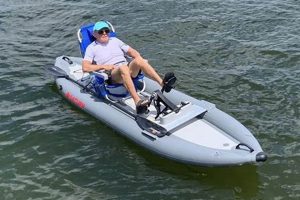
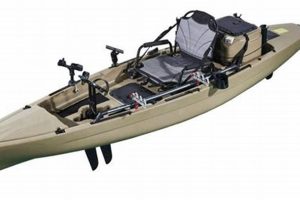
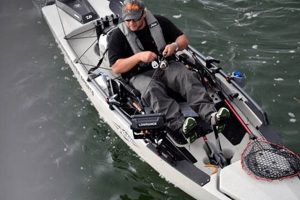
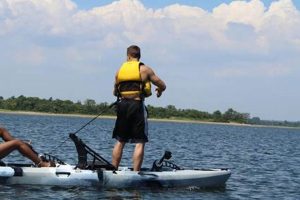
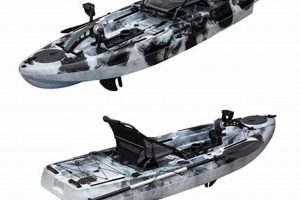
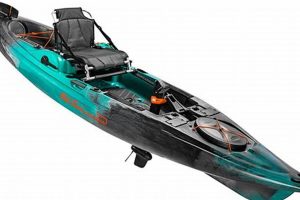
Hands-free propulsion kayaks designed for angling utilize pedal-driven systems. These vessels typically feature specialized seating, rod holders, and storage compartments tailored to the needs of anglers. An example is a sit-on-top design equipped with a propeller system controlled by leg movements, allowing the user to maintain position and navigate while simultaneously managing fishing gear.
Pedal-powered fishing kayaks offer significant advantages over traditional paddle kayaks. The freed hands enable anglers to focus on casting, reeling, and landing fish, improving efficiency and responsiveness. This propulsion method also allows for quieter movement, minimizing disturbance to fish and enhancing stealth. Furthermore, sustained, less strenuous propulsion over longer distances opens up new fishing areas previously difficult to reach by paddling. The development of these specialized watercraft reflects the increasing demand for sophisticated equipment catering to the growing popularity of kayak fishing.
This article will further explore the various types of pedal drive systems, their relative advantages and disadvantages, as well as key factors to consider when selecting a fishing kayak equipped with such a system.
Tips for Pedal Kayak Fishing
Optimizing the pedal kayak fishing experience requires careful consideration of several key factors. These tips address essential aspects, from pre-trip planning to on-the-water techniques.
Tip 1: Practice Pedal Operation: Familiarization with the pedal drive system before venturing onto the water is crucial. Understanding the nuances of forward and reverse pedaling, as well as turning maneuvers, enhances control and safety.
Tip 2: Plan Fishing Routes Strategically: Pre-trip route planning maximizes fishing time and minimizes wasted effort. Consider factors such as water depth, current, and known fish habitats when mapping intended fishing locations.
Tip 3: Organize and Secure Gear: Proper gear organization and secure storage are essential for maintaining a clutter-free and stable kayak. Utilize designated storage compartments and secure loose items to prevent loss or interference with pedaling.
Tip 4: Adjust Seat Position for Comfort and Efficiency: Proper seat positioning ensures both comfort and efficient pedaling. Adjust the seat height and backrest to achieve optimal biomechanics and reduce fatigue during long fishing trips.
Tip 5: Master Rudder Control: Effective rudder use enhances maneuverability and precise boat control, particularly in windy conditions or when navigating currents. Practice coordinated pedaling and rudder adjustments for optimal performance.
Tip 6: Employ Appropriate Anchoring Techniques: Understanding anchoring techniques specific to pedal kayaks maximizes stability while fishing in stationary positions. Consider using a stake-out pole or anchor trolley system for optimal positioning.
Tip 7: Maintain and Clean the Pedal Drive: Regular maintenance and cleaning of the pedal drive system ensure optimal performance and longevity. Rinse the system with fresh water after each use and follow manufacturer recommendations for lubrication and maintenance.
Implementing these strategies allows anglers to fully utilize the advantages of pedal-powered fishing kayaks, increasing efficiency, comfort, and overall fishing success.
By considering these factors, anglers can effectively leverage the unique capabilities of pedal kayaks to enhance their fishing experience.
1. Hands-free Fishing
Hands-free fishing represents a significant advantage offered by pedal-driven kayaks. This capability fundamentally alters the angling experience, allowing for increased efficiency and responsiveness. The direct connection between foot pedals and propulsion frees both hands for critical fishing tasks such as casting, retrieving lures, and fighting fish. This is particularly crucial in situations requiring quick reactions, like setting hooks or adjusting lines. Consider a scenario where an angler hooks a large fish; the ability to maintain boat control and manage the rod and reel simultaneously, without the need to paddle, becomes paramount.
This hands-free operation significantly impacts various fishing techniques. For example, trolling becomes considerably more manageable as anglers can adjust lure presentation and react to strikes without interrupting boat movement. Similarly, techniques like fly fishing, which demand precise line and rod control, benefit immensely from the continuous hands-free propulsion. Moreover, the freedom to manage multiple rods simultaneously expands fishing options and increases catch potential. The stability afforded by these kayaks, coupled with hands-free operation, also allows for easier handling of landing nets and other fishing accessories.
The hands-free nature of pedal kayaks directly translates to a more streamlined and productive fishing experience. This key feature not only simplifies existing techniques but also opens up possibilities for more complex maneuvers and improved responsiveness to changing fishing conditions. While factors such as pedal drive type and kayak design contribute to overall performance, the core benefit of hands-free operation remains a defining characteristic of this evolving fishing platform.
2. Increased Maneuverability

Maneuverability represents a critical performance attribute in fishing kayaks, directly influencing angling effectiveness. Pedal-powered systems offer distinct advantages in this domain, enhancing boat control and navigation precision compared to traditional paddle kayaks. This increased maneuverability stems from the integration of hands-free propulsion with rudder systems, enabling intricate adjustments and rapid directional changes.
- Precise Boat Positioning:
Pedal kayaks allow for precise boat positioning, crucial for targeting specific fish-holding locations. Anglers can maintain position in currents or wind with minimal effort, optimizing lure presentation and depth control. For example, holding steady near submerged structures or along weed lines becomes significantly easier, maximizing fishing effectiveness.
- Quick Turns and Adjustments:
Rapid directional changes become readily achievable with pedal-driven systems. The continuous propulsion combined with rudder control allows for quick turns and adjustments, essential for pursuing moving fish or reacting to changing current patterns. This responsiveness proves particularly valuable in dynamic fishing environments.
- Hands-Free Navigation:
Navigating complex waterways, such as narrow creeks or shallow flats, becomes simplified with pedal kayaks. Hands-free propulsion eliminates the need to switch between paddling and fishing, enabling continuous navigation while maintaining focus on the fishing task. This proves advantageous in situations requiring constant adjustments to avoid obstacles or follow contours.
- Improved Tracking and Stability:
Many pedal-driven kayaks exhibit improved tracking and stability compared to paddle kayaks, particularly in challenging conditions. The continuous propulsion counteracts the effects of wind and current, maintaining a straighter course and reducing the need for constant corrective strokes. This enhanced stability also benefits casting accuracy and fish fighting.
The increased maneuverability offered by pedal kayaks significantly enhances fishing versatility and effectiveness. This advantage translates to improved control in various fishing scenarios, from navigating challenging waterways to precisely positioning the boat for optimal presentations. While specific features and hull designs influence the degree of maneuverability, the fundamental integration of hands-free propulsion and rudder control remains central to this performance enhancement.
3. Enhanced Stability

Stability plays a crucial role in kayak fishing, impacting both angler comfort and fishing effectiveness. Pedal-driven kayaks offer inherent stability advantages due to their design and propulsion method. This enhanced stability directly translates to improved casting accuracy, more effective fish fighting, and a safer overall fishing experience. The following facets explore the key components contributing to enhanced stability in pedal kayaks.
- Lower Center of Gravity:
Pedal kayaks often feature a lower center of gravity compared to traditional paddle kayaks. The placement of the pedal drive system and the angler’s seated position contribute to this lower center of gravity, increasing stability and reducing the likelihood of capsizing. This inherent stability is particularly beneficial in rough water conditions or when dealing with larger fish.
- Wider Hull Design:
Many pedal kayaks utilize wider hull designs specifically to enhance stability. This wider beam provides a larger surface area in contact with the water, creating greater resistance to tipping. While wider hulls may slightly compromise speed, the added stability is a significant advantage for fishing, especially when standing to cast or reel.
- Weight Distribution:
The weight distribution in a pedal kayak also contributes to its overall stability. The placement of the pedal drive system, combined with the angler’s weight and gear, typically creates a balanced and stable platform. Furthermore, many pedal kayaks offer designated storage compartments that facilitate even weight distribution, further enhancing stability.
- Reduced Oscillation from Paddling:
Unlike paddle kayaks, pedal kayaks eliminate the side-to-side motion associated with paddling. This reduction in oscillation enhances stability, particularly during critical moments like casting or landing a fish. The consistent and smooth propulsion provided by the pedal drive contributes to a more stable and predictable platform.
The enhanced stability offered by pedal kayaks contributes significantly to angler confidence and fishing performance. This increased stability allows anglers to focus on the task at hand, whether it be casting accurately, fighting a fish effectively, or simply enjoying a comfortable and secure fishing experience. By understanding the design elements that contribute to enhanced stability, anglers can make informed decisions when selecting a pedal kayak that best suits their needs and fishing style. This inherent stability, coupled with other features like hands-free operation and increased maneuverability, distinguishes pedal kayaks as a specialized and effective platform for fishing.
4. Improved Propulsion Efficiency

Propulsion efficiency represents a critical performance factor in kayak fishing, directly influencing range, speed, and fatigue levels. Pedal-driven systems offer distinct advantages in this area, enabling anglers to cover greater distances with less effort compared to traditional paddling. This enhanced efficiency stems from the biomechanics of leg-powered propulsion and the consistent application of power. The following facets explore the key components contributing to improved propulsion efficiency in pedal kayaks.
- Biomechanical Advantages:
Leg muscles are generally larger and more powerful than arm muscles, providing a biomechanical advantage for sustained propulsion. Pedal drives leverage this advantage, allowing anglers to generate more power and maintain higher speeds over extended periods. This translates to less fatigue and the ability to cover greater distances, expanding fishing opportunities.
- Consistent Power Application:
Unlike paddling, which involves cyclical strokes with intermittent power application, pedal drives provide continuous and consistent propulsion. This consistent power delivery results in smoother, more efficient movement through the water, maximizing speed and minimizing energy expenditure. This proves particularly advantageous in currents or against headwinds.
- Hydrodynamic Efficiency:
Modern pedal drive systems often incorporate propeller or fin designs optimized for hydrodynamic efficiency. These designs minimize water resistance and maximize thrust, further enhancing propulsion efficiency. For example, propeller systems generate thrust by displacing water, while fin systems mimic the efficient propulsion of marine animals. This focus on hydrodynamic design contributes to improved speed and range.
- Reduced Energy Expenditure:
The combined effect of biomechanical advantages, consistent power application, and hydrodynamic efficiency results in reduced energy expenditure for anglers. This means less fatigue during long fishing trips, allowing anglers to focus on fishing rather than battling exhaustion. This increased endurance opens up possibilities for exploring more distant fishing grounds and spending longer hours on the water.
The improved propulsion efficiency offered by pedal kayaks significantly enhances the overall fishing experience. This advantage translates to greater range, increased speed, and reduced fatigue, allowing anglers to cover more water and maximize fishing time. By understanding the factors contributing to improved propulsion efficiency, anglers can appreciate the distinct advantages of pedal-driven systems and make informed decisions when selecting a fishing kayak that aligns with their specific needs and fishing style. This efficiency gain, coupled with the inherent stability and hands-free operation of pedal kayaks, contributes to their increasing popularity among serious anglers.
5. Quieter Operation
Stealth often proves crucial in angling, particularly when targeting wary species. Quieter operation represents a significant advantage of pedal-driven fishing kayaks compared to traditional paddle kayaks or motorized boats. Reduced noise output minimizes disturbance to fish, increasing the likelihood of successful approaches and improving catch rates. This advantage stems from the smooth, continuous motion of the pedal drive system and the absence of splashing associated with paddling.
- Reduced Fish Disturbance:
The quiet nature of pedal kayaks allows anglers to approach fish without creating excessive noise or vibrations that could spook them. This proves particularly advantageous in shallow water or clear water environments where fish are more easily startled. For example, approaching shallow flats populated by bonefish or redfish requires a stealthy approach, and a pedal kayak offers a distinct advantage in these scenarios. The reduced noise signature allows anglers to get closer to fish, increasing casting opportunities and improving presentation accuracy.
- Enhanced Stealth in Shallow Water:
Shallow water fishing often demands extreme stealth. The minimal water disturbance generated by a pedal drive allows for quiet maneuvering in shallow areas, maximizing fishing effectiveness without spooking fish in the shallows. This proves particularly beneficial when targeting species like trout or bass that inhabit shallow, clear streams and rivers. The ability to navigate silently through shallow water opens up new fishing opportunities previously difficult to access with noisier propulsion methods.
- Improved Presentations in Clear Water:
In clear water conditions, fish are more likely to detect approaching vessels. Pedal kayaks minimize noise and surface disturbance, allowing for more natural and less intrusive presentations. This subtle approach can significantly improve fishing success when targeting wary species in clear lakes or streams. The reduced visual and auditory disturbance associated with pedal kayaks enables closer approaches and more effective lure presentations without alerting the fish.
- Advantage Over Motorized Vessels:
Compared to motorized boats, pedal kayaks offer a significant advantage in terms of noise reduction. The absence of engine noise and vibrations creates a quieter and more natural fishing environment, reducing fish disturbance and improving catch rates. This proves particularly important in areas where motorized vessels are restricted or undesirable, such as protected waterways or pristine fishing environments. The quiet operation of pedal kayaks allows anglers to access these sensitive areas without disrupting the ecosystem or impacting the fishing experience of others.
The quieter operation inherent in pedal-driven fishing kayaks provides a distinct tactical advantage, enhancing angling stealth and increasing the likelihood of successful approaches to target species. This advantage proves valuable across diverse fishing environments, from shallow flats to clear lakes, and reinforces the position of pedal kayaks as a specialized and effective tool for serious anglers. The reduced noise signature, combined with the other benefits of pedal kayaks such as hands-free operation and enhanced maneuverability, contributes to a more refined and productive fishing experience.
6. Access to Shallower Waters
Shallow water zones often hold significant populations of desirable fish species, yet accessing these areas can prove challenging with traditional motorized boats or even paddle kayaks. Pedal-driven fishing kayaks offer a distinct advantage in this regard, providing access to shallower waters previously inaccessible or difficult to navigate. This capability expands fishing opportunities and allows anglers to target species that inhabit these productive shallow-water environments.
- Reduced Draft:
Pedal kayaks typically possess a shallower draft compared to motorized boats, enabling navigation in significantly shallower water. This reduced draft minimizes the risk of grounding or damaging the hull, allowing anglers to explore shallow flats, creeks, and backwater areas that would be inaccessible to larger vessels. For example, pursuing bonefish on shallow flats necessitates a shallow draft, making pedal kayaks an ideal choice.
- Quiet Approach:
The quiet operation of pedal kayaks further enhances their effectiveness in shallow water. Minimizing noise and vibration reduces disturbance to fish, allowing anglers to approach shallow-water species without spooking them. This proves crucial when targeting species like redfish or snook that are highly sensitive to noise and vibration, especially in shallow, clear water environments.
- Precise Maneuverability:
The precise maneuverability offered by pedal kayaks is particularly advantageous in shallow water. Anglers can navigate tight channels, weave through submerged vegetation, and maintain precise positioning in currents without disturbing the bottom or creating excessive noise. This level of control is essential for effectively targeting fish in complex shallow-water habitats.
- Environmental Considerations:
Accessing shallow waters with a pedal kayak often aligns with environmental preservation efforts. Unlike motorized boats, pedal kayaks do not rely on fossil fuels and produce no emissions, minimizing environmental impact on delicate shallow-water ecosystems. This environmentally friendly approach allows anglers to enjoy these pristine areas while contributing to their preservation.
The ability to access shallow waters represents a key advantage of pedal-driven fishing kayaks. This capability expands fishing opportunities, provides access to productive fish habitats, and aligns with environmentally conscious angling practices. By combining shallow-water access with the inherent stability, hands-free operation, and maneuverability of pedal kayaks, anglers gain a significant advantage in targeting species that inhabit these dynamic and often challenging environments. This combination of features solidifies the position of pedal kayaks as a versatile and effective platform for a wide range of fishing styles and target species.
Frequently Asked Questions
This section addresses common inquiries regarding pedal-driven fishing kayaks, providing concise and informative responses to clarify key aspects and address potential concerns.
Question 1: What are the primary advantages of a pedal-driven fishing kayak over a traditional paddle kayak?
Key advantages include hands-free operation for fishing tasks, increased maneuverability and precise boat control, enhanced stability, improved propulsion efficiency over longer distances, and quieter operation for stealthy approaches.
Question 2: How durable are pedal drive systems in saltwater environments?
Most modern pedal drive systems are designed for saltwater use, incorporating corrosion-resistant materials. Regular rinsing with fresh water and periodic maintenance are essential for longevity and optimal performance.
Question 3: Are pedal kayaks significantly heavier than paddle kayaks, and how does this affect transportation?
Pedal kayaks are generally heavier due to the pedal drive system. Transportation requires appropriate roof racks or trailers designed to handle the additional weight. Proper loading and securing techniques are essential for safe transport.
Question 4: What types of pedal drive systems are available, and what are their relative strengths and weaknesses?
Common types include propeller and fin systems. Propeller systems generally offer higher speeds in open water, while fin systems excel in shallow water and vegetation, offering better weedless performance. Specific system choice depends on intended fishing environments.
Question 5: What maintenance is required for a pedal drive system?
Regular rinsing with fresh water after each use is crucial. Periodic lubrication and inspection of moving parts, as outlined in the manufacturer’s instructions, are essential for maintaining optimal performance and preventing premature wear.
Question 6: Are pedal kayaks suitable for all fishing environments?
While pedal kayaks offer significant advantages in many fishing scenarios, they are not universally ideal. Extremely shallow water, heavy vegetation, or areas with numerous submerged obstacles may limit their effectiveness. Careful consideration of intended fishing environments is crucial when selecting a pedal kayak.
Addressing these common inquiries clarifies key aspects of pedal-driven fishing kayaks, enabling informed decisions based on individual needs and intended fishing applications.
The next section delves into specific models and manufacturers of pedal-driven fishing kayaks, offering a comparative analysis to guide selection.
Kayak for Fishing with Foot Pedals
Pedal-driven fishing kayaks represent a significant advancement in angling technology. This article explored key aspects of these specialized vessels, highlighting the advantages offered by hands-free propulsion. Enhanced maneuverability, improved stability, increased propulsion efficiency, quieter operation, and access to shallow waters distinguish these kayaks as effective fishing platforms. Understanding these core attributes enables informed decisions regarding selection and utilization, maximizing fishing effectiveness and overall experience.
The evolution of kayak fishing continues, driven by innovation and a demand for specialized equipment. Pedal-driven kayaks represent a significant step in this evolution, offering anglers distinct advantages in diverse fishing environments. As technology progresses, further refinements and innovations in pedal drive systems and kayak design are anticipated, promising even greater performance and expanded fishing opportunities. Careful consideration of individual fishing styles and target species remains crucial in selecting the optimal kayak and propulsion system for maximizing on-the-water success.