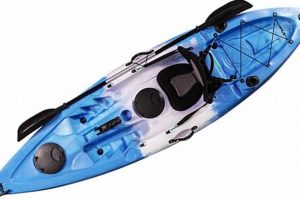
A weight limit of 350 pounds for a kayak refers to the maximum combined weight of the paddler(s), gear, and any other items the vessel can safely carry. This limit ensures the kayak remains stable and buoyant, minimizing the risk of capsizing or submersion. Exceeding this limit can compromise the kayak’s structural integrity and performance.
This weight capacity is a crucial safety factor for choosing a suitable kayak. Selecting a kayak with an appropriate weight limit prevents dangerous situations on the water. A higher limit allows for carrying more gear, accommodating larger paddlers, or enabling tandem kayaking. The development of kayaks with varying weight capacities demonstrates an evolution in design, catering to diverse needs and activities, from recreational paddling to fishing expeditions.
Understanding this fundamental principle of kayak selection allows for informed decisions regarding kayak types, intended use, and overall safety considerations. Exploring the various kayak categories and their respective capacities will further clarify the significance of this metric.
Tips for Kayaks with a 350-Pound Capacity
Selecting and using a kayak with a 350-pound weight capacity requires careful consideration to ensure safety and optimal performance. The following tips offer guidance for maximizing the benefits of this capacity.
Tip 1: Accurate Weight Calculation: Calculate the total weight of all intended passengers, gear, and equipment. This calculation should include personal weight, clothing, safety gear, paddles, dry bags, coolers, and any other items brought on board. Overestimation is recommended to maintain a safety margin.
Tip 2: Even Weight Distribution: Distribute weight evenly throughout the kayak, both lengthwise and widthwise. This balance enhances stability and prevents tipping. Centering heavier items low in the kayak also improves stability.
Tip 3: Consider Water Conditions: Calm, flat water generally allows closer proximity to the maximum weight capacity. Rougher water or strong currents require a larger safety margin between the total load and the capacity limit.
Tip 4: Test Stability Before Full Loading: Conduct a stability test in shallow water with a partial load before venturing into deeper water with a full load. This allows one to assess the kayak’s behavior and stability characteristics.
Tip 5: Regular Capacity Checks: Periodically verify the weight capacity listed on the kayak itself. This information may fade or become illegible over time. Refer to the manufacturer’s documentation for accurate specifications.
Tip 6: Tandem Kayak Considerations: When using a tandem kayak, coordinate movements and paddling strokes with the other paddler to maintain balance and efficient forward motion.
Tip 7: Respect the Limit: Never exceed the manufacturer’s stated weight capacity. This jeopardizes safety and risks structural damage to the kayak.
Adhering to these guidelines contributes to safe and enjoyable kayaking experiences while maximizing the utility of the kayak’s 350-pound weight capacity.
By understanding and applying these principles, individuals can confidently choose and utilize a kayak suitable for their specific needs and intended activities.
1. Safety
Safety is paramount when considering a kayak’s 350-pound capacity. This limit isn’t arbitrary; it represents the maximum weight the kayak can safely support without compromising stability and structural integrity. Ignoring this limit significantly increases the risk of capsizing, leading to potentially dangerous situations, especially in challenging water conditions.
- Buoyancy and Freeboard
A kayak’s buoyancy, its ability to float, is directly related to its weight capacity. Exceeding the 350-pound limit reduces freeboardthe distance between the waterline and the deck. Reduced freeboard increases the risk of water entering the kayak, potentially leading to swamping or capsizing. Maintaining adequate freeboard is crucial for safe operation.
- Stability and Center of Gravity
The 350-pound capacity influences the kayak’s center of gravity. Overloading shifts the center of gravity higher, making the kayak more prone to tipping. Proper weight distribution within the kayak becomes increasingly critical as the total weight approaches the capacity limit. Uneven distribution can further destabilize the vessel, especially during turns or in rough water.
- Structural Integrity
Kayaks are designed to withstand specific stress levels based on their weight capacity. Exceeding the 350-pound limit places undue stress on the hull, seams, and other structural components. This can lead to cracks, leaks, or even catastrophic failure, particularly in challenging conditions. Respecting the weight limit preserves the kayak’s structural integrity and ensures safe operation.
- Emergency Situations
In an emergency, such as a capsize, an overloaded kayak becomes more difficult to right and re-enter. The added weight can impede self-rescue efforts and increase the risk of injury or drowning. Adhering to the 350-pound capacity improves the chances of a successful self-rescue or assisted rescue in an emergency.
These facets of safety highlight the critical nature of the 350-pound capacity. It serves as a fundamental safety benchmark influencing buoyancy, stability, and structural integrity. Adhering to this limit is essential for minimizing risks and ensuring a safe and enjoyable kayaking experience.
2. Stability

Stability, a critical performance characteristic in kayaking, is intrinsically linked to the 350-pound weight capacity. This capacity represents the maximum weight a kayak can safely carry while maintaining a reasonable degree of stability. Exceeding this limit compromises stability, increasing the risk of capsizing. Understanding the factors influencing stability and their relationship to weight capacity is crucial for safe and enjoyable kayaking.
- Center of Gravity
A kayak’s center of gravity significantly influences its stability. The 350-pound capacity defines the upper limit of weight that allows for a manageable center of gravity. Adding weight beyond this limit raises the center of gravity, making the kayak more susceptible to tipping. Lowering the center of gravity by positioning heavier items closer to the bottom of the kayak enhances stability. For example, placing a cooler filled with supplies at the bottom of the hull contributes to a lower, more stable center of gravity compared to storing it on the deck.
- Hull Design
Kayak hull designs play a crucial role in stability. Wider hulls generally offer greater initial stability, making them less prone to tipping when stationary or at low speeds. However, wider hulls may be less maneuverable. Narrower hulls, while more maneuverable, offer less initial stability but often exhibit greater secondary stabilityresistance to capsizing when leaned. A kayak’s specified 350-pound capacity considers the hull design and its inherent stability characteristics. A wider, flatter hull might accommodate the 350-pound capacity with greater stability compared to a narrow, V-shaped hull.
- Weight Distribution
Even weight distribution within the confines of the 350-pound capacity is essential for optimal stability. Concentrating weight in one area of the kayak can create an imbalance, increasing the likelihood of tipping. Distributing weight evenly from bow to stern and side to side optimizes the center of gravity and enhances stability. For instance, distributing gear evenly in the front and rear storage compartments promotes balanced stability, whereas concentrating all gear in the stern could lead to instability.
- Water Conditions
Water conditions significantly affect kayak stability, especially as the total weight approaches the 350-pound capacity. Calm, flat water allows for greater stability, even near the maximum weight limit. However, rough water, strong currents, or waves can destabilize a kayak more easily, particularly if it is heavily loaded. Operating near the 350-pound capacity in challenging conditions requires increased caution and attention to balance. Exceeding the capacity in rough conditions drastically elevates the risk of capsizing.
These elements demonstrate the intricate relationship between stability and the 350-pound weight capacity of a kayak. Respecting this capacity limit and understanding how center of gravity, hull design, weight distribution, and water conditions influence stability contributes significantly to safer and more controlled kayaking experiences.
3. Performance
Performance in a kayak is significantly affected by its 350-pound weight capacity. This capacity isn’t merely a safety limit; it represents the optimal weight range for efficient and enjoyable paddling. Exceeding this limit negatively impacts speed, maneuverability, and tracking, while staying well below it may not fully utilize the kayak’s designed capabilities. Understanding this relationship is crucial for selecting the appropriate kayak for specific needs and activities.
Speed and Efficiency: A kayak loaded near its 350-pound capacity displaces more water, increasing drag and reducing speed. Paddling efficiency decreases as more effort is required to maintain the same speed compared to a lighter load. Consider a sea kayak designed for long-distance touring. Loaded near its 350-pound capacity with camping gear, it will move slower and require more energy to paddle than when carrying only a day’s worth of supplies. Conversely, a lightly loaded kayak, while easier to paddle, may not track as effectively, particularly in windy conditions.
Maneuverability and Tracking: A heavily loaded kayak, nearing its 350-pound capacity, becomes less maneuverable. Turning requires more effort, and the kayak may feel sluggish in responding to paddle strokes. Trackingthe ability to maintain a straight coursecan also be affected. A kayak loaded near its capacity may require more frequent corrective strokes to maintain its intended direction. For example, a recreational kayak used for exploring narrow waterways or maneuvering around obstacles will perform optimally with a lighter load, while a heavier load approaching the 350-pound limit will reduce its responsiveness.
Practical Significance: Understanding the impact of weight on performance is essential for selecting the appropriate kayak and managing gear effectively. Choosing a kayak with a capacity significantly higher than anticipated needs allows for future expansion of activities and gear acquisition. Conversely, selecting a kayak with too low a capacity limits versatility and may necessitate leaving essential items behind. Experienced kayakers often optimize performance by carefully considering the weight and distribution of their gear, aiming for a balance between capacity utilization and efficient paddling.
The 350-pound capacity serves as a critical benchmark influencing not only safety but also the overall performance of a kayak. Acknowledging this relationship allows for informed decisions regarding kayak selection, gear management, and paddling technique, ultimately enhancing the enjoyment and efficiency of kayaking experiences. Balancing the load within the specified capacity optimizes the kayak’s performance characteristics, resulting in a more rewarding experience on the water.
4. Weight Distribution

Weight distribution in a kayak plays a crucial role in its performance and safety, particularly concerning its 350-pound capacity. Proper distribution ensures the kayak remains balanced and stable, maximizing efficiency and minimizing the risk of capsizing. Understanding the principles of weight distribution is essential for any kayaker, especially when operating near the maximum capacity.
- Longitudinal Balance
Distributing weight evenly from bow to stern (front to back) is crucial for maintaining longitudinal balance. Too much weight at either end can cause the kayak to plow through the water (bow-heavy) or to squat (stern-heavy), increasing drag and reducing efficiency. For a 350-pound capacity kayak, proper longitudinal balance becomes increasingly critical as the total load approaches the limit. An uneven distribution can exacerbate the effects of wind and waves, making the kayak difficult to control.
- Lateral Balance
Lateral balance, or side-to-side stability, is equally important. Uneven weight distribution can cause the kayak to lean, increasing the risk of capsizing. Distributing weight evenly across the width of the kayak, particularly when carrying gear, helps maintain lateral balance. In a tandem kayak with a 350-pound capacity, the combined weight of two paddlers and their gear requires careful consideration of lateral balance to prevent tipping.
- Low Center of Gravity
Positioning heavier items low in the kayak creates a lower center of gravity, enhancing stability. Storing heavy gear near the bottom of the hull rather than on the deck or seat improves the kayak’s resistance to tipping. In a 350-pound capacity kayak, maximizing stability through a low center of gravity becomes even more critical as the load increases. Placing heavier items such as water bottles or batteries at the bottom of the hull, rather than in less stable locations, significantly improves stability.
- Impact on Capacity
While a kayak might have a stated 350-pound capacity, improper weight distribution can effectively reduce this limit. An unevenly distributed load can destabilize the kayak, making it behave as if it were overloaded, even if the total weight is below 350 pounds. Therefore, proper weight distribution is not just about performance; it directly impacts the practical capacity and safety margin of the kayak.
Effective weight distribution optimizes performance, enhances stability, and maximizes the usable capacity of a 350-pound kayak. By understanding and applying these principles, kayakers can ensure safer and more enjoyable experiences on the water, even when carrying heavier loads.
5. Gear Capacity
Gear capacity is intrinsically linked to a kayak’s 350-pound weight capacity. This relationship necessitates careful consideration of the type and amount of gear carried to ensure safe and efficient paddling. Exceeding the weight limit, even with essential gear, compromises stability and performance. Understanding how gear capacity interacts with the overall weight limit is crucial for successful kayaking experiences.
- Essential Gear versus Optional Items
Differentiating between essential safety gear and optional items is crucial when considering a kayak’s 350-pound capacity. Essential items, such as personal flotation devices (PFDs), paddles, first-aid kits, and signaling devices, should always be included, regardless of other gear. Optional items, such as fishing rods, cameras, or camping equipment, require careful evaluation based on their weight and necessity. Prioritizing essential gear within the weight limit ensures safety remains paramount.
- Weight Optimization Strategies
Optimizing gear weight is crucial for maximizing capacity utilization. Choosing lightweight materials, such as dry bags made of durable yet light fabrics, and minimizing unnecessary items contributes to a lower overall weight. Careful packing and distribution of gear within the kayak also play a significant role in maintaining balance and stability. For example, selecting a compact, lightweight camping stove instead of a bulkier model allows for other essential items to be included without exceeding the 350-pound limit.
- Trip Duration and Gear Requirements
Trip duration directly influences gear requirements and their impact on a kayak’s 350-pound capacity. Longer trips necessitate more supplies, such as food, water, and shelter, potentially pushing the total weight closer to the limit. Shorter trips allow for a lighter load, offering greater flexibility in gear choices. Accurately assessing gear needs based on trip duration ensures efficient packing and prevents exceeding the weight limit. For instance, a multi-day kayaking expedition requires significantly more supplies than a short afternoon paddle, influencing gear choices and weight management within the 350-pound capacity.
- Distribution and Accessibility
Strategic gear distribution within the kayak maximizes stability and accessibility. Distributing weight evenly from bow to stern and storing frequently used items within easy reach enhances both safety and convenience. Securing gear properly prevents shifting during paddling, which could compromise balance. For example, storing a first-aid kit in an easily accessible location while distributing heavier items evenly within the hull promotes both safety and efficient use of the 350-pound capacity.
Effective gear management within the constraints of a kayak’s 350-pound capacity is fundamental to a successful and safe kayaking experience. By prioritizing essential items, optimizing weight, and employing strategic distribution techniques, kayakers can fully utilize their kayak’s capabilities while ensuring safe and enjoyable outings.
6. Passenger Limit

Passenger limit, a critical aspect of kayak safety, is directly determined by the “kayak 350 pound capacity.” This capacity represents the maximum weight the kayak can safely support, encompassing passengers, gear, and any other items onboard. The passenger limit, therefore, must be calculated within this 350-pound constraint. Exceeding this limit, even with additional passengers whose individual weights seem negligible, significantly compromises stability and increases the risk of capsizing. For instance, a tandem kayak designated for two adults might appear to have ample capacity for a small child as well. However, the combined weight of two adults, the child, and associated gear could easily exceed the 350-pound limit, creating a dangerous situation.
The practical significance of understanding this connection is paramount for safe kayaking practices. Calculating the passenger limit requires accurate weight estimations for each individual and all accompanying gear. Overestimating individual weights and gear provides a crucial safety margin. Furthermore, passenger limit considerations influence kayak selection. A solo kayaker with substantial gear requirements might need a kayak with a higher capacity than 350 pounds, while two smaller individuals with minimal gear could safely utilize a tandem kayak with this capacity. Recognizing these factors empowers informed decisions regarding kayak choice, passenger numbers, and overall weight management.
In summary, the passenger limit is not an independent variable but a direct function of the “kayak 350 pound capacity.” Careful calculation of the passenger limit within this constraint ensures safe and stable kayaking experiences. Neglecting this relationship risks overloading the kayak, compromising stability, and increasing the likelihood of accidents. Understanding this connection is essential for responsible kayak use and promotes safe practices on the water.
7. Water Conditions

Water conditions significantly influence the practical implications of a kayak’s 350-pound weight capacity. Calm, flat water allows operation closer to the maximum capacity, while rougher conditions necessitate a greater safety margin. Understanding this relationship is crucial for safe and effective kayak handling.
- Currents
Strong currents exert additional force on a kayak, potentially destabilizing it, particularly when loaded near its 350-pound capacity. Paddling against a current requires increased effort, and an overloaded kayak may become difficult to control. For example, navigating a swift river with a fully loaded 350-pound capacity kayak can be challenging and requires advanced paddling skills. Reduced capacity allows for greater maneuverability and control in currents.
- Waves and Chop
Waves and choppy water present significant challenges for kayaks, especially those nearing their maximum weight capacity. The impact of waves can destabilize a kayak, increasing the risk of capsizing. A kayak loaded near its 350-pound capacity sits lower in the water, making it more susceptible to swamping in waves. Reducing the load in rough conditions enhances stability and safety. For instance, venturing into coastal waters with a 350-pound capacity kayak requires careful assessment of wave conditions and potentially reducing the load to maintain a sufficient safety margin.
- Wind
Wind affects kayak handling, particularly when operating near the 350-pound weight limit. Strong winds can push a kayak off course, requiring more effort to maintain direction. A heavily loaded kayak presents a larger surface area to the wind, exacerbating this effect. Reducing the load in windy conditions improves control and reduces the risk of being blown off course. Navigating a large lake in strong winds with a kayak loaded near its 350-pound capacity can be difficult and requires constant correction. Lowering the load improves handling and reduces wind drift.
- Water Temperature
While not directly impacting the 350-pound capacity itself, cold water significantly increases the risks associated with capsizing. An overloaded kayak in cold water presents a greater danger due to the increased risk of hypothermia. Maintaining a larger safety margin below the weight capacity in cold water conditions is prudent to minimize the potential consequences of a capsize. Paddling in cold water environments necessitates additional safety precautions, even within the specified 350-pound capacity, to mitigate the risks associated with immersion.
These factors highlight the critical relationship between water conditions and a kayak’s 350-pound capacity. Adapting to changing water conditions by reducing the load, even below the stated capacity, is crucial for maintaining stability and safety. Ignoring these factors increases the risks associated with kayaking and can lead to hazardous situations. Understanding this interplay allows for informed decision-making regarding appropriate loading and safe paddling practices in various water conditions.
Frequently Asked Questions
This section addresses common inquiries regarding kayaks with a 350-pound weight capacity, clarifying potential misconceptions and providing practical guidance for safe and informed kayak selection and usage.
Question 1: Does the 350-pound capacity include the weight of the kayak itself?
No. The 350-pound capacity refers solely to the maximum weight of passengers, gear, and any other items carried on board. The kayak’s own weight is separate.
Question 2: Can one exceed the 350-pound capacity by a small amount?
Exceeding the stated weight capacity, even slightly, is strongly discouraged. It compromises stability and increases the risk of capsizing. Maintaining a safety margin below the limit is always recommended.
Question 3: How is weight capacity determined?
Manufacturers determine weight capacity through rigorous testing, considering factors such as hull design, material strength, and intended usage. Adhering to these specifications ensures safe operation.
Question 4: Does weight distribution affect the 350-pound capacity?
Yes. Uneven weight distribution can destabilize a kayak, effectively reducing its practical capacity and increasing the risk of tipping, even if the total weight is below 350 pounds. Even distribution is crucial.
Question 5: What type of kayak is typically rated for 350 pounds?
Kayaks with a 350-pound capacity often include recreational kayaks, tandem kayaks, and some touring kayaks. The specific type varies depending on design and intended usage.
Question 6: How does water condition influence the 350-pound capacity?
Rough water, strong currents, and wind require operating further below the maximum capacity to maintain stability and control. Calm water generally allows operation closer to the 350-pound limit, but caution is still advised.
Understanding these key aspects of kayak weight capacity promotes safe and informed decision-making. Prioritizing safety within the specified limits ensures enjoyable and responsible kayaking experiences.
For further information on specific kayak models and their respective capacities, consult manufacturer specifications and reputable kayak retailers.
Kayak 350 Pound Capacity
The 350-pound weight capacity, a critical factor in kayak selection and usage, governs safe and efficient operation. This metric dictates not only the maximum combined weight of passengers and gear but also influences stability, performance, and overall suitability for various water conditions. Understanding the implications of exceeding this limitcompromised stability, reduced maneuverability, and increased risk of capsizingis fundamental for responsible kayaking. Proper weight distribution within the kayak further enhances stability and performance, maximizing the benefits of the designated capacity. Choosing a kayak based on accurate weight estimations, considering both individual weight and gear, ensures safe and enjoyable experiences on the water.
Respecting the 350-pound capacity is not merely a recommendation but a critical safety precaution. Informed decision-making, grounded in an understanding of this fundamental principle, empowers individuals to select appropriate kayaks and engage in safe paddling practices. This knowledge contributes to responsible enjoyment of the sport and fosters a culture of safety within the kayaking community. Prioritizing safety within established capacity limits ensures sustainable and rewarding experiences on the water for all.