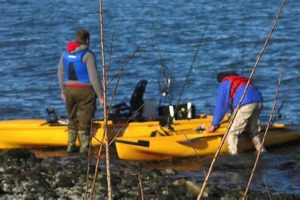
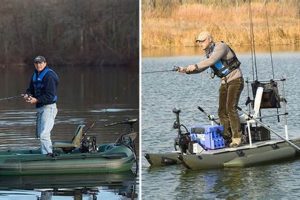
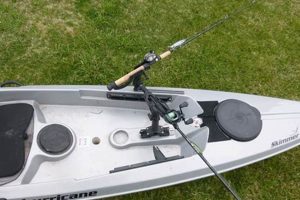
Small, human-powered watercraft designed for angling often feature pontoon-like attachments called stabilizers or outriggers. These extensions enhance lateral stability, reducing the likelihood of capsizing, particularly in challenging conditions like choppy water or when a large fish is being landed. They provide a wider platform, offering increased stability for anglers standing while casting or reeling.
Enhanced stability translates to a safer and more comfortable fishing experience. This allows anglers to focus on fishing rather than balancing, particularly valuable in offshore environments or when using techniques requiring more movement. Historically, outriggers were used on larger vessels; their adaptation to kayaks enhances the accessibility of stable fishing platforms for a wider range of users. The added stability also permits the integration of features like elevated seating and specialized equipment mounts, further enhancing the fishing experience.
This enhanced stability opens possibilities for anglers seeking improved performance and safety in diverse aquatic environments. The following sections will explore the various types of stabilizers available, their installation and maintenance, and the impact they have on kayak handling and performance in different fishing scenarios.
Tips for Utilizing Kayaks with Stabilizers
Optimizing the use of kayaks equipped with stabilizers involves understanding their impact on vessel performance and angler safety. The following tips provide guidance for maximizing the benefits of these stability-enhancing features.
Tip 1: Consider Water Conditions: Stabilizers offer significant advantages in rough water or strong currents but can be less beneficial in calm, shallow environments. Evaluate the expected conditions before deciding whether to deploy them.
Tip 2: Adjust Stabilizer Deployment: Some stabilizers offer adjustable deployment positions. Experiment with different settings to find the optimal balance between stability and maneuverability based on the specific fishing conditions.
Tip 3: Practice Deployment and Retrieval: Familiarize oneself with the deployment and retrieval mechanisms of the stabilizers before venturing onto the water. This ensures efficient and safe adjustments while afloat.
Tip 4: Account for Added Width: Stabilizers increase the overall width of the kayak. This needs consideration when navigating narrow passages or docking. Plan routes and maneuvers accordingly.
Tip 5: Maintain Stabilizer Hardware: Regularly inspect and maintain the hardware connecting the stabilizers to the kayak. Ensure all components are securely fastened and free from corrosion or damage.
Tip 6: Balance Weight Distribution: Even with stabilizers, proper weight distribution remains crucial for kayak stability. Distribute gear evenly throughout the vessel to prevent imbalances.
Tip 7: Understand Impact on Speed and Maneuverability: While enhancing stability, stabilizers can slightly reduce speed and maneuverability. Adapt paddling techniques and expectations accordingly.
By adhering to these guidelines, anglers can effectively leverage the stability advantages offered by these specialized kayaks while mitigating potential drawbacks, leading to a safer and more productive fishing experience.
The insights provided in this article aim to empower anglers to make informed decisions regarding the utilization of kayaks equipped with stabilizers, ultimately enhancing their enjoyment and success on the water.
1. Enhanced Stability

A primary advantage of fishing kayaks equipped with stabilizers, often referred to as “wings,” lies in their enhanced stability. This characteristic significantly impacts angler safety, comfort, and overall fishing effectiveness. The following facets explore the key components and implications of this enhanced stability.
- Reduced Capsize Risk
The wider base provided by deployed stabilizers significantly reduces the likelihood of capsizing, especially in challenging conditions such as choppy water, strong currents, or unexpected wakes. This is crucial for angler safety, particularly in offshore environments or when engaging with larger fish.
- Stand-Up Fishing Capability
Increased stability allows anglers to confidently stand while casting and retrieving, providing a better vantage point for spotting fish, improved casting accuracy, and greater leverage when fighting fish. This enhanced mobility contributes to a more active and engaging fishing experience.
- Improved Comfort and Reduced Fatigue
The stable platform minimizes rocking and swaying, reducing angler fatigue, particularly during longer fishing trips. This enhanced comfort allows for greater focus on fishing techniques and improves the overall experience, even in less-than-ideal conditions.
- Enhanced Gear Management
The stability provided by outriggers allows anglers to more easily access and manage gear, including tackle boxes, rods, and other equipment, without compromising balance. This contributes to a more efficient and organized fishing experience.
These combined benefits of enhanced stability contribute significantly to the overall effectiveness and enjoyment of kayak fishing. The ability to stand, the reduced risk of capsizing, and the improved comfort allow anglers to focus on the task at hand catching fish with increased confidence and reduced physical strain. This enhanced stability makes kayaks with stabilizers a compelling choice for anglers seeking a more secure and versatile on-the-water experience.
2. Improved Safety

Safety is paramount in any watersport, and kayak fishing is no exception. Integrating stabilizers, sometimes referred to as “wings,” onto fishing kayaks demonstrably enhances safety, mitigating risks inherent in the activity. This enhanced safety contributes significantly to angler confidence and allows for a more focused and enjoyable fishing experience.
- Reduced Capsize Risk
The primary safety benefit of kayak stabilizers lies in their ability to significantly reduce the likelihood of capsizing. The added lateral support provided by these extensions counteracts destabilizing forces such as waves, currents, and sudden shifts in weight distribution, which are common occurrences in kayak fishing, especially when landing a fish. This is particularly crucial in challenging offshore conditions or when anglers stand to cast or reel.
- Enhanced Stability in Adverse Conditions
Unexpected weather changes or unforeseen circumstances can create precarious situations on the water. Kayak stabilizers offer increased stability in adverse conditions like strong winds or choppy water, providing anglers with a greater margin of safety and reducing the risk of capsize during these critical moments. This allows for a more controlled and safer response to unexpected challenges.
- Increased Confidence for Novice Anglers
Beginners in kayak fishing often experience apprehension regarding balance and stability. Stabilizers offer a reassuring platform, allowing novice anglers to gain confidence and focus on developing their fishing techniques rather than constantly worrying about capsizing. This enhanced confidence can contribute to a more positive and enjoyable learning experience.
- Safer Handling of Larger Catches
Landing a large fish can create a significant destabilizing force on a kayak. The added stability provided by outriggers assists in managing these forces, reducing the risk of capsize during the exciting but potentially precarious moments of bringing a substantial catch onboard. This contributes to a safer and more successful angling experience.
The enhanced safety offered by kayak stabilizers translates to a more secure and enjoyable fishing experience. By mitigating the risks associated with capsizing and instability, these features allow anglers to focus on the sport with increased confidence, leading to greater peace of mind and a more rewarding time on the water. This improved safety profile makes kayaks equipped with stabilizers a particularly attractive option for anglers venturing into more challenging environments or those seeking an added layer of security.
3. Increased Capacity

The increased capacity afforded by fishing kayaks equipped with stabilizers, often referred to as “wings,” significantly enhances their utility and expands their range of applications. This added capacity translates to greater functionality and versatility, enabling anglers to carry more equipment, larger catches, and venture further afield with increased confidence.
- Enhanced Gear Storage
The inherent stability provided by stabilizers allows for the safe and effective utilization of additional storage options. Anglers can confidently carry more tackle, rods, and other essential equipment without compromising stability. This is particularly beneficial for longer expeditions or specialized fishing techniques requiring a diverse array of gear.
- Larger Catch Capacity
The stability offered by these platforms enables anglers to handle larger catches without jeopardizing balance. This expanded capacity increases the potential for successful outings targeting larger fish species and contributes to a more rewarding angling experience.
- Provisioning for Longer Expeditions
Increased capacity translates to the ability to carry additional supplies like food, water, and safety equipment, facilitating longer fishing trips and explorations of more remote locations. This extended range opens up new fishing opportunities and enhances the overall adventure.
- Accommodation of Specialized Equipment
The added stability and capacity allow for the integration of specialized equipment like fish finders, trolling motors, and other accessories, enhancing the fishing experience and increasing the likelihood of success. This adaptability caters to a wider range of fishing styles and preferences.
The increased capacity offered by kayaks with stabilizers contributes significantly to their versatility and effectiveness as fishing platforms. The ability to carry more gear, handle larger catches, and undertake longer expeditions expands the possibilities for anglers, enabling them to explore new waters, target different species, and pursue their passion with greater confidence and capability.
4. Versatile Fishing

Versatile fishing, the ability to adapt to various angling techniques and aquatic environments, is significantly enhanced by the utilization of kayaks equipped with stabilizers, often referred to as “wings.” The increased stability offered by these platforms expands angling possibilities, enabling techniques otherwise challenging or impossible in traditional kayaks. Cause and effect are directly linked; the enhanced stability directly enables techniques requiring greater freedom of movement and stability. For example, stand-up fishing, crucial for sight casting in shallow flats or fly fishing in moving water, becomes significantly more feasible and safe. Similarly, trolling with multiple lines or utilizing heavier tackle becomes less precarious. This versatility isn’t merely a convenient feature; it fundamentally transforms the fishing kayak into a multi-faceted angling platform. Consider an angler targeting both bass in a shallow lake and trout in a fast-flowing river. A kayak with deployable stabilizers enables this angler to effectively and safely employ different techniques in diverse environments within the same fishing expedition.
Practical applications of this versatility are numerous. Anglers can confidently switch between techniques like casting, jigging, and trolling without compromising stability. Furthermore, the increased stability accommodates diverse fishing environments, from calm lakes to choppy coastal waters. This adaptability is particularly valuable for anglers targeting a variety of species or fishing in unpredictable conditions. For example, an angler pursuing both inshore species and offshore game fish benefits significantly from the enhanced stability provided by these kayaks, enabling them to confidently navigate varying water conditions and employ appropriate techniques for each target species. This versatility contributes to a more productive and rewarding angling experience, maximizing opportunities for success.
The enhanced versatility offered by kayaks with stabilizers represents a significant advancement in kayak fishing technology. This adaptability unlocks new angling possibilities, enabling techniques and access to environments previously challenging or inaccessible for kayak anglers. While challenges regarding storage and maneuverability in tight spaces exist, the significant benefits in terms of stability and versatility outweigh these considerations for many anglers. Ultimately, this versatility empowers anglers to explore a wider range of fishing experiences, contributing to a more dynamic and fulfilling pursuit of their passion.
5. Adaptable Design

Adaptable design in fishing kayaks equipped with stabilizers, often called “wings,” centers around the ability to modify the configuration to suit varying fishing conditions and angler preferences. This adaptability manifests primarily in the stabilizers themselves. Retractible designs allow the user to deploy the stabilizers when enhanced stability is required, such as in rough water or when standing to cast, and retract them for improved maneuverability in calmer conditions or tight spaces. Adjustable stabilizers offer further customization, allowing anglers to fine-tune their position and angle to optimize performance based on factors like water conditions, fishing technique, and individual balance preferences. This design flexibility is crucial because it directly addresses the trade-off between stability and maneuverability inherent in kayak design. For example, an angler fishing in a sheltered cove might prioritize maneuverability to navigate tight channels, while the same angler venturing into open water would prioritize the stability offered by deployed stabilizers. The adaptability of these designs allows for seamless transitions between these differing needs.
The practical significance of adaptable design is readily apparent in diverse fishing scenarios. Consider an angler targeting different species in varying locations. When fishing for bass in shallow, weedy areas, retracted stabilizers allow for efficient movement through confined spaces. Later, when transitioning to offshore trolling for larger species, deploying the stabilizers provides the necessary stability for managing heavier tackle and larger catches. Similarly, adjustable stabilizers cater to diverse fishing techniques. A higher angle might be preferred for stand-up fishing, while a lower angle might be optimal for increased speed and tracking when paddling longer distances. This dynamic adaptability empowers anglers to optimize their kayak’s performance across a wide range of fishing situations, enhancing both efficiency and enjoyment on the water.
Adaptable design is a key element in the effectiveness and versatility of fishing kayaks equipped with stabilizers. The ability to adjust or retract these stability-enhancing features allows anglers to fine-tune their vessel’s performance to match the specific demands of each fishing scenario. While the added complexity of these mechanisms can introduce potential points of failure or require additional maintenance, the benefits of enhanced stability and maneuverability in diverse environments outweigh these considerations for many anglers. This adaptability ultimately expands the potential of the fishing kayak, allowing anglers to explore a wider range of fishing styles and environments with increased confidence and efficiency.
Frequently Asked Questions about Kayaks with Stabilizers
This section addresses common inquiries regarding kayaks equipped with stabilizers, aiming to provide clear and concise information for informed decision-making.
Question 1: How do stabilizers impact kayak speed and maneuverability?
While stabilizers enhance stability, they can slightly reduce top speed and maneuverability due to increased drag and wider profile. The impact is generally minimal, particularly with retractable or adjustable designs.
Question 2: Are stabilizers suitable for all water conditions?
Stabilizers offer the greatest advantage in rough water or strong currents. In calm, shallow environments, their benefits are less pronounced, and they might impede navigation in very confined areas.
Question 3: Do stabilizers make kayaks more difficult to transport and store?
Depending on the design, stabilizers can add to the overall width of the kayak, potentially impacting transport and storage. Retractable or removable stabilizers offer solutions to this challenge.
Question 4: What maintenance considerations apply to kayaks with stabilizers?
Regular inspection and maintenance of stabilizer hardware are essential. Ensuring all components are securely fastened and free from corrosion or damage is crucial for optimal performance and safety.
Question 5: Are stabilizers universally beneficial for all kayak anglers?
While offering significant advantages for many, stabilizers are not universally beneficial. Anglers prioritizing speed, maneuverability in tight spaces, or simplified setups might find them less advantageous. Individual needs and fishing styles should guide the decision.
Question 6: How do different stabilizer designs (e.g., inflatable, rigid) compare?
Rigid stabilizers typically offer greater stability, while inflatable options provide portability and ease of storage. Material durability and deployment mechanisms also vary between designs.
Understanding the advantages and limitations of kayaks with stabilizers is crucial for making informed purchasing and usage decisions. Careful consideration of individual fishing styles, target environments, and specific needs will guide anglers toward the most suitable configuration.
For further exploration of specific stabilizer types and their applications, continue to the next section detailing various designs and materials.
Fishing Kayak with Wings
Fishing kayaks equipped with stabilizers represent a significant evolution in angling from small watercraft. Enhanced stability, improved safety, increased capacity, versatile fishing applications, and adaptable designs contribute to a more effective and enjoyable on-the-water experience. While potentially impacting maximum speed and maneuverability, the benefits of increased stability and the ability to stand while fishing outweigh these considerations for many anglers, particularly those fishing in challenging conditions or requiring a more stable platform.
Careful consideration of individual fishing styles, target species, and preferred environments remains crucial in determining the suitability of a fishing kayak with stabilizers. The advancements in design and functionality offered by these specialized kayaks empower anglers to explore diverse fishing opportunities with enhanced confidence and capability. Continued exploration of stabilizer designs, materials, and integration with kayak platforms promises further innovation in this evolving segment of the fishing industry.