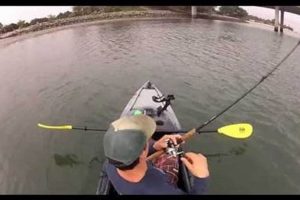
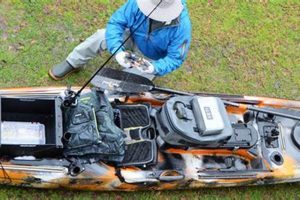
Motorized kayaks equipped with GPS-guided navigation systems offer hands-free movement across the water. These systems, often controlled via remote or mobile app, allow anglers to define routes, maintain positions against currents or wind, and return to specific locations. This technology represents a significant departure from traditional paddle or pedal-powered kayaks.
Automated navigation enhances the fishing experience by freeing up the angler’s attention and physical effort. This translates to more time focused on finding and catching fish, rather than navigating or maintaining position. Furthermore, these systems can improve safety by providing a reliable return-to-launch point function, particularly useful in changing weather conditions or unfamiliar waters. The evolution of these vessels has stemmed from a growing demand for more efficient and enjoyable fishing experiences, merging technological advancements with recreational activities.
This article further explores the various aspects of GPS-guided motorized kayaks, including the technology employed, the different models available on the market, and the impact this innovation has on the sport of fishing.
Tips for Utilizing GPS-Guided Motorized Kayaks
Effective use of motorized kayaks with GPS navigation requires careful planning and execution. The following tips offer guidance for maximizing the benefits and ensuring safe operation.
Tip 1: Pre-Trip Planning: Thorough planning is crucial. Chart intended fishing locations, routes, and alternative return points before embarking. Familiarize oneself with local regulations concerning motorized watercraft.
Tip 2: Battery Management: Understand the kayak’s battery capacity and range. Carry spare batteries or charging options, especially for longer trips. Monitor battery levels regularly.
Tip 3: Weather Awareness: Check weather forecasts before and during outings. Wind, currents, and changing conditions can significantly impact battery life and navigation accuracy. Exercise caution in adverse conditions.
Tip 4: System Familiarization: Thoroughly understand the operation of the GPS navigation system and remote control. Practice maneuvering and using the various features in a controlled environment before venturing into open water.
Tip 5: Safety Precautions: Always wear a personal flotation device (PFD). Carry essential safety equipment, including a whistle, signaling device, and communication tools. Inform someone of the intended fishing location and estimated return time.
Tip 6: Responsible Use: Respect wildlife and the environment. Avoid disturbing sensitive habitats or approaching wildlife too closely. Adhere to local fishing regulations and practice catch-and-release whenever possible.
Tip 7: Regular Maintenance: Regularly inspect and maintain the kayak and its navigation system. Follow the manufacturer’s guidelines for cleaning, storage, and any necessary software updates.
Adhering to these guidelines will enhance safety, improve fishing efficiency, and contribute to a more enjoyable experience on the water.
Through careful planning and responsible operation, anglers can fully utilize the advantages offered by these advanced fishing platforms.

GPS-guided navigation forms the foundation of automated control in fishing kayaks, transforming the angling experience. Precise positioning and route-following capabilities differentiate these vessels from traditional kayaks, offering distinct advantages for anglers.
- Waypoint Navigation
Waypoints, pre-defined locations marked by GPS coordinates, allow anglers to navigate to specific fishing spots, create routes, and automatically return to launch points. This feature simplifies navigation, especially in unfamiliar waters or challenging conditions. For example, an angler can mark a productive fishing area, drift away, and then effortlessly return to the exact location using the saved waypoint.
- Route Planning and Following
GPS systems enable the creation and execution of predefined routes. Anglers can plan a fishing route covering multiple locations and the system will autonomously guide the kayak along the designated path. This allows for efficient coverage of target areas and eliminates the need for constant manual adjustments. A common application is trolling along a specific depth contour or shoreline.
- Position Holding/Anchor Lock
Maintaining a precise position, especially in currents or wind, is crucial for certain fishing techniques. GPS-guided systems offer an “anchor lock” function that automatically adjusts the kayak’s motor to hold its position against external forces. This eliminates the need for a physical anchor, reducing noise and disturbance in the water, which can spook fish.
- Automated Return to Launch Point
This safety feature provides a reliable method for returning to the starting location. Particularly beneficial in changing weather conditions or when navigating unfamiliar waterways, the automated return function simplifies navigation and mitigates risks. It also offers peace of mind, especially for solo anglers.
These facets of GPS-guided navigation collectively contribute to the enhanced efficiency, safety, and overall fishing experience offered by autopilot kayaks. By automating navigation, anglers can dedicate more time and attention to the actual fishing process, maximizing their chances of success and enjoyment on the water.
2. Hands-Free Fishing

Hands-free fishing represents a significant advantage offered by autopilot kayaks. Automated navigation eliminates the need for constant paddling or pedal-powered propulsion, freeing the angler to focus entirely on fishing techniques. This capability is transformative, particularly in situations requiring precise bait or lure presentation, such as trolling, jigging, or fly fishing. For instance, an angler trolling for salmon can set a desired course and speed, then focus on rod manipulation and line control, maximizing the chances of a successful hookup. Similarly, an angler targeting specific structures can maintain position effortlessly, optimizing lure presentation without the distraction of managing the kayak’s movement.
The practical implications of hands-free fishing extend beyond individual techniques. Anglers can manage multiple rods simultaneously, increasing the chances of catching fish. Additionally, it reduces physical fatigue, allowing for longer and more productive fishing sessions. The ability to quickly adjust to changing conditions or fish behavior without manually maneuvering the kayak provides a significant tactical advantage. Consider a scenario where a school of fish suddenly appears; the angler can immediately cast and retrieve without having to reposition the kayak, maximizing the opportunity.
In summary, hands-free fishing, enabled by autopilot technology, enhances angling effectiveness and enjoyment. From intricate lure presentations to managing multiple lines and adapting to dynamic situations, the freedom from manual propulsion significantly improves the overall fishing experience. While challenges such as battery management and responsible use remain considerations, the benefits of hands-free fishing contribute significantly to the growing popularity of autopilot kayaks.
3. Increased Efficiency

Efficiency gains represent a core advantage of autopilot fishing kayaks. Automated navigation and hands-free operation streamline the fishing process, allowing anglers to maximize their time on the water and potentially improve their catch rates. Analyzing the facets of this increased efficiency reveals the significant impact of this technology on the angling experience.
- Reduced Travel Time to Fishing Spots
Automated navigation systems allow direct travel to designated fishing areas. Instead of paddling or pedaling, anglers can input coordinates or select pre-planned routes, minimizing travel time and maximizing time spent fishing. This is especially beneficial when targeting distant locations or navigating complex waterways. For example, an angler seeking offshore reefs can reach their destination more quickly, reserving energy and daylight hours for actual fishing.
- Optimized Lure Presentation and Retrieval
Maintaining precise speeds and courses enhances lure presentation, particularly for techniques like trolling. Autopilot systems allow anglers to fine-tune their approach, presenting lures at optimal depths and speeds without the distractions of manual propulsion. This improves the chances of attracting and hooking fish. Moreover, consistent retrieval speeds can be maintained, crucial for certain lures and presentations.
- Enhanced Focus on Fish Finding and Catching
By automating navigation and boat control, autopilot systems free the angler’s attention. This allows for greater focus on reading the water, interpreting sonar data, and reacting to fish activity. The elimination of manual propulsion tasks minimizes distractions and allows for quicker responses to opportunities. For example, an angler can dedicate full attention to sonar readings and immediately react to identified fish schools.
- Multitasking and Management of Multiple Rods
Hands-free operation enables anglers to manage multiple rods simultaneously. This increases the chances of catching fish by covering a wider area or employing diverse techniques concurrently. Autopilot systems facilitate this by handling boat control, allowing the angler to focus on rod manipulation, line management, and hooksets across multiple lines.
These facets of increased efficiency demonstrate how autopilot kayaks transform the fishing experience. By streamlining tasks and automating navigation, these vessels optimize the use of time and resources, enabling anglers to concentrate on the core elements of fishing: finding and catching fish. The resulting improvements in effectiveness and enjoyment contribute significantly to the appeal of this evolving technology.
4. Enhanced Safety Features

Safety considerations are paramount in any watersport, and autopilot fishing kayaks incorporate features designed to mitigate risks and enhance angler security. These features address potential hazards and contribute to a more secure on-the-water experience, fostering confidence and responsible enjoyment of the sport.
- Return-to-Launch Point Functionality
A key safety feature is the automated return-to-launch point capability. This functionality allows anglers to program their starting location and initiate an automated return at any time. This is invaluable in situations of disorientation, sudden weather changes, or emergencies. Consider a scenario where fog rolls in unexpectedly; the return-to-launch point function provides a reliable navigational aid back to safety.
- GPS Tracking and Location Sharing
Many autopilot systems integrate GPS tracking, allowing anglers to monitor their location and share it with others. This feature enhances safety by providing a record of the kayak’s movements and enabling real-time location monitoring by family or friends. In case of an emergency, this information can be crucial for search and rescue operations. For solo anglers, this provides an added layer of security.
- Stability and Maneuverability Enhancements
While not strictly safety features, the inherent stability and maneuverability offered by motorized kayaks contribute to overall safety. Electric motors provide controlled propulsion, even in challenging conditions, enabling safer navigation through currents, wind, or obstacles. Improved stability reduces the risk of capsizing, particularly in rough water. These characteristics enhance control and reduce the likelihood of accidents.
- Integration with Safety Equipment and Communication Devices
Some autopilot systems offer integration with other safety equipment, such as personal locator beacons (PLBs) or VHF radios. This integration streamlines communication in emergencies and allows for rapid response. Furthermore, the hands-free operation facilitated by autopilot allows for easier access to and operation of communication devices, should the need arise.
These enhanced safety features distinguish autopilot fishing kayaks from traditional kayaks, providing a greater margin of safety for anglers. While responsible operation and adherence to safety guidelines remain essential, these technological advancements contribute significantly to a more secure and enjoyable on-the-water experience. The integration of these features reflects a growing emphasis on angler safety within the evolution of kayak fishing technology.
5. Remote Control Operation
Remote control operation is integral to the functionality of autopilot fishing kayaks, providing the crucial link between the angler and the automated navigation system. This control mechanism enables direct and immediate command over the kayak’s movement and features, even when operating in hands-free autopilot mode. This integration of remote control with automated navigation distinguishes these kayaks from traditional motorized kayaks, offering enhanced precision and responsiveness. For example, an angler can initiate a return-to-launch point sequence, adjust trolling speed, or navigate around obstacles with a handheld remote, all without manually manipulating the kayak.
The practical significance of remote control operation extends to various fishing scenarios. Consider an angler spotting a promising cove while trolling along a pre-programmed route. Using the remote, the angler can temporarily override the autopilot, steer the kayak into the cove, and then resume automated navigation along the original route. This flexibility allows for dynamic adaptation to changing conditions or opportunities without interrupting the overall fishing strategy. Moreover, remote control operation facilitates precise adjustments to trolling patterns, depth control, and positioning for optimal lure presentation. This level of control enhances fishing effectiveness by allowing anglers to respond quickly and accurately to environmental cues and fish behavior. Furthermore, the remote control can be used to engage and disengage the motor, providing an additional layer of control over the kayak’s movement and power consumption.
Remote control operation, therefore, represents a critical component of the autopilot fishing kayak system. It bridges the gap between automated navigation and angler input, allowing for dynamic adjustments and precise control. This integration enhances the overall fishing experience by enabling efficient navigation, optimized lure presentation, and adaptable responses to on-the-water conditions. However, effective utilization requires familiarization with the specific remote control functionalities and an understanding of how they interact with the autopilot system. Mastering this interface is essential for maximizing the benefits of this technology and ensuring safe and successful fishing expeditions.
6. Motorized Propulsion

Motorized propulsion forms the foundation upon which the autopilot fishing kayak’s functionality rests. Without a reliable and controllable source of power, automated navigation and hands-free fishing become impossible. The connection between motorized propulsion and autopilot capabilities is fundamental, representing a synergistic relationship where each component enhances the other’s effectiveness. Electric motors, typically integrated into the kayak’s hull, provide the thrust necessary for executing automated movements. This integration allows the autopilot system to control speed, direction, and positioning with precision, responding to GPS data and user inputs via the remote control. Consider the scenario of maintaining a precise trolling speed against a current; the motor’s responsiveness to autopilot commands ensures consistent lure presentation, a critical factor for fishing success. Moreover, the quiet operation of electric motors minimizes disturbance to the aquatic environment, reducing noise pollution and avoiding potential disruption of fish behavior, crucial for stealthy approaches in shallow waters.
Further analysis reveals the practical significance of this integration. Variable speed control, a characteristic of most motorized propulsion systems, allows anglers to fine-tune their approach based on fishing conditions and target species. Slow trolling speeds are essential for certain types of fishing, while higher speeds might be required for covering larger areas or combating strong currents. This adaptability is facilitated by the seamless interaction between the motor and the autopilot system. The efficiency of motorized propulsion also extends to battery management. Modern electric kayak motors offer a range of power options and battery capacities, allowing anglers to select systems appropriate for their intended fishing duration and range. Understanding the interplay between motor power, battery capacity, and autopilot usage patterns is crucial for optimizing performance and ensuring sufficient power for both automated navigation and return trips. Furthermore, advancements in battery technology, such as lithium-ion batteries, offer improved energy density and longer run times, further enhancing the practicality of motorized propulsion for extended fishing expeditions.
In conclusion, the integral connection between motorized propulsion and autopilot functionality defines the modern fishing kayak. The electric motor serves as the responsive muscle, executing the commands of the autopilot system, while the autopilot provides the navigational brain, guiding the vessel based on pre-programmed routes and user inputs. This synergy enhances fishing efficiency, expands access to fishing locations, and improves angler safety. Challenges such as battery management and responsible use remain considerations, but the advancements in motorized propulsion technology continue to drive the evolution of the autopilot fishing kayak, shaping the future of the sport and providing anglers with powerful tools for enhanced on-the-water experiences. The ongoing development of more efficient motors, longer-lasting batteries, and more sophisticated integration with autopilot systems promises further improvements in performance, range, and overall fishing effectiveness.
7. Advanced Fishing Platforms

The term “advanced fishing platforms” encapsulates the evolution of fishing kayaks beyond basic personal watercraft into integrated systems designed to maximize angling effectiveness. Autopilot fishing kayaks represent a prime example of this evolution, integrating technology and design features to create a comprehensive and efficient fishing platform. This integration fundamentally changes the relationship between the angler and the watercraft, shifting the focus from navigation and propulsion to fish finding and catching. Consider the example of an angler targeting specific underwater structures. An autopilot fishing kayak allows precise navigation to and positioning around the structure, enabling the angler to concentrate solely on lure presentation and fish behavior, effectively transforming the kayak into a stable and responsive fishing platform.
This transformation is driven by several key factors. Integrated sonar systems, GPS-guided navigation, and hands-free operation combine to provide anglers with real-time information and precise control over their fishing environment. Live sonar feeds displayed on integrated screens provide detailed underwater imagery, revealing fish location, bottom structure, and depth contours. GPS waypoint navigation allows anglers to mark productive areas and return to them effortlessly, while autopilot systems maintain precise positions or follow pre-planned routes, further enhancing the platform’s stability and effectiveness. Furthermore, features like rod holders, tackle storage, and integrated lighting systems contribute to the overall efficiency and functionality of the fishing platform, allowing anglers to organize their gear and optimize their fishing approach. For instance, an angler trolling for pelagic fish can monitor multiple rods, adjust trolling speed and direction based on real-time sonar data, and maintain a consistent course using the autopilot systemall facilitated by the integrated nature of the advanced fishing platform.
The development of advanced fishing platforms like the autopilot fishing kayak signifies a shift towards greater integration of technology and design in angling. This integration enhances efficiency, improves safety, and ultimately increases the potential for successful fishing outcomes. However, the effective utilization of these advanced platforms necessitates a deeper understanding of the interconnected systems and a commitment to responsible use. Challenges such as battery management, ethical fishing practices, and the potential impact on traditional angling methods require careful consideration. Ultimately, the continued evolution of advanced fishing platforms promises to further refine the angling experience, providing new opportunities and challenges for anglers in the pursuit of their quarry.
Frequently Asked Questions
Addressing common inquiries regarding autopilot fishing kayaks provides clarity for prospective users and promotes informed decision-making.
Question 1: How does an autopilot system differ from a standard GPS on a fishing kayak?
A standard GPS provides location and navigational information. An autopilot system uses GPS data to actively control the kayak’s motor, enabling automated navigation and features like waypoint following and position holding.
Question 2: What are the typical battery life expectations for these kayaks?
Battery life depends on factors such as motor size, usage patterns (continuous vs. intermittent), battery capacity, and environmental conditions. Consulting manufacturer specifications for specific models is recommended. Generally, expect several hours of continuous use.
Question 3: Can these kayaks be used in saltwater environments?
Many models are designed for both freshwater and saltwater use. However, proper care and maintenance, including rinsing with fresh water after saltwater exposure, are essential for longevity.
Question 4: What are the legal requirements for operating these kayaks?
Regulations vary by jurisdiction. Consulting local boating authorities is crucial for understanding registration, licensing, and operational restrictions that may apply to motorized kayaks.
Question 5: What maintenance is required for the autopilot system and motor?
Regular maintenance, as outlined in the manufacturer’s instructions, is essential. This may include software updates for the autopilot system, propeller inspection and cleaning, and general upkeep of the motor and electrical components.
Question 6: Are there limitations to where these kayaks can be used?
Certain areas may restrict motorized watercraft. Checking local regulations and respecting environmental sensitivities, such as protected habitats or designated no-wake zones, is crucial.
Understanding these key aspects empowers potential users to make informed choices regarding the suitability of autopilot fishing kayaks for their specific needs and environments. Thorough research and careful consideration of individual requirements remain crucial for maximizing the benefits and ensuring safe operation of these advanced fishing platforms.
The subsequent sections will explore specific models and manufacturers, providing further insights into the diverse offerings available within the autopilot fishing kayak market.
Conclusion
Motorized kayaks equipped with GPS-guided navigation systems represent a significant advancement in fishing technology. This article has explored the core components of these systems, including GPS-guided navigation, hands-free fishing, increased efficiency, enhanced safety features, remote control operation, motorized propulsion, and the overall concept of advanced fishing platforms. Each aspect contributes to a transformative angling experience, offering benefits ranging from optimized lure presentation and reduced physical exertion to improved safety and access to previously inaccessible fishing locations. Understanding the interplay of these elements is crucial for leveraging the full potential of these sophisticated systems.
The continued development of autopilot fishing kayak technology promises further enhancements to the sport. As battery technology advances, range and operational duration will likely increase, opening up new possibilities for exploration and extended fishing trips. Further integration with sonar, fish-finding technology, and environmental monitoring systems may further refine the angling experience, providing anglers with unprecedented levels of information and control. However, responsible use and careful consideration of the potential environmental impacts remain paramount. The future of autopilot fishing kayaks hinges on a balance between technological advancement and sustainable angling practices. Only through thoughtful engagement with this evolving technology can its full potential be realized while preserving the integrity of the aquatic environment and the spirit of the sport.