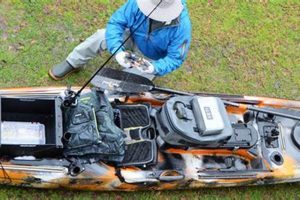
A specialized storage solution designed for anglers, this equipment typically mounts on the deck of a kayak, providing quick access to essential fishing gear. Imagine a readily accessible and organized compartment for lures, lines, tools, and other small items crucial for a successful fishing trip, positioned conveniently within arm’s reach.
This type of gear organization enhances efficiency and safety on the water. Having vital equipment secured and readily available minimizes time spent searching, reduces clutter, and allows the angler to focus on fishing. Historically, kayak anglers often relied on less specialized storage, such as tackle boxes or dry bags. The evolution of purpose-built storage reflects the growing popularity and specialization within kayak fishing.
This discussion will further explore key features to consider when selecting such a product, including materials, design, mounting options, and capacity, as well as popular brands and models available on the market.
Tips for Selecting and Using Kayak Fishing Deck Bags
Choosing and utilizing appropriate storage is crucial for a successful and enjoyable kayak fishing experience. The following tips offer guidance on selecting and effectively using this specialized equipment.
Tip 1: Consider Capacity and Organization: Evaluate storage needs based on typical fishing trips. Prioritize bags with compartments and pockets to maintain organization and prevent gear from shifting during paddling.
Tip 2: Prioritize Durable and Waterproof Materials: Opt for marine-grade materials resistant to UV rays, abrasion, and water damage. Seams should be sealed or welded for enhanced waterproofing.
Tip 3: Evaluate Mounting Options and Stability: Ensure the bag attaches securely to the kayak deck and remains stable during paddling and fishing. Look for adjustable straps and non-slip bases.
Tip 4: Assess Accessibility and Ergonomics: The bag should allow easy access to frequently used items while minimizing interference with paddling or casting.
Tip 5: Factor in Visibility and Safety Features: Consider bags with reflective elements or attachment points for lights to enhance visibility in low-light conditions.
Tip 6: Think About Drainage and Ventilation: Proper drainage prevents water accumulation inside the bag, while ventilation helps dry stored items and prevents mildew.
By considering these factors, anglers can select a storage solution that enhances their efficiency, safety, and overall enjoyment on the water.
These tips provide a solid foundation for selecting and using kayak fishing deck bags. The following section concludes with final thoughts on the importance of proper gear organization for kayak anglers.
1. Accessibility

In kayak fishing, accessibility translates to the ease and speed with which essential gear can be retrieved and stowed. A well-designed deck bag significantly impacts this accessibility, influencing efficiency and safety on the water. This section explores key facets of accessibility related to these specialized storage solutions.
- Placement and Reach:
Optimal placement allows anglers to access frequently used items without shifting body weight or interrupting paddling rhythm. A deck bag positioned within easy reach eliminates the need to contort or search blindly for gear. This is particularly crucial in dynamic fishing situations requiring quick reactions. For example, having pliers readily available for hook removal contributes to both fish and angler safety.
- Bag Design and Opening Mechanism:
The bag’s opening and closure mechanism should be intuitive and operable with one hand. Zipper designs, closures, and overall bag construction influence how quickly items can be accessed. Overly complex or stiff closures can impede access, especially in challenging weather conditions or when hands are wet. Wide openings and strategically placed compartments allow for quick identification and retrieval of necessary tools and tackle.
- Internal Organization:
Internal compartments, dividers, and pockets facilitate organized storage and prevent gear from shifting during paddling. This organization promotes efficient retrieval and prevents time wasted searching for specific items. Clear pockets or labeled compartments further enhance visibility and accessibility. A well-organized bag allows anglers to maintain focus on fishing rather than searching for lost lures or tools.
- External Attachment Points:
Exterior loops, straps, or attachment points provide additional accessibility for frequently used tools like pliers, line cutters, or fish grips. These external points keep essential tools within immediate reach, reducing the need to open the main compartment. This feature further enhances efficiency and safety, particularly in situations requiring quick access to critical tools.
By carefully considering these facets of accessibility, anglers can select a kayak fishing deck bag that optimizes on-the-water efficiency and contributes to a safer and more enjoyable fishing experience. The right balance of placement, design, and organization transforms a simple storage bag into a valuable tool for maximizing fishing success.
2. Durability
Durability is a critical factor in the selection of a kayak fishing deck bag. These bags are exposed to harsh environmental conditions, including UV radiation, saltwater, and abrasion from gear and the kayak itself. A durable bag ensures reliable performance and longevity, protecting valuable equipment and contributing to a positive fishing experience. The following facets explore the key components of durability related to these specialized storage solutions.
- Material Selection:
The primary material of the bag plays a crucial role in its overall durability. High-quality materials, such as heavy-duty nylon or polyester with a denier rating of at least 600D, offer excellent abrasion and tear resistance. Marine-grade fabrics specifically designed for water-resistance and UV protection further enhance longevity. For example, a bag constructed with ripstop nylon will be more resistant to tears and punctures than one made of a lighter-weight material.
- Construction Quality:
Beyond material selection, the construction quality of the bag significantly impacts its durability. Reinforced stitching, particularly in high-stress areas like seams and attachment points, contributes to overall strength. Welded or sealed seams offer superior water resistance compared to traditional stitching. A bag with robust construction can withstand the rigors of repeated use and exposure to the elements, protecting stored gear from damage.
- Hardware and Zippers:
High-quality hardware, such as corrosion-resistant zippers, buckles, and D-rings, plays a vital role in the long-term durability of the bag. Zippers should operate smoothly and resist saltwater corrosion. Durable buckles and D-rings provide secure attachment points and contribute to the overall strength of the bag. Choosing a bag with reliable hardware ensures continued functionality and prevents premature failure due to corrosion or breakage.
- UV Resistance:
Prolonged exposure to sunlight can degrade materials, causing fading and weakening. A UV-resistant coating or treatment protects the bag from sun damage, preserving its color and structural integrity. This is particularly important for kayak fishing, where bags are frequently exposed to direct sunlight for extended periods. A UV-resistant bag will maintain its appearance and functionality over time, offering extended service life compared to a non-treated bag.
Investing in a durable kayak fishing deck bag ensures reliable performance and protects valuable equipment from the elements. By considering the material selection, construction quality, hardware, and UV resistance, anglers can choose a bag that withstands the rigors of kayak fishing and provides years of reliable service. This ultimately contributes to a more enjoyable and productive fishing experience.
3. Water Resistance
Water resistance is paramount for kayak fishing deck bags, given their constant proximity to water. Protecting essential gear from moisture and splashes, even full submersion in some cases, is crucial for maintaining functionality and preventing damage. This characteristic directly impacts the longevity of stored items and the overall success of a fishing trip. The following facets explore the key components of water resistance in these specialized storage solutions.
- Fabric Properties:
The fabric’s inherent water resistance stems from its construction and treatment. Tightly woven fabrics with Durable Water Repellent (DWR) finishes provide the first line of defense against moisture. DWR coatings cause water to bead and roll off the fabric’s surface. For example, nylon and polyester fabrics with a polyurethane coating or a laminated waterproof membrane provide higher levels of water resistance than untreated fabrics. The chosen fabric directly influences the bag’s ability to repel water and protect contents from splashes and light rain.
- Seam Construction:
Seams represent potential entry points for water. Taped or welded seams prevent water from seeping through stitch holes. Taped seams involve applying a waterproof tape over the stitching, while welded seams use heat or ultrasonic welding to create a waterproof bond. A bag with fully taped or welded seams offers superior protection compared to one with simple stitching. This is particularly important for items stored at the bottom of the bag, which are more susceptible to water damage.
- Closure Mechanisms:
The closure system significantly impacts water resistance. Roll-top closures, waterproof zippers, or flap-covered zipper systems create a barrier against water ingress. Roll-top closures, commonly found in dry bags, offer excellent protection against submersion. Waterproof zippers utilize a rubberized coating to prevent water from passing through the zipper teeth. The closure’s design directly influences the bag’s ability to prevent water entry during rain or accidental submersion.
- Waterproof Ratings:
Waterproof ratings provide a standardized measure of a bag’s water resistance. The IPX rating system, for example, classifies levels of protection against water ingress. A higher IPX rating indicates greater protection. Understanding these ratings helps anglers select a bag appropriate for their specific needs and expected conditions. A bag with an IPX7 rating, for instance, can withstand temporary submersion, while an IPX4 rating indicates protection against splashing water. This allows anglers to make informed decisions based on the level of water resistance required for their fishing environment.
Selecting a kayak fishing deck bag with appropriate water resistance safeguards essential gear and ensures functionality in various weather conditions. Understanding the factors contributing to water resistance, including fabric properties, seam construction, closure mechanisms, and waterproof ratings, allows anglers to choose a bag that meets their specific needs and provides reliable protection for valuable equipment. This ultimately contributes to a more successful and enjoyable fishing experience.
4. Storage Capacity
Storage capacity significantly influences a kayak fishing deck bag’s practicality and utility. Adequate capacity ensures essential gear remains readily accessible, streamlining the fishing process and minimizing disruptions. Insufficient capacity, conversely, necessitates difficult choices regarding what gear to bring, potentially compromising preparedness and fishing success. Consider a scenario where an angler encounters changing water conditions requiring a different lure type. A deck bag with ample capacity readily accommodates various lure options, while a smaller bag may force the angler to return to shore for re-equipping, disrupting the fishing flow.
Balancing storage capacity with kayak stability and maneuverability presents a practical challenge. Overly large or heavily packed bags can shift the kayak’s center of gravity, affecting stability, particularly in rough water or during casting. Furthermore, bulky bags may interfere with paddling strokes or impede access to other onboard equipment. For instance, a large bag positioned too far forward can obstruct paddle entry and exit, hindering efficient paddling. Conversely, a bag positioned too far aft can interfere with rod placement and casting. Optimal storage capacity considers the angler’s typical gear requirements while maintaining kayak balance and maneuverability. Modular or expandable deck bag designs offer versatility, allowing anglers to adjust capacity based on specific trip requirements.
Appropriate storage capacity directly contributes to a more efficient and enjoyable kayak fishing experience. Balancing gear needs with kayak stability requires careful consideration of bag size, placement, and organization. Modular designs and thoughtful packing strategies offer solutions for varying gear requirements, enhancing adaptability on the water. Ultimately, selecting a deck bag with appropriate storage capacity empowers anglers to focus on fishing, rather than managing gear limitations.
5. Secure Mounting

Secure mounting is paramount for kayak fishing deck bags, directly impacting both safety and efficiency on the water. A stable, non-shifting bag allows anglers to focus on fishing, rather than managing precarious gear. Consider a scenario where a loosely mounted bag slides toward the angler’s legs during a hooked fish retrieval. This sudden shift in weight can disrupt balance and potentially lead to capsizing, particularly in challenging conditions. Conversely, a securely mounted bag remains in place, allowing for unhindered movement and gear access.
Several factors contribute to secure mounting. Multiple attachment points, strategically positioned on the bag and kayak deck, distribute weight and minimize movement. Durable straps, buckles, and non-slip bases further enhance stability. Attachment systems should accommodate various kayak deck configurations, including bungee cords, D-rings, and track systems. Compatibility between the bag’s mounting system and the kayak’s deck hardware is essential for achieving optimal stability. For instance, a bag designed for track mounting will not be suitable for a kayak lacking a track system.
The practical significance of secure mounting extends beyond mere convenience. It ensures readily accessible gear while maintaining kayak stability and balance. A stable deck bag contributes to a safer and more efficient fishing experience, allowing anglers to focus on the task at hand. Choosing a bag with robust mounting options and ensuring proper installation directly impacts on-the-water performance. This understanding underscores the critical link between secure mounting and overall fishing success.
6. Organized Compartments

Organized compartments within a kayak fishing deck bag contribute significantly to on-the-water efficiency and safety. Consider the scenario of a hooked fish struggling near the kayak. Rapid access to pliers or a line cutter becomes crucial. A deck bag with dedicated compartments for these tools allows for immediate retrieval, minimizing handling time and stress on both fish and angler. Conversely, rummaging through a disorganized bag wastes valuable time and increases the risk of tangles or lost gear. This organized approach translates directly to a smoother, more controlled fishing experience. Dedicated compartments also prevent damage to sensitive electronic devices, such as fish finders or GPS units, by separating them from hooks, lures, and other potentially harmful items.
Practical examples further illustrate the importance of organized compartments. A compartment specifically designed for leader material keeps spools untangled and readily available for quick re-rigging. Similarly, compartments for various lure types, categorized by size or action, streamline lure selection based on prevailing water conditions or target species. This level of organization allows anglers to adapt quickly to changing circumstances, maximizing fishing opportunities. Furthermore, clear compartments or labeled dividers enhance visibility, eliminating the need to blindly search for specific items, thereby reducing wasted time and frustration. This organizational structure translates to a more streamlined and productive fishing experience.
The advantages of organized compartments extend beyond mere convenience. They represent a strategic approach to gear management, enhancing both safety and efficiency. Rapid access to essential tools promotes safe fish handling practices and minimizes the risk of accidents. Efficient gear retrieval allows anglers to focus on fishing, rather than managing gear-related challenges. Ultimately, organized compartments within a kayak fishing deck bag contribute to a more streamlined, productive, and enjoyable on-the-water experience.
7. Stable Design
A stable design is fundamental to a kayak fishing deck bag’s functionality and the angler’s safety. A bag that shifts or tips during use disrupts fishing activities and presents a potential safety hazard. Stability ensures consistent gear access and maintains the kayak’s balance, contributing to a more efficient and secure fishing experience. This stability is achieved through a combination of design elements and thoughtful integration with the kayak’s structure.
- Low Profile and Center of Gravity:
A low-profile design, minimizing height above the kayak deck, contributes to a lower center of gravity. This enhances stability, especially in rough water or during sudden movements. A lower center of gravity reduces the likelihood of the bag tipping or shifting, maintaining a stable platform for gear access and preventing disruptions to the kayak’s balance.
- Non-Slip Base:
A non-slip base, often incorporating textured materials or rubberized grips, prevents the bag from sliding on the kayak’s deck. This maintains the bag’s position, even during abrupt maneuvers or when encountering waves. This feature is particularly important in dynamic fishing situations, ensuring consistent access to gear and preventing unwanted movement that could compromise stability.
- Rigid Construction:
Rigid or semi-rigid construction prevents the bag from collapsing or deforming under the weight of its contents. This maintains a consistent shape, facilitating easy access to compartments and preventing gear from shifting within the bag. Rigid construction also contributes to the bag’s overall durability, protecting contents from impact or crushing.
- Secure Attachment System:
A secure attachment system, utilizing multiple attachment points and durable straps, anchors the bag firmly to the kayak deck. Multiple attachment points distribute weight evenly, minimizing stress on any single point and preventing the bag from detaching during use. Robust straps and buckles provide secure fastening, preventing loosening or slippage, even under pressure.
These elements of stable design work in concert to create a secure and efficient platform for gear storage and access. A stable deck bag enhances angler safety by minimizing the risk of entanglement or disruption to kayak balance. It also improves fishing efficiency by providing consistent access to essential gear, allowing anglers to focus on the task at hand. This interplay of design and functionality underscores the critical role of stability in a successful kayak fishing experience.
Frequently Asked Questions
This section addresses common inquiries regarding kayak fishing deck bags, providing concise and informative responses to facilitate informed decision-making.
Question 1: What are the key benefits of using a specialized deck bag for kayak fishing?
Specialized deck bags offer readily accessible storage for essential fishing gear, enhancing on-the-water efficiency and safety. They minimize clutter, reduce time spent searching for items, and maintain a balanced kayak setup.
Question 2: How does one choose the appropriate size and capacity for a deck bag?
Appropriate size depends on individual fishing styles and gear requirements. Consider typical fishing trips and necessary equipment. Balance storage needs with kayak stability to avoid excessive weight or bulk.
Question 3: What materials are best suited for kayak fishing deck bags?
Durable, water-resistant materials such as heavy-duty nylon or polyester with a denier rating of at least 600D are recommended. Marine-grade fabrics offer enhanced protection against UV rays, abrasion, and water damage.
Question 4: What mounting options are available for deck bags, and how does one ensure secure attachment?
Common mounting options include straps, buckles, and attachment points compatible with kayak deck hardware, such as D-rings or track systems. Ensure compatibility between bag and kayak. Multiple attachment points distribute weight and enhance stability.
Question 5: How does internal organization within a deck bag contribute to fishing efficiency?
Internal compartments, dividers, and pockets maintain organized storage and prevent gear from shifting during paddling. This facilitates quick retrieval of specific items, reducing time spent searching and minimizing disruption.
Question 6: What safety considerations should be taken into account when using a deck bag?
Ensure the bag is securely mounted and does not interfere with paddling or casting. Avoid overloading the bag, as excessive weight can compromise kayak stability. Consider bags with reflective elements or attachment points for lights for enhanced visibility in low-light conditions.
Careful consideration of these frequently asked questions facilitates informed purchasing decisions and promotes safe and efficient use of kayak fishing deck bags.
The subsequent section will delve into specific product recommendations and reviews.
Kayak Fishing Deck Bag
Exploration of specialized kayak fishing deck bags reveals their significant contribution to efficient and safe angling practices. Key considerations include durable construction, secure mounting systems, organized compartments, and appropriate storage capacity. These factors directly influence on-the-water performance, impacting accessibility, gear organization, and overall kayak stability. Selection should align with individual angler needs and anticipated fishing conditions.
Proper gear organization, facilitated by a well-chosen kayak fishing deck bag, elevates the fishing experience. Streamlined access to essential equipment allows for focused engagement with the sport, fostering enhanced safety and enjoyment. Strategic gear management, empowered by appropriate storage solutions, contributes significantly to successful kayak angling pursuits.