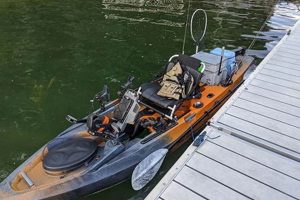
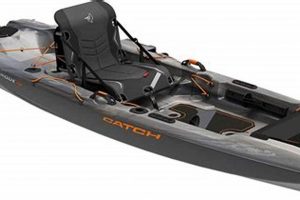
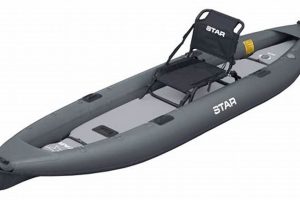
This motorized fishing vessel combines the utility of a hands-free propulsion system with a stable, pedal-driven platform designed for anglers. The vessel offers features tailored for fishing, such as rod holders, tackle storage, and transducer mounts. Its automated navigation system allows for precise positioning and controlled movement, freeing the user to focus on fishing techniques.
Hands-free propulsion offers significant advantages for anglers, including improved maneuverability in challenging waters, increased fishing time by reducing paddling effort, and the ability to maintain position quietly without disturbing fish. This type of vessel represents a notable advancement in fishing kayak technology, integrating advanced features for a more efficient and enjoyable fishing experience. Its development reflects the growing demand for user-friendly, high-performance fishing kayaks.
Further exploration will cover specific design elements, performance characteristics, user experiences, and the broader impact of automated propulsion systems on the fishing kayak market.
Tips for Hands-Free Kayak Fishing
Maximizing the advantages of a motorized fishing kayak requires understanding its capabilities and employing best practices. These tips offer guidance for a safer and more productive fishing experience.
Tip 1: Pre-Trip Planning: Thorough planning is essential. Research fishing locations, water conditions, and potential hazards. Check battery charge levels and ensure all necessary safety equipment is onboard.
Tip 2: Mastering the Autopilot System: Familiarize oneself with the autopilot system’s controls and functionalities before venturing onto the water. Practice maneuvering in open areas to understand its responsiveness and limitations.
Tip 3: Battery Management: Monitor battery consumption throughout the trip. Factors such as speed, wind, and current affect battery life. Carry a spare battery or consider a solar charger for extended trips.
Tip 4: Utilizing GPS and Navigation Tools: Integrate GPS and chartplotters with the autopilot system for precise navigation and waypoint marking. This allows for efficient route planning and returning to productive fishing spots.
Tip 5: Safety Precautions: Always wear a personal flotation device (PFD) and carry a communication device. Inform someone of the planned fishing location and estimated return time.
Tip 6: Respecting the Environment: Adhere to local fishing regulations and practice responsible boating. Avoid disturbing wildlife and minimize environmental impact by properly disposing of waste.
Tip 7: Regular Maintenance: Proper maintenance ensures optimal performance and longevity. Regularly inspect the propulsion system, check for wear and tear, and follow manufacturer recommendations for cleaning and storage.
By following these guidelines, anglers can enhance their fishing experience while prioritizing safety and environmental responsibility.
These practical tips offer a foundation for successful hands-free kayak fishing, leading to a more comprehensive understanding of the technology and its applications in the next section.
1. Motorized Fishing Kayak

The term “motorized fishing kayak” represents a category of vessels designed to enhance angling experiences through integrated propulsion systems. The Old Town Autopilot 136 fishing kayak stands as a specific example within this category, showcasing the practical application of motorized propulsion in a fishing-focused design. The cause-and-effect relationship is clear: the demand for increased efficiency and hands-free fishing has driven the development of motorized kayaks, with models like the Old Town Autopilot 136 fulfilling this need by providing anglers with the ability to cover greater distances, hold position in currents, and focus more on fishing rather than paddling.
The motorized component is integral to the Old Town Autopilot 136’s functionality. It elevates the kayak beyond a simple paddle-powered vessel, transforming it into a versatile fishing platform. Consider a scenario where an angler wishes to fish a distant shoreline or navigate against a strong current. Without motorization, this would require significant physical exertion, potentially limiting fishing time and effectiveness. The Old Town Autopilot 136’s motor addresses this challenge directly, enabling anglers to reach desired locations efficiently and maintain position effortlessly. This advantage becomes even more pronounced in challenging conditions, such as windy estuaries or fast-flowing rivers.
Understanding this connection allows for a more informed evaluation of fishing kayak technology. Recognizing the broader category of “motorized fishing kayak” and the specific features of the Old Town Autopilot 136 provides a framework for assessing the benefits and limitations of different propulsion systems, hull designs, and integrated features. This understanding empowers anglers to make informed decisions based on individual fishing styles and target environments. While the Old Town Autopilot 136 presents a notable example, the “motorized fishing kayak” category continues to evolve, offering diverse options for enhancing angling experiences.
2. Hands-free Propulsion

Hands-free propulsion represents a significant advancement in kayak fishing technology, directly impacting the functionality and user experience of specialized fishing kayaks such as the Old Town Autopilot 136. This technology allows anglers to navigate and position themselves without manual paddling, freeing their hands for fishing activities and enhancing overall efficiency on the water.
- Enhanced Fishing Focus:
Without the need for constant paddling, anglers can dedicate more attention to casting, retrieving lures, and fighting fish. This heightened focus can lead to increased catch rates and a more immersive fishing experience. The Old Town Autopilot 136, with its hands-free propulsion, exemplifies this advantage by allowing anglers to maintain precise positioning and navigate effortlessly while focusing on the task at hand fishing.
- Improved Maneuverability:
Hands-free systems offer superior maneuverability, particularly in challenging environments. Precise control over speed and direction allows anglers to navigate tight spaces, hold position against currents or wind, and approach fish discreetly. The Old Town Autopilot 136 leverages this technology to provide enhanced control in diverse fishing scenarios.
- Reduced Physical Strain:
Eliminating the physical exertion of paddling reduces fatigue, allowing for longer fishing trips and greater enjoyment on the water. This benefit is especially significant for anglers with physical limitations or those fishing in demanding conditions. The Old Town Autopilot 136, by removing the need for continuous paddling, makes kayaking accessible to a wider range of individuals.
- Increased Efficiency and Range:
Motorized propulsion enables anglers to cover larger distances and access remote fishing spots more quickly than traditional paddling. This expanded range opens up new fishing opportunities and allows for more efficient use of fishing time. The Old Town Autopilot 136 benefits directly from this increased efficiency, allowing anglers to reach distant locations swiftly and conserve energy for fishing.
These facets of hands-free propulsion underscore its transformative impact on fishing kayak design and functionality. The Old Town Autopilot 136, as a prime example of this technology’s application, highlights the convergence of enhanced fishing capability, improved user experience, and increased accessibility within the evolving landscape of modern fishing kayaks. By examining these elements individually, a comprehensive understanding of the value and implications of hands-free propulsion within the context of fishing kayaks emerges.
3. Stability and Control
Stability and control are critical performance attributes of the Old Town Autopilot 136 fishing kayak, directly influencing its suitability for diverse fishing environments and angler activities. The kayak’s design prioritizes stability to provide a secure platform for casting, reeling, and landing fish, while precise control enables maneuverability in various water conditions. Cause and effect are evident: a stable hull design minimizes rocking and tipping, facilitating comfortable fishing, while responsive control mechanisms allow for accurate positioning and navigation, even in currents or wind. Consider an angler standing to cast in a choppy bay. A stable kayak ensures a safe, balanced platform, maximizing casting accuracy and minimizing the risk of capsizing. Similarly, precise control enables the angler to maintain position near structure or navigate through tight channels effectively.
The importance of stability and control as integral components of the Old Town Autopilot 136’s functionality is undeniable. Stability enhances the angler’s confidence and comfort, enabling a wider range of fishing techniques and prolonged periods on the water. Precise control, facilitated by the autopilot system, allows for efficient navigation and positioning, maximizing fishing opportunities and minimizing wasted effort. Imagine trolling along a weed line or maintaining position near a submerged reef. The autopilot system’s precise control capabilities enable the angler to hold the desired course or position accurately, optimizing lure presentation and increasing the likelihood of a successful hookup. Furthermore, enhanced stability provides a secure platform for landing larger fish, minimizing the risk of instability during critical moments.
Understanding the relationship between stability, control, and the Old Town Autopilot 136 provides valuable insights for evaluating fishing kayaks. Prioritizing these attributes ensures a safe, efficient, and enjoyable fishing experience. While stability contributes to angler comfort and safety, precise control, often enhanced by autopilot systems, maximizes fishing effectiveness and expands access to diverse fishing locations. These elements are essential considerations for anglers seeking optimal performance and adaptability in their fishing kayaks.
4. Fishing-Specific Features
Fishing-specific features distinguish the Old Town Autopilot 136 fishing kayak from recreational kayaks, optimizing its performance for angling activities. These features are not merely additions but integral components designed to enhance fishing effectiveness and user experience. Cause and effect are intertwined: the demand for specialized fishing kayaks has driven the incorporation of features tailored to anglers’ needs, resulting in designs like the Old Town Autopilot 136. Consider rod holders, for example. Their presence allows anglers to keep multiple rods readily accessible, increasing fishing efficiency and responsiveness to changing conditions. Similarly, integrated transducer mounts facilitate seamless fish finder installation, providing crucial underwater insights without cumbersome rigging.
The importance of fishing-specific features as components of the Old Town Autopilot 136’s overall functionality is significant. These features contribute directly to improved fishing outcomes and user convenience. Imagine navigating a shallow, weedy flat. The ability to stow rods securely while maneuvering through tight spaces prevents entanglement and damage. Likewise, a readily accessible tackle storage system streamlines lure changes and keeps essential gear organized, maximizing fishing time and minimizing disruptions. Furthermore, features like anchor trolleys or stake-out poles allow for precise positioning in specific locations, enhancing fishing effectiveness in targeted areas.
Understanding the relationship between fishing-specific features and the Old Town Autopilot 136 provides a framework for evaluating fishing kayak designs. These features are not superficial additions but essential components contributing to the kayak’s specialized functionality. Evaluating their presence, placement, and quality provides valuable insights into a fishing kayak’s suitability for specific angling styles and target environments. The practical significance of this understanding empowers anglers to make informed decisions based on their individual needs and fishing preferences, maximizing their potential for success on the water.

Automated navigation represents a significant technological advancement in fishing kayaks, exemplified by its integration into the Old Town Autopilot 136. This system transforms the on-water experience by allowing anglers to focus on fishing rather than constant paddle adjustments for position maintenance or navigation. This capability is particularly valuable in challenging conditions, such as strong currents or wind, where maintaining a desired position or course requires continuous effort. Automated navigation fundamentally alters how anglers interact with their environment, increasing efficiency and enhancing the overall fishing experience.
- Precise Position Holding:
Automated navigation systems, like the one found in the Old Town Autopilot 136, excel at maintaining precise positions. This capability is crucial for techniques like anchoring virtually over structure or remaining stationary while fishing a specific spot. Consider an angler targeting a school of fish suspended over a submerged reef. The automated navigation system allows the kayak to hold its position directly over the reef, maximizing fishing time and effectiveness without constant adjustments against wind or current.
- Effortless Course Tracking:
Maintaining a consistent course, especially in challenging conditions, becomes effortless with automated navigation. This feature allows anglers to follow contours, troll along shorelines, or navigate predetermined routes without continuous manual input. Imagine trolling along a weed line in a windy estuary. The automated navigation system maintains the desired course, freeing the angler to focus on lure retrieval and fish detection rather than compensating for wind drift.
- Enhanced Fishing Efficiency:
By automating navigation, anglers conserve energy and maximize fishing time. Reduced physical exertion translates to longer trips and increased focus on fishing techniques rather than paddling. Consider a scenario where an angler needs to navigate a considerable distance to reach a preferred fishing spot. Automated navigation expedites travel, conserving energy for fishing upon arrival.
- Integrated with GPS Technology:
Automated navigation systems seamlessly integrate with GPS technology, enabling features like waypoint navigation and route planning. This integration enhances navigational precision and allows anglers to revisit productive fishing spots efficiently. Imagine marking a location where a large fish was caught or identifying a promising underwater structure. GPS integration allows the angler to return to these precise locations effortlessly using the automated navigation system.
These facets of automated navigation highlight its transformative impact on the fishing kayak experience. The Old Town Autopilot 136, by incorporating this technology, demonstrates a shift towards increased efficiency, precision, and user-friendliness in fishing kayak design. This integration of technology empowers anglers to focus on the core aspects of fishing, enhancing their overall experience and potential for success on the water. The combination of precise positioning, effortless course tracking, and GPS integration demonstrates the potential of automated navigation to redefine fishing kayak capabilities and angler expectations.
6. Enhanced Fishing Experience

The Old Town Autopilot 136 fishing kayak is designed to elevate the angling experience through a combination of features and functionalities. The concept of an “enhanced fishing experience” goes beyond simply catching fish; it encompasses comfort, efficiency, and a deeper engagement with the environment. This exploration examines key facets contributing to this enhanced experience specifically within the context of the Old Town Autopilot 136.
- Hands-Free Fishing:
The Autopilot system’s automated propulsion eliminates the need for constant paddling, allowing anglers to focus entirely on fishing. This hands-free approach translates to more casts, quicker reactions to bites, and reduced physical fatigue. Consider a scenario where an angler hooks a large fish. With hands already free, the fight can be managed efficiently and effectively, increasing the likelihood of a successful landing.
- Precise Boat Control:
Maintaining optimal positioning is crucial for successful fishing. The Old Town Autopilot 136’s precise control mechanisms, including GPS integration and Spot-Lock technology, allow anglers to hold position in currents, follow precise trolling paths, and return to productive fishing spots effortlessly. Imagine fishing a river channel. The autopilot system can maintain the kayak’s position within the channel’s flow, optimizing lure presentation and maximizing exposure to fish.
- Increased Accessibility and Range:
Motorized propulsion expands fishing horizons by enabling anglers to cover greater distances and access previously unreachable areas. This expanded range opens up new fishing opportunities and reduces the limitations imposed by physical exertion or time constraints. Consider a large lake or reservoir. The Old Town Autopilot 136 can effortlessly traverse the expanse of water, allowing anglers to explore distant shorelines and target diverse fishing locations.
- Focus on the Sport:
By automating navigation and reducing physical effort, the Old Town Autopilot 136 allows anglers to immerse themselves fully in the sport of fishing. This heightened focus leads to increased awareness of environmental cues, improved technique refinement, and a deeper appreciation for the angling experience. Imagine fishing a quiet cove at dawn. The near-silent operation of the autopilot system minimizes disturbance, allowing anglers to connect with the natural environment and focus on the subtle nuances of fishing.
These facets converge to define the “enhanced fishing experience” offered by the Old Town Autopilot 136. The kayak’s design and features prioritize angler engagement with the sport by automating tasks, enhancing control, and expanding accessibility. This focus on enhancing the core elements of the fishing experience positions the Old Town Autopilot 136 as a significant advancement in fishing kayak technology.
7. Advanced Kayak Technology
The Old Town Autopilot 136 fishing kayak exemplifies advanced kayak technology, integrating innovations that significantly enhance fishing capabilities and user experience. Cause and effect are clearly linked: the demand for more efficient, user-friendly, and feature-rich fishing kayaks has driven the development and adoption of advanced technologies. The Old Town Autopilot 136 stands as a prime example, incorporating features like automated propulsion, GPS integration, and advanced hull designs. These technologies address specific angler needs, such as hands-free navigation, precise boat control, and increased stability. Consider the impact of the autopilot system. Its integration enables anglers to maintain position effortlessly in currents, navigate precisely to desired locations, and troll along defined paths without constant manual input. This advancement directly improves fishing efficiency and allows for greater focus on the activity itself.
The importance of advanced kayak technology as a defining characteristic of the Old Town Autopilot 136 cannot be overstated. These technologies are not mere add-ons but integral components that fundamentally change how anglers interact with their environment and pursue their sport. Imagine fishing in windy conditions. Maintaining a desired position or trolling path becomes a constant struggle without automated assistance. The Old Town Autopilot 136’s advanced technologies directly address this challenge, allowing anglers to maintain precise control and focus on fishing rather than battling the elements. Furthermore, the integration of fish finder technology and GPS mapping provides real-time data and navigational precision, enhancing situational awareness and strategic decision-making on the water.
Understanding the connection between advanced kayak technology and the Old Town Autopilot 136 provides crucial insights for evaluating and selecting fishing kayaks. Recognizing how these technologies directly address specific fishing challenges and enhance angler experiences enables informed decisions based on individual needs and preferences. While the Old Town Autopilot 136 showcases current advancements, the field of kayak technology continues to evolve. Remaining informed about emerging innovations, such as improved battery technology, enhanced autopilot systems, and integrated sonar capabilities, empowers anglers to leverage cutting-edge tools for a more productive and enjoyable fishing experience. The integration of these technologies signifies a shift towards greater efficiency, precision, and user-friendliness in fishing kayak design, ultimately shaping the future of the sport.
Frequently Asked Questions
This section addresses common inquiries regarding the Old Town Autopilot 136 fishing kayak, providing concise and informative responses to facilitate informed decision-making.
Question 1: What differentiates the Old Town Autopilot 136 from traditional fishing kayaks?
The primary distinction lies in the integrated autopilot system, enabling hands-free navigation and positioning. This feature, coupled with fishing-specific design elements, optimizes the kayak for angling activities.
Question 2: How does the autopilot system function in practical fishing scenarios?
The autopilot system utilizes GPS technology to maintain precise positioning, track predetermined courses, and navigate to saved waypoints. This functionality enhances fishing efficiency by automating navigation and allowing anglers to focus on fishing techniques.
Question 3: What are the advantages of hands-free propulsion in a fishing kayak?
Hands-free propulsion allows anglers to dedicate more attention to fishing, reduces physical strain, improves maneuverability, and increases overall fishing efficiency. These advantages contribute to a more productive and enjoyable on-water experience.
Question 4: How stable is the Old Town Autopilot 136, and is it suitable for standing while fishing?
The Old Town Autopilot 136 features a stable hull design engineered to provide a secure platform for standing and fishing. However, individual comfort levels and balance should always be considered.
Question 5: What maintenance is required for the autopilot system and motorized components?
Regular maintenance includes battery charging and care, inspection of the propulsion system for wear and tear, and adherence to manufacturer recommendations for cleaning and storage. Proper maintenance ensures optimal performance and longevity.
Question 6: What safety precautions should be observed when operating a motorized fishing kayak?
Standard safety practices apply, including wearing a personal flotation device (PFD), carrying a communication device, informing someone of fishing plans, and adhering to local boating regulations. Understanding and respecting the water environment remains paramount.
Addressing these common inquiries provides a clearer understanding of the Old Town Autopilot 136 fishing kayak’s capabilities and characteristics. Prospective users are encouraged to consult additional resources and conduct thorough research to make informed decisions aligned with individual fishing styles and preferences.
Further exploration of specific features, user experiences, and comparative analyses will provide a more comprehensive understanding of the Old Town Autopilot 136 within the broader context of fishing kayak technology.
Conclusion
The Old Town Autopilot 136 fishing kayak represents a notable convergence of design and technology within the angling community. Its automated navigation system, coupled with fishing-specific features, offers a distinct advantage in various fishing scenarios. The examination of its core attributesstability, control, and specialized featuresreveals a deliberate focus on enhancing fishing effectiveness and user experience. The integration of hands-free propulsion signifies a shift towards greater efficiency and accessibility within the realm of kayak fishing.
The evolution of fishing kayak technology continues, promising further advancements in areas like propulsion systems, integrated electronics, and user interfaces. Anglers seeking enhanced control, efficiency, and a more immersive fishing experience will find significant value in exploring offerings like the Old Town Autopilot 136. Consideration of individual fishing styles, target environments, and technological advancements remains essential for informed decision-making within the dynamic landscape of fishing kayak technology.