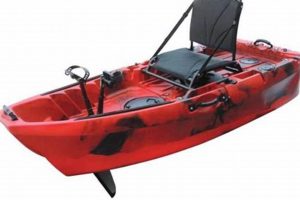
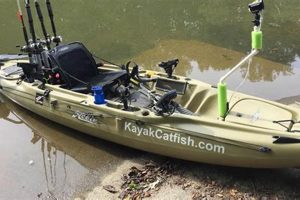
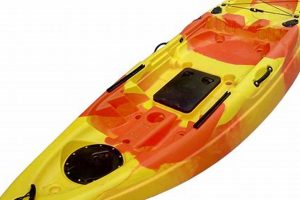
Small, human-powered watercraft designed for angling often incorporate a directional control system beneath the hull. This submerged blade, controlled by foot pedals, assists in maintaining course and maneuvering in challenging conditions such as currents, wind, and waves. A representative example would be a sit-on-top vessel equipped with adjustable foot braces and a rudder controlled by cables or linkages.
Enhanced maneuverability and tracking are key advantages provided by this underwater steering mechanism. Anglers benefit from improved directional stability, particularly in adverse weather or when contending with strong currents. This allows for precise boat positioning, crucial for techniques like trolling or maintaining a specific location while fishing a structure. Historically, similar systems have aided navigation in various watercraft for centuries, and their adaptation to recreational angling significantly enhances the efficiency and enjoyment of the sport.
Further exploration will cover specific types of kayaks suited for angling, rudder design variations, and the impact of rudder systems on performance characteristics like speed and stability. Additional topics will address installation, maintenance, and practical usage tips for maximizing the benefits of this navigational aid.
Tips for Utilizing Rudder-Equipped Angling Kayaks
Effective use of a rudder system significantly enhances angling kayak performance. These tips offer guidance for maximizing control and maneuverability on the water.
Tip 1: Deploying the Rudder: Lower the rudder blade fully when navigating in windy or current-prone areas. Partial deployment reduces effectiveness and can lead to premature wear.
Tip 2: Rudder Usage in Turns: Coordinate paddle strokes with rudder adjustments for efficient turning. Over-reliance on the rudder can increase turning radius.
Tip 3: Countersteering in Wind: Use the rudder to counteract wind drift, maintaining the desired course with minimal effort. This technique conserves energy during long paddles.
Tip 4: Shallow Water Operation: Raise the rudder blade in shallow water or near obstacles to prevent damage. Become familiar with the rudder’s draft (depth below the hull).
Tip 5: Regular Maintenance: Inspect cables, linkages, and the rudder blade regularly for wear or damage. Lubricate moving parts and tighten hardware as needed.
Tip 6: Practice and Experimentation: Time on the water builds proficiency. Experiment with rudder adjustments in various conditions to understand its impact on boat control.
Tip 7: Consider Rudder Style: Different rudder styles offer varying degrees of control and maneuverability. Research different designs to select the best fit for individual needs and fishing styles.
Proficient rudder usage translates to enhanced boat control, more efficient paddling, and ultimately, a more productive and enjoyable fishing experience. These techniques improve navigational precision, conserve energy, and reduce reliance on corrective paddle strokes.
By integrating these practices, anglers can fully leverage the advantages of rudder-equipped kayaks, leading to greater success on the water. The following section provides concluding thoughts on incorporating these systems into angling practices.
1. Maneuverability

Maneuverability represents a critical performance attribute in fishing kayaks, significantly enhanced by the integration of rudder systems. A rudder’s ability to precisely control yaw (rotation around a vertical axis) translates directly into superior responsiveness and directional control. This allows anglers to navigate complex waterways, position the kayak accurately for optimal casting angles, and adjust to changing currents or wind conditions efficiently.
Consider a scenario where an angler needs to navigate through tight mangrove tunnels or around submerged obstacles. Without a rudder, achieving precise directional changes would require significant paddle manipulation, potentially disrupting fishing activities or disturbing the water. A rudder, however, allows for subtle course corrections, minimizing disturbance and maximizing stealth. Similarly, when holding a position against a current, a rudder minimizes the need for constant paddling adjustments, allowing the angler to focus on fishing.
The practical significance of enhanced maneuverability extends beyond simple navigation. It directly impacts fishing success by enabling precise boat control, crucial for techniques like trolling, drifting, or maintaining position near structure. Understanding the relationship between rudder control and maneuverability is essential for anglers seeking to maximize their on-the-water efficiency and effectiveness. While some challenges, such as potential rudder damage in shallow water, exist, the overall benefits of improved maneuverability provided by rudder systems contribute substantially to the angler’s ability to navigate and fish effectively.
2. Tracking

Tracking, the ability of a kayak to maintain a straight course with minimal directional correction, represents a critical performance characteristic significantly influenced by rudder systems. Effective tracking reduces paddling effort, conserves energy, and allows anglers to focus on fishing rather than constant course adjustments. This discussion explores the multifaceted relationship between tracking and rudder-equipped fishing kayaks.
- Reduced Paddling Effort:
Rudders minimize the need for corrective paddle strokes, particularly in windy or current-prone conditions. This reduces fatigue and allows for longer paddling trips without compromising efficiency. For instance, an angler paddling into a headwind can deploy the rudder to counteract the wind’s force, maintaining a straight course without continuous compensatory paddling. This conserves energy and improves overall paddling endurance.
- Improved Course Stability:
Rudder systems enhance directional stability, especially in challenging environments. This is particularly beneficial for techniques like trolling, where maintaining a consistent speed and direction is essential for lure presentation. Consider an angler trolling along a shoreline; the rudder can compensate for crosswinds or currents, ensuring the lure remains in the target strike zone.
- Enhanced Efficiency in Crosscurrents:
Kayaks equipped with rudders navigate crosscurrents more effectively. The rudder counteracts the lateral force of the current, minimizing drift and keeping the kayak on the intended path. This is crucial for maintaining position while fishing a specific area, such as a drop-off or a channel edge.
- Impact of Hull Design:
While rudders significantly improve tracking, hull design also plays a crucial role. Longer, narrower hulls generally track better than shorter, wider designs. The rudder complements the inherent tracking characteristics of the hull, further enhancing performance. Understanding the interplay between hull design and rudder function optimizes tracking capabilities.
The synergistic relationship between rudder systems and tracking performance enhances the overall fishing experience. By minimizing the need for corrective paddling, improving course stability, and enabling efficient crosscurrent navigation, rudders contribute to a more controlled, less fatiguing, and ultimately more productive angling experience. Choosing a kayak with a well-designed rudder system, suited to the intended fishing environment, significantly improves on-the-water performance.
3. Control

Control, in the context of fishing kayaks equipped with rudders, represents the ability to precisely manage direction and position on the water. This enhanced command over the vessel’s movement translates directly into improved fishing efficiency and overall angling success. The following facets explore the nuanced relationship between control and rudder-equipped kayaks.
- Precision Boat Positioning:
Rudders enable fine-tuned adjustments to kayak positioning, crucial for presenting lures or bait effectively. Imagine an angler attempting to hold position near a submerged log in a flowing river. Without a rudder, maintaining the desired position requires constant paddle adjustments, distracting from the task of fishing. A rudder allows for subtle course corrections, enabling precise boat placement and maximizing fishing opportunities.
- Enhanced Maneuverability in Tight Spaces:
Navigating confined areas, such as narrow creeks or mangrove tunnels, benefits significantly from rudder control. The rudder’s ability to facilitate quick turns and precise adjustments allows anglers to explore these productive fishing grounds with greater confidence and efficiency. For example, maneuvering around tight bends or avoiding submerged obstacles becomes significantly easier and less disruptive with precise rudder control.
- Hands-Free Navigation:
Perhaps the most significant advantage of rudder control is the ability to maintain or adjust course without constant paddling. This frees the angler’s hands for fishing-related tasks, such as casting, retrieving, or adjusting tackle. Consider an angler fighting a fish in windy conditions; the rudder can be used to maintain boat position and minimize the impact of wind drift, allowing the angler to focus on landing the fish.
- Improved Stability in Challenging Conditions:
Rudders contribute to improved stability, particularly in windy or current-prone environments. By counteracting external forces, the rudder helps maintain the kayak’s desired orientation, reducing the risk of capsizing and enhancing overall safety and control. This is especially important in open water or when dealing with unpredictable weather conditions.
The multifaceted control offered by rudders translates directly into improved angling effectiveness. From precise boat positioning and enhanced maneuverability to hands-free navigation and increased stability, rudder control empowers anglers to navigate challenging environments, focus on fishing techniques, and ultimately maximize their chances of success on the water. This enhanced control elevates the angling experience, transforming a potentially challenging situation into a manageable and rewarding one.
4. Wind Compensation

Wind compensation represents a critical function of rudder systems in fishing kayaks, directly impacting angling efficiency and enjoyment. Wind exerts significant force on kayaks, causing drift and hindering precise boat control. Rudders effectively counteract this force, enabling anglers to maintain desired courses, hold positions, and optimize fishing presentations even in challenging wind conditions. This capability proves particularly valuable in open water or larger bodies of water where wind effects are amplified.
Consider a scenario where an angler intends to drift along a weed line, casting parallel to the vegetation. A strong crosswind would quickly push the kayak off course, requiring constant paddling adjustments to maintain the desired trajectory. A rudder, however, allows the angler to compensate for the wind’s force, keeping the kayak aligned with the weed line and freeing their hands for casting and retrieving. This exemplifies the practical significance of wind compensation provided by rudders, enabling anglers to focus on fishing rather than battling the elements. Similarly, when holding position near a structure in windy conditions, a rudder minimizes drift, conserving energy and enhancing fishing precision.
Understanding the dynamics of wind compensation enhances rudder utilization. The angle of the rudder blade dictates the magnitude of the corrective force applied to the kayak. Smaller adjustments suffice for gentle breezes, while stronger winds necessitate greater rudder input. Furthermore, anticipating wind gusts and adjusting the rudder proactively minimizes deviations from the intended course. While factors such as kayak hull design and wind intensity influence the effectiveness of wind compensation, a well-designed rudder system significantly enhances an angler’s ability to mitigate wind effects, ultimately improving control, efficiency, and overall fishing success. Mastery of wind compensation techniques translates directly into a more productive and enjoyable angling experience, regardless of prevailing wind conditions.
5. Current Management

Current management constitutes a critical aspect of kayak fishing, particularly in rivers, tidal zones, or areas with significant water movement. Effectively navigating and controlling a kayak in currents directly impacts angling success, and rudder systems play a crucial role in this aspect. This discussion explores the multifaceted relationship between current management and rudder-equipped fishing kayaks.
- Maintaining Position:
Holding a stationary position in a current, crucial for techniques like bottom fishing or targeting specific structures, presents a significant challenge without a rudder. Constant paddling adjustments would be required to counteract the current’s force. A rudder, however, enables anglers to maintain position effortlessly, freeing hands for fishing. For example, an angler targeting a submerged rock pile in a flowing river can use the rudder to counteract the current, remaining precisely positioned over the target area without continuous paddling.
- Controlled Drifting:
Precise drift control is essential for techniques like float fishing or drifting bait along a channel. A rudder allows anglers to adjust the drift speed and angle, optimizing presentation and coverage. Imagine an angler drifting a bait through a deep channel; the rudder allows for subtle adjustments to the drift path, ensuring the bait remains in the strike zone while accounting for variations in current speed or direction.
- Navigating Crosscurrents:
Crosscurrents, often encountered near river bends or confluences, can significantly impede kayak control. Rudders counteract the lateral force of the current, allowing anglers to maintain the desired course and avoid being swept downstream. This capability is essential for crossing rivers safely or navigating complex current patterns effectively.
- Ferrying Across Currents:
Ferrying, the act of paddling across a current at an angle, benefits significantly from rudder control. The rudder counteracts the downstream push of the current, allowing the kayak to reach the opposite bank efficiently. This maneuver is crucial for accessing specific fishing spots or returning to launch points across flowing water.
Proficient current management significantly enhances angling effectiveness and safety in dynamic water environments. Rudder systems provide the necessary control to maintain position, execute controlled drifts, navigate crosscurrents, and ferry effectively. These capabilities translate directly into improved fishing opportunities and a more controlled, efficient, and enjoyable angling experience. By understanding the principles of current management and utilizing the rudder effectively, anglers can confidently tackle challenging water conditions and maximize their success on the water.
Hands-free navigation, facilitated by rudder systems, represents a significant advantage in fishing kayaks. It allows anglers to maintain or adjust course without continuous paddling, freeing their hands for essential fishing tasks. This capability significantly enhances angling efficiency and overall success. The connection between hands-free navigation and rudder-equipped kayaks warrants detailed exploration.
Consider the scenario of an angler battling a strong fish in windy conditions. Without a rudder, maintaining boat position and simultaneously managing the rod and reel becomes challenging. The angler must constantly switch between paddling to correct for wind drift and attending to the hooked fish. A rudder, however, allows course correction without paddling, enabling the angler to focus entirely on the fight, increasing the likelihood of landing the fish. Similarly, when trolling, a rudder maintains the desired course, allowing the angler to focus on rod manipulation, lure action, and strike detection, rather than constant paddle adjustments.
Hands-free navigation translates directly into improved fishing efficiency. It allows for seamless transitions between paddling and other essential tasks like casting, retrieving, adjusting tackle, or landing fish. This enhanced efficiency proves particularly valuable in dynamic fishing environments where conditions change frequently or when specific techniques, such as trolling or drift fishing, demand precise boat control without constant paddling input. While learning to utilize a rudder effectively requires practice, the resulting ability to navigate hands-free significantly enhances angling versatility and success, allowing anglers to focus more intently on the art of fishing itself.
Frequently Asked Questions
This section addresses common inquiries regarding kayaks designed for angling and equipped with rudder steering systems. Clear and concise responses aim to provide a comprehensive understanding of key aspects related to selection, usage, and maintenance.
Question 1: How does a rudder system enhance kayak fishing performance?
Rudder systems provide enhanced maneuverability and directional control, crucial for navigating currents, wind, and challenging waterways. This allows for precise boat positioning, optimizing techniques like trolling or maintaining position near structures, ultimately increasing fishing efficiency.
Question 2: Are rudder systems suitable for all kayaking environments?
While beneficial in many situations, rudders are less advantageous in shallow, obstacle-filled waters where the submerged blade risks damage. Anglers frequenting such environments should carefully consider their needs and the potential for rudder contact with underwater obstructions.
Question 3: What maintenance is required for a kayak rudder system?
Regular inspection and maintenance ensure optimal performance and longevity. Cables, linkages, and the rudder blade should be checked for wear or damage. Lubrication of moving parts and tightening of hardware are essential preventative measures.
Question 4: How does one learn to use a rudder system effectively?
Practice and experimentation are key to mastering rudder control. Time on the water, experimenting with rudder adjustments in various conditions, and understanding the interplay between rudder input and kayak response build proficiency.
Question 5: What are the different types of rudder systems available for fishing kayaks?
Various rudder designs exist, each offering specific performance characteristics. Common types include retractable rudders, kick-up rudders, and weedless rudders. Researching these variations allows anglers to select the system best suited to their fishing style and environment.
Question 6: How does the addition of a rudder affect a kayak’s overall performance?
While enhancing maneuverability and tracking, a rudder can slightly reduce top speed due to added drag. However, the benefits of improved control and reduced paddling effort often outweigh this minor performance trade-off for anglers.
Understanding the functionality and benefits of rudder systems equips anglers to make informed decisions regarding kayak selection and utilization. Proper maintenance and practical experience further optimize performance and enhance the overall fishing experience.
This concludes the FAQ section. The following section offers concluding remarks regarding the integration of rudder-equipped kayaks into angling practices.
Fishing Kayaks with Rudders
This exploration has highlighted the significant advantages conferred by rudder systems in angling kayaks. Enhanced maneuverability, improved tracking, precise control, wind compensation, efficient current management, and hands-free navigation represent key benefits discussed. These capabilities translate directly into improved angling efficiency, reduced paddling effort, and enhanced on-the-water control. While considerations such as potential rudder damage in shallow water and the slight impact on top-end speed exist, the overall benefits for anglers in various fishing environments are substantial.
Strategic integration of rudder-equipped kayaks into angling practices offers significant potential for enhancing fishing success and overall enjoyment. Careful consideration of individual fishing styles, target environments, and specific performance needs informs appropriate rudder system selection and maximizes its on-the-water effectiveness. Continued exploration of evolving rudder technologies and refined usage techniques promises further advancements in kayak angling performance.