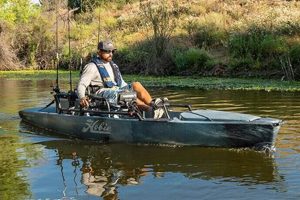
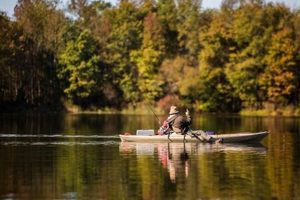
This specialized angling approach combines the maneuverability of Hobie kayaks, renowned for their pedal-driven propulsion system, with the finesse and challenge of fly fishing. Imagine casting for bonefish on shallow flats or pursuing trout in a secluded river bend, all while navigating hands-free with a foot-controlled kayak. This style facilitates access to otherwise difficult-to-reach fishing grounds and provides a stealthy approach for pursuing a variety of fish species.
The hands-free nature of pedal-driven kayaks offers substantial advantages for anglers. It allows for constant lure or fly retrieval and immediate hook sets, crucial for success in fly fishing. This type of fishing expands opportunities for angling in diverse environments, from coastal saltwater marshes to inland freshwater lakes and rivers. Historically, specialized boats or wading were the primary methods for accessing such diverse fishing locations. This innovative fusion of kayak design and angling technique allows for a more efficient and less physically demanding fishing experience.
The following sections will delve into specific aspects of this fishing style, covering equipment choices, techniques, suitable locations, and responsible angling practices.
Tips for Effective Kayak Fly Fishing
Success in this specialized angling discipline requires careful consideration of equipment and technique. The following tips offer guidance for optimizing the experience and increasing the likelihood of successful outings.
Tip 1: Choose the Right Kayak: Kayak selection depends on the target fishing environment. Shorter, wider kayaks offer greater stability for stillwater fishing, while longer, narrower models are better suited for navigating currents and covering larger distances in open water.
Tip 2: Master the Pedal Drive: Practice maneuvering the kayak using the pedal drive before venturing into fishing areas. Developing proficiency in controlling speed and direction is crucial for maintaining position and approaching fish stealthily.
Tip 3: Organize Tackle and Gear: Efficient organization is essential in the limited space of a kayak. Utilize tackle boxes designed for kayak fishing and consider a gear track system for mounting accessories within easy reach.
Tip 4: Prioritize Safety Equipment: Always wear a personal flotation device and carry essential safety gear, including a whistle, signaling device, and first-aid kit. Inform someone of your fishing plans and estimated return time.
Tip 5: Employ Stealth Tactics: Approach fishing spots slowly and quietly, minimizing disturbances on the water’s surface. Avoid sudden movements that might spook fish.
Tip 6: Adapt Casting Techniques: Practice casting from a seated position and adjust techniques to account for the lower vantage point. Short, accurate casts are often more effective than long casts in kayak fishing scenarios.
Tip 7: Respect the Environment: Adhere to leave-no-trace principles by packing out all trash and avoiding disturbances to sensitive habitats. Observe local fishing regulations and handle fish with care.
By implementing these tips, anglers can enhance their experience and increase the likelihood of successful catches. Proper preparation and mindful practices contribute to both enjoyment and conservation of the natural environment.
With a solid understanding of these fundamental principles, anglers can proceed to explore the advanced techniques and specialized equipment discussed in the concluding section.
1. Stealth

Stealth plays a crucial role in the effectiveness of angling from a Hobie kayak. Minimizing disturbances that could alert fish to the angler’s presence is essential for successful fly fishing. A quiet approach and controlled movements allow anglers to get closer to fish, increasing opportunities for a successful presentation of the fly.
- Reduced Noise:
The pedal-driven propulsion system of a Hobie kayak generates significantly less noise compared to traditional paddling. This minimizes disturbance to the underwater environment and prevents fish from being spooked by splashing sounds or vibrations transmitted through the hull. The quiet operation allows anglers to approach fish in shallow water or areas with high clarity without detection.
- Low Profile:
The low profile of a kayak sits closer to the waterline than larger motorized boats, reducing its visibility to fish. This lower vantage point contributes to a stealthier approach, allowing anglers to remain undetected while moving into casting range. The reduced silhouette against the skyline is especially beneficial in clear water conditions and when fishing for wary species.
- Controlled Movement:
The hands-free operation of the pedal drive allows for precise and controlled movements. Anglers can make subtle adjustments to their position without the disruptive motions associated with paddling. This level of control enables delicate presentations of the fly and facilitates accurate casting, crucial for enticing fish in challenging environments.
- Approaching Fish in Shallow Water:
The shallow draft of a kayak enables access to areas inaccessible to larger boats, expanding opportunities for targeting fish in shallow water habitats. This advantage, combined with the quiet operation of the pedal drive, creates a stealthy approach for pursuing species that frequent shallow flats, backwaters, or protected coves.
These facets of stealth, combined with the maneuverability of a Hobie kayak, contribute significantly to its effectiveness as a platform for fly fishing. The ability to approach fish undetected in a variety of environments enhances the angler’s chances of a successful presentation and increases the likelihood of hooking and landing target species. This advantage makes Hobie kayaks a valuable tool for anglers seeking to enhance their fly fishing experience.
2. Stability

Stability is a critical factor in Hobie kayak fly fishing, directly influencing casting accuracy, line management, and the ability to hook and land fish. A stable platform allows anglers to focus on the nuances of fly fishing techniques without the constant concern of capsizing or losing balance, particularly crucial when standing to cast or fighting active fish. The following facets explore the components of stability and their implications in this specialized angling method.
- Primary Stability:
Primary stability refers to a kayak’s initial resistance to tipping. Hobie kayaks, particularly wider models designed for fishing, exhibit excellent primary stability due to their hull design and broader beam. This inherent stability provides a secure platform for casting, retrieving line, and making subtle adjustments in position. It allows anglers to maintain balance even when shifting weight, such as during the casting stroke or when reaching for gear.
- Secondary Stability:
Secondary stability refers to a kayak’s ability to remain stable when tilted beyond its initial point of resistance. While not as pronounced as primary stability in Hobie fishing kayaks, secondary stability still plays a role in maintaining balance during unexpected movements or when leaning to reach for a landed fish. This characteristic contributes to the overall feeling of security and confidence while on the water.
- Impact of Kayak Design:
The hull design, including width, shape, and length, directly influences a Hobie kayak’s stability. Wider, flatter hulls generally provide greater initial stability, while longer, narrower hulls prioritize speed and tracking over stability. The design of Hobie’s MirageDrive system, with its underwater fins, also contributes to stability by acting as a keel, minimizing lateral movement and enhancing tracking performance.
- Influence of Angler Position and Movement:
An angler’s position and movements within the kayak significantly impact stability. Distributing weight evenly and avoiding sudden shifts helps maintain balance. Practicing casting and other fishing maneuvers from a seated position allows anglers to develop a feel for the kayak’s stability limits and adjust their movements accordingly. Certain Hobie models are designed for stand-up fishing, offering enhanced stability for sight casting and improved leverage when fighting larger fish.
The inherent stability of Hobie kayaks, coupled with mindful angler positioning and movement, provides a secure platform for fly fishing activities. This stability translates to improved casting accuracy, more efficient line management, and ultimately, increased success in hooking and landing fish. By understanding the components of stability and how they interact, anglers can maximize their performance and enjoyment on the water.
3. Maneuverability

Maneuverability represents a defining advantage in Hobie kayak fly fishing, enabling anglers to navigate diverse and challenging environments with precision and efficiency. This attribute allows access to secluded fishing spots, strategic positioning in currents, and efficient tracking of moving fish. Understanding the factors that contribute to maneuverability empowers anglers to maximize the potential of their Hobie kayaks in pursuit of target species.
- Precise Boat Control:
The pedal-driven MirageDrive system provides exceptional control over the kayak’s movement. Unlike paddle kayaks, where hand movements interrupt fishing activities, the MirageDrive allows for continuous adjustments to speed and direction without sacrificing fishing time. This level of control allows anglers to hold position in currents, navigate tight quarters in mangrove forests or rocky streams, and precisely approach target areas without spooking fish.
- Hands-Free Navigation:
Hands-free propulsion is a defining characteristic of Hobie kayaks. This design frees the angler’s hands for casting, retrieving line, and fighting fish, enhancing overall fishing efficiency. Without the need to switch between paddling and fishing, anglers can maintain focus on their technique and respond quickly to changing conditions or fish behavior. This advantage is particularly beneficial in fly fishing, where maintaining a consistent retrieve and reacting promptly to strikes is essential.
- Navigating Shallow Water and Obstacles:
The shallow draft and responsive handling of Hobie kayaks enable navigation through shallow water and around obstacles such as submerged logs, rocks, and vegetation. This capability opens up access to prime fishing areas often inaccessible to larger, deeper-draft boats. The ability to maneuver through these complex environments significantly expands the angler’s reach and increases opportunities for encountering target species.
- Tracking and Turning Performance:
Hobie kayaks demonstrate excellent tracking and turning performance, essential for maintaining desired courses and executing quick maneuvers. The MirageDrive system, with its underwater fins, acts as a rudder, providing directional stability and enhancing the kayak’s responsiveness to steering input. This characteristic is particularly valuable when fishing in moving water or when pursuing agile fish species that require rapid changes in direction.
The maneuverability of Hobie kayaks, facilitated by the MirageDrive system and the kayak’s design, represents a significant advantage in fly fishing applications. This capability enhances access to fishing grounds, improves boat control, and allows for a more efficient and engaging fishing experience overall. The ability to move effortlessly and precisely through a variety of aquatic environments allows anglers to focus on the nuances of fly fishing and maximize their chances of success.
4. Accessibility

Accessibility in the context of Hobie kayak fly fishing refers to the ease with which anglers can reach desired fishing locations, often inaccessible by traditional methods. This enhanced access expands fishing opportunities, allowing exploration of diverse environments previously beyond reach. The MirageDrive system, eliminating the need for paddling, plays a crucial role in this enhanced accessibility. Consider a shallow, secluded cove teeming with fish but surrounded by dense vegetation. Wading or using a traditional motorized boat would prove impractical or disruptive. A Hobie kayak, however, can navigate these shallows quietly and efficiently, granting access to prime fishing grounds otherwise unreachable. This capability expands the range of fishable water, significantly impacting angling potential.
Furthermore, the accessibility offered by Hobie kayaks extends beyond physical locations. The hands-free nature of the MirageDrive system democratizes the sport, making it more accessible to individuals with physical limitations that might hinder traditional paddling. Anglers with back problems or shoulder injuries, for example, can still enjoy the full experience of fly fishing from a Hobie kayak without the physical strain of paddling. This inclusivity aspect underscores the importance of accessibility as a core component of this specialized fishing style. Moreover, transporting and launching Hobie kayaks often proves easier compared to larger boats, further enhancing accessibility. Many models can be car-topped or transported on small trailers, reducing reliance on boat ramps and marinas, which can be geographically limited or subject to access fees. This portability opens up opportunities for fishing in remote locations, adding another layer to the enhanced accessibility offered by Hobie kayaks.
In conclusion, accessibility significantly enhances the appeal and effectiveness of Hobie kayak fly fishing. This advantage, stemming from the MirageDrive system, the kayak’s design, and its portability, broadens the scope of fishable waters, caters to a wider range of anglers, and simplifies logistical aspects of the sport. This expanded accessibility translates into a richer, more inclusive, and ultimately, more rewarding fly fishing experience. Recognizing and leveraging these accessibility benefits allows anglers to maximize their fishing potential while minimizing physical limitations and logistical challenges. This contributes to the growing popularity of this specialized angling method, opening up a world of fishing opportunities for a diverse community of anglers.
5. Hands-Free Fishing

Hands-free fishing represents a defining characteristic of the Hobie kayak fly fishing experience, fundamentally altering the dynamic between angler and environment. This capability, derived from the pedal-driven MirageDrive system, eliminates the need for paddling, freeing both hands for the intricate tasks of fly fishing. The cause-and-effect relationship is direct: the MirageDrive facilitates hands-free operation, enabling simultaneous boat control and fly manipulation. This has profound implications for fishing success. Consider the scenario of presenting a delicate dry fly to a selective trout. Maintaining precise boat position in a current while simultaneously managing line slack and reacting to subtle takes requires unimpeded hand control. Hands-free operation allows for immediate adjustments to fly drift, precise mends, and efficient hook setscritical elements often compromised in traditional paddle kayaks. This advantage translates directly into increased opportunities for successful hookups and landed fish.
The importance of hands-free fishing extends beyond the technical aspects of fly presentation. It contributes significantly to overall fishing efficiency. Anglers can cover more water, explore diverse locations, and react more quickly to changing conditions or fish behavior without the constant interruption of paddling. For instance, when sight-fishing for bonefish on shallow flats, the ability to maintain continuous visual contact with the fish while simultaneously maneuvering the kayak and preparing to cast proves invaluable. This seamless integration of boat control and fishing technique allows anglers to maximize their time on the water, enhancing the overall fishing experience. Furthermore, hands-free operation offers safety benefits. In challenging conditions, such as strong winds or currents, having both hands available for boat control or emergency maneuvers increases angler safety and overall confidence on the water.
In summary, hands-free fishing, facilitated by the MirageDrive system, is integral to the Hobie kayak fly fishing experience. It directly impacts fishing success, efficiency, and safety, transforming the way anglers interact with their environment. This understanding underscores the practical significance of hands-free operation as a defining element of this specialized fishing style. While challenges such as mastering the pedal drive and adapting casting techniques from a seated position exist, the advantages offered by hands-free fishing significantly outweigh these considerations, solidifying its position as a core principle within the broader theme of Hobie kayak fly fishing.
6. Specialized Equipment
Specialized equipment plays a crucial role in optimizing the Hobie kayak fly fishing experience. Specific gear choices directly influence casting performance, fish-fighting effectiveness, and overall angler comfort and safety. The unique demands of this fishing style, combining the dynamics of kayak angling with the intricacies of fly fishing, necessitate careful consideration of equipment tailored to the task. For example, shorter fly rods, typically in the 7- to 9-foot range, offer advantages in the confined space of a kayak cockpit. These shorter rods facilitate casting beneath overhanging branches and allow for greater maneuverability in tight quarters. A lightweight, balanced reel, paired with a suitable fly line, complements the shorter rod, creating a setup optimized for accurate casts and efficient line management in a seated position.
Furthermore, specialized accessories enhance both functionality and safety. A well-designed anchor system, such as a stake-out pole or a deployable anchor trolley, allows anglers to hold position in currents or wind, critical for maintaining precise fly presentation. Rod holders, strategically placed within easy reach, secure rods when not in use, preventing loss or damage. Safety equipment, including a personal flotation device (PFD) designed for kayak fishing and a leash for essential gear, is paramount. Specialized clothing, including quick-drying fabrics and sun-protective layers, contributes to angler comfort and safety during long hours on the water. Tackle organization also merits attention. Kayak-specific tackle boxes and storage systems maximize limited space, ensuring efficient access to flies, leaders, tippet material, and other essential gear. A stripping basket, attached to the angler’s waist or the kayak itself, keeps retrieved fly line organized and prevents tangles, a critical consideration in the dynamic environment of a moving kayak.
In summary, specialized equipment tailored to the demands of Hobie kayak fly fishing significantly enhances angler performance, safety, and overall enjoyment. The selection of appropriate rods, reels, accessories, and safety gear directly influences fishing success and efficiency. Recognizing the practical significance of these specialized tools underscores the importance of thoughtful equipment choices within the broader context of Hobie kayak fly fishing. While cost considerations and the potential learning curve associated with new equipment exist, the advantages offered by specialized gear contribute substantially to a more successful, safe, and ultimately more rewarding angling experience.
Frequently Asked Questions
This section addresses common inquiries regarding this specialized angling method, providing concise and informative responses to clarify potential uncertainties and misconceptions.
Question 1: What advantages does a Hobie kayak offer for fly fishing compared to other kayaks or fishing from shore?
The pedal-driven propulsion system allows for hands-free fishing, enabling simultaneous boat control and fly manipulation. This enhances casting accuracy, line management, and responsiveness to fish strikes. Increased access to shallow or otherwise inaccessible areas expands fishing opportunities compared to shore fishing or traditional paddle kayaks.
Question 2: What type of Hobie kayak is best suited for fly fishing?
Kayak selection depends on the intended fishing environment. Wider, shorter models offer enhanced stability for stillwater fishing, while longer, narrower designs excel in open water or flowing rivers. Models designed for stand-up fishing provide increased visibility and casting leverage.
Question 3: What essential equipment is recommended for Hobie kayak fly fishing?
Essential equipment includes a shorter fly rod (7-9 feet), a balanced fly reel with appropriate fly line, a PFD, appropriate fishing attire, a well-organized tackle system, and safety accessories such as a leash and whistle. An anchor system and rod holders further enhance functionality.
Question 4: How does one adapt fly casting techniques for a seated position in a kayak?
Casting from a seated position requires adjustments to casting stroke and body mechanics. Practicing shorter, more controlled casts is recommended. Utilizing the kayak’s stability to maintain balance during the casting motion is crucial. Adapting to a lower casting angle and accounting for wind drift are essential skills to develop.
Question 5: What safety precautions should be observed while fly fishing from a Hobie kayak?
Always wear a PFD. Inform someone of fishing plans and estimated return time. Carry essential safety gear, including a whistle, signaling device, and first-aid kit. Be mindful of weather conditions and water currents. Practice self-rescue techniques and understand local boating regulations.
Question 6: What are the environmental considerations for Hobie kayak fly fishing?
Adhere to leave-no-trace principles by packing out all trash and avoiding disturbances to sensitive habitats. Observe local fishing regulations, including catch limits and size restrictions. Handle fish with care, minimizing handling time and ensuring proper release practices.
Understanding these fundamental aspects of Hobie kayak fly fishing contributes to a safer, more productive, and environmentally responsible angling experience. Proper preparation, mindful practices, and informed equipment choices enhance both enjoyment and conservation efforts.
For those seeking further guidance, the following resources offer valuable information and expert insights.
Conclusion
This exploration of Hobie kayak fly fishing has highlighted the unique synergy between specialized equipment and angling technique. The maneuverability offered by the MirageDrive system, combined with the stability and stealth of these kayaks, provides distinct advantages for anglers pursuing a variety of species in diverse environments. The hands-free nature of pedal propulsion enhances casting efficiency and line management, crucial elements for successful fly fishing. Furthermore, the accessibility afforded by Hobie kayaks opens up new fishing grounds, expanding opportunities beyond the limitations of traditional wading or motorized boats. Understanding the interplay of these factorsstealth, stability, maneuverability, accessibility, hands-free operation, and specialized equipmentprovides a comprehensive overview of this evolving angling discipline.
As angling technology continues to advance and environmental awareness grows, Hobie kayak fly fishing represents a compelling approach to angling, balancing performance, accessibility, and environmental responsibility. This method encourages mindful interaction with the natural world, promoting conservation principles while offering a dynamic and rewarding fishing experience. Further exploration of specialized techniques, equipment advancements, and responsible angling practices will continue to shape the evolution of this specialized pursuit, offering exciting possibilities for anglers seeking to connect with the aquatic environment in a meaningful and sustainable way.