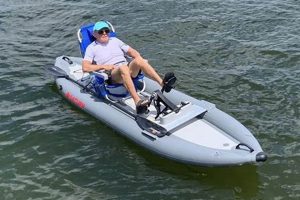
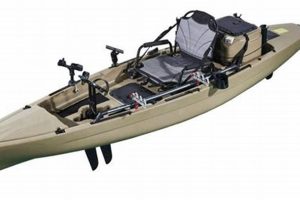
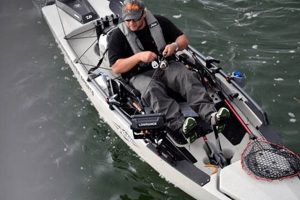
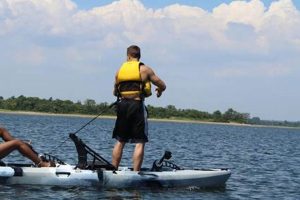
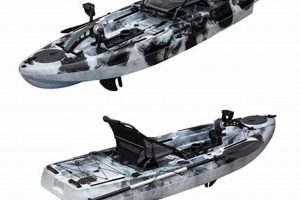
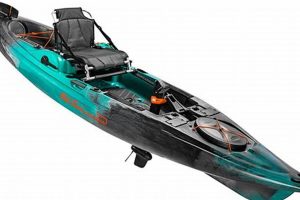
High-quality kayaks equipped with foot-powered propulsion systems offer anglers significant advantages. These vessels combine stability, speed, and hands-free operation, allowing for efficient fishing in various environments. For example, an angler can maintain a desired position while simultaneously casting and retrieving a lure, without the need for paddling. This hands-free capability is particularly valuable in situations requiring precise boat control, such as fishing in currents or around structures.
The evolution of human-powered watercraft has led to advancements in both kayak design and propulsion methods. Pedal-powered systems represent a significant step forward, offering improved maneuverability and endurance compared to traditional paddle kayaks. This technology enables anglers to cover more water with less physical exertion, maximizing fishing time and opportunities. The freedom to focus solely on fishing techniques significantly enhances the overall experience and often leads to improved results.
This article will further explore the key features that distinguish excellent pedal-driven fishing kayaks, including drive mechanisms, hull design, and specialized fishing features. Subsequent sections will delve into specific models, offering a detailed comparison to aid consumers in selecting the best vessel for their individual needs and preferences.
Essential Tips for Selecting and Using Pedal Drive Fishing Kayaks
Choosing and effectively utilizing a pedal-driven fishing kayak requires careful consideration of several factors. These tips offer guidance for maximizing performance and ensuring a positive on-the-water experience.
Tip 1: Consider Water Conditions: Different hull designs excel in different environments. Shorter, wider kayaks offer greater stability in calm lakes and ponds, while longer, narrower kayaks track better in rivers and open water. Evaluate typical fishing locations when selecting a hull design.
Tip 2: Evaluate Propulsion Systems: Pedal drives utilize either propeller or fin systems. Propeller systems offer speed and efficiency in open water, while fin systems excel in shallow water and over vegetation, minimizing the risk of fouling. Choose a system suited to the intended fishing environment.
Tip 3: Prioritize Stability and Comfort: Anglers often stand while fishing. A stable platform is crucial for safety and casting accuracy. Consider seat design, kayak width, and overall stability ratings when making a selection.
Tip 4: Assess Storage Capacity: Fishing requires gear. Adequate storage space for tackle boxes, rods, and other equipment is essential. Evaluate storage compartments, tank wells, and other storage solutions to ensure sufficient capacity.
Tip 5: Factor in Transportation and Storage: Kayak size and weight influence transportation and storage logistics. Consider vehicle capacity and available storage space when choosing a model. Roof racks and trailers may be necessary for larger kayaks.
Tip 6: Practice Maneuvering and Control: Spend time familiarizing oneself with the kayak’s handling characteristics before venturing into challenging conditions. Practice turning, reversing, and maneuvering in open water to build confidence and control.
Tip 7: Maintain the Drive System: Regular maintenance ensures optimal performance and longevity. Rinse the drive system after each use, particularly in saltwater environments. Lubricate moving parts and inspect for wear according to the manufacturer’s recommendations.
By considering these factors, anglers can select and utilize pedal-driven fishing kayaks effectively, enhancing their fishing experience and maximizing their success on the water.
The following section will offer a detailed comparison of several top-rated pedal-drive fishing kayaks, providing further guidance for informed decision-making.
1. Propulsion System

The propulsion system forms the heart of a high-performing pedal-driven fishing kayak. This system dictates speed, maneuverability, and overall efficiency on the water. Two primary types of propulsion dominate the market: propeller-based systems and fin-based systems. Each offers distinct advantages and disadvantages, influencing kayak performance in specific environments. Propeller systems generally provide greater speed and efficiency in open water, making them suitable for covering larger distances or trolling. Fin systems, conversely, excel in shallow water and areas with heavy vegetation, as their design minimizes the risk of entanglement or damage from underwater obstacles. The choice between these systems depends significantly on the intended fishing environment and angler preferences. For instance, kayaks intended for ocean fishing often employ propeller systems for their speed and efficiency in open water, while kayaks designed for navigating shallow rivers and ponds frequently utilize fin systems for their weedless operation and shallow-water capabilities.
Understanding the nuances of each propulsion type allows for informed decision-making. Propeller systems, while efficient, require deeper water clearance and can be susceptible to damage from submerged objects. Fin systems, though less prone to fouling, may offer slightly reduced top-end speed compared to propellers. Moreover, the specific design and implementation of each system vary between manufacturers, further influencing performance characteristics. Hobie’s MirageDrive, a prominent fin-based system, is known for its durability and shallow-water performance. Old Town’s PDL Drive, a propeller-based system, is recognized for its speed and efficiency in open water. These distinctions underscore the importance of researching specific drive systems and matching them to individual fishing needs and preferences. Factors such as maintenance requirements, noise levels, and overall ease of use should also be considered when evaluating different propulsion systems.
Ultimately, the propulsion system serves as a defining characteristic of pedal-driven fishing kayaks. Careful consideration of the advantages and disadvantages of each system type, alongside an understanding of specific manufacturer implementations, proves crucial for selecting the most appropriate kayak for a given fishing environment and style. Effectively harnessing the power of the propulsion system enhances fishing efficiency, expands access to diverse fishing locations, and contributes significantly to the overall angling experience. This understanding allows anglers to leverage their equipment more effectively, maximizing both enjoyment and on-the-water success.
2. Hull Design

Hull design significantly influences the performance of pedal-driven fishing kayaks, affecting stability, speed, maneuverability, and tracking. Optimal hull design balances these factors to create a vessel suitable for specific fishing environments and angler preferences. Understanding the nuances of various hull designs allows for informed decision-making and enhances on-the-water performance.
- Pontoon Hulls:
Pontoon hulls provide exceptional stability, making them ideal for stand-up fishing and sight casting. These designs feature two separate pontoons connected by a platform, creating a wide, stable base. While highly stable, pontoon hulls typically sacrifice maneuverability and speed compared to other designs. Their wide profile increases wind resistance, and their inherent stability can make quick turns challenging. Within the context of pedal-driven fishing kayaks, pontoon hulls cater specifically to anglers prioritizing stability over speed and agility. Example: Hobie Pro Angler.
- Catamaran Hulls (Twin Hull):
Similar to pontoon hulls, catamaran hulls offer enhanced stability due to their twin-hulled structure. This design provides a compromise between stability and performance, offering improved speed and tracking compared to pontoon hulls while retaining a relatively stable platform. Catamaran hulls cut through the water efficiently, minimizing drag and maximizing speed potential. This design is well-suited for anglers seeking both stability and performance in calmer waters. Example: Native Slayer Propel Max.
- Displacement Hulls:
Displacement hulls are characterized by a V-shaped bottom, designed for efficient tracking and speed in open water. These hulls displace water as they move, creating a smooth, stable ride in calm conditions. However, displacement hulls can be less stable than pontoon or catamaran designs, particularly in rough water or when making sharp turns. They excel in covering distances efficiently, making them suitable for anglers targeting open-water species. Example: Wilderness Systems Radar 135.
- Flat-Bottom Hulls:
Flat-bottom hulls prioritize stability, particularly in shallow water environments. This design creates a wide, stable platform ideal for maneuvering in tight spaces and standing to cast. However, flat-bottom hulls typically sacrifice tracking and speed compared to displacement hulls. Their shallow draft allows access to shallow areas inaccessible to other hull designs. Example: Vibe Sea Ghost 110.
Selecting the appropriate hull design for a pedal-driven fishing kayak requires careful consideration of intended fishing locations and angler priorities. Prioritizing stability often necessitates choosing a pontoon, catamaran, or flat-bottom hull. Anglers seeking speed and tracking in open water may prefer a displacement hull. Evaluating the trade-offs between stability, speed, maneuverability, and tracking ensures selection of a kayak optimized for individual needs and fishing styles. By understanding the characteristics of each hull design, anglers can enhance their on-the-water experience and maximize fishing success in diverse environments.
3. Stability

Stability stands as a critical performance attribute in top pedal-drive fishing kayaks, directly influencing angler safety, comfort, and fishing effectiveness. A stable platform allows anglers to confidently stand while casting, retrieving, and landing fish, maximizing leverage and control. Conversely, instability compromises casting accuracy, increases the risk of accidental falls, and limits overall fishing enjoyment. The relationship between stability and kayak performance is particularly pronounced in pedal-driven systems, as hands-free propulsion necessitates a secure and balanced platform for optimal operation. For example, an angler sight-fishing in a stable kayak can maintain a standing position while simultaneously pedaling, scanning for fish, and preparing to cast, maximizing responsiveness and fishing effectiveness. Conversely, an unstable kayak would hinder these actions, demanding excessive focus on balance and potentially compromising fishing opportunities.
Several factors contribute to kayak stability, including hull design, width, and center of gravity. Wider kayaks generally offer greater initial stability, resisting tipping more effectively. Hull design plays a crucial role; pontoon and catamaran hulls provide enhanced stability due to their wider base and multiple contact points with the water. Kayak length also influences stability; longer kayaks tend to be less susceptible to rocking motions but may be less maneuverable in tight spaces. The distribution of weight within the kayak also affects stability. A lower center of gravity enhances stability, while a higher center of gravity increases the likelihood of tipping. Understanding these factors allows anglers to select kayaks optimized for their individual needs and fishing styles. Anglers fishing in calm, protected waters might prioritize a wider, more stable platform for stand-up fishing, while those fishing in open water or strong currents might opt for a slightly less stable but more maneuverable design.
Optimizing stability within a high-performing fishing kayak requires careful consideration of various design elements and their interactions. Achieving a balance between stability, maneuverability, and speed remains a central challenge in kayak design. Manufacturers employ various strategies to enhance stability, such as incorporating outriggers, strategically positioning seating, and optimizing hull shapes. Ultimately, understanding the factors contributing to stability and their practical implications empowers anglers to make informed decisions when selecting a pedal-drive fishing kayak, ensuring a safe, comfortable, and productive fishing experience. Recognizing the direct link between stability and on-the-water success underscores the importance of this often-overlooked performance attribute.
4. Storage Capacity
Storage capacity represents a crucial factor in evaluating top pedal-drive fishing kayaks. Effective angling necessitates carrying a variety of equipment, including rods, reels, tackle boxes, safety gear, and personal items. Insufficient storage capacity compromises organization, limits carrying potential, and can negatively impact fishing efficiency. A well-designed storage system enhances convenience, streamlines gear access, and maximizes time spent fishing rather than managing equipment. For example, dedicated rod holders prevent rod tangling and damage, while strategically placed compartments keep essential tools readily accessible. Conversely, inadequate storage leads to cluttered decks, increased risk of gear loss, and reduced overall fishing enjoyment. This direct link between storage capacity and on-the-water effectiveness underscores its importance in selecting a high-performing fishing kayak.
Evaluating storage solutions requires considering both quantity and accessibility. Ample storage space alone does not guarantee optimal performance. Well-designed kayaks incorporate specialized compartments tailored for specific gear, such as tackle trays, dry storage for electronics, and secure areas for larger items. Accessibility further enhances practicality. Conveniently located hatches, readily reachable compartments, and strategically placed bungee cords contribute to efficient gear management, minimizing disruptions during critical fishing moments. Kayaks prioritizing storage accessibility facilitate quick retrieval of essential items, enhancing responsiveness and maximizing fishing opportunities. The practical implication is clear: a well-organized and easily accessible storage system enhances fishing efficiency, contributing to a more successful and enjoyable experience.
Manufacturers of top pedal-drive fishing kayaks recognize the significance of storage capacity and implement diverse design strategies to maximize functionality. These strategies include integrated tank wells, recessed storage compartments, strategically placed bungee systems, and specialized rod holders. Evaluating these features requires careful consideration of individual fishing styles and gear requirements. Anglers targeting specific species may prioritize specialized storage for particular types of tackle, while those fishing in diverse environments may require more versatile storage solutions. Understanding the interplay between storage capacity, accessibility, and individual fishing needs empowers informed decision-making. Selecting a kayak with appropriate storage capabilities optimizes on-the-water performance and contributes significantly to overall fishing success. This recognition highlights the practical significance of storage capacity as a defining attribute of top-tier pedal-drive fishing kayaks.
5. Seat Comfort

Seat comfort directly impacts performance and enjoyment in top pedal-drive fishing kayaks. Extended fishing trips often involve prolonged periods seated in a relatively confined space. An uncomfortable seat leads to fatigue, discomfort, and potentially even pain, significantly detracting from the overall fishing experience. Conversely, a well-designed, comfortable seat allows anglers to maintain focus and energy throughout the day, maximizing fishing effectiveness and enjoyment. This direct link between seat comfort and on-the-water performance underscores its crucial role in defining a top-tier fishing kayak. Consider, for instance, an angler engaged in a full-day tournament. A comfortable, supportive seat allows for sustained focus on fishing technique and strategy, while an uncomfortable seat inevitably distracts and diminishes performance. This example illustrates the practical implications of seat comfort in demanding fishing scenarios.
Evaluating seat comfort involves assessing several key features. Adjustability plays a crucial role, allowing anglers to customize seat position and support for optimal posture and comfort. High-quality padding and breathable materials enhance comfort during extended use, particularly in warm weather. Ergonomic design further contributes to comfort by providing proper lumbar support and promoting healthy posture. Features such as adjustable backrests, breathable mesh fabrics, and customizable seat heights contribute to a more comfortable and enjoyable fishing experience. A seat designed with these considerations in mind minimizes fatigue, reduces pressure points, and promotes optimal body mechanics, allowing anglers to maintain focus and energy throughout the day. The practical implications extend beyond mere comfort; a properly designed seat can prevent long-term back pain and discomfort, promoting angler health and well-being.
Leading manufacturers of pedal-drive fishing kayaks recognize the critical importance of seat comfort and invest significant resources in developing ergonomic and adjustable seating systems. These systems prioritize comfort and support, recognizing the direct link between angler well-being and on-the-water performance. Features like adjustable lumbar support, breathable fabrics, and customizable seat positioning reflect this commitment to enhancing the overall fishing experience. Selecting a kayak equipped with a comfortable and supportive seat ensures sustained focus, minimizes fatigue, and ultimately contributes to a more productive and enjoyable fishing trip. This understanding underscores the practical significance of seat comfort as a defining characteristic of top pedal-drive fishing kayaks, elevating it beyond a mere convenience to a critical performance attribute.
6. Construction Quality

Construction quality directly influences the longevity, performance, and safety of top pedal-drive fishing kayaks. These kayaks are subjected to demanding conditions, including exposure to saltwater, UV radiation, and impacts from underwater obstacles. Robust construction ensures the vessel withstands these rigors, maintaining structural integrity and ensuring angler safety over extended periods. A kayak built with inferior materials or inadequate construction techniques will likely degrade prematurely, compromising performance and potentially leading to hazardous situations. For instance, a poorly constructed hull might crack or deform under stress, leading to leaks or instability. Conversely, a kayak built with high-quality materials and meticulous attention to detail will provide years of reliable service, maintaining its structural integrity and performance characteristics even in challenging environments. This direct correlation between construction quality and long-term performance underscores its critical importance in defining a top-tier pedal-drive fishing kayak.
Evaluating construction quality requires assessing several key factors. Material selection plays a crucial role. High-grade polymers, such as rotomolded polyethylene, offer excellent impact resistance, UV resistance, and durability. Reinforcements in critical areas further enhance structural integrity. Construction techniques, such as proper welding and bonding, ensure lasting seams and a watertight hull. Hardware quality also contributes to overall durability; corrosion-resistant stainless steel fittings and robust components ensure long-term functionality and minimize maintenance requirements. Examining these elements provides insight into the kayak’s ability to withstand long-term use and exposure to harsh environments. Kayaks built with meticulous attention to detail and employing high-quality materials offer greater resistance to wear and tear, ensuring sustained performance and longevity. This understanding enables informed decision-making, allowing consumers to prioritize kayaks built to withstand the rigors of demanding fishing environments.
The practical significance of construction quality extends beyond mere durability. A well-constructed kayak provides a solid, stable platform, enhancing angler safety and confidence. It tracks efficiently through the water, maximizing paddling efficiency and minimizing fatigue. Robust construction also contributes to resale value, allowing owners to recoup a greater portion of their initial investment. Recognizing the multifaceted implications of construction quality underscores its crucial role in defining top pedal-drive fishing kayaks. Ultimately, prioritizing construction quality ensures a safe, reliable, and high-performing vessel, maximizing long-term enjoyment and value. This understanding positions construction quality not as a secondary consideration but as a fundamental attribute of any top-tier fishing kayak.
Frequently Asked Questions
This section addresses common inquiries regarding high-performance pedal-driven fishing kayaks, providing concise and informative responses to facilitate informed decision-making.
Question 1: What are the primary advantages of pedal-driven kayaks over traditional paddle kayaks for fishing?
Pedal-driven kayaks offer hands-free propulsion, allowing anglers to focus on fishing techniques rather than paddling. This advantage proves particularly beneficial for activities requiring precise boat control, such as trolling or maneuvering in currents. Increased speed and range compared to paddling further enhance fishing efficiency.
Question 2: How do propeller-based and fin-based pedal drive systems differ in performance and suitability for various fishing environments?
Propeller systems generally offer superior speed and efficiency in open water but require greater clearance and can be susceptible to fouling in shallow or vegetated areas. Fin systems excel in shallow water and over vegetation due to their lower profile and weedless operation, though they may sacrifice some top-end speed. The optimal choice depends on the primary fishing environment.
Question 3: What factors contribute most significantly to kayak stability, and why is stability crucial for fishing?
Hull design, width, length, and center of gravity significantly influence kayak stability. Wider hulls generally offer greater stability, while longer kayaks track better in open water. A lower center of gravity enhances stability. Stability is paramount for fishing as it allows anglers to stand comfortably and safely while casting, fighting fish, and landing catches.
Question 4: What features should one consider when evaluating the storage capacity of a fishing kayak?
Consider both the overall storage space and the specific compartments available. Look for dedicated areas for tackle boxes, rods, and other essential gear. Accessibility is crucial; well-placed hatches and readily reachable compartments enhance on-the-water efficiency. Evaluate the layout and design of the storage system to ensure it aligns with individual fishing needs and preferences.
Question 5: Why is seat comfort an important consideration, particularly for extended fishing trips?
An uncomfortable seat can lead to fatigue and discomfort, negatively impacting fishing performance and enjoyment, especially during long hours on the water. Look for adjustable seats with ample padding and breathable materials. Ergonomic features, such as lumbar support and adjustable backrests, contribute to long-term comfort and prevent potential back pain.
Question 6: How does construction quality impact the long-term durability and performance of a pedal-driven fishing kayak?
High-quality construction ensures the kayak withstands harsh conditions, including UV exposure, saltwater, and impacts. Durable materials, such as rotomolded polyethylene, contribute to longevity. Proper construction techniques, including robust welds and reinforced seams, ensure a watertight and structurally sound hull. High-quality construction translates to long-term reliability and sustained performance.
Careful consideration of these frequently asked questions clarifies key considerations when selecting a high-performance pedal-driven fishing kayak. Understanding these elements empowers informed decision-making and contributes significantly to a more rewarding and productive fishing experience.
The subsequent sections of this article will delve into specific top-rated pedal-drive fishing kayak models, offering in-depth reviews and comparisons to guide selection based on individual needs and preferences.
Conclusion
High-performance pedal-driven fishing kayaks represent a significant advancement in angling technology. This article has explored key features distinguishing these specialized vessels, encompassing propulsion systems, hull designs, stability considerations, storage solutions, seat comfort, and construction quality. Understanding these interconnected elements empowers informed purchasing decisions, aligning kayak selection with individual angler needs and fishing styles. From the efficiency of propeller and fin drives to the stability of pontoon and catamaran hulls, each feature contributes significantly to overall performance and on-the-water success.
Investing in a premium pedal-driven fishing kayak represents an investment in enhanced fishing experiences. Careful consideration of the factors discussed herein ensures selection of a vessel optimized for specific fishing environments and individual preferences. As technology continues to evolve, advancements in kayak design and propulsion systems promise further enhancements to angling experiences, expanding access to diverse fishing locations and maximizing on-the-water effectiveness. Diligent research and informed decision-making remain paramount in harnessing the full potential of these advanced fishing platforms.