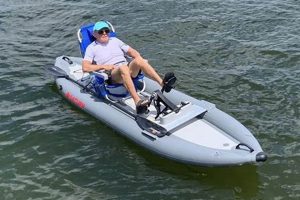
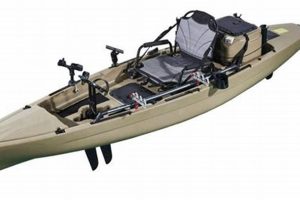
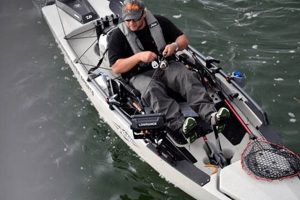
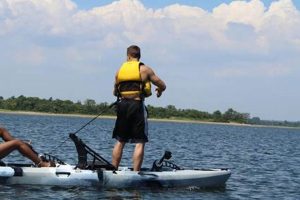
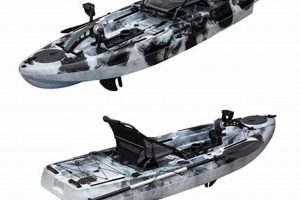
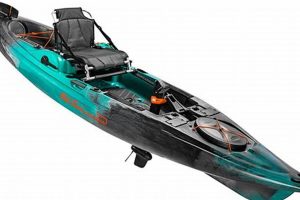
This specific watercraft combines a renowned brand with a feature-rich design tailored for anglers. It integrates a hands-free propulsion system, allowing for efficient and quiet movement through the water, ideal for approaching fish without disturbance. This type of vessel often features specialized seating, ample storage for fishing gear, and mounting points for accessories like rod holders and fish finders. Its design prioritizes stability and maneuverability, key considerations for anglers in various aquatic environments.
Hands-free propulsion offers several advantages over traditional paddle kayaks, including increased speed and range, reduced fatigue, and the ability to fish while simultaneously navigating. This combination of features can significantly enhance the fishing experience, allowing anglers to cover more water and focus on their technique. The evolution of fishing kayak design has seen continuous improvements in propulsion systems, hull designs, and integrated features, culminating in highly specialized vessels like this one which cater to the diverse needs of the modern angler.
Further exploration will delve into specific features, performance characteristics, user experiences, and comparisons with similar products in the market. This comprehensive analysis aims to provide potential users with valuable insights to inform their purchasing decisions and maximize their on-the-water experience.
Tips for Utilizing Pedal-Driven Fishing Kayaks
Effective use of pedal-driven fishing kayaks involves understanding their capabilities and employing best practices for optimal performance and safety. The following tips offer guidance for anglers seeking to maximize their experience.
Tip 1: Practice Pedal Operation in Calm Waters: Initial experience with pedal propulsion should occur in sheltered areas with minimal current or wind. This allows for acclimation to the system and practice maneuvering before venturing into more challenging conditions.
Tip 2: Understand Proper Weight Distribution: Even weight distribution is crucial for stability. Gear should be evenly distributed throughout the kayak, avoiding overloading any single area. This practice enhances both performance and safety.
Tip 3: Employ a Drift Sock for Controlled Drift Fishing: Utilizing a drift sock can significantly enhance fishing effectiveness by slowing the kayak’s drift, allowing for thorough coverage of target areas.
Tip 4: Plan Routes Considering Wind and Current: Wind and current play significant roles in navigation and effort required for pedaling. Routes should be planned to minimize resistance and maximize efficiency, accounting for prevailing conditions.
Tip 5: Regularly Inspect and Maintain the Pedal Drive System: Proper maintenance, including rinsing after each use and periodic lubrication, ensures longevity and optimal performance of the pedal drive system.
Tip 6: Utilize Appropriate Safety Gear: Personal flotation devices and other appropriate safety equipment are essential regardless of skill level or water conditions. Safety should always be a primary consideration.
Tip 7: Practice Deploying and Retrieving the Anchor: Proficiency in anchor deployment and retrieval is critical for maintaining position in desired fishing locations and reacting effectively to changing conditions.
Adhering to these guidelines will enhance on-water safety, improve fishing effectiveness, and extend the lifespan of the kayak and its propulsion system. These practices contribute to a more enjoyable and productive experience for anglers of all levels.
These insights into optimized kayak usage pave the way for a concluding discussion regarding the overall value proposition and considerations for potential purchasers.
1. Hands-free Fishing

Hands-free fishing represents a significant advancement in angling, particularly within kayak fishing. The Perception Pescador Pilot’s pedal-drive system directly addresses this, offering anglers the ability to maneuver and position themselves without using paddles. This capability unlocks several advantages, enhancing both efficiency and enjoyment on the water.
- Enhanced Focus on Fishing Techniques:
Without the need to manage paddles, anglers can dedicate their full attention to fishing techniques, rod manipulation, and lure presentation. This undivided focus can lead to improved catch rates, especially in situations requiring precise lure control or quick reactions to bites. The pedal drive frees up both hands, enabling anglers to manage multiple rods or tackle adjustments efficiently.
- Improved Boat Control and Positioning:
Precise boat control is crucial for successful fishing. The pedal drive system allows for subtle adjustments in position, maintaining optimal location relative to structure, cover, or current. This level of control is particularly advantageous in challenging environments like rivers or windy conditions, where maintaining position against the current or wind is paramount. Compared to paddle propulsion, the pedal drive offers more consistent and nuanced control.
- Increased Efficiency and Range:
Pedal drives generally offer greater speed and range compared to traditional paddles, allowing anglers to cover more water and access distant fishing spots. This efficiency expands fishing opportunities and allows for exploration of larger bodies of water. Reduced fatigue from continuous paddling also contributes to a longer and more productive fishing day.
- Stealth and Reduced Disturbance:
The underwater profile of a pedal drive system is often less intrusive than paddling, minimizing noise and surface disturbance. This quieter approach can be a significant advantage when targeting wary fish in shallow or clear water. The smooth, consistent movement provided by the pedals further reduces disturbance compared to the intermittent splashing of paddles.
The integration of hands-free fishing through the pedal-drive system in the Perception Pescador Pilot significantly enhances the overall angling experience. This technology’s contribution to improved control, efficiency, and stealth allows anglers to focus on the art of fishing, maximizing their potential for success and enjoyment on the water. This hands-free approach transforms kayak fishing, bridging the gap between traditional paddle kayaks and motorboats, offering a unique blend of maneuverability, efficiency, and a close-to-the-water experience.
2. Pilot Drive System
The Pilot Drive System is integral to the Perception Pescador Pilot pedal drive fishing kayak, serving as its primary propulsion method. This system distinguishes the Pescador Pilot from traditional paddle-powered kayaks, offering distinct advantages in maneuverability, speed, and overall fishing experience. The Pilot Drive System employs a rotational pedaling motion, translated through a series of gears and a propeller, to propel the kayak. This hands-free propulsion allows anglers to maintain constant forward momentum while simultaneously focusing on fishing techniques. Consider a scenario where an angler needs to hold position against a moderate current while casting to a specific target. The Pilot Drive System allows precise adjustments in position and speed without interrupting the fishing process. This represents a significant advantage over paddle kayaks, where maintaining position and fishing simultaneously can be challenging.
The Pilot Drive System’s impact extends beyond simple propulsion. Its design contributes to the kayak’s overall performance. The propeller’s position beneath the hull minimizes drag and maximizes efficiency, allowing for greater speed and range. The system’s quiet operation, compared to above-water propulsion methods like trolling motors, provides a stealth advantage, reducing disturbance to fish, particularly in shallow waters. For instance, in a shallow estuary, the quiet operation of the Pilot Drive System allows anglers to approach fish without spooking them, enhancing the likelihood of a successful catch. Furthermore, the system’s integrated design contributes to the kayak’s stability. The positioning of the drive and its associated components within the hull lowers the center of gravity, enhancing balance and making it less prone to tipping, especially in challenging conditions.
Understanding the Pilot Drive System’s role within the Perception Pescador Pilot is crucial for appreciating the kayak’s capabilities. It represents a key differentiator and significantly contributes to the kayak’s performance advantages. This system directly addresses the challenges of traditional paddle kayaks, providing a more efficient, versatile, and ultimately, more rewarding fishing experience. The system’s ease of use and maintenance further enhance its practical value, requiring minimal effort beyond regular cleaning and occasional lubrication. Its robust construction contributes to long-term reliability, ensuring the system can withstand the rigors of regular use in various aquatic environments.
3. Enhanced Stability

Enhanced stability is a critical design element in the Perception Pescador Pilot pedal drive fishing kayak, directly influencing its performance and suitability for angling. Stability in a kayak context refers to its resistance to tipping or capsizing, crucial for angler safety and effective fishing. Several factors contribute to the Pescador Pilot’s enhanced stability, including hull design, weight distribution, and the integration of the pedal drive system. The wider, flatter hull design, characteristic of many fishing kayaks, provides a larger surface area in contact with the water, increasing primary stability resistance to initial tipping. Consider an angler casting from a seated position; a stable platform minimizes wobble, allowing for accurate casts and reduces the risk of losing balance during the casting motion. This stability becomes even more critical when fighting a fish, where sudden movements and shifts in weight can compromise balance in a less stable kayak. The Pescador Pilot’s design addresses these challenges, providing a secure and confident platform for various fishing scenarios.
The pedal drive system further contributes to stability. Its placement beneath the hull lowers the center of gravity, enhancing secondary stability the kayak’s ability to recover from larger tilting forces. This lower center of gravity makes the kayak less prone to capsizing, even in rougher water conditions or during unexpected movements. Imagine an angler hooking a large fish that suddenly changes direction; the lower center of gravity provides greater resistance to the resulting destabilizing force. Furthermore, the even weight distribution achieved by integrating the drive system within the hull, rather than as an add-on, further enhances stability. This integrated design minimizes the risk of uneven weight distribution from added accessories or gear, which can negatively impact a kayak’s balance. The strategic placement of seating and storage compartments further contributes to optimal weight distribution, promoting overall stability and a predictable on-water experience.
The enhanced stability of the Perception Pescador Pilot translates into practical advantages for anglers. Increased stability builds confidence, allowing anglers to focus on fishing rather than constantly managing their balance. This is particularly crucial in dynamic fishing environments, such as rivers or coastal areas with changing currents and wave action. The stable platform provided by the Pescador Pilot enables anglers to stand and fish comfortably, offering a wider casting range and improved visibility. Ultimately, the emphasis on stability in the Pescador Pilot’s design contributes significantly to its effectiveness as a fishing platform. It enhances safety, improves casting accuracy, and allows anglers to confidently navigate and fish in a wider range of conditions, maximizing their on-the-water experience.
4. Ample Storage

Ample storage is a critical feature in fishing kayaks, directly impacting their practicality and effectiveness. The Perception Pescador Pilot pedal drive fishing kayak addresses this need by incorporating various storage solutions designed to accommodate the diverse gear requirements of anglers. Effective storage solutions allow for organized transport and easy access to essential equipment, contributing to a more efficient and enjoyable fishing experience. Examining the storage features of the Pescador Pilot reveals a thoughtful approach to maximizing storage capacity without compromising the kayak’s performance or stability.
- Front Hatch Storage:
The front hatch provides a large, watertight compartment ideal for storing bulky items like tackle boxes, extra clothing, or safety gear. Its location offers easy access while maintaining balanced weight distribution. This compartment’s sealed design protects contents from water damage, essential for preserving valuable equipment during unexpected splashes or even submersion. For example, anglers can safely store electronic devices, spare reels, or first-aid kits, ensuring their availability and functionality throughout the fishing trip.
- Rear Tankwell Storage:
The rear tankwell, often featuring bungee cords or other securing mechanisms, provides open storage suitable for larger items like crates, coolers, or even a small anchor. This area’s accessibility allows for quick retrieval of frequently used items like landing nets or additional rods. Its design allows for flexible storage configurations, accommodating items of varying shapes and sizes. Anglers can easily secure a cooler for storing their catch or carry extra gear like a dry bag or camera equipment.
- Side Storage and Rod Holders:
Many models include side storage compartments or pockets designed for smaller items like pliers, line cutters, or leader material. Integrated rod holders, typically positioned within easy reach of the angler, provide secure storage for rods while not in use. These specialized storage solutions contribute to an organized and efficient cockpit environment, minimizing clutter and maximizing fishing time. Having essential tools and accessories readily accessible streamlines the fishing process, allowing anglers to quickly change lures, re-rig lines, or address other needs without interrupting their flow.
- Center Console and Tackle Storage:
Some Pescador Pilot models incorporate a center console, offering additional storage within easy reach of the seated angler. This console may include dedicated compartments for tackle boxes, leader spools, or other small items frequently used during fishing. This centralized location provides quick access to essential gear, minimizing disruptions during critical fishing moments. For example, having frequently used lures or hooks readily available within the center console allows anglers to quickly adapt to changing fish behavior or water conditions.
The ample storage options integrated into the Perception Pescador Pilot contribute significantly to its overall utility as a fishing platform. The variety of storage solutions caters to the diverse needs of anglers, accommodating different gear types and sizes. This well-designed storage system enhances organization, improves efficiency, and maximizes on-water time by ensuring essential equipment remains readily accessible and protected. By prioritizing storage alongside performance and stability, the Pescador Pilot exemplifies a well-rounded design approach that enhances the overall fishing experience.
5. Comfortable Seating
Comfortable seating is a crucial factor influencing the overall fishing experience, particularly in kayak fishing where anglers often spend extended periods seated. Within the context of the Perception Pescador Pilot pedal drive fishing kayak, seating comfort directly impacts an angler’s ability to focus on fishing, endure longer trips, and ultimately, enjoy the experience. The connection between comfortable seating and the Pescador Pilot’s functionality as a fishing platform is significant, impacting both performance and enjoyment. Consider an angler spending several hours on the water; an uncomfortable seat can lead to fatigue, back pain, and decreased focus, negatively impacting their ability to effectively fish and enjoy the experience. The Pescador Pilot addresses this by incorporating seating systems designed for prolonged comfort and support.
The design of the Pescador Pilot’s seating system typically incorporates several key features aimed at enhancing comfort. Adjustable seating allows anglers to customize the seat position to their individual preferences and body type, promoting proper posture and reducing strain. Ergonomic design principles are often employed, incorporating features like lumbar support and contoured seating surfaces to minimize pressure points and promote proper body alignment. Breathable mesh fabrics or other moisture-wicking materials are commonly used in the seat construction to enhance ventilation and reduce heat buildup, particularly in warmer climates. These design elements collectively contribute to a more comfortable and supportive seating experience, reducing fatigue and allowing anglers to focus on fishing rather than discomfort. For example, the adjustable backrest in some Pescador Pilot models allows anglers to fine-tune the level of lumbar support, minimizing back strain during long fishing trips. The breathable mesh fabric contributes to airflow, preventing overheating and maintaining comfort even on hot days. These design considerations demonstrate a focus on user comfort as a critical component of the overall fishing experience.
The practical significance of comfortable seating within the Perception Pescador Pilot becomes evident in its impact on angler performance and enjoyment. Reduced fatigue allows for longer fishing trips and sustained focus, leading to increased opportunities for success. Enhanced comfort promotes a more positive overall experience, contributing to the enjoyment and relaxation associated with spending time on the water. Addressing the specific challenges of prolonged sitting inherent in kayak fishing through comfortable seating design demonstrates a user-centric approach that distinguishes the Pescador Pilot as a well-rounded fishing platform. By prioritizing comfort alongside performance and stability, the Pescador Pilot effectively caters to the needs of anglers seeking a comfortable and productive fishing experience. This focus on comfort ultimately contributes to the kayak’s overall value proposition, distinguishing it from competitors and solidifying its appeal to discerning anglers.
6. Durable Construction
Durable construction is paramount for fishing kayaks, especially those designed for diverse environments and rigorous use. The Perception Pescador Pilot pedal drive fishing kayak exemplifies this principle through its robust construction, directly impacting its longevity, performance, and overall value. Durability translates to resilience against impacts, abrasion, and environmental factors, ensuring the kayak withstands the rigors of regular use and maintains its structural integrity over time. This attribute is essential for navigating various water conditions, from shallow rivers and rocky coastlines to open lakes and bays. Consider a scenario where the kayak encounters submerged debris or scrapes against rocks during launching or landing. A durable hull minimizes the risk of damage, ensuring the kayak remains functional and safe. This resilience directly translates to a longer lifespan and reduced maintenance costs, representing a significant advantage for anglers seeking a reliable and long-lasting investment. The choice of materials and construction techniques employed in the Pescador Pilot reflects a prioritization of durability.
High-density polyethylene (HDPE) is commonly used in kayak construction due to its impact resistance, UV stability, and overall durability. HDPE can withstand considerable force without cracking or deforming, crucial for navigating challenging environments. The manufacturing process, often involving rotational molding, creates a seamless, one-piece hull with uniform thickness, enhancing structural integrity and minimizing weak points. Reinforced areas, particularly in high-stress zones like the keel and seating areas, further bolster the kayak’s resilience. For example, reinforced keel protection minimizes damage from dragging the kayak over sand or gravel during launching or landing. This meticulous attention to construction details underscores the emphasis on durability as a core design principle in the Pescador Pilot. Furthermore, UV resistance ensures the kayak’s color and structural integrity are maintained even after prolonged exposure to sunlight, preventing fading and material degradation.
The practical significance of durable construction in the Perception Pescador Pilot extends beyond simple longevity. A robust hull contributes to enhanced on-water performance. Its resistance to flex and deformation under load maintains the kayak’s hydrodynamic efficiency, maximizing speed and tracking performance. This rigidity also enhances stability, providing a solid and predictable platform for casting, reeling, and landing fish. Moreover, the durable construction contributes to the kayak’s overall safety. A strong, impact-resistant hull provides a secure platform, minimizing the risk of damage and potential compromise in challenging conditions. The long-term value of the Pescador Pilot is directly linked to its durable construction. Reduced maintenance requirements, extended lifespan, and consistent performance over time contribute to a higher return on investment for anglers. By prioritizing durable construction, the Pescador Pilot establishes itself as a reliable, long-lasting, and high-performing fishing kayak, well-suited for the demands of serious anglers.
Frequently Asked Questions
This section addresses common inquiries regarding kayaks equipped with pedal-drive systems, specifically focusing on aspects relevant to the angling experience.
Question 1: What are the primary advantages of a pedal-driven fishing kayak over a traditional paddle kayak?
Pedal-driven kayaks offer hands-free propulsion, allowing anglers to focus on fishing techniques and maintain precise boat control simultaneously. This design increases fishing efficiency and reduces fatigue compared to paddling. The increased speed and range achievable with pedal drives expand access to fishing locations, while the quiet operation minimizes disturbance to fish.
Question 2: How does the pedal drive system perform in different water conditions, such as shallow water, currents, or wind?
Performance varies depending on the specific pedal drive system and kayak design. Generally, pedal drives function effectively in various conditions. Shallow water performance depends on the propeller’s draft and susceptibility to weed entanglement. Strong currents or winds may require increased pedaling effort, and certain hull designs handle these conditions better than others. Researching specific model performance characteristics is advised.
Question 3: What maintenance is required for a pedal drive system, and how complex is it to perform?
Regular maintenance typically involves rinsing the system with fresh water after each use to remove salt, sand, or debris. Periodic lubrication of moving parts is also recommended. Most systems are designed for user-serviceability with readily available replacement parts. Consulting the manufacturer’s instructions provides specific maintenance guidelines and procedures.
Question 4: How durable are pedal drive systems, and what are the typical repair costs if damage occurs?
Durability depends on the system’s design and materials. Well-maintained systems generally offer reliable performance. Repair costs vary depending on the nature of the damage and whether replacement parts are required. Manufacturer warranties often cover specific defects or failures, providing a degree of consumer protection.
Question 5: Are pedal-driven kayaks significantly heavier than paddle kayaks, and how does this affect transportation and launching?
Pedal-driven kayaks are typically heavier due to the drive system’s added weight. This added weight may require assistance for loading and unloading, and specialized kayak carts can facilitate transportation. Launching may require slightly more effort but does not typically pose significant challenges.
Question 6: How does the stability of a pedal-driven fishing kayak compare to that of a traditional paddle kayak?
Stability varies depending on specific hull designs. Many pedal-driven fishing kayaks prioritize stability with wider hulls and lower centers of gravity. However, the added weight of the drive system can influence stability characteristics. Researching specific model stability ratings and user reviews provides valuable insights.
Understanding these key aspects informs potential purchasers about the capabilities, limitations, and maintenance requirements associated with pedal-driven fishing kayaks. This knowledge empowers informed decisions aligned with individual angling needs and preferences.
This FAQ section sets the stage for a comprehensive conclusion summarizing the key features and benefits, ultimately assisting potential buyers in making informed decisions.
Conclusion
Analysis of the Perception Pescador Pilot pedal drive fishing kayak reveals a design prioritizing angler needs. Hands-free propulsion, facilitated by the Pilot Drive System, enhances fishing efficiency and boat control. Ample storage accommodates essential gear, while comfortable seating ensures prolonged fishing comfort. Durable construction, often featuring high-density polyethylene, promises longevity and resilience in diverse environments. Enhanced stability, derived from hull design and weight distribution, provides a secure fishing platform. These features collectively contribute to a specialized kayak prioritizing performance and angler experience.
The evolution of fishing kayak design reflects a continuous pursuit of enhanced functionality and on-water performance. Vessels like the Perception Pescador Pilot represent a significant advancement, offering anglers a unique blend of efficiency, stability, and comfort. Continued innovation in materials, propulsion systems, and integrated features promises further refinement of the fishing kayak, enhancing the angling experience and expanding access to diverse aquatic environments. Careful consideration of individual needs and preferences remains crucial for selecting the optimal kayak for a fulfilling and productive fishing experience.