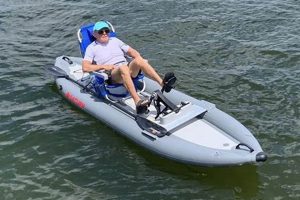
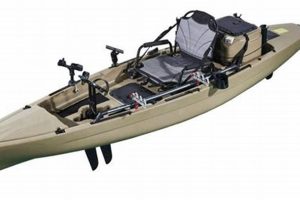
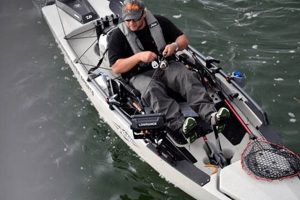
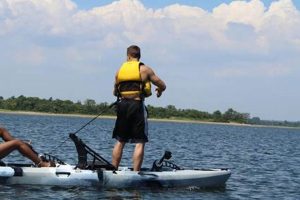
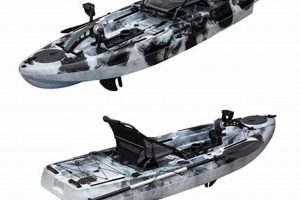
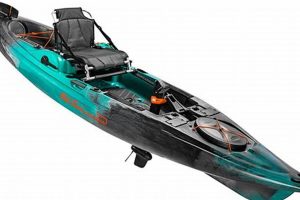
Hands-free propulsion kayaks designed for angling offer a unique approach to the sport. These specialized vessels utilize foot-powered pedal drives, leaving the angler’s hands free for casting, retrieving, and handling fish. This method combines the quiet, shallow-water access of traditional kayaks with the efficiency and speed of a small motorized boat. An example of this is an angler navigating a shallow estuary, simultaneously maneuvering through tight channels and casting a lure with ease.
This style of fishing provides significant advantages. Improved mobility and maneuverability contribute to increased fishing success, allowing for quick adjustments in position and the ability to cover more water. Maintaining a precise location in currents or wind, critical for techniques like drift fishing or targeting specific structures, becomes significantly easier. Furthermore, the quiet operation of the pedal drive minimizes disturbance to fish, enhancing stealth and increasing the chances of a successful catch. While traditional paddle kayaks remain popular, the advent of pedal-powered systems has opened up new possibilities, attracting both seasoned anglers and newcomers to the sport.
This article will further explore the nuances of this fishing method, examining the various types of pedal drive systems, optimal kayak designs, specialized fishing gear, and effective angling techniques tailored for this hands-free approach.
Tips for Hands-Free Kayak Angling
Maximizing efficiency and stealth are key to successful hands-free kayak angling. The following tips offer guidance for optimizing the experience and improving catch rates.
Tip 1: Master Pedal Drive Operation: Understanding the nuances of the specific pedal drive system is crucial. Practice deploying, adjusting, and stowing the drive smoothly and efficiently. Familiarization with the system’s responsiveness and maneuverability will enhance boat control and navigation.
Tip 2: Select Appropriate Kayak Design: Kayak stability and hull design significantly impact performance. Wider, flatter hulls provide greater stability, while longer, narrower designs offer increased speed and tracking. Consider the target fishing environment and choose a kayak suited to the conditions.
Tip 3: Prioritize Stealth: Minimize noise and movement to avoid spooking fish. Practice smooth pedal strokes and avoid sudden changes in direction. Consider using a drift sock or anchor to maintain position quietly in current or wind.
Tip 4: Optimize Gear Storage and Accessibility: Efficiently organized gear is essential for hands-free fishing. Utilize readily accessible storage compartments and tackle organizers to keep essential equipment within easy reach without hindering paddling or casting.
Tip 5: Employ Appropriate Fishing Techniques: Certain angling techniques are particularly well-suited to hands-free kayak fishing. Drift fishing, trolling, and sight casting benefit from the precise boat control and maneuverability offered by pedal-powered systems.
Tip 6: Plan Fishing Routes Strategically: Pre-plan fishing routes based on target species, water conditions, and potential hazards. Utilize mapping tools and navigational aids to maximize efficiency and ensure safe navigation.
Tip 7: Practice Safety Procedures: Always wear a personal flotation device and adhere to local boating regulations. Carry essential safety equipment, including a whistle, signaling device, and first-aid kit. Inform someone of the fishing plan, including location and expected return time.
By implementing these strategies, anglers can significantly improve their fishing experience and increase their chances of success while enjoying the advantages of hands-free kayak angling.
This article will now delve into specific equipment recommendations and advanced angling techniques to further enhance proficiency in this exciting and rapidly evolving segment of the sport.
1. Hands-Free Fishing

Hands-free fishing represents a significant advantage offered by pedal-powered kayaks, differentiating them from traditional paddle kayaks. This capability allows anglers to focus on fishing techniques, significantly impacting efficiency and overall success. The following facets explore the core components and implications of hands-free fishing within this context.
- Enhanced Lure Presentation:
Maintaining precise lure control while simultaneously maneuvering the kayak is a critical aspect of successful angling. Hands-free operation allows for subtle adjustments to lure depth and action, mimicking natural prey behavior and increasing the likelihood of attracting fish. For instance, an angler can subtly twitch a topwater lure while simultaneously navigating along a weed line, enticing a strike from a lurking bass. This level of control is often difficult to achieve with traditional paddling.
- Improved Hookset and Fish Fighting:
Reacting quickly to a fish strike is crucial for securing the hookset. With hands readily available, anglers can immediately set the hook and begin fighting the fish without the delay of adjusting paddle position. This responsiveness is particularly crucial when targeting species known for quick strikes or delicate bites. In scenarios where a large fish strikes unexpectedly, having both hands free provides a significant advantage in maintaining control and preventing line breakage.
- Increased Situational Awareness:
Maintaining constant awareness of the surrounding environment, including water conditions, structure, and potential hazards, is vital for angler safety and success. Hands-free operation allows anglers to continuously scan the water, observe bird activity, and identify promising fishing spots without the distraction of paddling. This heightened awareness can lead to discovering hidden fishing opportunities and reacting quickly to changing conditions.
- Multitasking Efficiency:
Hands-free fishing allows for efficient multitasking, enabling anglers to perform various actions simultaneously, such as adjusting fishing lines, changing lures, operating electronic fish finders, and landing fish, all while maintaining boat control and position. This streamlined workflow significantly improves efficiency and maximizes fishing time, particularly valuable in tournaments or limited-time outings. For example, an angler can quickly switch from a bottom-bouncing rig to a topwater lure without losing position or interrupting the fishing flow.
These combined facets of hands-free fishing significantly enhance the angling experience, empowering anglers with increased control, responsiveness, and efficiency, directly contributing to greater success on the water. This capability distinguishes pedal-powered kayaks as a powerful tool for anglers seeking to maximize their fishing potential.
2. Increased Maneuverability

Enhanced maneuverability represents a defining characteristic of pedal-driven kayaks, significantly impacting their effectiveness in various fishing scenarios. The hands-free nature of pedal propulsion allows for precise boat control, enabling anglers to navigate complex environments and position themselves strategically for optimal fishing presentations. This advantage stems from the continuous propulsion and steering control afforded by the pedal drive system. Unlike paddling, which requires alternating strokes and repositioning the paddle, pedaling provides uninterrupted power and directional control, facilitating quick adjustments and precise movements. This is particularly advantageous in challenging conditions such as navigating tight creeks, maneuvering through dense vegetation, or holding position in strong currents.
Consider a scenario where an angler targets fish holding tight to submerged structures in a river. The ability to subtly adjust position and maintain precise boat control while simultaneously presenting a lure is paramount. Pedal-driven kayaks excel in such situations, allowing anglers to hold position upstream or downstream of a target, making micro-adjustments to maintain the optimal presentation angle and depth. This level of control is often difficult to achieve with traditional paddle kayaks, where maintaining position and simultaneously manipulating a fishing rod can be cumbersome.
The practical significance of increased maneuverability extends beyond simply navigating challenging environments. It directly impacts fishing success by enabling anglers to present lures effectively, cover water efficiently, and respond quickly to changing conditions. While factors like kayak design and individual skill contribute to overall maneuverability, the fundamental advantage provided by the pedal drive system plays a crucial role. This enhanced control empowers anglers to exploit fishing opportunities that might otherwise be inaccessible or difficult to manage with traditional paddling methods, solidifying the importance of maneuverability as a core component of pedal kayak fishing.
3. Enhanced Propulsion

Enhanced propulsion stands as a cornerstone of pedal kayak fishing, fundamentally altering how anglers approach and experience the sport. The shift from paddle-powered propulsion to a pedal-driven system introduces several key advantages, impacting speed, efficiency, and overall fishing effectiveness. This section explores the multifaceted implications of enhanced propulsion in the context of pedal kayak fishing.
- Increased Speed and Efficiency:
Pedal drives offer a notable advantage in speed and efficiency compared to traditional paddling. The continuous, cyclical motion of pedaling translates to consistent propulsion, allowing anglers to cover greater distances with less effort. This efficiency is particularly beneficial when navigating larger bodies of water or traveling longer distances to reach desired fishing locations. Consider an angler targeting offshore fishing grounds; the increased speed of a pedal-driven kayak allows for quicker access and maximizes fishing time on the water.
- Maintaining Momentum and Position:
Currents, wind, and challenging water conditions can significantly impede progress and complicate boat control. Pedal drives provide a continuous source of propulsion, making it easier to maintain momentum and hold position against these forces. This capability is crucial for techniques like drift fishing or maintaining a precise location over a submerged structure. For example, an angler fishing in a fast-flowing river can utilize the pedal drive to hold position upstream of a promising eddy, presenting lures precisely to waiting fish.
- Reduced Fatigue and Extended Fishing Time:
Paddling, especially over extended periods, can lead to fatigue, limiting fishing time and effectiveness. Pedal drives engage larger muscle groups in the legs, distributing the physical exertion more evenly and reducing overall fatigue. This allows anglers to fish longer and maintain focus throughout the day, maximizing opportunities for success. The reduced physical strain is particularly advantageous for anglers with physical limitations or those undertaking multi-day fishing expeditions.
- Hands-Free Focus on Fishing Techniques:
While inherently linked to the benefits of hands-free fishing, the propulsion system contributes significantly by freeing the angler from the continuous physical demands of paddling. This allows for dedicated focus on fishing techniques, lure presentation, and fish fighting, ultimately increasing angling effectiveness. Consider a scenario where an angler spots a school of feeding fish; the immediate availability of both hands allows for a quick and accurate cast, maximizing the opportunity for a successful hookup.
These facets of enhanced propulsion collectively contribute to a more efficient, effective, and enjoyable fishing experience. By reducing fatigue, increasing speed and range, and allowing for precise boat control, pedal-driven kayaks empower anglers to explore new waters, employ diverse fishing techniques, and maximize their time on the water. This fundamental shift in propulsion technology has significantly redefined the possibilities of kayak fishing, opening up new avenues for angling success.
4. Improved Access
Improved access represents a significant advantage of pedal-powered kayaks, expanding fishing opportunities in environments often inaccessible to traditional motorized boats or even paddle kayaks. This enhanced access stems from the combination of shallow-water capabilities, efficient propulsion, and hands-free maneuverability inherent in pedal-driven systems. These kayaks can navigate shallow areas, dense vegetation, and tight waterways with relative ease, opening up a range of previously inaccessible fishing grounds. The shallow draft of these kayaks allows navigation in mere inches of water, reaching areas where larger boats cannot venture. Simultaneously, the hands-free nature of pedal propulsion allows for precise maneuvering through complex obstacles such as fallen trees or narrow channels, further expanding access to secluded fishing spots.
Consider a shallow, weedy estuary teeming with fish but inaccessible to larger boats. A pedal-powered kayak allows anglers to navigate these shallows effectively, reaching prime fishing locations while maintaining hands-free operation for casting and retrieving. This scenario exemplifies the practical significance of improved access. Reaching these otherwise inaccessible areas significantly expands fishing opportunities and potentially increases catch rates. Similarly, navigating upstream in a slow-moving river, often challenging with a paddle kayak, becomes considerably more efficient with a pedal drive. The continuous propulsion allows anglers to overcome currents and reach secluded upstream pools or riffles, offering access to prime fishing habitats often overlooked by other anglers.
The enhanced access offered by pedal kayaks translates directly to increased angling potential. By reaching secluded areas, navigating challenging environments, and maximizing fishing time in productive zones, anglers gain a significant advantage. While challenges such as portability and transportation remain considerations, the overall benefit of accessing prime fishing grounds often outweighs these limitations. The ability to explore new waters, exploit untapped resources, and experience the solitude of remote fishing locations solidifies improved access as a core advantage of pedal kayak fishing within the broader angling landscape.
5. Stealth Advantage
Stealth plays a crucial role in angling success, particularly in shallow water or when targeting wary species. Pedal-powered kayaks offer a significant stealth advantage compared to motorized boats and even traditional paddle kayaks. This advantage stems primarily from the quiet operation of the pedal drive system and the angler’s ability to maintain continuous, controlled movement without disruptive paddling strokes.
- Reduced Noise Pollution:
Combustion engines produce considerable noise, readily transmitted through water and capable of spooking fish from a significant distance. Electric motors, while quieter, still generate some noise and vibration. Pedal drives operate virtually silently, minimizing disturbance and increasing the likelihood of approaching fish undetected. This is particularly advantageous in shallow, clear water where fish are more easily alerted to noise.
- Elimination of Paddle Splash:
Traditional paddling necessitates dipping and pulling the paddle through the water, creating splashes and surface disturbances that can alert fish to the angler’s presence. Pedal drives eliminate this surface disturbance, allowing for a quieter, less intrusive approach. This is particularly beneficial when sight fishing in calm conditions or targeting fish in shallow, easily disturbed water.
- Controlled Movement and Micro-Adjustments:
Maintaining precise position and making subtle adjustments without generating noise or excessive movement is crucial for effective angling. Pedal drives allow for continuous, controlled propulsion and steering, enabling anglers to make micro-adjustments to their position without the disruptive splashing or repositioning associated with paddling. This precise control is particularly advantageous when presenting lures to wary fish in shallow water or tight spaces.
- Enhanced Approach in Shallow Water:
Shallow water environments often hold significant fish populations but are particularly susceptible to noise and surface disturbances. The quiet operation and precise maneuverability of pedal-powered kayaks provide a distinct advantage in these environments, allowing anglers to approach fish stealthily and maximize their chances of success. For example, stalking bonefish on shallow flats requires a stealthy approach, and a pedal-powered kayak offers a significant advantage in minimizing disturbance and increasing the likelihood of a successful presentation.
The cumulative effect of these factors significantly enhances stealth, a critical component of successful angling in many situations. By minimizing noise pollution, reducing surface disturbance, and enabling precise, controlled movement, pedal-powered kayaks provide a significant advantage, increasing the angler’s chances of approaching fish undetected and ultimately improving fishing success. This advantage is particularly pronounced in shallow-water environments and when targeting wary species sensitive to noise and disturbance, further emphasizing the connection between stealth and the effectiveness of pedal kayak fishing.
6. Elevated Fishing Experience
The concept of an “elevated fishing experience” encapsulates the multifaceted benefits derived from pedal kayak fishing, extending beyond mere catch rates to encompass a more holistic and enriching engagement with the sport. This elevation stems from the convergence of several key factors inherent in this fishing style: enhanced propulsion, increased maneuverability, hands-free operation, improved access, and the inherent stealth advantage. These elements synergistically create a fishing experience characterized by increased efficiency, heightened engagement, and a deeper connection with the natural environment.
Consider an angler pursuing redfish in shallow saltwater flats. The quiet propulsion of the pedal drive allows for a stealthy approach, minimizing disturbance to the fish and increasing the chances of a successful presentation. Simultaneously, hands-free operation allows for immediate hooksets and precise lure manipulation. The increased maneuverability enables navigation through shallow channels and around obstacles, accessing areas unreachable by larger boats. This scenario illustrates the tangible impact of these combined factors on the overall fishing experience. The angler isn’t simply catching fish; they are engaging with the environment on a deeper level, experiencing the thrill of the hunt with heightened awareness and control. Similarly, a bass angler navigating a densely vegetated lake benefits from the precise maneuverability and quiet operation of a pedal kayak, accessing secluded pockets and presenting lures with unparalleled precision. The hands-free operation allows for immediate reaction to strikes, maximizing hook-up ratios and enhancing the overall sense of engagement and accomplishment.
The practical significance of this elevated experience extends beyond anecdotal examples. It contributes to increased angler satisfaction, promotes conservation-minded practices through reduced environmental impact, and fosters a deeper appreciation for the intricacies of the sport. While challenges such as initial cost and transportation logistics remain considerations, the overall enhancement of the fishing experience offered by pedal-powered kayaks represents a significant evolution in angling, attracting both seasoned anglers seeking new challenges and newcomers drawn to a more immersive and rewarding approach. The elevated experience isn’t merely a marketing tagline; it is a tangible outcome, shaping the future of angling and fostering a deeper connection between angler and environment.
Frequently Asked Questions
This section addresses common inquiries regarding pedal-powered fishing kayaks, providing concise and informative responses to clarify potential uncertainties and facilitate informed decision-making.
Question 1: What are the primary advantages of a pedal-powered fishing kayak over a traditional paddle kayak?
Key advantages include hands-free operation for fishing, increased speed and range, enhanced maneuverability in challenging environments, and quieter operation for stealthier approaches.
Question 2: How durable are pedal drive systems, and what maintenance is required?
Pedal drive systems are generally durable and designed for marine environments. Regular rinsing with fresh water after each use and periodic lubrication according to manufacturer guidelines ensure optimal performance and longevity. Specific maintenance requirements vary depending on the manufacturer and model.
Question 3: Are pedal kayaks suitable for all fishing environments?
While pedal kayaks excel in many environments, they are best suited for relatively calm waters such as lakes, ponds, slow-moving rivers, and protected coastal areas. Extremely rough conditions, fast-flowing rivers, or exposed ocean environments may present challenges.
Question 4: What is the typical price range for a pedal-powered fishing kayak?
Prices vary based on features, materials, and brand reputation. Expect a range from approximately $1500 to upwards of $4000 for a new pedal-powered fishing kayak. Used kayaks may offer a more budget-friendly option.
Question 5: Are there any specific safety considerations for using a pedal-powered fishing kayak?
Standard kayak safety practices apply, including wearing a personal flotation device, carrying essential safety equipment, and informing someone of fishing plans. Additionally, understanding the operation of the pedal drive system and its potential impact on maneuverability is crucial for safe navigation.
Question 6: What features should one consider when choosing a pedal-powered fishing kayak?
Essential considerations include kayak stability, hull design (sit-on-top vs. sit-in), storage capacity, pedal drive system type (propeller or fin), seat comfort, and compatibility with desired fishing accessories.
Understanding these key aspects empowers informed decisions regarding the suitability and potential benefits of integrating a pedal-powered kayak into angling practices.
This concludes the frequently asked questions section. The following section will delve into specific product recommendations and reviews, guiding potential buyers towards appropriate selections based on individual needs and preferences.
Pedaling Kayak Fishing
This exploration of pedal-powered kayak fishing has highlighted its transformative impact on the angling experience. From enhanced propulsion and maneuverability to the advantages of hands-free operation and stealth, these specialized vessels offer significant benefits for anglers of all skill levels. The analysis of core features, practical advantages, and common inquiries underscores the growing popularity and effectiveness of this evolving fishing style. The ability to access previously unreachable fishing grounds, maintain precise boat control in challenging conditions, and present lures with unparalleled precision contributes to increased fishing success and a more immersive experience on the water. The discussion encompassing equipment considerations, strategic tips, and safety procedures provides a comprehensive framework for understanding and maximizing the potential of this innovative approach.
As technology continues to advance and kayak designs evolve, pedal-powered fishing kayaks represent a significant step forward in angling innovation. The merging of efficient propulsion, hands-free operation, and enhanced maneuverability unlocks new possibilities for anglers seeking to explore new waters, refine their techniques, and deepen their connection with the aquatic environment. The future of pedal kayak fishing holds immense potential, promising continued advancements and further refinement of the angling experience. Embracing this evolution equips anglers with the tools and knowledge to maximize their potential on the water, fostering a more rewarding and sustainable approach to the sport.