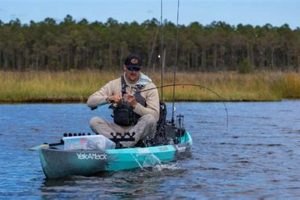
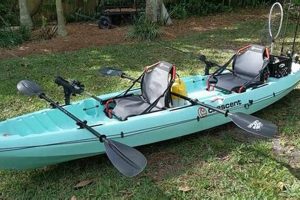
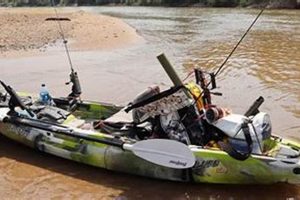
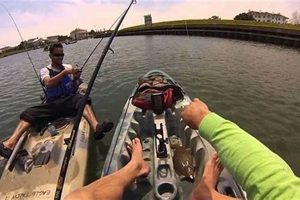
A small, human-powered watercraft designed for angling, augmented by stabilizing floats, offers enhanced stability and load capacity compared to traditional kayaks. This design allows anglers to stand and cast with greater confidence, access shallower waters, and carry additional gear.
Increased stability and buoyancy are key advantages, making these vessels suitable for diverse fishing environments, from calm lakes to choppy coastal waters. The added platform space provides anglers with more room for fishing equipment, coolers, and other necessities. This design evolution represents a significant advancement in kayak fishing, providing a safer and more versatile platform for anglers of all skill levels. Historically, anglers sought ways to improve stability and carrying capacity in their kayaks, leading to innovations like outriggers and wider hulls. The integration of pontoons represents a further refinement of these concepts, maximizing stability and load-bearing potential.
Further exploration will cover design variations, material selection, popular manufacturers, essential accessories, and safety considerations relevant to this specific type of watercraft. Understanding these aspects is crucial for informed decision-making and maximizing the angling experience.
Tips for Utilizing Pontoon-Equipped Fishing Kayaks
Effective use of these specialized watercraft requires an understanding of their unique characteristics. The following tips offer guidance for maximizing stability, safety, and fishing success.
Tip 1: Weight Distribution is Crucial: Evenly distribute weight within the vessel, considering gear placement and body position. This maintains balance and prevents tipping, especially when standing.
Tip 2: Practice Entering and Exiting: Due to increased width, entering and exiting requires a different technique than standard kayaks. Practice in shallow, calm water before venturing into more challenging environments.
Tip 3: Understand Pontoon Deployment: Familiarize oneself with the pontoon deployment mechanism. Ensure they are securely locked in both the deployed and stowed positions.
Tip 4: Consider Water Conditions: While pontoons enhance stability, strong currents and high winds still pose challenges. Exercise caution and avoid exceeding the vessel’s limitations.
Tip 5: Choose Appropriate Paddles: Wider vessels may require longer or differently shaped paddles for efficient propulsion. Experiment to find the optimal paddle length and blade design.
Tip 6: Regularly Inspect Pontoons: Check pontoons for wear, tear, and proper inflation before each outing. Address any damage promptly to maintain safety and performance.
Tip 7: Utilize Anchor Systems Effectively: Deploying an anchor from a pontoon-equipped kayak requires specific techniques to prevent capsizing. Practice proper anchoring methods in calm conditions.
Adhering to these guidelines enhances safety and allows anglers to fully exploit the advantages of pontoon-equipped fishing kayaks. Proper preparation and understanding of these vessels contribute significantly to a successful and enjoyable fishing experience.
This foundational knowledge prepares anglers for a deeper exploration of specific models, accessories, and advanced techniques.
1. Stability

Stability is a paramount consideration in the design and functionality of fishing kayaks, particularly those equipped with pontoons. Enhanced stability translates directly into improved angler safety, comfort, and fishing efficacy. This crucial attribute allows for activities like standing casting, fighting larger fish, and navigating challenging water conditions with increased confidence. The following facets explore the components and implications of stability in this context.
- Center of Gravity
A lower center of gravity contributes significantly to stability. Pontoons inherently lower the overall center of gravity by displacing buoyancy outwards. This design feature makes the vessel less prone to tipping, especially when anglers shift weight or encounter external forces like waves or currents. A lower center of gravity allows for greater freedom of movement and reduces the risk of capsizing.
- Initial Stability vs. Secondary Stability
Initial stability refers to the resistance to tipping at small angles of heel, providing a sense of security at rest. Secondary stability describes the resistance to further tipping at larger angles, crucial when leaning to cast or battling a fish. Pontoons enhance both initial and secondary stability. The wide base provided by deployed pontoons offers significant initial stability, while the buoyancy of the pontoons provides substantial secondary stability, allowing recovery from larger leans.
- Impact of Water Conditions
Calm lake conditions present minimal stability challenges. However, in choppy waters or strong currents, the stabilizing effect of pontoons becomes particularly valuable. The added buoyancy and resistance to tipping provide a safer and more manageable experience in adverse conditions, enabling anglers to continue fishing in conditions that would otherwise be unsafe or uncomfortable in a traditional kayak.
- Relationship to Capacity and Load Distribution
Increased stability allows for greater load capacity. However, proper weight distribution remains essential. Even with pontoons, unevenly distributed weight can compromise stability. Careful loading and balancing of gear contribute to maintaining optimal stability, maximizing the benefits provided by the pontoon design.
The enhanced stability offered by pontoon-equipped fishing kayaks expands angling opportunities, enabling access to more diverse environments and fishing styles. Understanding the factors influencing stability, including center of gravity, initial and secondary stability, and the impact of water conditions, empowers anglers to make informed choices and maximize their on-the-water safety and performance.
2. Capacity

Capacity, encompassing both weight and volume, is a critical factor influencing the functionality and suitability of a fishing kayak equipped with pontoons. The increased buoyancy provided by pontoons inherently allows for greater load-bearing potential compared to traditional kayaks. This enhanced capacity directly impacts the angler’s ability to carry essential gear, supplies, and even larger catches. Consider the scenario of an extended fishing trip: increased weight capacity accommodates ample supplies of food, water, and fishing tackle, while increased volume allows for storage of these items, along with safety equipment, extra clothing, and potentially camping gear. The ability to transport heavier and bulkier items expands the possibilities for longer expeditions and more diverse fishing environments.
The relationship between capacity and stability is intertwined. While pontoons enhance stability, exceeding the recommended weight capacity can compromise this advantage. Overloading can lead to decreased freeboard, increasing the risk of water ingress and potentially affecting maneuverability. For instance, exceeding the maximum weight capacity, even with pontoons providing added stability, can make the kayak sit lower in the water, increasing susceptibility to waves and potentially leading to instability. Understanding the specified weight limits and distributing the load evenly within the kayak are crucial for maintaining optimal performance and safety. Furthermore, the increased volume offered by pontoon-equipped kayaks provides dedicated storage compartments, often integrated into the pontoon structure itself. This allows for organized gear storage, enhancing accessibility and preventing clutter within the main cockpit area.
In conclusion, the enhanced capacity offered by pontoon-equipped fishing kayaks significantly expands their utility and versatility. Careful consideration of weight limits, load distribution, and effective utilization of storage compartments ensures optimal stability, safety, and overall fishing performance. This understanding empowers anglers to confidently select and equip their vessels for a wide range of fishing adventures, from short excursions to multi-day expeditions.
3. Fishability
Fishability, in the context of a fishing kayak with pontoons, encompasses the practical application of the vessel’s features for effective angling. It represents the confluence of stability, capacity, and design elements tailored specifically for fishing activities. Cause and effect relationships are readily apparent: enhanced stability, a direct result of pontoon integration, allows for stand-up casting, improving sight lines and casting accuracy. Increased capacity allows for more tackle and gear storage, directly impacting the angler’s preparedness and ability to adapt to changing fishing conditions. Dedicated features like rod holders, fish finders, and livewells, often seamlessly integrated into pontoon-equipped kayaks, further enhance fishability. Consider the scenario of sight fishing in shallow flats: the elevated perspective offered by standing on a pontoon-equipped kayak provides a significant advantage, enabling the angler to spot fish more easily and cast with greater precision. This direct correlation between design and function underscores the importance of fishability as a defining characteristic of these specialized watercraft.
Further enhancing fishability, the inherent stability of pontoon-equipped kayaks allows for more dynamic fishing techniques. Anglers can confidently fight larger fish without compromising balance, and the stable platform facilitates techniques like fly fishing, which often require nuanced body movements and weight shifts. For example, landing a large, powerful fish from a traditional kayak can be a precarious balancing act; however, the added stability of a pontoon-equipped kayak provides a secure platform, minimizing the risk of capsizing during the fight. This practicality translates into a more successful and enjoyable fishing experience, enabling anglers to focus on technique and strategy rather than precarious balancing. The integration of specialized features like anchor trolleys, which allow for precise boat positioning, and strategically placed gear tracks for mounting accessories, further amplifies fishability by optimizing workflow and maximizing efficiency on the water.
In conclusion, fishability, as a core attribute of fishing kayaks with pontoons, represents a significant advancement in angling from small watercraft. The enhanced stability, increased capacity, and integration of specialized features contribute synergistically to a more effective and enjoyable fishing experience. Understanding the practical significance of fishability empowers anglers to select the right vessel and utilize its capabilities to their full potential, maximizing success on the water. While challenges like portability and maneuverability in tight spaces exist, the advantages offered by pontoon-equipped kayaks in terms of fishability significantly outweigh these considerations for many anglers, particularly those targeting larger fish or fishing in challenging conditions.
4. Portability

Portability, while often a secondary consideration to stability and fishability, remains a relevant factor when evaluating fishing kayaks equipped with pontoons. The added bulk and weight associated with pontoon systems introduce logistical considerations related to transport, storage, and launch/retrieval procedures. Understanding these aspects is crucial for informed decision-making and seamless integration of these specialized vessels into an angler’s fishing practices.
- Transportation
Transporting pontoon-equipped kayaks often requires specialized roof racks or trailers due to their increased size and weight. While some models feature detachable pontoons, facilitating transport on standard roof racks, this adds assembly/disassembly time at the launch site. Larger, integrated pontoon systems necessitate trailers or dedicated kayak cradles. For example, transporting a fully rigged pontoon kayak to a remote fishing location may require a trailer capable of navigating unpaved roads, adding complexity to the logistical planning.
- Storage
Storage considerations are also impacted by the increased size of pontoon kayaks. Garages or sheds may require dedicated space to accommodate these vessels, particularly models with non-detachable pontoons. Disassembly and storage of pontoons separately can mitigate space constraints but introduces additional steps for pre- and post-fishing preparation. Apartment dwellers or those with limited storage space might find the size of these kayaks challenging to manage effectively.
- Launch/Retrieval
Launching and retrieving pontoon-equipped kayaks can present additional challenges compared to traditional kayaks. The added weight and width require more effort and careful maneuvering, especially in shallow water or from steep banks. Dedicated launch wheels or assistance from another person can significantly ease this process. For instance, launching from a rocky shoreline requires careful navigation to avoid damage to the pontoons, potentially necessitating the use of a kayak cart or assistance.
- Modular vs. Integrated Pontoon Systems
The portability of pontoon-equipped kayaks is significantly influenced by the pontoon design. Modular systems, with detachable pontoons, offer greater flexibility for transport and storage, but require assembly and disassembly. Integrated systems, while less portable, provide a more streamlined setup and enhanced structural rigidity. Anglers must weigh these trade-offs based on their individual needs and fishing preferences. For example, an angler frequently fishing from different locations may prioritize the portability of a modular system, while an angler primarily fishing from a dock might prefer the convenience and rigidity of an integrated system.
The portability considerations associated with fishing kayaks equipped with pontoons are integral to the overall ownership experience. Balancing the advantages of enhanced stability and fishability with the logistical challenges related to transport, storage, and launch/retrieval requires careful evaluation. Anglers must assess their individual needs, fishing styles, and available resources to determine the optimal balance between portability and performance. While these vessels may present some logistical hurdles, for many anglers, the benefits offered in terms of on-the-water capability significantly outweigh the portability compromises.
5. Safety
Safety is paramount in any on-the-water activity, and fishing from a kayak, particularly one equipped with pontoons, is no exception. While pontoons enhance stability, creating a more secure platform, they do not eliminate all risks. Understanding the interplay between pontoons and safety is crucial for responsible and enjoyable kayak fishing. A cause-and-effect relationship exists: increased stability, a direct consequence of pontoon deployment, reduces the likelihood of capsizing, thereby enhancing angler safety. However, this enhanced stability should not engender complacency. Factors like overloading, improper weight distribution, and venturing into unsuitable water conditions can still compromise stability, even with pontoons. For example, an angler standing to cast in rough conditions, even on a pontoon-equipped kayak, faces an increased risk of capsizing if weight is not properly managed. This highlights the importance of continuous awareness and prudent decision-making regardless of the perceived safety benefits offered by pontoons.
Practical application of safety principles is essential for mitigating risks associated with pontoon-equipped kayak fishing. Wearing a personal flotation device (PFD) is non-negotiable. Even with enhanced stability, unforeseen circumstances can lead to capsizing, and a PFD is the single most important piece of safety equipment in such situations. Carrying a communication device, such as a VHF radio or a waterproof cell phone, allows for summoning assistance in case of emergency. Awareness of weather conditions and water currents is crucial. Pontoons provide added stability in challenging conditions, but they do not make kayaks impervious to strong winds or currents. Exercising caution and avoiding hazardous conditions remains essential. Regular inspection and maintenance of pontoons, ensuring proper inflation and addressing any damage promptly, contribute significantly to safe operation. For example, a slow leak in a pontoon, if left unaddressed, could compromise stability, especially during longer outings or in challenging conditions, illustrating the importance of pre-trip inspections.
In summary, while pontoon-equipped fishing kayaks offer enhanced stability, contributing significantly to angler safety, they are not a substitute for responsible practices. Understanding the factors that can compromise stability, even with pontoons, and adhering to established safety guidelines, including wearing a PFD and carrying communication devices, are essential for mitigating risks. Continuous awareness of environmental conditions and meticulous maintenance of equipment further contribute to safe and enjoyable kayak fishing experiences. The inherent stability offered by pontoons expands angling opportunities, but prudent decision-making and adherence to safety protocols remain paramount for minimizing risks and maximizing enjoyment on the water.
Frequently Asked Questions
This section addresses common inquiries regarding fishing kayaks equipped with pontoons, providing concise and informative responses to facilitate informed decision-making.
Question 1: How do pontoons impact kayak stability?
Pontoons significantly enhance stability by widening the kayak’s base and lowering its center of gravity. This design allows anglers to stand and cast with greater confidence, even in challenging conditions.
Question 2: Are kayaks with pontoons more difficult to transport?
While pontoons add bulk, transportation options exist. Some models feature detachable pontoons, simplifying car-topping. Trailers or specialized kayak cradles accommodate larger, integrated pontoon systems.
Question 3: What are the advantages of pontoon kayaks for fishing?
Key advantages include enhanced stability for stand-up fishing, increased carrying capacity for gear and supplies, and a more stable platform for fighting larger fish. These features contribute to a more versatile and effective fishing experience.
Question 4: Do pontoon kayaks require specialized paddles?
While standard paddles can be used, longer paddles with wider blades often provide more efficient propulsion due to the increased width of pontoon-equipped kayaks. Experimentation can determine the optimal paddle choice for individual preferences and conditions.
Question 5: Are pontoon kayaks suitable for all water types?
While pontoons enhance stability, caution is advised in extreme conditions. These kayaks excel in calm lakes and slow-moving rivers but may be less suitable for challenging ocean environments or fast-flowing rapids. Careful consideration of water conditions is essential for safe operation.
Question 6: How does one maintain pontoons on a fishing kayak?
Regular inspection for leaks, tears, or damage is crucial. Proper inflation to the manufacturer’s recommended pressure ensures optimal performance. Cleaning and protecting pontoons from UV exposure prolong their lifespan. Adhering to maintenance guidelines ensures continued safety and performance.
Understanding these key aspects contributes to a more informed evaluation of pontoon-equipped fishing kayaks and their suitability for individual angling needs and preferences.
Further exploration of specific models, features, and accessories is recommended for a comprehensive understanding of this specialized category of fishing kayaks.
Fishing Kayak with Pontoons
Fishing kayaks with pontoons represent a significant evolution in angling from small watercraft. Enhanced stability, increased capacity, and specialized design features contribute synergistically to improved fishability, enabling anglers to confidently explore diverse environments and employ a wider range of fishing techniques. While portability considerations require careful evaluation, the advantages offered by these specialized vessels, particularly in terms of on-the-water performance and safety, often outweigh the logistical challenges. Understanding the nuanced interplay between stability, capacity, fishability, portability, and safety empowers informed decision-making, facilitating selection of the optimal vessel for individual angling needs and preferences. Regular maintenance and adherence to established safety protocols remain essential for maximizing the benefits and minimizing the risks associated with this evolving category of fishing kayaks.
The continued development and refinement of pontoon-equipped fishing kayaks promise further advancements in on-the-water capabilities, expanding angling opportunities and enhancing the overall fishing experience. Careful consideration of individual needs, coupled with a thorough understanding of the inherent advantages and potential limitations of these specialized vessels, remains crucial for maximizing their potential and contributing to safe and successful angling endeavors.