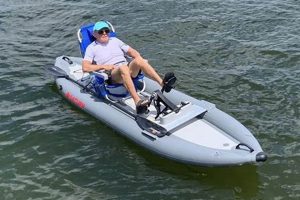
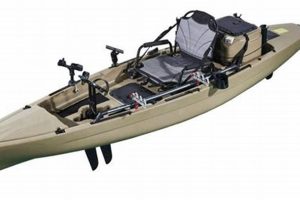
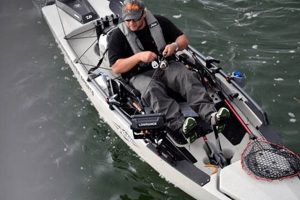
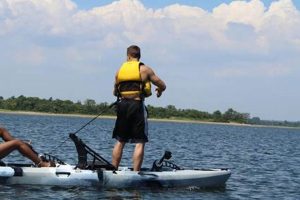
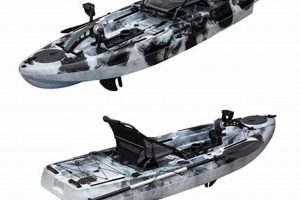
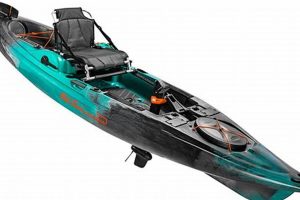
Hands-free propulsion kayaks designed specifically for angling offer distinct advantages. These vessels utilize foot pedals connected to a propeller or flipper system, allowing anglers to navigate and position themselves efficiently without using paddles. This leaves hands free for casting, reeling, and other fishing tasks. An example would be a kayak equipped with a pedal-driven propeller system and featuring rod holders, storage compartments, and other fishing-specific accessories.
This type of watercraft provides enhanced maneuverability and speed compared to traditional paddle kayaks, enabling anglers to cover more water and access difficult-to-reach fishing spots. The hands-free operation improves casting accuracy and reduces fatigue, allowing for longer and more productive fishing trips. Historically, fishing from kayaks relied solely on paddles. The development of pedal-drive systems represents a significant advancement, improving both efficiency and enjoyment of the sport.
The subsequent sections will delve into various aspects of these specialized kayaks, including different propulsion systems, key features to consider when making a purchase, popular brands and models, and tips for effective use on the water.
Tips for Effective Pedal Kayak Fishing
Maximizing the advantages of hands-free propulsion requires careful consideration of several key factors. These tips offer guidance for a successful and enjoyable fishing experience.
Tip 1: Understand Propulsion Systems: Familiarize oneself with the different pedal-drive systems available, including propeller and fin designs. Each system offers unique performance characteristics regarding speed, maneuverability, and draft.
Tip 2: Prioritize Stability: Kayak stability is crucial, especially when fishing in rough waters or standing to cast. Wider kayaks generally offer greater stability.
Tip 3: Choose Appropriate Seating: Comfortable seating is essential for long hours on the water. Adjustable seating systems allow for customization and optimal posture.
Tip 4: Utilize Storage Wisely: Efficient storage solutions are vital for organizing tackle, rods, and other equipment. Consider kayaks with dedicated storage compartments and mounting options.
Tip 5: Practice Maneuvering: Spend time practicing maneuvering the pedal kayak in open water before venturing into challenging fishing locations. This will build confidence and improve boat control.
Tip 6: Consider Water Conditions: Adapt fishing strategies to the specific water conditions. Propeller systems are generally more efficient in open water, while fin systems excel in shallow or weedy areas.
Tip 7: Maintain the Drive System: Regular maintenance of the pedal-drive system, including cleaning and lubrication, ensures optimal performance and longevity.
By following these guidelines, anglers can fully leverage the benefits of pedal-driven kayaks, enhancing both fishing success and overall experience.
These tips provide a solid foundation for anglers looking to improve their fishing experience. The concluding section will offer final thoughts and recommendations.
1. Hands-Free Fishing

Hands-free fishing represents a significant advantage offered by pedal kayaks, fundamentally changing the angling experience. Traditional paddle kayaks require constant hand movements for propulsion, limiting an angler’s ability to manage fishing rods and tackle efficiently. Pedal kayaks, however, free the hands entirely for casting, reeling, and handling fish. This is particularly beneficial in situations requiring quick reactions, such as setting the hook or adjusting lures. Consider a scenario where a fish strikes while an angler is paddling a traditional kayak. The angler must quickly paddle to a stop, secure the paddle, and then grab the rod, often losing precious seconds. A pedal kayak user, on the other hand, can instantly react to the strike, maintaining direct control of the rod throughout the process. This immediate response can be the difference between landing a trophy fish and losing it.
The practical significance of hands-free fishing extends beyond simply catching more fish. It contributes to improved angler safety by allowing for better boat control in challenging conditions. Navigating strong currents or windy conditions becomes easier as anglers maintain constant propulsion and steering control without having to switch between paddling and fishing. Furthermore, hands-free operation reduces physical strain, allowing for longer fishing trips without fatigue. Imagine sight fishing in shallow water. Maintaining a stealthy approach while constantly adjusting position with a paddle can be cumbersome. A pedal kayak allows for subtle adjustments and immediate reactions to fish movements, increasing the likelihood of a successful cast.
Hands-free fishing is thus not merely a convenient feature of pedal kayaks; it is a core element that enhances efficiency, safety, and overall enjoyment. While mastering any kayak requires practice, the transition to hands-free operation opens up new possibilities for anglers of all skill levels, allowing them to focus on the art of fishing rather than the mechanics of paddling.
2. Increased Maneuverability

Maneuverability represents a critical performance aspect of fishing kayaks, directly influencing angling success. Pedal-powered kayaks offer significant advantages in this domain compared to traditional paddle-powered vessels. The ability to precisely position the kayak, navigate complex waterways, and quickly change direction contributes substantially to fishing effectiveness.
- Precise Boat Control:
Pedal kayaks provide fine-tuned control over movement, allowing anglers to hold position in currents, approach fish stealthily, and make micro-adjustments for optimal casting angles. This level of control is challenging to achieve with traditional paddle kayaks, particularly in windy or current-prone environments. For example, maintaining a precise position near a submerged structure becomes significantly easier with the continuous and subtle adjustments afforded by pedal propulsion. This precision can be the key to presenting a lure effectively and enticing a strike.
- Navigation in Tight Spaces:
Navigating through narrow channels, around obstacles like fallen trees, or within shallow, weedy areas presents challenges for paddle kayaks. Pedal kayaks, with their hands-free operation and responsive steering, excel in these confined environments. Anglers can navigate intricate waterways without the cumbersome task of switching between paddle strokes and rod handling, thereby minimizing disturbance and maximizing fishing opportunities. Imagine maneuvering through a dense mangrove forest a pedal kayaks nimble handling becomes indispensable for reaching secluded fishing spots.
- Quick Turns and Adjustments:
Rapid changes in direction are often essential in fishing scenarios, whether tracking a moving school of fish or reacting to sudden changes in current or wind. Pedal kayaks offer superior agility in these situations. The ability to execute quick turns without losing momentum or stability is invaluable when pursuing fast-moving targets or adjusting to shifting environmental conditions. Consider a scenario where a fish surfaces unexpectedly a pedal kayak allows the angler to swiftly reposition for an optimal cast, a maneuver that might be impossible with a paddle kayak.
- Reduced Disturbance:
Paddle strokes, especially in shallow water, create surface disturbances that can spook fish. Pedal-driven systems operate below the surface, minimizing noise and water displacement, resulting in a stealthier approach. This is particularly crucial in clear, shallow waters where fish are easily alerted by surface commotion. The quiet operation of a pedal kayak allows anglers to approach fish undetected, significantly increasing the chances of a successful presentation. This is a significant advantage in sight fishing situations where stealth is paramount.
The increased maneuverability offered by pedal kayaks significantly enhances angling effectiveness. From maintaining precise positions in currents to navigating complex waterways and reacting quickly to changing conditions, the advantages translate directly to improved fishing outcomes and a more engaging experience on the water. While other factors contribute to a successful fishing trip, the ability to control and position the kayak effectively is paramount. This enhanced control, combined with the other benefits of pedal kayaks, solidifies their position as a valuable tool for the serious angler.
3. Enhanced Speed
Speed, a critical factor in fishing success, especially in larger bodies of water or when targeting specific species, receives a substantial boost with pedal kayaks. Unlike paddle kayaks limited by human arm strength and paddling technique, pedal-powered systems offer sustained higher speeds and efficient propulsion, expanding angling possibilities.
- Covering More Water:
Pedal kayaks enable anglers to cover significantly more water compared to traditional paddling, allowing exploration of wider areas and access to distant fishing spots. In a tournament setting, where time is of the essence, this speed advantage can be crucial for locating and exploiting productive fishing grounds. For instance, anglers can quickly traverse large lakes or reservoirs to reach areas known for specific fish activity, maximizing fishing time within limited durations.
- Reaching Fish Faster:
When fish are actively feeding or schooling in specific locations, reaching those spots quickly is paramount. Pedal kayaks provide the speed necessary to intercept moving schools of fish or respond rapidly to real-time fishing reports. Imagine receiving a tip about a feeding frenzy several miles away; a pedal kayak allows anglers to reach the action swiftly, increasing their chances of capitalizing on the opportunity.
- Combating Currents and Wind:
Strong currents and headwinds can significantly impede progress in paddle kayaks, demanding substantial physical effort and limiting fishing effectiveness. Pedal kayaks, with their more powerful propulsion, overcome these challenges more efficiently, maintaining speed and control even in adverse conditions. Fishing in tidal rivers or open bays, where currents are prevalent, becomes significantly more manageable with the consistent speed offered by pedal drive systems. This allows anglers to maintain desired positions and fishing presentations without constant struggle against the elements.
- Trolling Efficiency:
Trolling, a popular fishing technique involving dragging lures behind a moving boat, demands consistent speed and precise control. Pedal kayaks offer an ideal platform for trolling, providing the necessary speed and maneuverability while freeing the hands for rod management and adjustments. Anglers can maintain optimal lure presentation speeds while simultaneously controlling their position and reacting to strikes, optimizing the effectiveness of this technique.
The enhanced speed offered by pedal kayaks translates directly into greater fishing efficiency and broader access to fishing grounds. Covering more water, reaching fish faster, combating adverse conditions, and implementing trolling techniques effectivelythese speed-related advantages contribute significantly to a more productive and enjoyable angling experience. While factors such as stealth and precise maneuvering remain crucial, the ability to efficiently cover water and reach target areas quickly elevates the pedal kayak to a powerful tool for serious anglers. Comparing a day’s fishing in a pedal kayak versus a traditional paddle kayak often reveals a significant difference in the area covered and, potentially, the number of fish encountered, underscoring the value of speed in maximizing fishing success.
4. Stability
Stability forms a cornerstone of effective kayak fishing, significantly impacting safety and performance. In pedal kayaks, where anglers often stand to cast, retrieve, and fight fish, stability becomes paramount. This characteristic influences not only the angler’s ability to maintain balance but also the overall fishing experience, impacting casting accuracy, line management, and the ability to handle fish effectively.
- Primary Stability:
Primary stability refers to a kayak’s initial resistance to tipping when it’s sitting flat on the water. A wider hull typically provides greater primary stability, making it feel more secure and less prone to tipping when performing tasks like changing lures or reaching for equipment. A kayak with high primary stability instills confidence, allowing anglers to focus on fishing rather than constantly balancing. Consider an angler standing to cast in choppy water; a kayak with strong primary stability will provide a secure platform, minimizing the risk of capsizing.
- Secondary Stability:
Secondary stability describes a kayak’s resistance to tipping further once it’s leaned beyond its initial stability point. This characteristic is crucial for anglers who prefer standing or make dynamic movements while fishing. Kayaks with rounded hulls often exhibit good secondary stability, providing a reassuring feeling of support even when leaning into a turn or battling a strong fish. Visualize an angler leaning over the side to net a fish; a kayak with good secondary stability will prevent a complete capsize, providing a stable platform even at extreme angles.
- Impact of Hull Design:
Hull design plays a pivotal role in determining a kayak’s stability characteristics. Wider, flatter hulls offer greater initial stability, while longer, narrower hulls prioritize speed over stability. Specialized hull designs, such as pontoon-style hulls, maximize stability, particularly beneficial for stand-up fishing. Understanding the relationship between hull design and stability is crucial for selecting a kayak suited to individual fishing styles and preferences. For example, an angler prioritizing stability for sight fishing in shallow water might choose a wider, flatter hull, while an angler focusing on covering long distances might opt for a longer, narrower design, accepting a trade-off in stability for speed.
- Influence of Weight Distribution:
Proper weight distribution significantly influences kayak stability. Evenly distributing gear and equipment within the kayak, keeping heavier items low and centered, optimizes balance and prevents instability. Consider an angler with all their tackle stored at the stern of the kayak; this uneven weight distribution can negatively impact stability, making the kayak more prone to tipping. Careful consideration of weight placement enhances both primary and secondary stability, contributing to a safer and more enjoyable fishing experience.
Stability in pedal kayaks is not merely a safety feature; it’s a performance enhancer. A stable platform allows anglers to focus on fishing techniques, make precise casts, and confidently handle fish. Selecting a pedal kayak with appropriate stability characteristics for the intended fishing style and environment is crucial for maximizing both enjoyment and effectiveness on the water. The interplay between primary and secondary stability, hull design, and weight distribution determines the overall stability profile of a kayak, highlighting the importance of careful consideration when choosing a pedal kayak designed for specific fishing needs.
5. Storage Capacity
Storage capacity in pedal kayaks designed for fishing plays a crucial role in organization, efficiency, and overall fishing success. Ample and well-designed storage allows anglers to carry essential gear, tackle, and safety equipment, maximizing time on the water and minimizing disruptions. Insufficient storage can lead to cluttered decks, hindering movement and potentially compromising safety. Consider a scenario where an angler needs to quickly access a specific lure but must rummage through a disorganized pile of equipment; valuable fishing time is lost, and frustration mounts. Conversely, a well-organized kayak with dedicated compartments for different tackle types allows for quick retrieval of necessary items, maintaining fishing momentum and focus.
Several factors influence the practical application of storage capacity. Kayak size and design directly impact available storage space. Longer kayaks generally offer more storage volume than shorter models. Hull design also plays a role; some kayaks feature recessed storage wells, while others utilize elevated cargo areas. Understanding the trade-offs between storage capacity and other performance characteristics, such as maneuverability and speed, is essential for selecting the right kayak. For instance, a larger kayak with ample storage might be ideal for extended trips or multi-day excursions, while a smaller, more agile kayak with less storage might be preferred for navigating tight waterways. The type of fishing pursued also influences storage needs. Fly fishermen, for example, might prioritize storage solutions for fly boxes and lines, while bass anglers might require compartments for larger tackle boxes and lures.
Effective utilization of available storage space further enhances fishing efficiency. Utilizing waterproof bags and containers protects sensitive equipment from water damage. Organizing tackle boxes with compartments and dividers keeps lures and hooks readily accessible. Employing bungee cords and tie-down straps secures larger items and prevents shifting during transit. Consider the challenge of landing a fish while simultaneously managing a loose tackle box sliding across the deck; securing gear prevents such distractions, allowing anglers to focus on the task at hand. Ultimately, optimizing storage capacity contributes significantly to a streamlined and productive fishing experience, minimizing disruptions and maximizing time spent actively fishing. Careful consideration of storage needs, thoughtful organization, and appropriate utilization of available space transform a pedal kayak from simply a vessel into a well-equipped and efficient fishing platform.
6. Propulsion Systems

Propulsion systems represent a defining characteristic of pedal kayaks, distinguishing them from traditional paddle-powered vessels. Understanding the nuances of these systems is crucial for selecting a kayak that aligns with specific fishing needs and environmental conditions. The efficiency, maneuverability, and maintenance requirements of different propulsion systems directly impact fishing effectiveness and overall experience.
- Pedal-Driven Propellers:
Propeller-based systems utilize a rotating propeller, similar to those found on motorboats, to generate thrust. These systems typically offer higher speeds and excellent tracking in open water. However, propellers can be more susceptible to damage from underwater obstacles like rocks or vegetation. Consider a scenario where an angler is fishing in a shallow, weedy lake; a propeller system might become entangled in vegetation, hindering performance. Conversely, in a large, open reservoir, the speed and efficiency of a propeller system can be a significant advantage.
- Fin-Based Propulsion:
Fin-based systems employ underwater fins that move in a reciprocating motion, mimicking the kicking action of a swimmer’s legs. These systems excel in shallow water and vegetated areas due to their lower profile and weedless design. While generally less efficient than propellers in open water, fin drives offer superior maneuverability in tight spaces. Imagine navigating a shallow creek choked with weeds; a fin drive allows passage with minimal disturbance, whereas a propeller might become fouled. This makes fin drives ideal for shallow-water fishing environments.
- Hybrid Systems:
Emerging hybrid systems combine elements of both propeller and fin drives, seeking to capitalize on the advantages of each. These systems might utilize a propeller for open-water speed and a deployable fin for shallow-water maneuverability. While still relatively new, hybrid systems offer versatility for anglers fishing in diverse environments. Consider a fishing trip that involves traversing a large lake and then exploring shallow coves; a hybrid system offers the adaptability to handle both situations effectively.
- Maintenance Considerations:
Maintenance requirements vary between propulsion systems. Propeller systems necessitate regular inspection and cleaning to remove debris and ensure optimal performance. Fin drives typically require less maintenance but may still need occasional lubrication and inspection for wear and tear. Understanding the maintenance demands of each system helps anglers make informed decisions based on their willingness and ability to perform routine upkeep. Neglecting maintenance can lead to decreased performance and potentially costly repairs, highlighting the importance of routine care.
The choice of propulsion system significantly influences a pedal kayak’s performance characteristics and suitability for specific fishing environments. Carefully evaluating the trade-offs between speed, maneuverability, and maintenance requirements, in conjunction with the intended fishing locations and styles, ensures selection of the most appropriate and effective propulsion system for maximizing fishing success. A clear understanding of these factors empowers anglers to choose a pedal kayak that seamlessly integrates with their fishing needs, enhancing both efficiency and enjoyment on the water.
Frequently Asked Questions
This section addresses common inquiries regarding pedal-powered fishing kayaks, providing concise and informative responses to facilitate informed decision-making.
Question 1: What are the primary advantages of pedal kayaks over traditional paddle kayaks for fishing?
Key advantages include hands-free operation for casting and reeling, increased speed and maneuverability, and reduced physical exertion, allowing anglers to cover more water efficiently and focus on fishing techniques rather than paddling.
Question 2: How do different pedal-drive systems compare in terms of performance and maintenance?
Propeller systems generally offer higher speeds in open water but are more susceptible to damage in shallow or vegetated areas. Fin drives excel in shallow water and weeds due to their lower profile and weedless design, although they may provide slightly less speed in open water. Hybrid systems attempt to combine the advantages of both. Maintenance requirements vary, with propellers needing more frequent cleaning and fin drives requiring occasional lubrication.
Question 3: What factors should be considered when choosing the right size and hull design for a pedal fishing kayak?
Factors include angler weight and size, intended fishing environment (open water, rivers, shallows), storage needs, and desired stability level. Wider hulls offer greater stability, while longer hulls enhance speed. Anglers prioritizing stability might choose wider, shorter kayaks, whereas those seeking speed might opt for longer, narrower designs.
Question 4: Are pedal kayaks suitable for all types of fishing environments?
While highly versatile, pedal kayaks are not universally suitable for all environments. Extremely shallow, rocky, or fast-flowing water can pose challenges for pedal-drive systems. Anglers frequently fishing in such environments might consider alternative propulsion methods. Pedal kayaks excel in moderately shallow to open water conditions where maneuverability and speed are advantageous.
Question 5: What safety precautions should be taken when using a pedal kayak for fishing?
Standard kayak safety precautions apply, including wearing a personal flotation device (PFD), carrying a whistle or other signaling device, informing someone of fishing plans and expected return time, and checking weather conditions before embarking. Familiarization with self-rescue techniques and carrying appropriate safety equipment is also recommended.
Question 6: What is the typical price range for pedal kayaks designed for fishing, and what factors influence cost?
Prices typically range from approximately $1,500 to over $5,000. Factors influencing cost include materials (e.g., polyethylene vs. fiberglass), propulsion system complexity, features (e.g., integrated electronics, advanced seating systems), and brand reputation. Entry-level models provide essential functionality at lower price points, while higher-end models offer advanced features and performance enhancements.
Careful consideration of these frequently asked questions provides a foundation for informed decision-making regarding pedal kayaks for fishing, facilitating a selection process aligned with individual needs, preferences, and fishing styles.
The following section will delve into specific pedal kayak models and brands, offering a comparative analysis to aid selection.
Pedal Kayaks for Fishing
This exploration of pedal kayaks for fishing has highlighted their transformative impact on the angling experience. From enhanced maneuverability and speed to hands-free operation and increased stability, these vessels offer distinct advantages for anglers seeking to maximize efficiency and effectiveness on the water. Careful consideration of propulsion systems, hull designs, storage capacity, and stability characteristics empowers informed decision-making, ensuring alignment between kayak features and individual fishing styles and target environments. Understanding the nuances of these features allows anglers to select the optimal platform for specific needs, whether navigating shallow creeks, traversing vast lakes, or tackling challenging currents.
Pedal kayaks represent a significant advancement in fishing technology, offering a unique blend of performance, versatility, and accessibility. As designs continue to evolve and technology progresses, the future of pedal-powered fishing kayaks promises further enhancements, refining the angling experience and expanding opportunities for anglers of all skill levels to explore and connect with the aquatic environment. The informed angler, equipped with the knowledge presented here, stands poised to leverage these advancements, maximizing fishing success and embracing the evolving landscape of modern angling.