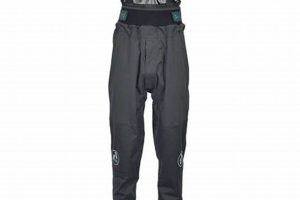
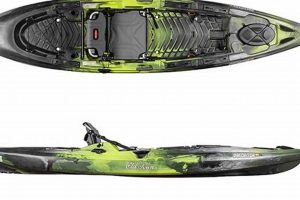
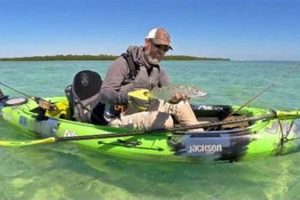
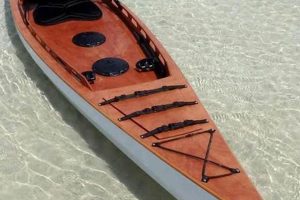
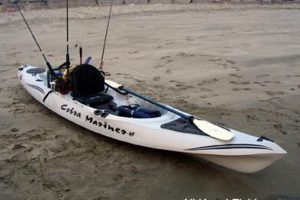
Equipping a kayak for angling in open waters involves a careful selection and arrangement of specialized gear. This includes the kayak itself, chosen for stability and storage capacity, along with essential accessories like rod holders, fish finders, and safety equipment. A typical configuration might feature a sit-on-top kayak with flush-mounted rod holders, a GPS-enabled fish finder, and a well-secured tackle crate.
Effective organization and specialized equipment contribute significantly to a successful and enjoyable saltwater fishing experience from a kayak. A properly outfitted vessel allows anglers to reach otherwise inaccessible fishing grounds, offering a unique perspective and connection with the marine environment. This practice has evolved alongside advancements in kayak design and fishing technology, progressing from basic adaptations to highly specialized setups catering to specific angling styles and target species.
The following sections delve into the key components of this specialized form of fishing, covering kayak selection, essential accessories, safety considerations, and recommended techniques for various species and conditions.
Essential Tips for Open-Water Kayak Angling
Careful planning and preparation are crucial for successful and safe kayak fishing excursions in the ocean. These tips offer guidance on optimizing equipment and techniques for a productive experience.
Tip 1: Prioritize Stability: Kayak selection should prioritize stability, particularly for offshore conditions. Wider hulls and sit-on-top designs generally offer greater stability compared to narrower, sit-inside models.
Tip 2: Secure Equipment Properly: All fishing gear, including rods, reels, tackle boxes, and safety equipment, must be securely fastened to the kayak to prevent loss in the event of a capsize.
Tip 3: Utilize a Leash System: Essential items like paddles and rods should be tethered to the kayak using leashes. This prevents them from drifting away if dropped overboard.
Tip 4: Plan for Weather Conditions: Always check marine weather forecasts before embarking on a trip. Wind, tides, and currents can significantly impact safety and fishing conditions.
Tip 5: Dress Appropriately: Wear appropriate clothing for anticipated weather conditions, including layers for warmth and protection from the elements. Brightly colored attire enhances visibility.
Tip 6: Inform Someone of Your Plans: Share your intended fishing location and estimated return time with a responsible individual. This ensures someone is aware of your whereabouts in case of an emergency.
Tip 7: Practice Self-Rescue Techniques: Familiarize oneself with self-rescue techniques, including re-entering the kayak after a capsize. Practice these skills in calm water before venturing offshore.
Tip 8: Respect Wildlife and the Environment: Adhere to local fishing regulations and practice responsible angling. Minimize environmental impact by properly disposing of waste and avoiding disturbance of marine life.
By adhering to these guidelines, anglers can significantly enhance their safety and enjoyment while kayak fishing in the ocean. Preparation allows for a more focused and productive experience, maximizing opportunities for success.
These preparatory measures lay the foundation for a successful outing, allowing a focus to shift towards the intricacies of fishing techniques and species-specific strategies, which will be discussed in the following sections.
1. Kayak Selection (Stability & Space)

Kayak selection represents a foundational element of a successful ocean fishing setup. Stability and space directly influence angler safety, fishing effectiveness, and overall comfort. Stability governs the ability to cast, fight fish, and remain upright in unpredictable ocean conditions. A stable platform minimizes the risk of capsizing, especially crucial when handling active fish or navigating challenging waters. Sufficient storage space accommodates essential gear, including rods, tackle boxes, safety equipment, and potential catches. Attempting to manage inadequate storage compromises both efficiency and safety.
Consider two contrasting scenarios: an angler in a short, wide, sit-on-top kayak versus an angler in a long, narrow, sit-inside kayak. The wider sit-on-top design inherently offers superior stability, permitting comfortable casting and fish fighting even in moderate chop. Its open deck facilitates easy access to gear. Conversely, the longer, narrower sit-inside kayak, while potentially faster, presents stability challenges, particularly for less experienced paddlers. Limited storage restricts gear capacity and accessibility.
Appropriate kayak selection hinges on a pragmatic assessment of individual needs and anticipated conditions. Prioritizing stability and adequate storage directly contributes to a safer and more productive ocean fishing experience. Choosing a kayak suited to the intended fishing style and environment allows anglers to focus on the pursuit of fish rather than managing an unwieldy or unstable vessel. This fundamental choice sets the stage for a well-rounded and successful ocean kayak fishing setup.
2. Paddle Choice (Length & Blade)

Paddle selection significantly impacts efficiency and maneuverability within an ocean kayak fishing setup. Paddle length and blade shape directly influence paddling power, speed, and control. An appropriately sized paddle facilitates efficient propulsion, conserving energy and maximizing fishing time. Blade shape affects stroke dynamics; a narrower blade offers higher cadence, while a wider blade provides more power per stroke. These factors become particularly critical in challenging ocean conditions where efficient paddling is paramount for maintaining position and navigating currents.
Consider two scenarios illustrating the practical significance of paddle choice. An angler using a paddle too short struggles to achieve an effective stroke, wasting energy and reducing boat speed. This hinders the ability to cover distance, reach desired fishing spots, or manage changing tides and currents. Conversely, an angler with a paddle too long experiences restricted stroke mechanics and potential shoulder strain. This compromises paddling efficiency and increases the risk of injury. Optimizing paddle length and blade type for individual physique and paddling style directly translates to improved performance on the water. A high-angle paddle with a shorter shaft and wider blades provides more power for quick maneuvers, while a low-angle paddle with a longer shaft and narrower blades allows for efficient cruising over longer distances.
Appropriate paddle selection, considering both length and blade design, represents a crucial aspect of a well-optimized ocean kayak fishing setup. Efficient propulsion translates directly to enhanced maneuverability, reduced fatigue, and maximized fishing time. A correctly chosen paddle contributes to a more enjoyable and productive experience on the water, allowing anglers to focus on fishing rather than struggling against an inefficient paddling setup. Understanding the interplay between paddle dimensions and on-the-water performance empowers informed decisions, ultimately contributing to a more successful and enjoyable fishing excursion.
3. Rod Holders (Placement & Type)

Rod holder selection and placement represent critical considerations within an ocean kayak fishing setup, directly impacting fishing efficiency and safety. Strategic placement maximizes accessibility while minimizing interference with paddling and other onboard activities. Choosing appropriate rod holder types ensures secure rod storage and facilitates diverse fishing techniques. Improperly positioned or unsuitable rod holders can lead to tangled lines, lost gear, and potentially hazardous situations, especially when handling active fish or navigating challenging waters.
Consider the practical implications of rod holder placement. Positioning rod holders too far forward can obstruct paddling strokes, while placement too far aft can create difficulties reaching rods quickly when a fish strikes. Similarly, rod holder type influences fishing style. Flush-mounted rod holders offer a streamlined profile for paddling but may limit certain fishing techniques. Adjustable rod holders provide versatility for different fishing styles but require careful positioning to avoid interference. For example, trolling requires rod holders positioned to keep lines clear of the kayak and other gear, while bottom fishing benefits from holders that allow rods to be placed vertically. Matching rod holder type and placement to the intended fishing style enhances efficiency and enjoyment.
Effective rod holder integration enhances an ocean kayak fishing setup by optimizing gear organization and accessibility. Careful consideration of placement and type ensures rods remain secure yet readily available, maximizing fishing time and minimizing potential complications. This contributes significantly to a more streamlined and productive fishing experience, allowing anglers to focus on the pursuit of fish rather than managing equipment challenges. Understanding the interplay between rod holder selection, placement, and fishing style empowers informed decisions, culminating in a more efficient and enjoyable experience on the water.
4. Fish Finder & GPS (Mounting & Features)

Integrating a fish finder and GPS significantly enhances the effectiveness of an ocean kayak fishing setup. These electronic tools provide crucial real-time information about water depth, bottom structure, fish location, and navigational details, empowering anglers to make informed decisions and maximize their chances of success. Mounting location and feature selection directly impact the utility of these devices; optimal placement ensures clear visibility and ease of operation without interfering with paddling or other onboard activities. Feature selection should align with specific fishing needs and target species.
Consider the impact of these tools in different scenarios. An angler seeking reef-dwelling species benefits significantly from a fish finder’s ability to identify underwater structures and pinpoint fish concentrations around them. Without this technology, locating these productive zones becomes considerably more challenging, relying primarily on guesswork or local knowledge. Similarly, a GPS unit proves invaluable in navigating to distant fishing grounds, tracking drifts over promising areas, and ensuring safe return, particularly in conditions of reduced visibility. Imagine an angler venturing offshore in search of pelagic fish; the GPS allows precise navigation to known feeding grounds or areas with favorable water temperatures, dramatically increasing the likelihood of encountering target species. Furthermore, the GPS provides critical safety by enabling accurate tracking of position and facilitating navigation back to shore, especially in changing weather conditions or after long drifts.
Effective integration of a fish finder and GPS unit, considering both mounting location and relevant features, elevates an ocean kayak fishing setup from basic to advanced. These tools provide a significant competitive advantage by offering real-time insights into the underwater environment and navigational context. This enhanced awareness empowers informed decision-making, leading to increased fishing success and improved safety on the water. Understanding the capabilities and limitations of these technologies, and selecting appropriate models based on individual fishing needs, contributes directly to a more productive and enjoyable ocean kayak fishing experience.
5. Safety Gear (PFD & Leash)
Prioritizing safety within an ocean kayak fishing setup is paramount. The inherent risks associated with open water environments necessitate meticulous attention to safety equipment, particularly Personal Flotation Devices (PFDs) and leashes. These components play a crucial role in mitigating potential hazards and ensuring angler well-being. Neglecting these safety measures can have severe consequences, especially in unpredictable ocean conditions. A comprehensive understanding of their function and proper utilization is essential for a safe and responsible fishing experience.
- Personal Flotation Devices (PFDs)
PFDs represent the most critical piece of safety equipment. A properly fitted PFD provides essential buoyancy in the event of a capsize, significantly increasing survival chances. Choosing a PFD specifically designed for kayaking, with unrestricted arm movement, is vital for paddling and fishing activities. Inflatable PFDs offer greater comfort but require regular inspection and maintenance to ensure reliable deployment. For example, an angler unexpectedly capsizing in cold water faces immediate risk of hypothermia and potential drowning; a properly worn PFD provides crucial flotation, increasing survival time and aiding rescue efforts. Regular inspection and maintenance of inflatable PFDs, such as checking the inflation mechanism and CO2 cartridges, are essential to ensure they function correctly in an emergency.
- Leashes for Essential Equipment
Leashes secure essential gear, such as paddles and rods, preventing loss in the event of a capsize or accidental drop. Losing a paddle in open water severely compromises maneuverability and self-rescue capabilities. Similarly, losing a fishing rod represents both a financial loss and a potential entanglement hazard. Imagine an angler hooking a large fish; a sudden surge could pull an unsecured rod overboard, potentially leading to capsize or injury. Securing essential items with leashes mitigates these risks, allowing anglers to focus on fishing and safety rather than managing loose equipment in challenging conditions. Different types of leashes exist, with coiled versions being popular for their flexibility and ability to stay out of the way while paddling or fishing.
- Whistle and Signaling Devices
Carrying a whistle or other signaling devices enhances safety by providing a means of attracting attention in emergencies. A whistle’s high-pitched sound carries farther than shouting, proving invaluable in situations requiring assistance, such as capsize or medical emergencies. Visual signaling devices, like flares or mirrors, further increase visibility, particularly in low-light conditions or when other vessels are present. Consider an angler encountering difficulties far from shore; a whistle or flare can alert nearby boats or coastal authorities, expediting rescue efforts. Regularly testing these devices and ensuring they are readily accessible is essential for effective deployment in critical situations.
- First-Aid Kit and Emergency Supplies
A well-stocked first-aid kit is crucial for addressing minor injuries or providing initial care in more serious situations while awaiting professional medical assistance. Essential supplies include bandages, antiseptic wipes, pain relievers, and any personal medications. Adding items like sunscreen, insect repellent, and a basic repair kit for minor kayak damage enhances preparedness. For instance, a hook injury, while relatively minor, can become infected without proper cleaning and bandaging. A comprehensive first-aid kit empowers anglers to address such situations promptly, preventing complications and ensuring a safe continuation of the fishing trip.
Integrating these safety measures forms an integral part of a responsible ocean kayak fishing setup. PFDs, leashes, signaling devices, and first-aid supplies contribute significantly to angler safety by mitigating potential risks and providing resources for managing emergencies. Prioritizing these elements ensures a more secure and enjoyable fishing experience, allowing anglers to focus on the sport with confidence, knowing they are well-prepared for unforeseen challenges. These precautions enhance not only personal safety but also contribute to a culture of responsible angling, demonstrating respect for the inherent risks of the ocean environment.
6. Tackle Storage (Organization & Accessibility)
Effective tackle storage forms an integral component of a well-planned ocean kayak fishing setup. Organized and accessible tackle contributes directly to fishing efficiency and safety. A cluttered kayak deck increases the risk of entanglement, equipment loss, and potentially hazardous situations, particularly when handling active fish or navigating challenging waters. Conversely, a well-organized system allows anglers to quickly locate and deploy necessary gear, maximizing fishing time and minimizing distractions. This efficiency proves particularly crucial in dynamic ocean environments where opportunities can be fleeting.
Consider the contrast between two scenarios: an angler with a disorganized tackle system versus one with a meticulously arranged setup. The angler struggling to find a specific lure amidst a tangled mess of lines and hooks loses valuable fishing time and increases frustration. This disarray also elevates the risk of snagged hooks or tangled lines interfering with paddling or fish fighting. In contrast, the angler with a dedicated tackle storage system, featuring labeled compartments and readily accessible tools, can swiftly switch lures, adjust rigs, and address other needs without disrupting the fishing flow. This organized approach not only saves time but also contributes to a safer and more focused experience on the water. For instance, having readily accessible pliers or line cutters can be crucial for quickly releasing a hooked fish or dealing with a tangled line, minimizing stress on both the angler and the fish.
Optimized tackle storage contributes significantly to a streamlined and productive ocean kayak fishing experience. A well-organized system minimizes wasted time and frustration, allowing anglers to focus on the task at hand. Prioritizing accessibility enhances safety by reducing the risk of entanglement and equipment-related incidents. This thoughtful approach to tackle management reflects a broader commitment to efficiency and preparedness, essential qualities for successful ocean kayak angling. Implementing practical storage solutions, such as waterproof tackle boxes, trays with dividers, and designated compartments for specific items, significantly improves organization and streamlines the fishing process, ultimately maximizing enjoyment and success on the water.
7. Anchor & Drift Chute (Deployment & Use)
Effective deployment and utilization of anchors and drift chutes represent critical skills within an ocean kayak fishing setup. These tools offer precise control over kayak position, crucial for successful fishing in various conditions. Anchors provide a stationary position in specific locations, while drift chutes regulate speed and direction in currents or wind. Understanding the appropriate application of each tool significantly enhances fishing effectiveness and overall safety. Incorrect deployment or misuse can lead to entanglement, equipment damage, or hazardous situations, particularly in challenging environments.
Consider the practical implications of these tools in specific fishing scenarios. When targeting reef structures, precise anchoring allows anglers to maintain position directly over the target area, maximizing fishing time and minimizing drift away from productive zones. Without an anchor, currents could quickly displace the kayak, requiring constant repositioning and reducing fishing efficiency. Conversely, when drifting along a shoreline or targeting pelagic species, a drift chute proves invaluable. It controls the kayak’s speed and angle relative to the current or wind, presenting lures or baits naturally and covering more water effectively. Imagine drifting along a kelp bed for halibut; a drift chute maintains the ideal speed and angle for presenting lures near the bottom, maximizing the chances of a successful hookup. Without a drift chute, the kayak might drift too quickly, reducing lure effectiveness, or become entangled in the kelp. Choosing the right tool for the specific fishing situation is paramount for success.
Mastering anchor and drift chute deployment and use elevates an ocean kayak fishing setup by providing enhanced control over positioning and drift management. Appropriate application of these tools enables anglers to maintain ideal positions in diverse fishing scenarios, maximizing fishing time and effectiveness. This informed approach reflects a commitment to maximizing efficiency and safety on the water, essential qualities for successful ocean kayak angling. Understanding the nuances of anchor types, deployment techniques, drift chute sizing, and water current interaction empowers informed decisions, leading to a more controlled and productive fishing experience. This expertise allows anglers to adapt to changing conditions and exploit various fishing strategies, ultimately increasing the likelihood of success while maintaining a safe and controlled environment.
Frequently Asked Questions
This section addresses common inquiries regarding the establishment and utilization of an effective ocean kayak fishing setup.
Question 1: What type of kayak is best suited for ocean fishing?
Kayaks designed specifically for fishing, particularly sit-on-top models, are generally recommended for ocean use due to their stability, storage capacity, and self-bailing capabilities. Wider hulls offer enhanced stability, while specialized features like rod holders and anchor trolleys contribute to fishing efficiency.
Question 2: What essential safety equipment should be included in an ocean kayak fishing setup?
Essential safety equipment includes a properly fitted personal flotation device (PFD), a leash for the paddle, a whistle or other signaling device, a first-aid kit, and a communication device such as a VHF radio or a waterproofed cell phone. Navigation lights are also recommended for low-light conditions.
Question 3: How does one choose appropriate fishing rods and reels for ocean kayak fishing?
Rod and reel selection depends on target species and fishing techniques. Shorter rods are generally preferred for kayak fishing due to space constraints. Reels should be durable and corrosion-resistant, capable of handling saltwater conditions. Matching rod and reel combinations to the intended fishing style is crucial for effectiveness.
Question 4: What are the key considerations for tackle storage and organization on a fishing kayak?
Tackle storage should prioritize organization and accessibility. Waterproof tackle boxes, trays with dividers, and designated compartments for specific items enhance efficiency. Secure storage prevents equipment loss and minimizes clutter, contributing to a safer and more productive fishing experience.
Question 5: How do weather and tides impact ocean kayak fishing, and how should one prepare?
Weather and tides significantly influence ocean conditions and fishing success. Checking marine weather forecasts before embarking on a trip is essential. Understanding tidal currents and their impact on fish behavior informs strategic fishing location choices. Appropriate clothing and safety precautions should align with anticipated conditions.
Question 6: What are the recommended practices for responsible kayak fishing in the ocean?
Responsible kayak fishing practices include adhering to local fishing regulations, practicing catch and release when appropriate, minimizing environmental impact by properly disposing of waste, and respecting marine wildlife and habitats. Awareness of other boat traffic and maintaining safe distances contributes to a responsible and sustainable approach to ocean kayak fishing.
Addressing these frequently asked questions provides a foundational understanding of the key aspects of ocean kayak fishing setup and operation. This knowledge empowers informed decision-making, contributing to a safer, more efficient, and ultimately more enjoyable fishing experience.
The next section will offer practical tips and techniques for successful ocean kayak fishing, building upon the foundational knowledge presented here.
Ocean Kayak Fishing Setup
Effective ocean kayak fishing setups require careful consideration of multiple interconnected factors. Kayak selection, paddle choice, rod holder placement, electronic integration, safety equipment, tackle organization, and deployment of anchors or drift chutes all contribute significantly to a successful and safe fishing experience. Each element plays a crucial role in maximizing efficiency, enhancing fishing success, and mitigating potential risks inherent in the ocean environment. A comprehensive understanding of these components and their interplay empowers informed decision-making and fosters a responsible approach to ocean kayak angling.
Mastery of ocean kayak fishing setups represents a continuous learning process. Adaptation to evolving technologies, refined fishing techniques, and heightened awareness of environmental considerations contribute to a dynamic and rewarding pursuit. Careful preparation and a commitment to safety remain paramount for maximizing enjoyment and ensuring long-term sustainability within this specialized angling discipline. This pursuit offers a unique connection with the marine environment, demanding respect for its power and appreciation for its resources. Through informed preparation and responsible practices, anglers can experience the full potential and inherent rewards of ocean kayak fishing.