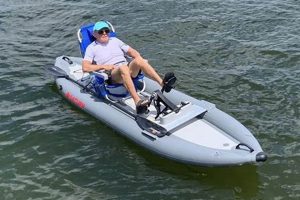
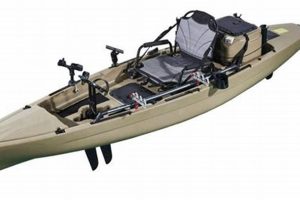
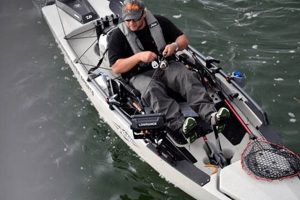
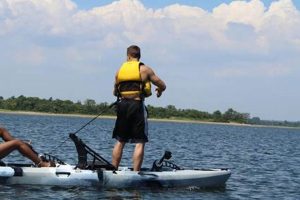
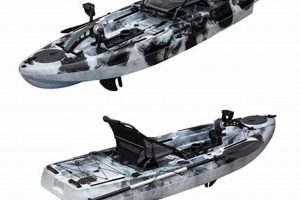
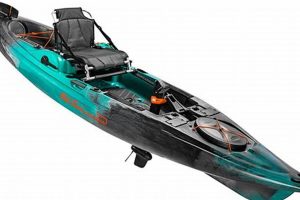
A kayak designed for fishing and propelled by pedals offers a hands-free angling experience. Stability in such a vessel is paramount, allowing anglers to cast, reel, and land fish without compromising balance or safety. A wider hull, outriggers, and a lower center of gravity are design features that contribute to stability, enabling anglers to stand and fish comfortably.
Enhanced stability translates to increased fishability and safety on the water. A stable platform provides a secure base for casting and fighting fish, particularly in challenging conditions. It allows for more confident movement within the kayak, minimizing the risk of capsizing. The evolution of these watercraft reflects a growing demand for hands-free propulsion and a stable fishing platform, leading to designs prioritizing both stability and performance.
This exploration of stability in pedal-powered fishing kayaks will delve into design considerations, popular models, and practical tips for maximizing on-the-water stability. It will further address key factors such as hull design, weight capacity, and additional stability-enhancing features.
Tips for Enhanced Kayak Fishing Stability
Optimizing stability is crucial for a safe and successful fishing experience from a kayak. The following tips offer guidance for maximizing stability and control.
Tip 1: Consider Hull Design: Wider hulls and those with a flatter bottom generally offer greater initial stability, reducing the likelihood of tipping. However, they may sacrifice some maneuverability.
Tip 2: Distribute Weight Evenly: Proper weight distribution is fundamental. Centering heavy items low and distributing gear evenly throughout the kayak minimizes rocking and improves balance.
Tip 3: Utilize Outriggers or Stabilizers: Outriggers and stabilizers provide additional support, significantly enhancing stability, especially when standing or fishing in rough conditions.
Tip 4: Practice Entering and Exiting: Mastering smooth entry and exit techniques minimizes rocking and the potential for capsizing. Practicing in shallow, calm water is recommended.
Tip 5: Understand Water Conditions: Adapt to prevailing conditions. Exercise additional caution in windy or choppy water, and avoid exceeding the kayak’s recommended weight capacity.
Tip 6: Maintain a Low Center of Gravity: Keeping movements low and controlled minimizes shifts in weight and enhances balance. Avoid sudden, jerky motions.
Tip 7: Choose the Right Pedal System: Different pedal systems offer varying degrees of stability. Research and test different systems to find one that suits individual needs and fishing styles.
By implementing these strategies, anglers can significantly enhance their stability and control while fishing from a kayak, ensuring a safer and more productive experience on the water.
These tips provide a foundational understanding of stability principles. Further sections will explore specific kayak features and advanced techniques for optimal performance and safety.
1. Hull Design

Hull design plays a crucial role in determining a pedal fishing kayak’s stability. The hull’s shape, width, and depth directly influence its performance and how it handles various water conditions. Understanding these factors enables informed decisions when selecting a kayak for optimal stability and fishing experience.
- Width and Shape
Wider hulls generally offer greater initial stability, reducing the tendency to tip. Flat-bottomed hulls provide maximum stability for stationary fishing, while slightly rounded or V-shaped hulls offer better tracking and maneuverability. Pontoon hulls, with their twin-hull design, provide exceptional stability, often allowing anglers to stand comfortably. This design choice impacts the overall fishing experience, particularly in calmer waters.
- Length and Depth
Longer kayaks tend to track better in a straight line but can be less maneuverable. Depth influences the kayak’s capacity and how it sits in the water. Shallower hulls offer more stability but less internal storage, whereas deeper hulls provide ample storage but sit lower, potentially impacting stability. Choosing the appropriate balance between length, depth, and desired performance characteristics is essential.
- Chines
Chines, the edges where the hull sides meet the bottom, influence stability and handling. Hard chines provide sharper turning and secondary stability (resistance to tipping when leaned), while soft chines offer smoother tracking and a gentler ride. The choice of chine design impacts how the kayak responds to changes in direction and water conditions.
- Rocker
Rocker refers to the curvature of the hull from bow to stern. A higher rocker (more curve) provides better maneuverability in waves and currents, but less tracking. A lower rocker (less curve) offers improved tracking but reduced maneuverability. Balancing rocker with other design elements contributes to the overall performance and stability profile of the kayak.
Considering these facets of hull design is fundamental when selecting a pedal fishing kayak optimized for stability. The ideal hull design balances stability, maneuverability, and performance based on the angler’s individual needs and intended fishing environment. A thorough understanding of these principles contributes significantly to a safe and successful fishing experience.
2. Weight Capacity

Weight capacity is a critical factor influencing the stability of a pedal fishing kayak. It represents the maximum combined weight of the angler, gear, and any additional equipment the kayak can safely carry without compromising performance or, importantly, stability. Understanding weight capacity and its implications is essential for safe and effective kayak fishing.
- Total Weight Limit
This specifies the absolute maximum weight the kayak can support. Exceeding this limit significantly compromises stability and increases the risk of capsizing. For example, a kayak with a 400-pound capacity should not carry more than that combined weight. Operating within this limit ensures safe and efficient performance.
- Gear and Angler Weight
Calculating the combined weight of the angler, fishing gear, and personal items is crucial. Accurately estimating weight helps prevent exceeding the kayak’s limit. Real-world examples include weighing tackle boxes, rods, and other equipment to ensure the total weight remains within the specified capacity.
- Impact on Stability
Carrying weight near the kayak’s capacity can affect its stability, especially in rough conditions. A kayak loaded near its limit will sit lower in the water, potentially impacting maneuverability and increasing susceptibility to waves or currents. Understanding this relationship between weight and stability is crucial for a safe and successful fishing experience.
- Performance Considerations
Weight also influences the kayak’s performance. A heavily loaded kayak will require more effort to pedal and maneuver, potentially reducing speed and range. Selecting a kayak with adequate weight capacity ensures optimal performance and efficient use of energy while fishing.
Selecting a pedal fishing kayak with appropriate weight capacity is crucial for maintaining stability and maximizing performance. A careful assessment of anticipated loads, combined with an understanding of the relationship between weight and stability, ensures a safe and enjoyable fishing experience. Proper weight management within the specified capacity contributes significantly to both stability and efficient operation on the water.
3. Center of Gravity

Center of gravity (COG) significantly influences the stability of a pedal fishing kayak. A lower COG enhances stability, while a higher COG increases the likelihood of tipping. The kayak’s design, weight distribution, and angler’s position affect the COG. A kayak with a wider beam and lower profile inherently possesses a lower COG, contributing to greater stability. Positioning heavier items lower in the kayak and closer to the center further lowers the COG. For instance, storing tackle boxes and batteries low in the hull, rather than on top of decks, improves stability. Similarly, an angler sitting lower in the kayak maintains a lower COG compared to standing. Understanding these principles is crucial for maximizing stability and safety.
The interplay between COG and stability is particularly crucial in dynamic situations. Leaning to one side, casting, or reeling in a fish shifts the COG. A lower, more centralized COG minimizes the impact of these movements, reducing the risk of capsizing. Consider the scenario of an angler leaning over the side to net a fish; a lower COG provides a greater margin of stability, preventing the kayak from tipping. Similarly, standing to cast requires careful weight management to maintain a stable COG. Kayaks designed with a wider, flatter hull and a lower seating position facilitate a lower COG, even when standing. These design features enhance stability and enable anglers to fish more confidently.
Managing the center of gravity is essential for achieving optimal stability in a pedal fishing kayak. A lower COG contributes significantly to both initial stability (resistance to tipping when still) and secondary stability (resistance to tipping when leaned). Understanding the factors influencing COG and employing strategies to lower and centralize weight enhance safety and improve overall fishing performance. This knowledge translates to increased confidence and control on the water, allowing anglers to focus on fishing effectively rather than constantly managing balance.
4. Outriggers/Stabilizers

Outriggers and stabilizers play a crucial role in enhancing the stability of pedal fishing kayaks, especially for activities that require additional balance, such as standing to cast or sight fishing. These additions provide supplementary support, increasing the kayak’s resistance to tipping and improving overall safety. Understanding their function and proper usage is essential for anglers seeking enhanced stability.
- Types of Stabilizers
Various stabilizer types exist, including rigid outriggers, inflatable stabilizers, and pontoon-style floats. Rigid outriggers offer maximum stability but can be less portable. Inflatable stabilizers provide a balance of portability and performance, while pontoon floats offer exceptional stability, particularly for standing. Choosing the right type depends on individual needs and fishing style.
- Deployment and Adjustment
Proper deployment and adjustment are essential for maximizing stabilizer effectiveness. Rigid outriggers require secure attachment and positioning, while inflatable stabilizers need proper inflation and adjustment for optimal performance. Pontoon floats typically attach directly to the hull and may offer adjustability for varying water conditions. Following manufacturer guidelines ensures optimal stability and performance.
- Impact on Performance
While stabilizers enhance stability, they can influence other performance aspects. They may slightly reduce maneuverability and increase drag, impacting speed and paddling efficiency. Understanding these trade-offs allows anglers to make informed decisions based on their priorities, balancing stability with performance.
- Safety Considerations
Stabilizers enhance stability but do not eliminate the risk of capsizing. Anglers should still exercise caution, especially in rough water or challenging conditions. Properly deployed stabilizers contribute to safety but should not replace fundamental safety practices, such as wearing a personal flotation device and understanding water conditions.
Outriggers and stabilizers are valuable additions for anglers seeking enhanced stability in their pedal fishing kayaks. Understanding the different types, proper deployment, and impact on performance allows for informed decisions. While stabilizers offer significant stability benefits, they should be used responsibly and in conjunction with other safety practices. By integrating stabilizers effectively, anglers can maximize their stability and fishing experience, enhancing both safety and enjoyment on the water.
5. Weight Distribution
Weight distribution is paramount for achieving optimal stability in a pedal fishing kayak. Improper weight distribution can compromise stability, increasing the risk of capsizing, particularly in challenging conditions. Understanding and implementing proper weight distribution techniques is essential for maximizing safety and performance on the water.
- Fore-Aft Balance
Distributing weight evenly from bow to stern is crucial. Too much weight at either end can cause the kayak to trim incorrectly, affecting tracking and maneuverability. For example, overloading the stern can cause the bow to rise, increasing susceptibility to wind and waves. Maintaining a balanced trim ensures optimal performance and stability.
- Low Center of Gravity
Concentrating weight low in the kayak lowers the center of gravity, improving stability. Storing heavier items, such as tackle boxes and batteries, low in the hull and close to the centerline minimizes rocking and enhances balance. This practice is particularly important when standing or fishing in rough conditions.
- Side-to-Side Balance
Maintaining even weight distribution from side to side is essential. Uneven weight distribution can cause the kayak to lean, reducing stability and increasing the risk of tipping. Distributing gear evenly and avoiding concentrating weight on one side minimizes leaning and enhances overall stability.
- Dynamic Weight Shifts
Understanding how movements within the kayak affect weight distribution is crucial. Leaning, casting, and retrieving fish all shift the center of gravity. Smooth, controlled movements minimize these shifts, while sudden or jerky movements can compromise stability. Anticipating these shifts and adjusting body position accordingly maintains balance and control.
Proper weight distribution is fundamental to achieving a stable and efficient pedal fishing kayak. By understanding the principles of fore-aft balance, low center of gravity, side-to-side balance, and managing dynamic weight shifts, anglers can significantly enhance their stability and control on the water. This understanding translates to increased safety, improved performance, and ultimately, a more enjoyable fishing experience.
Frequently Asked Questions
This section addresses common inquiries regarding stability in pedal-powered fishing kayaks. Clear and concise answers provide practical guidance for anglers seeking enhanced stability and performance on the water.
Question 1: How does hull design influence stability?
Wider hulls and those with flatter bottoms generally provide greater initial stability. However, these designs can sometimes compromise maneuverability. Longer kayaks tend to track better in a straight line but may be less agile in turning. The choice of hull design involves balancing stability with desired performance characteristics.
Question 2: What is the significance of weight capacity?
Weight capacity denotes the maximum weight a kayak can safely support, encompassing the angler, gear, and equipment. Exceeding this limit significantly compromises stability and increases the risk of capsizing. Selecting a kayak with ample weight capacity is crucial for safety and performance.
Question 3: How does the center of gravity impact stability?
A lower center of gravity enhances stability. Distributing weight low in the kayak and close to the centerline improves balance and minimizes rocking. Storing heavier items low in the hull and maintaining a low body position contribute to a lower center of gravity and enhanced stability.
Question 4: What are the benefits of outriggers or stabilizers?
Outriggers and stabilizers provide additional support, significantly enhancing stability, especially when standing or fishing in rough conditions. They increase the kayak’s resistance to tipping, allowing for greater confidence and control on the water.
Question 5: How does weight distribution affect stability?
Proper weight distribution is essential for maintaining balance and stability. Distributing weight evenly from bow to stern and side to side minimizes rocking and leaning. Concentrating heavier items low in the kayak further enhances stability.
Question 6: What are some additional tips for improving stability?
Practicing smooth entry and exit techniques, understanding water conditions, and maintaining a low center of gravity contribute to enhanced stability. Choosing a pedal system that suits individual needs and fishing styles further optimizes performance and control.
Understanding these key elements contributes significantly to selecting and effectively utilizing a stable pedal fishing kayak. Prioritizing stability ensures a safe and enjoyable fishing experience, allowing anglers to focus on their technique and maximizing their time on the water.
For a more in-depth exploration of specific kayak models and advanced stability techniques, consult the following sections.
Conclusion
Stability represents a critical factor in pedal fishing kayak selection. This exploration has highlighted key design elements, including hull design, weight capacity, center of gravity, outriggers, and weight distribution, all of which contribute significantly to overall stability. Understanding these elements empowers informed decisions, enabling anglers to choose kayaks suited to individual needs and fishing styles. Proper weight management and adherence to safety guidelines further enhance stability and promote a secure fishing experience.
A stable platform optimizes fishing performance and enhances safety on the water. Continued exploration of kayak design and stability enhancements will further refine the fishing experience. Anglers are encouraged to prioritize stability as a key selection criterion, ensuring confident and productive outings on the water. Careful consideration of these factors contributes significantly to a safe and enjoyable fishing experience.