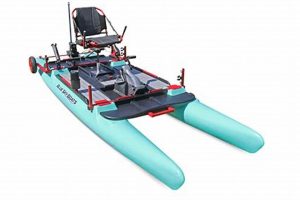
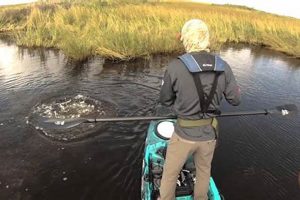
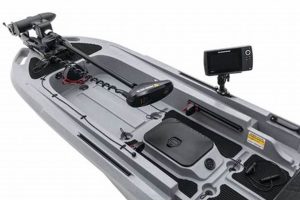
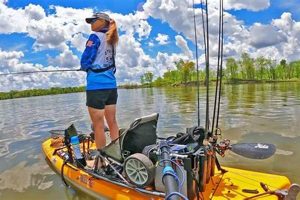
A specialized landing tool designed for use in smaller watercraft, this equipment typically features a compact, collapsible design for easy storage and deployment from a seated position. These tools often employ rubberized or coated netting to minimize harm to the catch and prevent hooks from becoming entangled. Examples include teardrop-shaped nets and hoop nets with telescoping handles.
Effective landing is crucial for anglers practicing catch-and-release, ensuring minimal stress on the fish. The compact nature of these tools makes them ideal for the limited space aboard kayaks. Historically, anglers adapted larger nets for kayak use, but the development of purpose-built tools has significantly improved efficiency and convenience. This advancement reflects the growing popularity of kayak angling and the demand for specialized equipment.
Further exploration will cover specific net types, materials, proper usage techniques, and maintenance tips to maximize the lifespan and effectiveness of this essential piece of kayak fishing equipment.
Kayak Fishing Net Tips
Proper net selection and usage are critical for successful kayak angling. These tips offer guidance for maximizing efficiency and ensuring responsible fishing practices.
Tip 1: Choose the Right Net: Match net size and shape to target species. Smaller nets suffice for panfish, while larger, deeper nets are necessary for larger game fish. Consider handle length for reach and maneuverability.
Tip 2: Practice Deployment: Smooth, efficient net deployment is crucial. Practice opening and extending the net quickly from a seated position to minimize the chance of losing a fish.
Tip 3: Secure the Net: Utilize a leash or clip to secure the net to the kayak when not in use. This prevents loss and keeps the net readily accessible.
Tip 4: Lead the Fish: Guide the fish headfirst into the net. Scooping from behind can cause the fish to spook and escape.
Tip 5: Proper Handling: Minimize fish handling time by supporting its weight and keeping it submerged as much as possible. Use rubberized nets to reduce damage to the fish’s slime coat.
Tip 6: Regular Maintenance: Rinse the net with fresh water after each use to remove salt, debris, and odors. Allow the net to dry completely before storing to prevent mildew and corrosion.
Following these guidelines enhances angling success and promotes responsible fish handling practices crucial for conservation. Appropriate equipment selection and proper technique contribute significantly to a positive and productive kayak fishing experience.
By incorporating these tips, anglers can improve their catch rate while minimizing the impact on the environment. The subsequent section offers concluding thoughts on the role of appropriate equipment in successful kayak fishing.
1. Portability

Portability is a defining characteristic of effective kayak fishing equipment, particularly nets. Kayaks offer limited storage, necessitating compact, easily stowable gear. A bulky net hinders maneuverability and presents a safety hazard in the confined space of a kayak cockpit. Folding or telescoping handles and collapsible net frames are design features that directly address this portability requirement. These features allow anglers to deploy the net quickly when needed and stow it securely when not in use, maximizing available space and minimizing interference with paddling and other fishing activities. For example, a fixed-hoop net, while potentially effective for landing fish, proves cumbersome and impractical in a kayak setting due to its size and rigidity. Conversely, a folding net with a telescoping handle occupies minimal space and allows for easy deployment and retrieval.
The importance of portability extends beyond mere convenience. It directly impacts safety and fishing efficiency. A cumbersome net can snag on gear, obstruct paddling strokes, or become entangled in lines, creating potentially dangerous situations. Furthermore, fumbling with a large, unwieldy net during the critical moments of landing a fish often leads to lost catches. A portable, easily deployable net ensures a smooth, efficient landing process, minimizing stress on both the angler and the fish. This is particularly crucial in catch-and-release fishing, where minimizing handling time is paramount to fish welfare. Choosing a net specifically designed for kayak fishing, with features that prioritize portability, demonstrates a commitment to responsible and efficient angling practices.
In summary, portability in a kayak fishing net is not simply a desirable feature; it is a fundamental requirement. It directly influences safety, efficiency, and overall fishing success. Selecting a net designed with portability in mind contributes significantly to a positive and productive kayak fishing experience. This careful selection of equipment allows anglers to focus on the core aspects of fishinglocating, hooking, and landing fishrather than struggling with cumbersome gear. The principle of portability extends to other essential kayak fishing equipment, reinforcing its critical role in this specialized angling discipline.
2. Durability

Durability is a critical factor in kayak fishing net selection. The marine environment presents harsh conditions: saltwater corrosion, UV exposure, and the physical stresses of landing fish all contribute to net degradation. A durable net withstands these challenges, ensuring consistent performance and extended lifespan. Construction materials, net design, and manufacturing quality directly influence a net’s ability to resist wear and tear. For example, a net constructed with a lightweight aluminum frame and coated nylon netting offers superior corrosion resistance and strength compared to a net made with untreated steel and standard nylon mesh. The reinforced joints and robust construction of a high-quality net minimize the risk of breakage during use, even with larger, more powerful fish.
The practical significance of net durability extends beyond mere longevity. A durable net provides reliable performance when it matters most during the critical moment of landing a fish. A broken handle or torn netting can lead to lost catches and potential safety hazards. Furthermore, investing in a durable net reduces the frequency of replacement, minimizing both cost and environmental impact. Considering the long-term value proposition, a durable, well-constructed net represents a sound investment for any serious kayak angler. For instance, a net with a rubberized coating not only protects the fish but also resists abrasion and tearing, significantly extending its useful life compared to a standard nylon net. This resistance to wear and tear translates to fewer net replacements, reduced waste, and ultimately, a more sustainable approach to fishing.
In summary, net durability is essential for consistent performance, safety, and long-term value. Selecting a kayak fishing net constructed with robust materials and quality craftsmanship ensures reliable performance in demanding conditions. Prioritizing durability contributes not only to angling success but also to a more sustainable and responsible approach to the sport. The selection process should involve a careful evaluation of materials, construction techniques, and manufacturer reputation to ensure the chosen net withstands the rigors of kayak fishing and provides years of reliable service.
3. Net Material

Net material significantly influences the effectiveness and ethical implications of a kayak fishing net. Material choice impacts fish safety, net durability, and overall fishing performance. Different materials interact with the aquatic environment and the fish themselves in distinct ways. For example, standard nylon netting, while cost-effective, can be abrasive to a fish’s skin and slime coat, potentially increasing the risk of infection or stress. Rubber or silicone-coated mesh, while more expensive, offers superior protection, minimizing damage and promoting healthier catch-and-release practices. Furthermore, the material affects the net’s handling characteristics. Rubberized nets tend to be heavier and less prone to tangling, but may require more effort to maneuver in the water, while lighter nylon nets offer easier handling but can snag more readily. The choice of material also affects the net’s visibility in the water, with darker colors offering better camouflage and potentially improving stealth, while brighter colors enhance visibility for the angler, which can be advantageous in low-light conditions.
The practical implications of net material selection are readily apparent in real-world scenarios. Consider a kayak angler targeting sensitive species like trout in a clear, shallow stream. Using a net with abrasive nylon netting increases the risk of damaging the fish’s delicate skin and disrupting its protective slime coat, potentially leading to infection or death. Conversely, a net with a fine, rubberized mesh minimizes physical harm, promoting successful catch-and-release and preserving the health of the fish population. Similarly, in saltwater environments, the choice of material impacts the net’s resistance to corrosion. A net constructed with coated stainless steel or anodized aluminum components coupled with a synthetic, rot-resistant netting material, like coated nylon or rubber, significantly outperforms a net made with standard steel and untreated nylon in terms of longevity and resistance to saltwater degradation.
In conclusion, the seemingly simple choice of net material profoundly impacts the ethical and practical dimensions of kayak fishing. Selecting a material that prioritizes fish safety, net durability, and environmental responsibility aligns with the principles of conservation and promotes sustainable angling practices. Balancing these considerations with the specific demands of the target species and fishing environment ensures optimal performance and reinforces the angler’s role as a responsible steward of aquatic ecosystems. Understanding the nuanced relationship between net material and the broader context of kayak fishing equips anglers to make informed decisions that benefit both the sport and the environment it relies upon.
4. Handle Length

Handle length is a critical consideration when selecting a kayak fishing net. It directly impacts an angler’s reach and ability to effectively land fish from a seated position. Optimal handle length balances maneuverability within the confined space of a kayak cockpit with sufficient extension to retrieve fish from the water. Choosing the appropriate length contributes significantly to landing success and minimizes the risk of fish loss or injury.
- Reach and Retrieval
A longer handle extends the angler’s reach, facilitating retrieval of fish further from the kayak. This is particularly advantageous when targeting larger species that may require additional maneuvering during landing. Conversely, an excessively long handle can be cumbersome within the limited space of a kayak, hindering control and potentially interfering with paddling or other fishing activities. For example, a short-handled net might prove inadequate for landing a large fish alongside a kayak, while a long-handled net offers the necessary reach, reducing the need for precarious leaning or repositioning. The optimal handle length allows for efficient fish retrieval without compromising stability or maneuverability.
- Maneuverability and Control
Handle length directly affects net maneuverability within a kayak. A shorter handle allows for quicker, more precise movements, crucial for netting agile fish in close proximity. However, shorter handles sacrifice reach, potentially necessitating awkward leaning or stretching. A longer handle, while providing extended reach, can become unwieldy and difficult to control in the confined space of a kayak, increasing the risk of entanglement or accidental strikes. Finding the right balance between reach and maneuverability is essential. For instance, a telescoping handle offers adjustable length, providing both the extended reach needed for larger fish and the compact maneuverability required for close-quarters netting.
- Kayak Compatibility and Storage
Handle length must be considered in relation to kayak dimensions and storage capacity. A long-handled net, while beneficial for reach, may be difficult to store securely within a smaller kayak. Conversely, a short-handled net, while easy to stow, might prove inadequate for certain fishing scenarios. Compatibility with available storage space ensures the net remains readily accessible while minimizing interference with other gear and equipment. For instance, a folding net with a retractable handle offers a practical solution, combining extended reach with compact storage, ideal for kayaks with limited space.
- Angler Height and Preference
Angler height and personal preference also influence optimal handle length. Taller anglers may find longer handles more comfortable and effective, while shorter anglers might prefer a shorter handle for enhanced control and maneuverability. Individual fishing styles and target species further refine handle length requirements. Anglers targeting larger fish from sit-on-top kayaks might prioritize reach with a longer handle, while those fishing for smaller species from sit-inside kayaks might favor maneuverability with a shorter option. Ultimately, selecting the appropriate handle length depends on a combination of physical factors, fishing style, and personal preference.
Considering these facets of handle length in relation to kayak dimensions, target species, and individual angling style ensures optimal net performance. The appropriate handle length enhances landing efficiency, reduces fish loss, and contributes to a more positive and productive kayak fishing experience. Selecting a net with an appropriate handle length reflects an understanding of the nuanced relationship between equipment and technique in successful kayak angling.
5. Hoop Size

Hoop size is a crucial aspect of kayak fishing net design, directly influencing its effectiveness and suitability for specific target species. Appropriate hoop size balances the need for a large enough opening to capture the fish with the constraints of maneuverability and storage within a kayak’s limited space. Careful consideration of hoop dimensions ensures efficient landing while minimizing the risk of fish loss or injury. Selecting the correct hoop size contributes significantly to a positive and productive kayak fishing experience.
- Target Species and Hoop Dimensions
Matching hoop size to target species is paramount for effective kayak fishing. Larger fish require larger hoops, while smaller species can be landed with smaller hoops. Using a hoop disproportionately small for the target species risks losing the fish during landing, as the fish may not fit fully within the net opening. Conversely, an excessively large hoop, while capable of accommodating larger fish, can be cumbersome and difficult to maneuver within the confined space of a kayak. For instance, a small hoop net designed for panfish proves inadequate for landing larger game fish like bass or pike, while a large salmon net, although effective for its intended purpose, becomes unwieldy and impractical when targeting smaller species from a kayak. Careful consideration of target species ensures selection of an appropriately sized hoop, balancing capture effectiveness with maneuverability.
- Maneuverability and Kayak Compatibility
Hoop size directly impacts net maneuverability within a kayak. Larger hoops, while effective for capturing larger fish, present challenges in confined spaces. They can snag on gear, obstruct paddling strokes, and become difficult to control during the critical moments of landing a fish. Smaller hoops offer enhanced maneuverability, allowing for quicker, more precise movements, particularly important when targeting agile fish in close proximity to the kayak. However, smaller hoops limit the size of fish that can be landed effectively. The optimal hoop size balances capture capacity with practical handling within the kayak environment. A larger hoop might prove cumbersome in a small, sit-inside kayak, while a smaller hoop offers better control and maneuverability, particularly when navigating tight fishing spots. Conversely, a larger hoop might be more suitable for a larger, more stable sit-on-top kayak, providing the necessary capacity for landing larger fish.
- Net Depth and Fish Containment
Hoop size influences net depth, which plays a crucial role in containing fish once captured. A larger hoop typically allows for a deeper net bag, reducing the likelihood of the fish escaping after being netted. This is particularly important for larger, more active species prone to jumping or thrashing. However, excessive net depth can create drag in the water, making it more difficult to maneuver the net and potentially stressing the fish. Balancing hoop size and net depth ensures effective fish containment while minimizing drag and facilitating efficient retrieval. For example, a shallow net with a large hoop might prove inadequate for containing active fish, while a deeper net with a smaller hoop offers better containment but may create more drag during retrieval, especially in strong currents.
- Storage Considerations and Kayak Space
Kayak anglers must consider storage constraints when selecting net hoop size. Larger hoops require more storage space, potentially impacting the organization and accessibility of other essential gear. Smaller hoops, while easier to stow, may limit the size of fish that can be effectively landed. Folding nets with collapsible hoops offer a practical compromise, providing a larger landing area when deployed while minimizing storage footprint when not in use. This adaptability is crucial for maximizing available space and maintaining a clutter-free kayak cockpit. For instance, a rigid-hoop net, while potentially effective for larger fish, occupies valuable storage space in a kayak, while a folding net with a collapsible hoop provides a balance between functionality and portability. Careful consideration of hoop size in relation to available kayak storage ensures efficient use of limited space and contributes to a more organized and streamlined fishing experience.
In conclusion, hoop size is an integral factor influencing kayak fishing net performance. Selecting the appropriate hoop size depends on a complex interplay of factors, including target species, kayak dimensions, angler preference, and overall fishing style. Careful consideration of these factors empowers anglers to choose a net that maximizes landing efficiency while maintaining maneuverability and minimizing the impact on the limited space available within a kayak. The seemingly simple choice of hoop size reflects a nuanced understanding of the relationship between equipment and technique, contributing significantly to successful and enjoyable kayak fishing experiences. Balancing these practical considerations with conservation principles ensures responsible angling practices that protect fish populations and preserve the aquatic environment for future generations.
6. Ease of Use

Ease of use is paramount in kayak fishing net selection. Within the confined space of a kayak, efficient net deployment and operation are critical for successful fish landing. Cumbersome or complicated net designs hinder maneuverability and increase the risk of losing fish. This section explores key facets of ease of use related to kayak fishing nets.
- One-Handed Operation
Many kayak anglers fish solo, necessitating equipment operable with one hand. A net deployable and controllable with a single hand allows the angler to maintain paddle control and kayak stability during the critical fish-landing process. For example, a net with a quick-release mechanism and a telescoping handle can be deployed and extended rapidly with one hand, while the other hand controls the kayak’s position relative to the fish. Struggling with a two-handed net deployment system compromises both boat control and landing efficiency, increasing the likelihood of capsizing or losing the fish.
- Deployment Speed and Simplicity
Rapid net deployment is crucial for securing a hooked fish before it escapes. Complex unfolding mechanisms or tangled netting delay deployment, increasing the chance of fish loss. A net that can be quickly and effortlessly deployed maximizes landing success. For instance, a net with a simple spring-loaded opening mechanism deploys instantaneously, while a net requiring multiple unfolding steps or manual adjustments delays the capture process, potentially allowing the fish to throw the hook or break the line. In the fast-paced environment of kayak fishing, streamlined deployment mechanisms are essential for maximizing catch rates.
- Storage and Accessibility
Efficient storage and easy accessibility are crucial for kayak fishing nets. Limited storage space necessitates compact, easily stowable designs. A net that is difficult to access or deploy quickly hinders fishing efficiency and creates unnecessary clutter in the kayak cockpit. For example, a net with a dedicated sheath or clip system attached to the kayak’s gunwale allows for quick retrieval and deployment, while a net stowed loosely in the cockpit creates clutter and may become entangled with other gear, hindering access during critical moments. Prioritizing convenient storage and accessibility maximizes fishing efficiency and minimizes disruptions during the landing process.
- Lightweight Construction and Handling
A lightweight net minimizes fatigue during extended fishing trips and enhances maneuverability within the kayak. Heavy or unwieldy nets become cumbersome, particularly in challenging conditions or when fighting larger fish. A lightweight net allows for quicker, more precise movements, increasing landing success and reducing strain on the angler. For instance, a net constructed from lightweight aluminum or composite materials reduces overall weight and enhances handling characteristics compared to a heavier net made from steel. This improved maneuverability facilitates precise net placement and reduces fatigue during repeated use, contributing to a more comfortable and productive fishing experience.
These facets of ease of use are interconnected and contribute significantly to the overall effectiveness of a kayak fishing net. Prioritizing these elements in net selection ensures a seamless and efficient fishing experience, maximizing catch rates while minimizing frustration and promoting responsible fish handling practices. Choosing a net designed for effortless operation within the specific constraints of kayak fishing reflects a commitment to both angling success and the responsible stewardship of aquatic resources.
Frequently Asked Questions
This section addresses common inquiries regarding kayak fishing nets, providing concise and informative responses to facilitate informed equipment selection and usage.
Question 1: What net material is best suited for catch-and-release kayak fishing?
Rubber or silicone-coated mesh nets minimize harm to a fish’s slime coat and reduce the risk of scale loss, promoting healthier catch-and-release practices. These materials also tend to be more resistant to tangling and hook snags.
Question 2: What handle length is recommended for a kayak fishing net?
Optimal handle length depends on kayak dimensions, target species, and angler preference. Generally, a handle length between 36 and 48 inches provides adequate reach without compromising maneuverability within a kayak’s limited space. Telescoping handles offer adjustable length, accommodating various fishing scenarios.
Question 3: How does hoop size impact net performance in a kayak?
Hoop size should correspond with target fish size. Larger hoops are suitable for larger fish but can be cumbersome in a kayak. Smaller hoops offer enhanced maneuverability but may limit the size of fish that can be effectively landed. Balancing size and maneuverability is key.
Question 4: What features contribute to a kayak fishing net’s ease of use?
One-handed operation, rapid deployment mechanisms, and convenient storage solutions enhance ease of use. Features like quick-release handles and integrated clip systems streamline the landing process and minimize disruptions.
Question 5: How should a kayak fishing net be maintained?
Regular rinsing with fresh water after each use removes salt, debris, and odors. Allowing the net to dry completely before storage prevents mildew and corrosion, extending its lifespan.
Question 6: Are there specific net designs better suited for certain types of kayaks?
Folding nets with telescoping handles are generally preferred for kayaks due to their compact storage footprint and adaptable reach. Sit-on-top kayaks may accommodate slightly larger nets due to their open deck design, while sit-inside kayaks benefit from more compact, easily stowable nets.
Careful consideration of these factors ensures selection of a kayak fishing net optimized for individual needs and fishing style, contributing to both angling success and the responsible stewardship of aquatic resources.
The following section offers concluding thoughts and recommendations for maximizing the effectiveness of kayak fishing nets in various angling scenarios.
Kayak Fishing Net
Effective angling from a kayak requires specialized equipment adapted to the unique challenges and opportunities presented by this fishing platform. A properly chosen kayak fishing net, distinguished by its portability, durability, appropriate material, handle length, hoop size, and ease of use, contributes significantly to landing success and responsible fish handling. Careful consideration of these factors ensures the selected net complements both the angler’s technique and the specific demands of the fishing environment.
Successful kayak fishing hinges on the seamless integration of angler skill and specialized equipment. The kayak fishing net exemplifies this synergy, serving as a critical tool for efficient and responsible angling. Prioritizing thoughtful equipment selection empowers anglers to maximize their potential on the water while contributing to the long-term health of aquatic ecosystems.