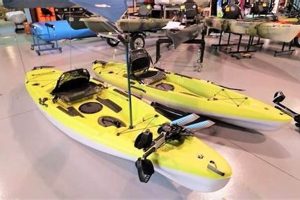
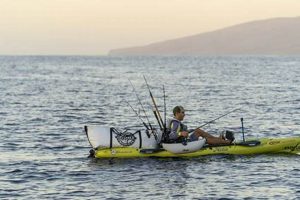
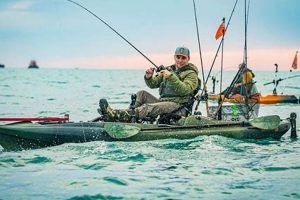
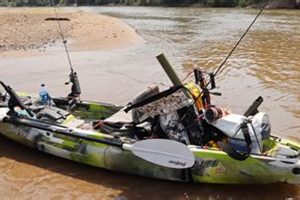
A compact sonar device designed for anglers in small watercraft helps locate fish and underwater structures. These devices typically use sound waves to create images of the underwater environment, revealing fish, vegetation, and bottom contours. A small, portable unit can be easily mounted on a kayak and powered by a rechargeable battery, providing real-time data on a compact display.
Locating fish efficiently is crucial for a successful fishing trip, especially from a kayak where mobility is key. These compact sonar systems offer anglers a significant advantage by providing a clear picture of what lies beneath the surface. This technology allows anglers to strategically target areas with higher concentrations of fish, saving valuable time and enhancing the overall fishing experience. The development of smaller, more affordable sonar units has democratized this technology, making it accessible to a wider range of anglers.
The following sections will explore the different types of these helpful devices, factors to consider when selecting one, and tips for optimal usage and installation on a kayak.
Tips for Utilizing Sonar on a Kayak
Effective use of sonar technology can significantly improve angling success from a kayak. These tips offer guidance for maximizing the benefits of these devices.
Tip 1: Transducer Placement is Key: Correct transducer placement is crucial for accurate readings. Mounting the transducer too low can result in interference from the kayak’s hull, while positioning it too high can create surface turbulence issues. Follow manufacturer recommendations for optimal placement.
Tip 2: Understand Sonar Settings: Familiarize yourself with the device’s settings, including sensitivity, frequency, and depth range adjustments. Experimenting with these settings can optimize performance in different water conditions and target specific fish species.
Tip 3: Interpret Sonar Readings Accurately: Learning to interpret the displayed information correctly takes practice. Distinguishing between fish, vegetation, and bottom structure is essential for effective targeting. Study the device’s manual and online resources to improve interpretation skills.
Tip 4: Consider Water Conditions: Water clarity, temperature, and current can influence sonar readings. Adjust settings accordingly to compensate for these factors and maintain accurate data acquisition.
Tip 5: Battery Management: Ensure the device’s battery is fully charged before each trip. Monitoring battery life during use is crucial to avoid losing power at a critical moment. Consider carrying a spare battery or a portable charging solution.
Tip 6: Regular Maintenance: Regularly inspect the transducer and its cabling for damage. Keep the device clean and dry when not in use to ensure optimal performance and longevity.
Tip 7: Integrate with Other Tools: Combining sonar data with other tools like GPS and maps can provide a comprehensive understanding of the fishing environment, leading to more strategic angling decisions.
By following these tips, anglers can maximize the potential of their sonar units, leading to a more efficient and rewarding kayaking fishing experience.
This information provides a foundation for successful sonar usage. The concluding section offers final thoughts and encourages further exploration of this valuable tool.
1. Portable Sonar Technology

Portable sonar technology forms the foundation of a kayak fish locator, enabling anglers to gain critical insights into the underwater environment. This technology utilizes sound waves to create detailed images of the water column, revealing fish, vegetation, bottom structure, and other submerged features. The portability aspect is crucial for kayak fishing, allowing anglers to easily mount and power these devices on their small vessels. Without portable sonar, kayak anglers would rely primarily on guesswork or limited visual cues, significantly reducing their chances of success. For example, a kayak angler seeking bass in a vegetated area can use portable sonar to identify pockets within the weeds where fish are likely to hold. This targeted approach conserves time and effort, maximizing fishing efficiency.
The integration of portable sonar technology into kayak fishing has revolutionized the sport. Previously, accessing detailed underwater information required bulky and expensive equipment unsuitable for kayaks. Portable sonar units have democratized this technology, providing a compact and affordable solution. The ability to quickly assess water depth, locate fish-holding structures, and even identify individual fish provides a distinct advantage. Consider a scenario where an angler is targeting crappie suspended over deep water. Portable sonar allows precise depth positioning of the lure, increasing the likelihood of a successful hookup. This level of precision was previously unattainable in kayak fishing.
In essence, portable sonar technology empowers kayak anglers with real-time underwater intelligence, transforming the fishing experience. While interpreting sonar readings effectively requires practice and understanding, the benefits are undeniable. The ability to strategically target fish based on real-time data significantly increases the chances of success. Moving forward, continued advancements in portable sonar technology promise even greater precision and detail, further enhancing the kayak angler’s ability to understand and interact with the underwater world.
2. Underwater Mapping
Underwater mapping is a critical function of a kayak fish locator, providing anglers with a crucial understanding of the submerged terrain. This capability transforms the fishing experience, shifting reliance from guesswork to informed decision-making based on real-time data. Effective interpretation of underwater maps allows anglers to identify promising fishing locations and strategize approaches for optimal results.
- Depth Contours and Drop-offs:
Depth contours depicted on a fish locator’s display reveal the underwater topography, including depth variations, slopes, and drop-offs. These features often attract fish, as they provide ambush points or access to different temperature gradients. For instance, a steep drop-off leading to a deeper basin might hold schools of baitfish and the predatory species that feed on them. Understanding depth contours enables anglers to target specific depths and structures effectively.
- Vegetation and Cover:
Identifying underwater vegetation, submerged trees, or other forms of cover is essential for locating fish habitats. These areas provide shelter, ambush points, and foraging opportunities. A kayak fish locator can distinguish between different types of vegetation, allowing anglers to target specific areas, such as weed beds or submerged timber, where target species are likely to reside. For example, locating dense patches of submerged grass can be key to finding bass or panfish.
- Bottom Composition:
Determining the bottom compositionwhether it’s rocky, sandy, muddy, or a mixprovides valuable insights into fish behavior and habitat preferences. Certain species prefer specific bottom types. For example, walleye often congregate on rocky reefs, while catfish might prefer muddy bottoms. A fish locator can discern these variations, enabling anglers to focus their efforts on areas with suitable bottom composition for their target species. Changes in bottom hardness might also indicate transitions between different habitats.
- Structure Identification:
Identifying underwater structures like submerged humps, ridges, or artificial reefs is crucial for locating fish-holding spots. These structures create variations in current flow and provide shelter, attracting baitfish and predators. A kayak fish locator helps pinpoint these structures, allowing anglers to position themselves strategically for optimal casting and retrieval. For instance, locating a submerged hump in the middle of a flat can be a key to finding schooling fish.
By combining these facets of underwater mapping, a kayak fish locator empowers anglers with comprehensive knowledge of the submerged environment. This understanding enables strategic decision-making regarding location selection, lure presentation, and overall fishing approach, ultimately increasing the likelihood of success. Effective underwater mapping transforms the kayak fishing experience from one of chance encounters to a calculated pursuit based on data-driven insights. This data-driven approach, combined with angling skill and knowledge, optimizes fishing efficiency and enhances the overall experience.
3. Fish Identification

Accurate fish identification is a significant advantage offered by kayak fish locators, enabling anglers to target specific species effectively. Distinguishing between desired species and other underwater objects or less desirable fish allows for focused effort and optimizes fishing strategies. This capability enhances angling efficiency and promotes conservation by minimizing unintended catches.
- Sonar Return Interpretation:
Fish locators use sonar returns to create visual representations of underwater objects. Interpreting these returnsspecifically the arches, blobs, or lines they form on the displaycan help identify fish. Strong, well-defined arches often indicate larger fish, while smaller marks or clusters may represent baitfish or smaller species. Understanding the nuances of sonar returns is crucial for accurate fish identification. For example, recognizing the distinct arch shape of a largemouth bass versus the more elongated shape of a walleye allows anglers to tailor their approach.
- Depth and Habitat Correlation:
Combining depth readings with knowledge of fish habitat preferences provides further clues for identification. Certain species tend to inhabit specific depths or structures. For instance, locating fish suspended mid-water in open water might suggest pelagic species like crappie or shad, while fish hugging the bottom in a rocky area could indicate bottom-dwellers like catfish or sculpin. Correlating depth and habitat with sonar returns enhances identification accuracy.
- Size Estimation:
While not always precise, fish locators can provide estimates of fish size based on the strength and shape of sonar returns. Larger fish typically produce stronger, more pronounced arches. This information is valuable for targeting trophy-sized individuals or avoiding smaller fish. For example, anglers seeking larger bass might focus on areas where the fish locator displays larger arches, while those targeting panfish could seek out clusters of smaller returns.
- Water Column Behavior:
Observing fish behavior within the water column as displayed on the fish locator offers further identification clues. Some species, like schooling baitfish, will appear as tight groups, while solitary predators might be seen moving independently. The way fish react to lures or changes in the environment can also aid identification. For instance, a quick upward movement toward a lure might suggest an aggressive predator, while a slow, meandering movement could indicate a less active species.
Proficient fish identification through a kayak fish locator significantly enhances angling success. By analyzing sonar returns, considering depth and habitat, estimating size, and observing behavior, anglers gain valuable insights into the species present. This targeted approach allows for greater efficiency and minimizes unintended catches, contributing to a more rewarding and sustainable fishing experience. As technology advances, future fish locators may offer even more sophisticated fish identification capabilities, further empowering anglers with the knowledge to make informed decisions on the water.
4. Structure Location

Locating underwater structure is a fundamental aspect of successful fishing, and kayak fish locators play a crucial role in this process. Understanding how these devices aid in identifying and interpreting different types of structure is essential for maximizing angling effectiveness. A kayak fish locator provides anglers with the ability to visualize the underwater landscape, revealing features that often attract and hold fish.
- Submerged Vegetation:
Fish locators can differentiate between various types of vegetation, such as weeds, grass beds, and submerged trees. These areas provide cover, ambush points, and foraging opportunities for many fish species. Identifying the extent and density of vegetation allows anglers to target specific areas within these habitats, increasing the likelihood of finding fish. For example, locating a sparse patch of weeds within a larger, denser bed can be key to finding bass or pike.
- Bottom Composition Changes:
Transitions between different bottom compositionssand, gravel, rock, mudoften indicate potential fish-holding areas. These transitions create edges where baitfish may congregate, attracting predatory species. Fish locators can detect these changes in bottom hardness and texture, enabling anglers to focus on these prime locations. A shift from a soft, muddy bottom to a harder, rocky bottom might signal a drop-off or reef, both attractive features for many fish.
- Drop-offs and Ledges:
Steep drop-offs, ledges, and underwater cliffs are crucial fish-holding structures. These features often concentrate baitfish and provide ambush points for predators. Fish locators clearly depict these depth changes, allowing anglers to precisely position themselves along these contours for optimal presentations. Identifying a subtle drop-off along a seemingly featureless shoreline can be the key to locating active fish.
- Artificial Structures:
Sunken debris, artificial reefs, and other man-made structures attract fish by providing shelter and concentrating food sources. Fish locators can pinpoint these structures, even in murky or deep water, enabling anglers to target these often-productive fishing spots. Locating a submerged wreck or a series of strategically placed artificial reefs can significantly improve fishing success.
By effectively utilizing a kayak fish locator to identify and interpret these structural elements, anglers gain a significant advantage. This ability to visualize the underwater world allows for strategic positioning, targeted presentations, and ultimately, increased fishing success. Understanding how fish relate to different structures enhances the angler’s ability to predict fish location and behavior, turning a passive search into an active and informed pursuit.
5. Enhanced Angling Efficiency

A kayak fish locator directly contributes to enhanced angling efficiency by providing real-time underwater insights. This technology empowers anglers with the knowledge to make informed decisions, optimizing time on the water and increasing the likelihood of success. Understanding the various facets of this enhanced efficiency is crucial for maximizing the benefits of a kayak fish locator.
- Reduced Search Time:
By identifying fish-holding structures and areas with higher fish concentrations, a kayak fish locator significantly reduces the time spent searching unproductive water. This allows anglers to focus their efforts on promising locations, maximizing fishing time. Consider an angler targeting drop-offs. Without a fish locator, locating these features can be time-consuming. With a fish locator, the angler can quickly identify and navigate to these areas, increasing fishing efficiency.
- Targeted Species Selection:
Fish locators aid in identifying fish species based on size, behavior, and location. This allows anglers to specifically target desired species, avoiding bycatch and focusing on preferred catches. For example, an angler seeking larger game fish can use the fish locator to identify larger individuals and disregard smaller fish or baitfish schools, streamlining the fishing process. This targeted approach conserves resources and minimizes environmental impact.
- Optimized Lure Presentation:
Understanding depth contours and fish location enables anglers to present lures at the optimal depth and in the most effective manner. This increases the likelihood of enticing a strike. For instance, knowing the precise depth at which fish are suspended allows anglers to adjust lure retrieval speed and depth, maximizing presentation effectiveness. This precision contributes significantly to improved catch rates.
- Adaptive Fishing Strategies:
Real-time data from a fish locator allows anglers to adapt their strategies based on current conditions and fish behavior. Observing how fish react to lures or changes in the environment enables on-the-fly adjustments, maximizing opportunities. For example, if fish are showing little interest in a particular lure, an angler can quickly switch to a different presentation based on observed fish behavior, optimizing the chances of success.
These facets of enhanced angling efficiency demonstrate the significant advantages provided by a kayak fish locator. By reducing search time, enabling targeted species selection, optimizing lure presentation, and facilitating adaptive fishing strategies, these devices transform the kayak fishing experience. The integration of technology and angling knowledge significantly increases catch rates and contributes to a more informed and rewarding time on the water.
Frequently Asked Questions
This section addresses common inquiries regarding kayak fish locators, providing concise and informative responses.
Question 1: What is the typical range of a kayak fish locator?
The range varies depending on the model and frequency used. Lower frequencies generally penetrate deeper but cover a wider area, while higher frequencies offer greater detail in shallower water. Many units suitable for kayaks provide ample range for typical freshwater environments.
Question 2: How is a kayak fish locator powered?
Most kayak fish locators operate on rechargeable 12-volt batteries. Battery life depends on usage and screen brightness, but many offer several hours of continuous use on a single charge.
Question 3: Can these devices be used in saltwater?
Some models are specifically designed for saltwater use, featuring corrosion-resistant components. Using a freshwater unit in saltwater can damage the device. Always verify the manufacturer’s specifications.
Question 4: What is the difference between CHIRP sonar and traditional sonar?
CHIRP (Compressed High-Intensity Radar Pulse) sonar uses a range of frequencies simultaneously, providing greater detail and target separation compared to traditional single-frequency sonar.
Question 5: How does water temperature affect sonar performance?
Water temperature influences sound wave propagation. Colder water transmits sound more effectively. Some fish locators compensate for temperature variations, while others require manual adjustments for optimal performance.
Question 6: Are kayak fish locators difficult to install?
Installation typically involves mounting the transducer and connecting the display unit. Many kayak-specific models offer straightforward mounting options, and detailed instructions are usually provided.
Understanding the capabilities and limitations of a kayak fish locator is crucial for effective use. Consulting product manuals and online resources can provide further information tailored to specific models.
The following section explores advanced techniques for maximizing the benefits of a kayak fish locator.
Conclusion
Kayak fish locators offer significant advantages to anglers, transforming the fishing experience from one of chance to informed pursuit. Understanding underwater topography, fish location, and species identification empowers anglers to make strategic decisions, maximizing efficiency and increasing catch rates. From identifying productive structures to optimizing lure presentations, these devices provide a crucial edge in kayak fishing. The ability to interpret data effectively is essential for maximizing the benefits of this technology.
As technology continues to advance, kayak fish locators promise even greater precision and detail, further enhancing the angler’s understanding of the underwater environment. This evolution will undoubtedly lead to more refined techniques and strategies, solidifying the role of these devices as indispensable tools for the serious kayak angler. Continual exploration of these advancements and their applications is crucial for staying at the forefront of kayak fishing technology.