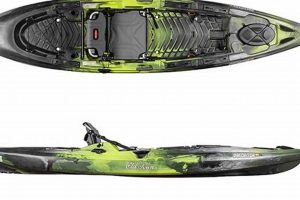
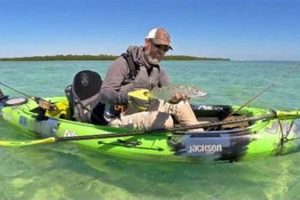
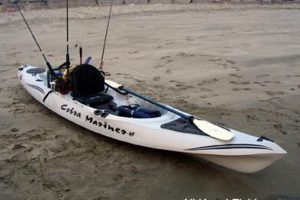
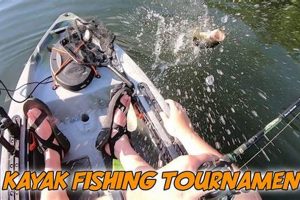
These vessels utilize pedal-driven propulsion systems, offering hands-free operation for anglers. This design allows for simultaneous fishing and maneuvering, increasing efficiency and casting opportunities. A typical example features foot pedals connected to a propeller or flippers beneath the hull, providing forward and reverse movement, and often incorporating rudder steering controlled by hand or foot levers.
Hands-free propulsion offers significant advantages for anglers. It allows for continuous lure retrieval and immediate hook setting, critical for techniques like trolling and jigging. The quiet operation of pedal drives, compared to motorized kayaks, minimizes disturbance to fish, potentially increasing catch rates, especially in shallow waters. This technology provides enhanced maneuverability in tight spaces, such as around vegetation or other obstacles, common in productive fishing environments. Historically, kayaks have been propelled by paddles, demanding physical exertion that could detract from fishing. Pedal-powered designs address this limitation, conserving energy for the core activity and enabling longer fishing trips with less fatigue.
The following sections will delve deeper into various aspects of pedal-driven fishing kayaks, exploring the different types of propulsion systems, discussing key features to consider when selecting a model, and offering guidance on effective fishing techniques from these innovative platforms.
Tips for Pedal Kayak Fishing
Maximizing the advantages of pedal-driven kayaks requires an understanding of their unique characteristics and operational nuances. The following tips offer guidance for enhancing fishing success and overall experience.
Tip 1: Master Propulsion System Control: Familiarization with the specific pedal drive system is crucial. Practice maneuvering in open water to develop proficiency in forward and reverse movement, turning radius, and speed control before venturing into complex fishing environments.
Tip 2: Optimize Seat Positioning: Proper seat adjustment is essential for comfortable and efficient pedaling. Ensure correct leg extension and back support to minimize fatigue during long fishing trips. Experiment with different seat positions to find the optimal balance and stability.
Tip 3: Plan Fishing Routes Strategically: Consider wind direction and current flow when planning fishing routes. Pedal kayaks offer maneuverability, but strong currents or headwinds can impact speed and efficiency. Plan routes that leverage natural forces whenever possible.
Tip 4: Utilize Rudder Steering Effectively: The rudder system enhances maneuverability and directional control, especially in windy conditions. Learn to coordinate pedaling and rudder adjustments for precise navigation and positioning in target fishing zones.
Tip 5: Maintain Propulsion System: Regular maintenance of the pedal drive system is essential for optimal performance and longevity. Rinse the system with fresh water after each use, especially in saltwater environments, and follow manufacturer recommendations for lubrication and periodic inspections.
Tip 6: Choose Appropriate Fishing Gear: Rod holders, tackle storage, and fish finders designed specifically for kayaks enhance organization and efficiency. Selecting gear compatible with the kayak’s layout and fishing style optimizes performance and enjoyment.
Tip 7: Practice Stealth and Observation: The quiet operation of pedal-driven kayaks provides a distinct advantage for approaching fish discreetly. Minimize noise and movement while observing the water for signs of fish activity.
By implementing these tips, anglers can fully leverage the advantages of pedal kayaks, enhancing fishing success, comfort, and overall experience on the water. These practices contribute to efficient angling, enabling focused observation and strategic positioning in pursuit of target species.
The concluding section will summarize the key advantages of pedal-driven kayaks and reinforce their position as valuable tools for enhancing fishing experiences.
1. Hands-Free Fishing

Hands-free fishing represents a significant advantage offered by foot-powered kayaks. Traditional paddle kayaks require alternating hand paddling, interrupting fishing activities like lure retrieval or line management. Foot-powered propulsion eliminates this interruption, enabling continuous fishing engagement. This is particularly advantageous for techniques like trolling or jigging where consistent lure presentation is critical. For instance, an angler trolling with a foot-powered kayak can maintain precise lure depth and speed while simultaneously adjusting rod position or preparing additional tackle, maximizing fishing efficiency. This uninterrupted engagement allows for immediate reaction to strikes, increasing hook-up ratios, a crucial factor in successful angling.
The hands-free nature of pedal kayaks extends beyond lure presentation. It allows anglers to manage lines, change lures, and land fish more efficiently. Consider a scenario where a fish strikes while an angler is paddling a traditional kayak. The angler must first position the paddle, then grab the rod, potentially losing precious seconds and risking losing the fish. In a foot-powered kayak, the angler can immediately react to the strike, maintaining tension and control throughout the fight. This responsiveness contributes significantly to landing larger or more powerful fish, expanding angling possibilities. Furthermore, maneuvering within confined spaces, such as navigating through weeds or around submerged structures, becomes significantly easier with hands-free propulsion.
In essence, the hands-free capability inherent in foot-powered kayaks represents a paradigm shift in kayak fishing. It enhances efficiency, responsiveness, and overall fishing success by allowing continuous engagement and precise control. This advantage, coupled with increased maneuverability and the potential for stealthier approach, positions foot-powered kayaks as a valuable tool for anglers seeking to optimize their fishing experience. While factors like cost and maintenance remain considerations, the benefits of hands-free fishing contribute significantly to the increasing popularity and adoption of these innovative vessels within the angling community.
2. Pedal Propulsion
Pedal propulsion forms the core functionality of foot-powered fishing kayaks, distinguishing them from traditional paddle-driven designs. This system converts reciprocating leg motion into rotational propeller or fin movement, generating thrust and enabling hands-free navigation. The direct link between leg power and kayak movement offers several distinct advantages. Firstly, it frees the angler’s hands for fishing activities, enhancing efficiency and responsiveness. Secondly, it provides a more continuous and controlled form of propulsion compared to paddling, allowing for precise speed adjustments and sustained movement over longer distances. For example, an angler targeting offshore reefs can maintain a consistent trolling speed with minimal effort using pedal propulsion, while simultaneously managing fishing rods and tackle. Understanding this connection is crucial for appreciating the core functionality and benefits of foot-powered fishing kayaks.
Several types of pedal propulsion systems exist, each with unique characteristics. Rotary systems, employing propeller-based designs, offer efficient forward and reverse movement, well-suited for open water and covering distances. Fin-based systems, mimicking the motion of a fish’s tail, provide exceptional maneuverability in shallow water and around obstacles, making them ideal for navigating complex environments like mangrove forests or weed beds. Consider an angler fishing in a shallow river system. A fin-based system allows for precise maneuvering through tight channels and around submerged logs, minimizing disturbance to the fish and maximizing access to prime fishing locations. The choice of propulsion system significantly influences the kayak’s performance and suitability for specific fishing environments.
The effectiveness of pedal propulsion depends on factors including system design, kayak hull shape, and water conditions. Efficient transfer of leg power to propulsion requires a well-engineered system with minimal friction and optimal gear ratios. Hydrodynamic hull design minimizes drag and maximizes speed potential. Strong currents or headwinds can significantly impact performance, requiring increased pedaling effort to maintain desired speed and direction. Understanding these factors allows anglers to select appropriate kayaks and adjust their techniques to optimize performance in various fishing scenarios. The integration of pedal propulsion within kayak design represents a significant advancement in fishing technology, offering enhanced efficiency, maneuverability, and access to previously challenging fishing environments.
3. Stability and Control
Stability and control are paramount for effective fishing from a kayak, particularly when employing a foot-powered propulsion system. A stable platform allows anglers to focus on fishing techniques, cast accurately, and fight fish effectively without compromising balance. Control, encompassing maneuverability and responsiveness, is crucial for navigating various water conditions and accessing desired fishing locations. These factors directly influence angling success and overall experience on the water.
- Primary Stability:
Primary stability refers to a kayak’s resistance to initial tipping. A wider hull generally provides greater primary stability, making it suitable for calm water conditions and activities like standing casting. Wider designs offer a secure platform for less experienced anglers or those requiring a stable base for specific fishing techniques.
- Secondary Stability:
Secondary stability describes a kayak’s ability to remain stable as it leans further. This is crucial for handling rougher water or engaging in more dynamic maneuvers. Kayaks with rounded or flared hulls typically offer greater secondary stability, providing reassurance in challenging conditions. This characteristic becomes particularly relevant in offshore environments or during strong winds and currents.
- Maneuverability:
Maneuverability encompasses a kayak’s responsiveness to steering input and its ability to navigate tight spaces. Shorter kayaks generally offer greater maneuverability, enabling swift turns and precise positioning in complex environments like shallow creeks or weed beds. Coupled with a rudder system, foot-powered propulsion enhances maneuverability, allowing anglers to navigate efficiently and access difficult-to-reach fishing spots.
- Tracking:
Tracking describes a kayak’s ability to maintain a straight course with minimal steering input. Longer kayaks generally track better, making them suitable for covering distances efficiently in open water. While foot-powered propulsion contributes to maintaining speed and direction, a well-designed hull and keel enhance tracking performance, reducing the need for constant course correction.
The interplay between stability and control significantly influences the overall performance and suitability of a foot-powered fishing kayak for specific fishing styles and environments. A careful assessment of these factors, alongside propulsion system type and other features, ensures angler comfort, safety, and ultimately, fishing success. Understanding the nuances of stability and control empowers anglers to make informed decisions and select the most appropriate kayak to meet their individual needs and fishing objectives.
4. Stealth and Approach
Stealth and approach are critical elements in successful angling, significantly enhanced by the inherent characteristics of foot-powered fishing kayaks. Traditional motorized boats generate considerable noise and vibration, often alerting fish and disrupting their natural behavior. Paddle kayaks, while quieter, still produce splashing sounds during propulsion, potentially compromising a stealthy approach. Foot-powered kayaks offer a distinct advantage in this regard, employing a propulsion system that operates with minimal noise and surface disturbance. This quiet operation allows anglers to approach fish discreetly, increasing the likelihood of successful presentations and enhancing overall fishing success, particularly in shallow or clear water environments.
Consider a scenario where an angler targets wary bonefish in shallow flats. The whirring of a motor or the rhythmic splashing of a paddle would likely spook these fish, causing them to flee. However, a foot-powered kayak allows the angler to glide silently through the shallows, maintaining a low profile and minimizing disturbance. This stealthy approach increases the chances of getting within casting range without alerting the fish, significantly improving the odds of a successful hookup. Similarly, in freshwater environments, anglers targeting bass or trout in clear streams benefit from the quiet operation of foot-powered kayaks, enabling them to approach feeding areas without disturbing the water’s surface or alerting fish to their presence. This capability enhances the effectiveness of sight fishing techniques, where stealth and precise positioning are crucial for success.
The quiet operation of foot-powered kayaks, coupled with their maneuverability, allows anglers to position themselves strategically for optimal casting angles and presentations. This precise control over movement and positioning, combined with a stealthy approach, significantly enhances fishing effectiveness. While factors such as wind and current can still influence fish behavior and detectability, foot-powered kayaks offer a distinct advantage in minimizing angler-induced disturbance. This inherent stealth capability empowers anglers to exploit fishing opportunities more effectively, particularly in environments where fish are easily spooked by noise or surface commotion. The integration of stealth and precise maneuverability establishes foot-powered kayaks as a valuable tool for anglers seeking to maximize their chances of success in diverse fishing scenarios.
5. Fishing Versatility

Fishing versatility, a defining characteristic of foot-powered fishing kayaks, stems directly from the hands-free operation afforded by pedal propulsion. This fundamental design element expands angling possibilities, enabling diverse fishing techniques and access to a wider range of environments. Traditional paddle kayaks, while offering maneuverability, restrict fishing activities during propulsion. Conversely, foot-powered kayaks allow simultaneous navigation and fishing actions, enhancing adaptability across various fishing styles. For example, an angler can troll effectively while maintaining precise lure control, jig vertically in deep water while maintaining boat position, or sight cast in shallow flats while maneuvering silently and accurately. This adaptability significantly broadens the scope of fishing opportunities available to kayak anglers.
The enhanced versatility translates into practical advantages in diverse fishing scenarios. In river systems, anglers can navigate upstream against currents while maintaining fishing focus, accessing prime holding areas inaccessible to traditional drift fishing techniques. In offshore environments, the stability and control offered by pedal kayaks, combined with hands-free fishing, permit trolling multiple lines or bottom fishing in deeper waters, expanding the range of target species. Moreover, in shallow, vegetated areas, the quiet operation and precise maneuverability of foot-powered kayaks allow for stealthy approaches and targeted casting in tight spaces, maximizing success when pursuing wary species. These practical applications underscore the significant contribution of fishing versatility to the effectiveness and appeal of foot-powered kayaks.
The versatility inherent in foot-powered fishing kayaks enhances angling adaptability, allowing exploration of diverse environments and employment of varied techniques. While factors such as hull design, storage capacity, and specific features contribute to overall fishing effectiveness, the foundational element of hands-free operation distinguishes these kayaks, empowering anglers to pursue a wider range of fishing opportunities with enhanced efficiency and precision. This adaptable nature underscores the value and appeal of foot-powered fishing kayaks within the evolving landscape of recreational angling.
Frequently Asked Questions
This section addresses common inquiries regarding foot-powered fishing kayaks, providing concise and informative responses to clarify key aspects and address potential concerns.
Question 1: What are the primary advantages of foot-powered kayaks over traditional paddle kayaks for fishing?
The primary advantages include hands-free operation for continuous fishing and enhanced maneuverability, particularly in challenging environments. These features allow for increased fishing efficiency, precise boat control, and a stealthier approach, potentially leading to higher catch rates.
Question 2: How do different pedal propulsion systems compare in terms of performance and suitability for various fishing environments?
Rotary propeller systems generally offer greater speed and efficiency in open water, while fin-based systems excel in maneuverability within shallow, vegetated areas or strong currents. System selection depends on the intended fishing environment and personal preferences.
Question 3: What factors should be considered when choosing between a foot-powered kayak and a motorized fishing kayak?
Key considerations include fishing environment, target species, budget, and desired level of physical exertion. Foot-powered kayaks offer a quiet, environmentally friendly approach suitable for shallow waters and stealthy fishing. Motorized kayaks provide greater speed and range, advantageous for larger bodies of water or longer distances.
Question 4: What maintenance requirements are associated with foot-powered kayak propulsion systems?
Regular rinsing with fresh water, especially after saltwater use, is essential. Periodic lubrication and inspection of moving parts, following manufacturer guidelines, ensure optimal performance and longevity. Specific maintenance procedures may vary depending on the propulsion system design.
Question 5: How does the stability of a foot-powered fishing kayak compare to other kayak types, and what factors influence stability?
Stability varies depending on hull design, width, and length. Wider, flatter hulls generally offer greater initial stability, while rounded or flared hulls provide better secondary stability in rougher conditions. Understanding these distinctions is crucial for selecting a kayak appropriate for the intended fishing environment and personal comfort level.
Question 6: Are foot-powered kayaks suitable for all fishing styles and environments?
While offering significant advantages, foot-powered kayaks may not be ideal for all situations. Extremely rough water conditions or very long-distance travel might favor motorized options. Anglers should carefully evaluate their fishing style, target species, and typical fishing environment to determine the most appropriate kayak type.
Careful consideration of these frequently asked questions provides a foundational understanding of foot-powered fishing kayaks, enabling informed decisions regarding suitability and potential benefits for individual angling needs.
The following section will provide concluding thoughts on the role of foot-powered fishing kayaks within the broader context of angling practices and technological advancements.
Conclusion
Foot-powered fishing kayaks represent a significant advancement in angling technology, offering a unique blend of efficiency, stealth, and versatility. The integration of pedal-driven propulsion systems addresses key limitations of traditional paddle kayaks and motorized boats, enabling hands-free fishing operation, precise maneuverability, and quiet operation. These advantages enhance angling effectiveness across diverse fishing styles and environments, from shallow freshwater streams to open coastal waters. The discussion encompassed key aspects such as propulsion system mechanics, stability considerations, stealth advantages, and overall fishing versatility, providing a comprehensive overview of the capabilities and benefits associated with these specialized vessels.
The evolution of kayak fishing continues, driven by technological innovation and the pursuit of enhanced angling experiences. Foot-powered kayaks signify a notable step in this evolution, offering anglers a compelling alternative to traditional methods. Careful consideration of individual fishing needs, target species, and preferred environments remains crucial in determining the suitability of these specialized craft. As technology progresses and designs refine, foot-powered fishing kayaks hold a prominent position within the future of recreational angling, empowering anglers with enhanced capabilities and opportunities for successful and immersive fishing experiences.