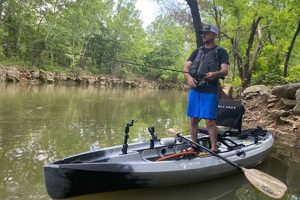
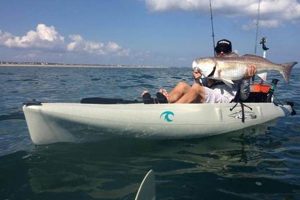
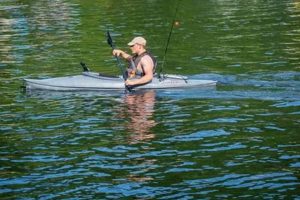
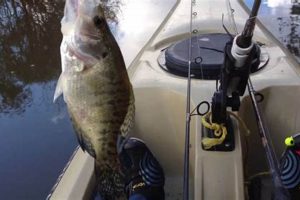
Anglers often utilize specialized kayaks manufactured by Old Town, a renowned canoe and kayak company, to enhance their fishing experience. These vessels are typically designed with features like rod holders, tackle storage, and comfortable seating to facilitate angling activities. An example would be a sit-on-top model outfitted with multiple rod holders and a spacious tank well for storing catches.
The stability, specialized design, and durability of these watercraft make them a popular choice. These kayaks contribute to a more convenient and productive fishing experience. Old Towns long history of boat building, dating back to 1898, provides a rich legacy of quality and innovation in the paddling industry, further contributing to the popularity of their fishing-specific kayaks.
Further exploration will cover specific model features, benefits of choosing such a vessel, and essential accessories for kayak angling. Considerations for selecting the appropriate kayak based on fishing style and environment will also be discussed.
Tips for Kayak Fishing with an Old Town
Optimizing angling experiences with an Old Town kayak involves careful consideration of several key factors. These tips offer guidance for enhancing fishing success and overall enjoyment on the water.
Tip 1: Choose the Right Kayak Model: Selecting a model suited to the intended fishing environment and style is crucial. Consider factors such as hull design (sit-on-top vs. sit-inside), length, and weight capacity. Anglers targeting larger game fish in offshore waters might opt for a longer, more stable model, while those fishing in calmer, shallower waters may prefer a shorter, more maneuverable design.
Tip 2: Organize Tackle and Gear: Efficient organization maximizes fishing time and minimizes frustration. Utilize the kayak’s built-in storage compartments and consider adding aftermarket accessories such as tackle boxes, rod holders, and gear tracks for customized storage solutions.
Tip 3: Prioritize Safety Equipment: Always wear a personal flotation device (PFD). Carry a whistle, signaling device, and first-aid kit. A leash for essential gear like paddles and fishing rods prevents loss in the event of a capsize.
Tip 4: Practice Paddling and Maneuvering: Before venturing into fishing locations, practice paddling techniques and maneuvering the kayak in various conditions. This builds confidence and improves control, particularly in challenging currents or wind.
Tip 5: Understand Local Regulations: Research and adhere to all local fishing regulations, including licensing requirements, catch limits, and permitted fishing areas. Respecting these regulations contributes to sustainable fisheries management.
Tip 6: Employ Effective Anchoring Techniques: Mastering anchoring techniques is essential for maintaining position in desired fishing spots, particularly in currents or wind. Consider using a stake-out pole in shallow water or a traditional anchor in deeper areas.
Tip 7: Respect Wildlife and the Environment: Minimize disturbance to wildlife and their habitats. Practice catch-and-release whenever possible, and properly dispose of all fishing line and other waste.
Adhering to these guidelines will enhance safety, improve fishing success, and promote responsible enjoyment of the sport.
This information prepares anglers to fully utilize their Old Town kayak, maximizing their on-the-water fishing experience. The following section will offer a detailed exploration of specific Old Town models suitable for various fishing styles and environments.
1. Stability

Stability is a paramount consideration when selecting a fishing kayak, especially for activities like casting, reeling, and landing fish. A stable platform contributes significantly to angler safety and fishing success. Old Town kayaks are designed with various hull designs and features to address stability needs across different fishing environments.
- Primary Stability:
Primary stability refers to a kayak’s initial resistance to tipping. A wider, flatter hull provides greater primary stability, making it ideal for calm waters and activities requiring minimal movement. Old Town’s Predator PDL, for instance, offers excellent primary stability due to its wide hull, making it suitable for stand-up fishing. This stability allows anglers to focus on casting and retrieving without constantly adjusting balance.
- Secondary Stability:
Secondary stability describes a kayak’s resistance to tipping at greater angles of lean. Kayaks with a more rounded or V-shaped hull typically offer better secondary stability, performing well in rougher waters or when leaning into turns. The Old Town Loon 120, with its moderate V-hull, balances primary and secondary stability, providing maneuverability while maintaining a secure feel. This allows anglers to confidently navigate challenging conditions and lean into turns without fear of capsizing.
- Contributing Design Features:
Beyond hull shape, features like outriggers, pontoons, and weighted keels can enhance stability. While not standard on all Old Town models, these features are available on select models or as aftermarket additions. Outriggers, for example, significantly increase primary stability, making them a popular choice for anglers fishing in open water. The ability to customize stability allows anglers to tailor their kayak to specific needs and fishing styles.
- Impact on Fishing Activities:
Stability directly impacts the angler’s ability to perform essential fishing tasks. A stable platform enables smooth casting, controlled retrieves, and secure hooksets. It also facilitates other activities, such as photographing catches, changing lures, and navigating through challenging waters with confidence. In scenarios involving larger fish, a stable kayak is essential for maintaining control during the fight and landing. Reduced stability can lead to difficulty casting, increased risk of tangling lines, and potential capsizing, particularly when battling strong currents or larger fish.
By understanding the interplay of primary and secondary stability and the influence of design features, anglers can select an Old Town kayak best suited to their specific fishing style and the conditions they typically encounter. Prioritizing stability ensures a safer and more productive fishing experience, maximizing enjoyment on the water.
2. Specialized Features

Specialized features distinguish fishing kayaks from recreational models, enhancing angler performance and overall experience. Old Town kayaks incorporate various features designed to address specific fishing needs, contributing to increased efficiency and enjoyment on the water. These features often directly correlate with fishing success and long-term user satisfaction. For example, integrated rod holders securely hold rods while paddling or preparing tackle, freeing the angler’s hands for other tasks. Similarly, strategically placed tackle storage compartments keep essential gear organized and readily accessible, minimizing time spent searching for lures or tools.
Further enhancing functionality, many Old Town fishing kayaks offer features like anchor trolleys, allowing for precise anchor control and positioning in current. Paddle parks provide secure paddle storage during fishing, preventing accidental loss or interference with lines. Foot-controlled rudder systems offer hands-free steering, enabling anglers to maintain course and position while simultaneously managing rods and reels. These specialized features contribute to a more streamlined and productive fishing experience, allowing anglers to focus on the task at hand.
The presence and effective utilization of these specialized features significantly impact the overall fishing experience. While a standard kayak can certainly be used for fishing, the tailored design and integrated features of a dedicated fishing kayak, such as those offered by Old Town, significantly enhance efficiency, comfort, and overall success. Selecting a kayak with the right features for the intended fishing style and environment is crucial for maximizing enjoyment and achieving desired results. Consider factors such as the type of fishing pursued, the target species, and the typical water conditions when evaluating the necessity and practicality of specific features. This careful consideration ensures a well-equipped and optimized fishing platform, contributing to a more rewarding experience on the water.
3. Durability

Durability is a critical factor in fishing kayaks, directly influencing their lifespan and overall performance in demanding environments. Old Town kayaks are recognized for their robust construction, contributing to their longevity and resilience against the wear and tear associated with regular fishing use. The materials used, construction methods employed, and design considerations all play a role in ensuring durability. For example, Old Town utilizes single-piece, rotomolded polyethylene hulls in many of its fishing kayak models. This construction method creates a seamless, extremely durable hull capable of withstanding impacts, abrasions, and exposure to UV radiation. This inherent toughness allows these kayaks to endure harsh conditions, from rocky shorelines to submerged obstacles, extending their usable life and maintaining performance over time. The durability of the hull also translates to better performance in challenging conditions, providing a stable and reliable platform even in rough waters or shallow areas prone to impacts.
Beyond the hull material, hardware choices and construction techniques contribute to overall durability. Stainless steel hardware resists corrosion, maintaining functionality in saltwater environments. Reinforced areas, such as the keel and chines, further enhance impact resistance and structural integrity. These design choices, coupled with rigorous quality control processes, ensure Old Town kayaks can withstand the rigors of frequent use and exposure to the elements, providing years of reliable service. Consider an angler frequently fishing in rocky, shallow rivers. A durable kayak is essential in this environment to prevent damage from impacts and abrasion. The long-term cost savings of a durable kayak become apparent in such scenarios, as less frequent repairs or replacements are required.
Understanding the factors contributing to kayak durability allows for informed purchasing decisions and proper maintenance practices. While initial cost might be higher for more durable models, the extended lifespan and reduced need for repairs often result in lower long-term costs. Proper care, including regular cleaning and storage out of direct sunlight, further extends the life of the kayak. Ultimately, prioritizing durability in a fishing kayak translates to a reliable, long-lasting investment capable of performing consistently in diverse fishing environments, ultimately enhancing the overall fishing experience.
4. Maneuverability
Maneuverability in a fishing kayak significantly impacts an angler’s ability to navigate diverse water environments and access prime fishing locations. For Old Town kayaks, maneuverability is a key design consideration, influencing hull design and features. A kayak’s ability to turn quickly, track straight, and navigate tight spaces directly affects fishing success. For example, navigating narrow creeks or maneuvering around submerged structures requires a highly maneuverable kayak. Old Town addresses this need with models like the Loon series, designed with a shorter length and lighter weight for enhanced agility. In contrast, kayaks designed for open water, such as the Predator series, prioritize stability and tracking over nimble turning, reflecting the differing demands of various fishing environments. The relationship between maneuverability and fishing success is particularly evident in situations requiring precise boat control, such as presenting lures in specific currents or holding position near structure.
Several factors influence a kayak’s maneuverability, including hull design, length, width, and the presence of features like rudders or skegs. Shorter kayaks generally turn more easily, while longer kayaks offer better tracking. Wider kayaks provide more stability but may sacrifice maneuverability. A kayak’s rocker profile, the curvature of the hull from bow to stern, also plays a role. A higher rocker enhances maneuverability in rough water and tight turns, while a lower rocker improves tracking in calm conditions. Old Town incorporates these design elements strategically across its fishing kayak lineup, offering models tailored to specific fishing styles and environments. For instance, the Topwater series incorporates a moderate rocker profile balancing maneuverability and stability, making it suitable for a variety of fishing situations. Understanding these design elements allows anglers to select a kayak optimized for their specific needs.
Selecting a fishing kayak with appropriate maneuverability characteristics is essential for optimizing fishing effectiveness and overall enjoyment. Analyzing the intended fishing environment, target species, and preferred fishing techniques informs the decision-making process. Prioritizing maneuverability enhances an angler’s ability to access desired locations, present lures effectively, and ultimately increase fishing success. While stability remains crucial, particularly in challenging conditions, the appropriate balance between stability and maneuverability is key to a successful and enjoyable fishing experience. Choosing a kayak with the right balance ensures anglers can effectively navigate their chosen environment and focus on the task at hand: catching fish.
5. Fishing Performance

Fishing performance, a critical metric for evaluating fishing kayaks, encompasses a complex interplay of factors that directly influence angling success. Within the context of fishing Old Town kayaks, performance translates to how effectively the vessel facilitates various fishing activities, impacting efficiency, comfort, and ultimately, catch rates. This involves considering elements like stability, maneuverability, specialized features, and how these elements synergistically contribute to a productive fishing experience. Understanding these interconnected aspects provides a framework for assessing the suitability of different Old Town models for specific fishing styles and environments.
- Stability and Control:
A stable platform is crucial for casting accuracy, effective retrieves, and secure hooksets. Old Town kayaks prioritize stability through various hull designs and features, enabling anglers to maintain balance and control in diverse conditions. For instance, the wider hull of the Predator PDL provides exceptional stability for stand-up fishing, while the Loon series offers a balance of stability and maneuverability for navigating varied terrain. This stability translates to improved casting accuracy and control during fights, directly influencing fishing performance. An unstable kayak, conversely, can hinder casting, lead to missed strikes, and potentially compromise safety, particularly when handling larger fish.
- Feature Integration and Accessibility:
Integrated features, such as rod holders, tackle storage, and anchor trolleys, significantly impact fishing performance. Old Town kayaks offer a range of specialized features designed to enhance efficiency and organization. Ready access to rods, lures, and other essential gear minimizes wasted time and allows anglers to focus on fishing. For example, the multiple rod holders and ample storage compartments in the Topwater series streamline tackle management, enabling quick lure changes and efficient gear organization. This seamless integration of features directly contributes to improved fishing performance by maximizing fishing time and minimizing distractions.
- Maneuverability and Positioning:
Efficient navigation and precise boat positioning are crucial for accessing prime fishing spots and presenting lures effectively. Old Town kayaks offer varying degrees of maneuverability depending on the intended fishing environment. The Loon series, with its shorter length and lighter weight, excels in maneuverability, allowing anglers to navigate tight creeks and shallow waters. Conversely, the Predator PDL, with its pedal-driven system, excels in covering larger distances and maintaining position in open water. This tailored maneuverability directly impacts fishing performance by enabling anglers to reach target areas and effectively present lures to fish.
- Durability and Long-Term Performance:
A durable kayak ensures consistent performance over time, minimizing downtime and maintenance needs. Old Town kayaks are known for their robust construction, utilizing materials and techniques that withstand the rigors of regular fishing use. This durability translates to long-term performance reliability, ensuring the kayak remains a dependable fishing platform for years to come. A durable hull, resistant to impacts and abrasions, maintains its integrity and performance characteristics, even after extended use in harsh environments. This consistent performance is a critical aspect of overall fishing effectiveness, ensuring the kayak remains a reliable tool for anglers season after season.
These interconnected facets of fishing performance highlight the importance of selecting an Old Town kayak tailored to individual fishing styles and target environments. A kayak optimized for specific fishing needs maximizes efficiency, comfort, and ultimately, success on the water. Considering factors such as target species, fishing location, and preferred techniques informs the decision-making process, enabling anglers to choose a kayak that enhances their overall fishing experience and contributes to consistent results.
Frequently Asked Questions
This section addresses common inquiries regarding fishing from Old Town kayaks, providing concise and informative responses to assist potential buyers and current owners.
Question 1: What differentiates Old Town fishing kayaks from recreational models?
Old Town fishing kayaks incorporate specialized features like rod holders, tackle storage, anchor trolleys, and often a more stable hull design to enhance angling functionality. These features cater specifically to the needs of anglers, optimizing the on-the-water fishing experience.
Question 2: Are Old Town kayaks suitable for both freshwater and saltwater fishing?
Many Old Town kayaks are designed for use in both freshwater and saltwater environments. However, specific models may be better suited to certain conditions. Always consult the manufacturer’s recommendations for intended use. Proper care and maintenance, particularly after saltwater exposure, are essential for preserving the kayak’s longevity.
Question 3: How does one choose the right Old Town kayak for specific fishing needs?
Selecting the appropriate model involves considering factors such as fishing style, target species, typical water conditions, and desired features. Researching specific models, comparing specifications, and consulting with experienced anglers or retailers can aid in the decision-making process.
Question 4: What safety precautions should be taken when fishing from an Old Town kayak?
Always wear a personal flotation device (PFD). Carry essential safety equipment like a whistle, signaling device, and first-aid kit. Inform someone of the fishing location and expected return time. Check weather conditions before embarking and be aware of potential hazards such as changing tides, currents, and other boat traffic.
Question 5: How is an Old Town fishing kayak best maintained to ensure longevity?
Regular cleaning, especially after saltwater use, is crucial. Store the kayak out of direct sunlight and extreme temperatures. Inspect and maintain hardware regularly, addressing any signs of wear or corrosion promptly. Proper storage and maintenance practices significantly extend the kayak’s lifespan.
Question 6: Where can one find further information on specific Old Town kayak models and accessories?
Detailed information on specific models, features, specifications, and compatible accessories can be found on the official Old Town website. Authorized dealers can also provide valuable insights and assistance with selecting the appropriate kayak and gear.
Addressing these common questions provides a foundational understanding of Old Town fishing kayaks. Further research and consultation with experts are encouraged for detailed information regarding specific models and individual needs.
The following section will offer a concluding overview of the key benefits and considerations related to owning and operating an Old Town fishing kayak.
Fishing Old Town Kayak
Exploration of fishing from Old Town kayaks reveals specialized design and features catering to diverse angling needs. Hull design variations prioritize stability and maneuverability, impacting performance in various fishing environments. Integrated features, such as rod holders and tackle storage, enhance on-the-water efficiency. Durability ensures long-term value and reliable performance in demanding conditions. Consideration of these factors empowers informed decisions aligning kayak selection with individual fishing styles and target species.
Investing in an Old Town fishing kayak represents a commitment to enhancing angling pursuits. Careful selection based on individual needs and intended use optimizes the long-term value and enjoyment derived from these specialized vessels. Understanding the nuances of design, features, and performance characteristics empowers anglers to fully leverage the advantages offered by Old Town kayaks, ultimately contributing to a more rewarding and successful fishing experience.