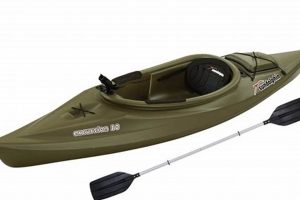
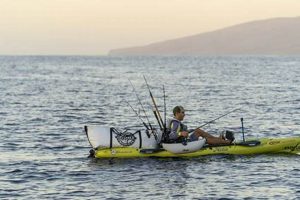
Selecting the correct implement for propelling a fishing kayak is crucial for efficient paddling and overall enjoyment on the water. A tool for determining appropriate dimensions considers factors such as kayaker height, kayak width, and paddling style. For example, a taller person in a wider kayak might require a longer implement than a shorter person in a narrower vessel. These tools often provide a range of suitable lengths rather than a single definitive measurement.
Proper sizing contributes significantly to comfort, power, and injury prevention. An incorrectly sized implement can lead to shoulder pain, fatigue, and decreased paddling efficiency. Historically, paddlers often relied on rudimentary methods or generic advice for determining suitable length. However, with the increasing popularity and specialization of kayaking, especially for fishing, more precise guidance has become available, reflecting the diverse needs of anglers.
The following sections delve into the key factors influencing appropriate implement length selection, offering detailed explanations and practical examples to assist anglers in choosing the best tool for their individual needs and on-the-water activities.
Tips for Determining Optimal Kayak Paddle Length
Several factors contribute to selecting the appropriate kayak paddle length for fishing. Careful consideration of these elements will enhance paddling performance and overall fishing experience.
Tip 1: Consider Torso Height: Torso length, measured from the seat to the top of the head, significantly influences paddle length. Longer torsos generally require longer paddles.
Tip 2: Account for Kayak Width: Wider kayaks necessitate longer paddles to reach the water effectively. Measure the kayak’s width at the seating area for an accurate assessment.
Tip 3: Evaluate Paddling Style: High-angle paddlers, who hold their paddles higher and utilize a more vertical stroke, typically benefit from shorter paddles. Low-angle paddlers, with a more horizontal stroke, often prefer longer paddles.
Tip 4: Factor in Fishing Needs: Anglers frequently require additional paddle length for maneuvering around fishing gear and navigating shallow waters. Consider the typical fishing environment and necessary paddle movements.
Tip 5: Test Different Lengths: If possible, test paddles of varying lengths before making a purchase. This allows for practical evaluation of comfort and performance. Many retailers offer demo programs or rental options.
Tip 6: Consult Charts and Guides: Numerous online resources and charts provide length recommendations based on the factors mentioned above. These resources offer a useful starting point for selecting an appropriate paddle length range.
Tip 7: Adjust Paddle Feathering: Paddle feathering, the angle between the blades, can influence paddling efficiency. Experiment with different feathering angles to find the optimal setting for individual paddling style and conditions.
By considering these tips, anglers can select a kayak paddle that optimizes performance, comfort, and overall fishing enjoyment. A properly sized paddle contributes to efficient paddling, reduces fatigue, and enhances maneuverability on the water.
Ultimately, the most effective approach involves combining these guidelines with personal experimentation to determine the ideal paddle length for individual needs and preferences.
1. Kayak Width

Kayak width plays a significant role in determining appropriate paddle length. Wider kayaks require longer paddles to achieve efficient stroke mechanics. This is due to the increased distance the paddle must travel to enter and exit the water on either side of the vessel. A paddle that is too short for a wide kayak will force the paddler into an awkward and inefficient stroke, potentially leading to reduced power, shoulder strain, and contact with the kayak hull. Conversely, a paddle that is too long for a narrow kayak can be cumbersome and difficult to control. For example, a 36-inch wide fishing kayak will typically demand a longer paddle than a 30-inch wide kayak, all other factors being equal. This relationship between kayak width and paddle length is a fundamental principle in selecting the right paddle.
The impact of kayak width on paddle length is further amplified by the presence of fishing-related accessories. Fishing kayaks often feature rod holders, tackle storage, and other equipment mounted on the gunwales, effectively increasing the overall width of the vessel. These additions necessitate a longer paddle to clear the gear and maintain an unobstructed stroke. Failure to account for these additions can lead to interference with the paddle, hindering efficient propulsion and potentially damaging equipment. Therefore, when considering kayak width, anglers must consider not only the hull width itself but also the added width contributed by any mounted accessories.
Understanding the direct correlation between kayak width and appropriate paddle length is essential for optimizing on-the-water performance and comfort. Selecting the correct paddle length based on kayak width, combined with other relevant factors such as paddler height and torso length, ensures efficient power transfer, minimizes strain, and maximizes enjoyment. Neglecting this crucial aspect of paddle selection can compromise paddling efficiency, potentially leading to fatigue and discomfort, ultimately detracting from the overall fishing experience.
2. Paddler Height

Paddler height is a critical factor in determining appropriate fishing kayak paddle length. Taller individuals generally require longer paddles to maintain efficient paddling mechanics and comfortable posture. This relationship stems from the biomechanics of paddling, where a longer paddle allows taller paddlers to reach the water effectively without excessive bending or overreaching. A paddle that is too short can force a taller paddler into a cramped position, leading to reduced power, shoulder strain, and back fatigue. Conversely, a shorter paddler using a paddle designed for a taller individual may find it difficult to control and maneuver, potentially compromising stability and paddling efficiency. For example, a paddler six feet tall will typically require a longer paddle than a paddler five feet four inches tall, even if both are paddling kayaks of the same width and using a similar paddling style.
The impact of paddler height on paddle length selection is further compounded by the nature of kayak fishing. Anglers often need to make quick adjustments to their paddling stroke to position themselves for casting, fighting fish, or navigating around obstacles. A properly sized paddle, relative to the paddler’s height, allows for these adjustments with greater ease and control. An improperly sized paddle can hinder responsiveness and maneuverability, compromising the angler’s ability to effectively manage the kayak in dynamic fishing situations. Consider a scenario where a tall angler using a short paddle encounters a sudden change in current or needs to quickly maneuver away from a submerged hazard. The inadequate paddle length could limit their ability to react efficiently, potentially leading to an unstable situation.
In summary, understanding the direct correlation between paddler height and appropriate paddle length is essential for optimizing fishing kayak performance and comfort. Selecting a paddle that aligns with one’s height allows for efficient power transfer, minimizes physical strain, and maximizes maneuverability. Failing to account for paddler height in the paddle selection process can compromise paddling efficiency, control, and overall fishing experience. Therefore, paddler height should be a primary consideration, alongside kayak width and other relevant factors, when choosing a fishing kayak paddle.
3. Torso Length

Torso length, often overlooked, plays a crucial role in determining appropriate fishing kayak paddle length. While overall height provides a general indication, torso length offers a more precise measurement for selecting a paddle that optimizes performance and comfort. Understanding the relationship between torso length and paddle length is essential for efficient paddling and injury prevention.
- Impact on Paddle Reach
Torso length directly affects a paddler’s reach. A longer torso allows for a greater forward extension during the paddling stroke, necessitating a longer paddle to maintain proper form and efficient power transfer. Conversely, a shorter torso requires a shorter paddle to avoid overreaching and potential shoulder strain. For example, two paddlers of the same overall height but differing torso lengths will require different paddle lengths for optimal performance.
- Relationship with Kayak Width
Torso length interacts with kayak width to influence ideal paddle length. A longer torso combined with a wider kayak necessitates a longer paddle to effectively reach the water. Conversely, a shorter torso in a narrower kayak benefits from a shorter paddle. Failing to consider both torso length and kayak width can result in an improperly sized paddle, compromising efficiency and comfort. For example, a paddler with a long torso in a wide fishing kayak will likely need a considerably longer paddle than a paddler with a short torso in a narrow kayak, even if they are the same height overall.
- Influence on Paddling Style
Torso length can also influence paddling style. Paddlers with longer torsos may naturally gravitate toward a lower-angle paddling style, benefiting from longer paddles that facilitate this technique. Shorter torsos might favor a higher-angle style, finding shorter paddles more manageable. While personal preference ultimately dictates paddling style, torso length can influence which styles feel most natural and efficient.
- Importance for Comfort and Injury Prevention
Selecting a paddle based on torso length is vital for long-term comfort and injury prevention. An incorrectly sized paddle can lead to shoulder impingement, back pain, and decreased paddling efficiency due to awkward body mechanics. A properly sized paddle ensures proper posture and minimizes strain, allowing for extended paddling sessions without discomfort. This is particularly important for fishing kayaks, where anglers often spend long hours on the water.
By considering torso length alongside overall height, kayak width, and paddling style, anglers can select a paddle length that maximizes efficiency, comfort, and injury prevention. A properly fitted paddle enhances the overall fishing experience, allowing anglers to focus on their technique and enjoy their time on the water. Neglecting torso length in the paddle selection process can lead to suboptimal performance and potential physical discomfort, hindering the enjoyment and effectiveness of fishing excursions.
4. Paddling Style

Paddling style significantly influences appropriate fishing kayak paddle length. Understanding the nuances of various paddling styles and their impact on paddle selection is crucial for optimizing performance, comfort, and efficiency on the water.
- High-Angle Paddling
High-angle paddling involves holding the paddle higher and employing a more vertical stroke. This style prioritizes power and speed over endurance, often favored in calmer waters or for short bursts of acceleration. Due to the higher hand position and shorter stroke path, high-angle paddling generally benefits from shorter paddles. Shorter paddles allow for quicker strokes and reduced shoulder strain in this style. For example, sprint kayakers often employ a high-angle technique with shorter paddles. In the context of fishing kayaks, a high-angle style with a shorter paddle might be suitable for quickly changing position or navigating tight spaces.
- Low-Angle Paddling
Low-angle paddling involves holding the paddle lower and employing a more horizontal stroke, emphasizing efficiency and endurance over raw power. This style is often preferred for longer distances and open water conditions. Low-angle paddling typically benefits from longer paddles. Longer paddles maximize reach and leverage, allowing for efficient power transfer and reduced fatigue over extended periods. Sea kayakers often utilize a low-angle style with longer paddles. For fishing kayaks, a low-angle style with a longer paddle is suitable for covering larger distances or trolling.
- Modified Paddling Styles for Fishing
Fishing often necessitates modifications to standard paddling styles. Frequent adjustments in paddle length and angle are often required for maneuvering around gear, navigating shallow water, or positioning for a cast. These adjustments underscore the importance of selecting a paddle length that accommodates a range of paddling positions and techniques. For example, an angler might need to switch between a high-angle paddle for quick maneuvering and a low-angle paddle for covering distance. A paddle length that allows for both styles without compromising comfort or efficiency is essential.
- Impact of Paddle Features on Style
Paddle features such as blade shape and feathering angle also interact with paddling style. Asymmetrical blades and feathered paddles can enhance efficiency in specific paddling styles. Understanding these interactions further refines paddle selection. For example, a feathered paddle can reduce wind resistance in a low-angle style, while an asymmetrical blade can improve catch in a high-angle style. Considering these nuances ensures the chosen paddle aligns with the angler’s preferred technique and fishing conditions.
Selecting a fishing kayak paddle requires careful consideration of paddling style alongside other factors like kayak width and paddler torso length. A paddle that complements the angler’s preferred style enhances efficiency, comfort, and overall fishing experience. By understanding the relationship between paddling style and paddle length, anglers can make informed decisions that optimize their time on the water. Choosing the correct paddle contributes significantly to a comfortable and productive fishing experience.
5. Fishing Style

Fishing style significantly influences appropriate kayak paddle length. Different fishing styles necessitate varying degrees of maneuverability and paddle control, impacting ideal paddle dimensions. Consideration of fishing techniques employed is crucial within a comprehensive paddle length guide. For example, trolling requires minimal paddle manipulation and benefits from longer paddles emphasizing efficient, long-distance propulsion. Conversely, sight casting or fly fishing necessitates frequent adjustments and precise boat control, favoring shorter paddles offering enhanced maneuverability. Similarly, stillwater angling often involves more frequent repositioning compared to river fishing, further impacting optimal paddle length.
The connection between fishing style and paddle length becomes particularly apparent in specialized angling scenarios. Kayak anglers targeting specific species in challenging environments, like shallow-water sight fishing for bonefish or maneuvering through dense vegetation for bass, require specialized paddle configurations. These situations often demand shorter paddles enabling rapid, precise movements in confined spaces. Conversely, open-water trolling for pelagic species necessitates longer paddles prioritizing efficient, sustained propulsion. Understanding these nuanced relationships between fishing style and paddle choice enhances angler effectiveness and enjoyment on the water. A paddle ill-suited to the intended fishing style can hinder performance, reduce comfort, and ultimately diminish the overall fishing experience. Proper paddle selection, considering specific fishing techniques and target environments, empowers anglers to optimize their approach and maximize success.
In summary, integrating fishing style into paddle length selection demonstrates a thorough understanding of kayak angling. A comprehensive paddle length guide acknowledges the diverse demands of various fishing disciplines, from open-water trolling to intricate close-quarters maneuvering. Recognizing this interconnectedness empowers anglers to choose paddles aligned with specific needs and fishing styles, promoting efficiency, comfort, and ultimately, a more rewarding experience on the water. Failing to consider fishing style can lead to suboptimal equipment choices, compromising performance and potentially hindering overall fishing success.
6. Paddle Type

Paddle type significantly influences appropriate length within a fishing kayak context. Blade shape, material construction, and adjustability features directly impact ideal paddle dimensions for specific fishing scenarios. Understanding these relationships is crucial for informed paddle selection and optimized on-the-water performance.
- Blade Shape
Blade shape impacts paddle efficiency and consequently, ideal length. Wider blades generate more power per stroke, potentially allowing for slightly shorter paddle lengths without compromising propulsion. Narrower blades, designed for higher cadence paddling, might necessitate slightly longer lengths to maintain effective speed. Asymmetrical blades, engineered to reduce flutter and enhance catch, often pair well with specific paddle lengths depending on paddling style. For example, a wide-bladed paddle designed for low-angle paddling might be slightly shorter than a narrow-bladed paddle intended for a high-angle style.
- Material Construction
Paddle material construction affects weight and flex, influencing appropriate length for optimal performance. Lighter paddles, typically constructed from carbon fiber or fiberglass, reduce fatigue over extended paddling sessions, potentially allowing for slightly longer lengths without added strain. Heavier paddles, often made from aluminum or plastic, might benefit from slightly shorter lengths to improve control and maneuverability. Consider a fishing scenario involving extensive paddling: a lighter carbon fiber paddle might be slightly longer than a heavier aluminum paddle for equivalent perceived effort.
- Adjustability Features
Adjustable-length paddles offer versatility across various fishing scenarios and paddling styles. These paddles allow for on-the-fly adjustments to accommodate changing conditions or fishing techniques. Understanding the impact of length adjustments on performance is crucial for maximizing the benefits of this feature. For example, a shorter length might be preferable for close-quarters maneuvering when sight fishing, while a longer length is beneficial for covering distance when trolling. The ability to quickly switch between these lengths enhances adaptability and overall fishing effectiveness.
- Feathered Blades
Feathered blades, offset at an angle relative to each other, reduce wind resistance and improve paddling efficiency, particularly in windy conditions. This feature often necessitates adjustments to overall paddle length compared to unfeathered blades. The offset angle affects the paddle’s “effective” blade area in the water, influencing appropriate length for optimal performance. Consider the impact of wind resistance during open-water fishing: a feathered paddle might require a slightly different length compared to an unfeathered paddle to maintain efficient propulsion and control in windy conditions.
Understanding the interplay between paddle type and appropriate length is fundamental for informed decision-making within a “fishing kayak paddle length guide.” These factors, combined with considerations for kayak width, paddler height, torso length, paddling style, and fishing style, contribute to a comprehensive understanding of paddle selection for optimal fishing kayak performance. Neglecting these nuances can compromise efficiency, comfort, and ultimately, the overall fishing experience. A well-chosen paddle, tailored to individual needs and specific fishing scenarios, enhances on-the-water effectiveness and enjoyment.
7. Comfort Level

Comfort level is paramount when selecting a fishing kayak paddle. An uncomfortable paddle can lead to fatigue, pain, and decreased performance, significantly impacting the overall fishing experience. A comprehensive paddle length guide must prioritize comfort alongside performance considerations. Understanding the factors influencing paddle comfort and their relationship to paddle length is crucial for informed decision-making.
- Reduced Fatigue
A comfortable paddle significantly reduces fatigue during long paddling sessions. Proper paddle length allows for efficient biomechanics, minimizing strain on joints and muscles. This is particularly important for fishing kayaks, where anglers often spend extended periods on the water. Reduced fatigue translates to more time focused on fishing and less on battling discomfort. For example, a paddle that is too long can overextend the shoulders, leading to rapid fatigue, while a paddle that is too short can strain the wrists and forearms.
- Injury Prevention
Proper paddle length plays a crucial role in injury prevention. An uncomfortable paddle can contribute to repetitive strain injuries, impacting long-term paddling health. Conditions like tendonitis and carpal tunnel syndrome can develop from using an improperly sized paddle. Selecting a comfortable paddle length that promotes proper body mechanics minimizes the risk of these injuries. For instance, a paddle that is too short can force awkward wrist angles, increasing the risk of carpal tunnel syndrome.
- Enhanced Performance
Comfort directly impacts paddling performance. A comfortable paddle allows for a more efficient and powerful stroke, translating to greater speed and maneuverability. Discomfort, conversely, can hinder technique and reduce paddling effectiveness. Consider a scenario where an angler needs to quickly reposition their kayak for a casting opportunity. A comfortable paddle enables swift and precise movements, while an uncomfortable paddle hinders responsiveness and control.
- Improved Enjoyment
Comfort significantly enhances the overall enjoyment of kayak fishing. A comfortable paddle allows anglers to focus on the fishing experience rather than battling discomfort. This heightened enjoyment translates to increased time on the water and greater overall satisfaction with the fishing trip. A comfortable paddle transforms paddling from a chore to a seamless part of the fishing experience, allowing for greater immersion in the surroundings and enjoyment of the activity.
Prioritizing comfort in paddle selection, alongside factors like kayak width, paddler height, and fishing style, ensures a positive and productive fishing experience. A comprehensive fishing kayak paddle length guide must emphasize the crucial role of comfort in maximizing on-the-water efficiency and enjoyment. Discomfort can detract significantly from the overall fishing experience, highlighting the importance of selecting a paddle that fits properly and promotes long-term paddling health. A comfortable paddle enhances not only performance but also the overall enjoyment of kayak fishing, allowing anglers to fully appreciate their time on the water.
Frequently Asked Questions
This section addresses common inquiries regarding fishing kayak paddle length selection.
Question 1: How is torso length measured for paddle selection?
Torso length is measured from the crease at the base of the neck (where a dress shirt button would be) to the seat of the kayak. Maintaining a natural seated posture during measurement ensures accuracy. Precise measurement is essential for accurate paddle sizing.
Question 2: Does paddle length affect kayak stability?
Paddle length indirectly influences kayak stability. An excessively long paddle can create difficulties in bracing and maneuvering, potentially compromising stability. Properly sized paddles facilitate balanced strokes, contributing to overall stability. Choosing a length that allows for comfortable and controlled strokes is crucial.
Question 3: Are adjustable paddles suitable for fishing kayaks?
Adjustable paddles offer versatility, accommodating various fishing styles and changing water conditions. They enable on-the-fly adjustments for optimal performance in different scenarios. However, adjustable mechanisms can introduce slight weight increases and potential weak points compared to fixed-length paddles.
Question 4: What is the impact of paddle blade offset (feathering) on length selection?
Feathering, the offset angle between paddle blades, reduces wind resistance and can impact ideal paddle length. Feathered paddles require adjustments to overall length to account for altered blade angles in the water. Understanding the relationship between feathering angle and effective blade area is essential for optimal sizing.
Question 5: Can paddle length compensate for kayak width limitations?
While paddle length can somewhat mitigate the impact of kayak width on paddling efficiency, it cannot fully compensate for significant width discrepancies. Kayak width remains a primary factor in paddle selection, and excessively long paddles can create control and maneuverability issues. A balanced approach considering both kayak width and paddler dimensions is essential.
Question 6: How frequently should paddle length be reevaluated?
Periodic reevaluation of paddle length is advisable, especially after significant changes in physical stature, paddling style, or kayak type. Confirming appropriate paddle length ensures continued comfort, efficiency, and injury prevention. Periodic assessment is particularly important for anglers transitioning between different kayak types or fishing styles.
Selecting an appropriately sized paddle significantly impacts fishing kayak performance, comfort, and overall enjoyment. Careful consideration of individual factors and consultation with experienced paddlers or outfitters is recommended.
The next section will provide practical tips for choosing and maintaining a fishing kayak paddle.
Fishing Kayak Paddle Length Guide
Appropriate paddle length selection is crucial for efficient and enjoyable fishing kayak experiences. This guide has explored the multifaceted nature of this process, emphasizing the interplay between factors such as paddler height, torso length, kayak width, paddling style, fishing style, and paddle type. Understanding these relationships empowers informed decisions, optimizing performance, comfort, and injury prevention. Neglecting these considerations can compromise paddling efficiency, leading to fatigue, discomfort, and potentially hindering overall fishing success. A properly sized paddle contributes significantly to a more rewarding and productive time on the water.
Continued exploration of individual paddling dynamics and experimentation with various paddle lengths and styles are encouraged. As kayak fishing evolves and specialized techniques emerge, the importance of appropriate paddle selection remains paramount. Investing time and effort in understanding these principles equips anglers with the knowledge necessary to maximize their on-the-water experiences. Ultimately, a well-chosen paddle becomes an extension of the angler, seamlessly integrating with their technique and enhancing their connection with the water.