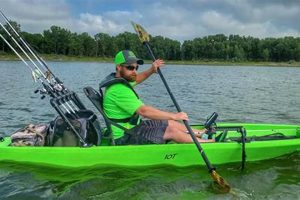
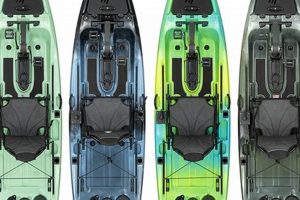
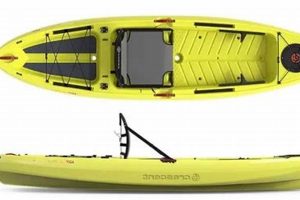
A small, self-propelled watercraft designed for angling typically accommodates a single occupant. These vessels are often characterized by specialized features like rod holders, tackle storage, and comfortable seating arrangements tailored for extended fishing trips. An example would be a sit-on-top model equipped with a paddle and built-in compartments for gear.
Compact, maneuverable watercraft purpose-built for individual anglers offer significant advantages. Their smaller size allows access to shallow waters and tighter spaces often inaccessible to larger boats, expanding fishing opportunities. Dedicated storage and strategically placed features enhance angling efficiency, while the self-propelled nature provides independent exploration and precise positioning. The evolution of these specialized vessels reflects a growing demand for personalized and adaptable fishing experiences, providing a balance between portability and performance.
This article will further explore the key aspects of selecting and utilizing these versatile vessels. Topics covered will include design variations, essential features, safety considerations, and recommended accessories.
Tips for Solo Kayak Fishing
Careful planning and preparation contribute significantly to successful and enjoyable solo kayak fishing excursions. The following tips offer guidance for maximizing efficiency and safety on the water.
Tip 1: Prioritize Stability: Vessel stability is paramount, especially when fishing. Wider, flatter hulls generally offer greater stability than narrower designs, particularly for beginners. Consider the expected water conditions and choose a kayak accordingly.
Tip 2: Plan and Share Float Plans: Always inform someone of the intended fishing location and estimated return time. Include details like launch point, planned route, and emergency contact information.
Tip 3: Equip for Safety: Carry essential safety gear, including a personal flotation device (PFD), a whistle, a visual distress signal, and a first-aid kit. A reliable communication device, such as a waterproof VHF radio or a charged mobile phone in a waterproof case, is also recommended.
Tip 4: Distribute Weight Evenly: Proper weight distribution is crucial for maintaining balance and efficient paddling. Distribute gear evenly within the kayak, avoiding overloading one area.
Tip 5: Practice Self-Rescue Techniques: Knowing how to re-enter the kayak after a capsize is essential. Practice self-rescue maneuvers in calm, shallow water before venturing into more challenging conditions.
Tip 6: Dress Appropriately for the Conditions: Consider weather forecasts and dress in layers to adapt to changing temperatures. Sun protection, including a hat, sunglasses, and sunscreen, is also essential.
Tip 7: Respect Wildlife and the Environment: Practice Leave No Trace principles. Pack out all trash, avoid disturbing wildlife, and respect sensitive habitats.
Tip 8: Check Local Regulations: Familiarize oneself with local fishing regulations, licensing requirements, and any specific rules regarding kayak usage in the area.
Adhering to these guidelines will enhance both the safety and enjoyment of solo kayak fishing trips, allowing anglers to focus on the sport and appreciate the natural environment.
This information provides a foundation for successful solo kayak fishing experiences. The following section will offer concluding thoughts and further resources for exploration.
1. Stability

Stability represents a critical factor in the design and performance of a fishing kayak intended for a single occupant. A stable platform directly influences angling success and user safety. Compromised stability hinders casting accuracy, fish fighting effectiveness, and overall comfort. Conversely, a highly stable kayak allows anglers to focus on fishing rather than maintaining balance, contributing to a more productive and enjoyable experience. The degree of stability required depends on intended use; calm lakes demand less stability than challenging ocean conditions or fast-flowing rivers.
Consider two contrasting scenarios: an angler attempting to land a large fish from a tippy kayak versus the same scenario in a highly stable vessel. In the former, maintaining balance becomes paramount, potentially compromising the ability to effectively play and land the fish. In the latter, the angler can confidently focus on the fight, increasing the likelihood of success. Real-life experiences demonstrate that a stable kayak enables techniques like stand-up fishing, significantly expanding casting range and visibility. This enhanced perspective often proves advantageous in locating fish and presenting lures effectively.
Understanding the relationship between stability and kayak design empowers informed decision-making. Factors like hull shape, width, and length contribute significantly to overall stability. Wider, flatter hulls generally offer greater initial stability, while longer, narrower hulls excel in tracking and speed. Selecting a kayak with appropriate stability for the intended fishing environment optimizes performance and safety, allowing anglers to concentrate on the pursuit of fish rather than the precariousness of their vessel. Neglecting stability considerations can lead to frustrating experiences, lost opportunities, and potentially dangerous situations.
2. Maneuverability

Maneuverability represents a critical performance attribute in fishing kayaks designed for single occupants. The ability to precisely and efficiently navigate diverse aquatic environments directly impacts angling success. Restricted maneuverability limits access to prime fishing locations, while responsive handling enhances the ability to exploit fleeting opportunities. This section explores the multifaceted nature of maneuverability and its significance in the context of solo kayak fishing.
- Tracking and Turning
Tracking refers to a kayak’s ability to maintain a straight course with minimal paddling input. Efficient tracking conserves energy and allows anglers to cover greater distances. Turning performance, conversely, dictates how quickly and responsively a kayak changes direction. Sharp turning radii are advantageous in confined spaces, such as narrow creeks or obstacle-filled waters. For example, navigating a winding river with fallen logs requires a kayak capable of tight turns. A kayak with poor tracking necessitates constant corrective strokes, diverting attention from fishing and increasing fatigue.
- Wind and Current Resistance
Wind and current significantly influence kayak handling. Kayaks with higher profiles or larger surface areas are more susceptible to wind drift, requiring greater effort to maintain course. Similarly, strong currents can impede progress and necessitate precise maneuvering. Consider a scenario where an angler attempts to hold position near a submerged structure in a fast-flowing river. A highly maneuverable kayak allows precise adjustments to maintain position, while a less responsive vessel may be swept downstream. Understanding how kayak design impacts wind and current resistance aids in selecting the appropriate vessel for specific fishing environments.
- Hull Design and Length
Hull design and length directly impact maneuverability. Shorter kayaks generally turn more quickly than longer kayaks, while longer kayaks tend to track better in open water. Hull shape also plays a crucial role. Flat-bottomed hulls provide excellent initial stability but may sacrifice maneuverability, while rounded or V-shaped hulls enhance maneuverability but may feel less stable. For example, a short, wide kayak excels in navigating tight mangrove tunnels, whereas a longer, narrower kayak performs better in open lakes or coastal areas. Choosing a hull design appropriate for the anticipated fishing environment optimizes maneuverability.
- Paddle Length and Technique
Paddle length and paddling technique influence kayak control. A properly sized paddle facilitates efficient and powerful strokes, enhancing maneuverability. Correct paddling technique, including sweep strokes and draws, allows for precise directional changes and adjustments. An angler using a paddle that is too short will experience reduced power and control, hindering maneuverability. Conversely, a paddle that is too long can be cumbersome and inefficient. Mastering fundamental paddling techniques significantly improves kayak control and maneuverability, irrespective of hull design.
Maneuverability, therefore, constitutes a critical factor influencing the effectiveness and enjoyment of solo kayak fishing. Selecting a kayak with appropriate maneuverability characteristics for the intended fishing environment enhances access to productive areas, improves fish-fighting capabilities, and contributes to a more rewarding experience on the water. Balancing maneuverability with other crucial factors, such as stability and storage capacity, ensures optimal performance and safety.
3. Storage Capacity

Storage capacity represents a critical consideration in evaluating fishing kayaks designed for single occupants. Adequate storage directly impacts the practicality and effectiveness of angling excursions. Insufficient storage limits the amount of gear that can be carried, potentially compromising preparedness and fishing success. Conversely, ample and well-organized storage allows anglers to bring essential equipment, enhancing versatility and the ability to adapt to changing conditions. This section explores the multifaceted nature of storage capacity and its significance in the context of solo kayak fishing.
- Types of Storage
Fishing kayaks offer various storage options, including hatches, tank wells, and dedicated compartments. Hatches provide secure, waterproof storage for sensitive items like electronics and clothing. Tank wells, typically located behind the seat, accommodate larger items such as tackle crates or coolers. Dedicated compartments offer specialized storage for specific gear, like rods or paddles. For example, a recessed tackle tray keeps lures and tools organized and easily accessible, while a rod holder secures fishing rods during transport and while fishing. The type and configuration of storage influence organizational efficiency and overall practicality.
- Capacity and Weight Distribution
The overall storage capacity of a kayak dictates how much gear can be carried, influencing trip duration and versatility. Weight distribution within the storage areas affects kayak balance and stability. Overloading one area can compromise stability, particularly in challenging conditions. Consider an angler embarking on a multi-day fishing trip. Ample storage capacity allows for essential supplies, including food, water, and camping gear. Proper weight distribution ensures the kayak remains stable and manageable, even with a heavy load. Careful consideration of capacity and weight distribution contributes to safety and efficient paddling.
- Accessibility and Organization
Easy access to frequently used items enhances angling efficiency. Well-organized storage minimizes time spent searching for gear, allowing anglers to focus on fishing. Features like readily accessible tackle boxes and strategically placed rod holders streamline the fishing process. For example, during a fast-paced fishing scenario, quick access to a specific lure can be the difference between landing a fish and missing the opportunity. Prioritizing accessibility and organization within the kayak’s storage system maximizes fishing time and minimizes frustration.
- Material and Durability
Storage compartments constructed from durable, weather-resistant materials ensure gear remains protected from the elements. High-quality hatches and seals prevent water intrusion, safeguarding sensitive items. For example, storing electronic devices in a waterproof hatch protects them from splashes and rain. Durable storage compartments withstand the rigors of regular use and exposure to the elements, contributing to the longevity of the kayak and the safety of stored gear.
Therefore, storage capacity represents a crucial factor in selecting a fishing kayak designed for a single occupant. Careful consideration of storage type, capacity, accessibility, and durability ensures anglers can carry essential gear, maintain balance and stability, and access equipment efficiently. Optimizing storage capacity enhances the overall fishing experience by allowing anglers to focus on the sport rather than the logistics of managing gear. Evaluating storage options in relation to individual fishing styles and anticipated needs ensures the kayak effectively supports angling pursuits.
4. Comfort & Ergonomics
Comfort and ergonomics constitute critical factors influencing the overall enjoyment and effectiveness of solo kayak fishing excursions. Extended periods spent on the water necessitate a comfortable and supportive seating system to mitigate fatigue and maintain focus. A poorly designed seating arrangement can lead to discomfort, back pain, and reduced fishing efficiency. Conversely, an ergonomic design promotes proper posture, reduces strain, and allows anglers to fish comfortably for longer durations. This enhances endurance, improves casting accuracy, and contributes to a more rewarding experience.
Consider the scenario of an angler battling a strong fish in a kayak with an uncomfortable seat. Discomfort and shifting posture can compromise leverage and control, potentially leading to a lost fish. In contrast, a comfortable and supportive seat allows the angler to maintain a stable and effective fishing position, increasing the likelihood of success. Furthermore, ergonomic considerations extend beyond seating to include features like adjustable footrests and strategically placed rod holders. Adjustable footrests provide essential bracing and support, contributing to paddling efficiency and overall stability. Properly positioned rod holders allow for easy access and efficient retrieval, minimizing strain and maximizing fishing time. These seemingly minor details significantly impact long-term comfort and performance on the water. For example, an angler with limited mobility might benefit from a higher seat position and adjustable backrest to facilitate entry and exit, while a taller angler requires ample legroom and adjustable footrests to maintain a comfortable paddling posture. Addressing these individual needs enhances comfort and promotes prolonged enjoyment of the sport.
Therefore, comfort and ergonomics represent integral components of a well-designed fishing kayak intended for a single occupant. Prioritizing these elements ensures anglers can maintain focus and effectiveness throughout extended fishing trips. A comfortable and supportive seating arrangement, coupled with ergonomic features like adjustable footrests and strategically placed rod holders, reduces fatigue, minimizes strain, and enhances overall fishing performance. Neglecting these considerations can lead to discomfort, reduced efficiency, and a diminished appreciation of the sport. Careful evaluation of comfort and ergonomic features empowers informed decision-making, ensuring the kayak aligns with individual needs and promotes long-term enjoyment on the water.
5. Propulsion (Paddle/Pedal)
Propulsion systems represent a defining characteristic of fishing kayaks designed for single occupants, directly influencing performance and angling effectiveness. The choice between paddle and pedal propulsion significantly impacts speed, maneuverability, and overall fishing experience. Understanding the advantages and disadvantages of each system empowers informed decision-making, aligning propulsion choice with individual fishing styles and target environments.
- Paddle Propulsion
Traditional paddle propulsion offers versatility and affordability. Paddles provide direct control over speed and direction, allowing for precise adjustments and maneuvering in tight spaces. The relatively low cost and ease of maintenance make paddle propulsion an attractive option for many anglers. However, paddling requires upper body strength and can lead to fatigue during extended trips, potentially limiting fishing time and effectiveness. Consider an angler navigating a shallow, weed-choked creek. Paddle propulsion provides the fine-tuned control necessary to navigate obstacles and access secluded fishing spots. However, the physical exertion required might limit exploration range, particularly in challenging conditions.
- Pedal Propulsion
Pedal propulsion offers hands-free operation, allowing anglers to maintain a fishing-ready posture and cast more efficiently. Pedal-powered kayaks typically achieve higher speeds than paddle kayaks, enabling quicker travel between fishing locations. This efficiency comes at a higher price point and increased maintenance complexity. For example, an angler targeting offshore species benefits from the speed and hands-free operation of a pedal kayak, allowing for rapid deployment and retrieval of fishing lines. The ability to maintain a fishing-ready posture maximizes response time when a fish strikes. However, the higher cost and potential maintenance requirements may influence budget-conscious anglers.
- Hybrid Propulsion
Some kayaks offer hybrid propulsion systems, combining paddle and pedal options. This versatility allows anglers to switch between propulsion methods based on conditions and fishing requirements. For instance, an angler might use pedal power for traversing open water and then switch to paddle propulsion for navigating shallow, confined areas. Hybrid systems provide flexibility but often come with added weight and complexity.
- Environmental Considerations
The choice of propulsion system also influences environmental impact. Paddle propulsion is inherently quiet and non-polluting, minimizing disturbance to aquatic life. Pedal systems, while generally quiet, may produce slight noise depending on the drive mechanism. Anglers fishing in ecologically sensitive areas might prioritize the minimal impact of paddle propulsion to avoid disturbing wildlife. Conversely, pedal propulsion might be preferred for covering larger distances with less physical exertion, reducing overall time spent in sensitive habitats.
Therefore, selecting the appropriate propulsion system for a one-person fishing kayak requires careful consideration of individual fishing styles, target environments, and budgetary constraints. Paddle propulsion offers versatility, affordability, and a direct connection to the water, while pedal propulsion provides hands-free operation and increased speed. Hybrid systems offer flexibility but may introduce added complexity. Evaluating these factors in relation to specific fishing needs ensures optimal performance, efficiency, and enjoyment on the water. The ideal propulsion system ultimately depends on prioritizing speed versus maneuverability, hands-free operation versus physical engagement, and budgetary considerations versus performance advantages.
6. Fishing-Specific Features
Specialized features distinguish fishing kayaks from recreational models, enhancing angling effectiveness and overall experience. These purpose-built additions cater specifically to the needs of anglers, optimizing functionality and promoting efficient use of space and resources. Understanding these features contributes significantly to informed kayak selection and enhanced on-the-water performance.
- Rod Holders
Rod holders secure fishing rods, freeing hands for paddling, baiting hooks, or landing fish. Multiple rod holders allow anglers to employ diverse fishing techniques simultaneously. Flush-mounted rod holders minimize interference with paddling, while adjustable rod holders offer flexibility in positioning rods at optimal angles. An angler trolling multiple lines benefits from multiple rod holders, keeping lines organized and readily accessible. Conversely, an angler focused on casting might prefer a single, adjustable rod holder positioned for quick access and retrieval. The type and placement of rod holders directly influence fishing efficiency and versatility.
- Tackle Storage
Dedicated tackle storage solutions keep essential gear organized and readily accessible. Integrated tackle boxes, trays, and compartments accommodate lures, hooks, weights, and other fishing accessories. Secure storage prevents gear from shifting or getting lost during transport or while fishing. An angler frequently changing lures benefits from a readily accessible tackle box, minimizing time spent searching for specific items. Secure storage protects valuable gear from damage and loss, ensuring preparedness for diverse fishing scenarios. The design and capacity of tackle storage systems directly influence angling efficiency and preparedness.
- Fish Finders & Electronics Mounts
Fish finders and electronics mounts integrate technology into the kayak fishing experience. Fish finders provide real-time information about water depth, bottom structure, and fish location, enhancing angling success. Dedicated mounts secure these devices within easy reach and viewing range. An angler targeting specific fish species benefits from the information provided by a fish finder, enabling strategic positioning and lure selection. Secure mounts ensure electronics remain stable and protected from the elements, maximizing their effectiveness. Integrating technology enhances fishing strategy and overall success.
- Anchor Trolleys & Stake-Out Systems
Anchor trolleys and stake-out systems allow anglers to maintain position in specific locations, particularly in current or wind. Anchor trolleys control anchor deployment and retrieval, while stake-out systems secure the kayak in shallow water. An angler fishing in a river current benefits from an anchor trolley, allowing precise positioning and boat control. Similarly, a stake-out system allows an angler to remain stationary in a shallow flat, maximizing fishing effectiveness in a specific area. These systems enhance boat control and positioning, optimizing fishing success in diverse environments.
These specialized features contribute significantly to the effectiveness and enjoyment of a fishing kayak designed for a single occupant. Rod holders, tackle storage, electronics mounts, and anchor/stake-out systems enhance functionality, optimize organization, and improve boat control, allowing anglers to focus on the sport. Careful consideration of these features during kayak selection ensures the vessel aligns with individual fishing styles and target environments, maximizing on-the-water performance and overall fishing experience. The presence and quality of these features distinguish dedicated fishing kayaks from recreational models, highlighting their specialized purpose and enhanced angling capabilities.
Frequently Asked Questions
This section addresses common inquiries regarding single-occupant fishing kayaks, providing concise and informative responses to facilitate informed decision-making and enhance understanding.
Question 1: What are the primary advantages of a fishing kayak designed for one person?
Key advantages include enhanced maneuverability in tight spaces, improved access to shallow waters, simplified transport and launch, and a personalized fishing experience tailored to individual preferences.
Question 2: How does one choose the right size and type of fishing kayak for individual needs?
Selection depends on factors such as angler size and weight, intended fishing environment (calm lakes vs. open ocean), desired features, and storage requirements. Researching various kayak types (sit-on-top, sit-inside) and considering specific fishing styles aids in appropriate selection.
Question 3: What essential safety equipment should be carried on a solo kayak fishing trip?
Essential safety gear includes a personal flotation device (PFD), a whistle, a visual distress signal, a first-aid kit, a communication device (waterproof VHF radio or mobile phone in a waterproof case), and appropriate navigation tools (map, compass, GPS). Knowledge of self-rescue techniques is also crucial.
Question 4: How does one maintain balance and stability in a fishing kayak, especially when casting or landing a fish?
Maintaining a low center of gravity, distributing weight evenly within the kayak, and practicing proper paddling techniques contribute significantly to stability. Using an anchor or stake-out system enhances stability in current or wind. Practicing self-recovery techniques prepares anglers for unexpected capsizes.
Question 5: What are the key considerations for transporting and storing a one-person fishing kayak?
Transport options include roof racks, trailers, and truck beds. Secure tie-down straps and proper padding prevent damage during transit. Storage considerations involve protecting the kayak from UV exposure and extreme temperatures. Indoor storage is ideal, but outdoor storage requires a protective cover.
Question 6: What are the typical costs associated with owning and maintaining a fishing kayak designed for one person?
Costs vary based on kayak type, features, and materials. Entry-level models may cost several hundred dollars, while high-end kayaks can exceed several thousand dollars. Ongoing maintenance includes cleaning, occasional repairs, and potential replacement of parts like seats or footrests. Additional expenses may include paddles, PFDs, fishing gear, and transportation accessories.
Understanding these key aspects of solo kayak fishing promotes informed decisions and enhances the overall experience. Careful consideration of individual needs, safety precautions, and responsible practices ensures enjoyable and productive outings on the water.
The following section provides concluding remarks and additional resources for further exploration.
Conclusion
This exploration of single-person fishing kayaks has highlighted key aspects impacting performance, selection, and overall angling experience. Factors such as stability, maneuverability, storage capacity, comfort, propulsion systems, and specialized fishing features contribute significantly to effective and enjoyable outings. Understanding the interplay of these elements empowers informed decisions regarding kayak choice, equipment selection, and on-the-water practices.
Anglers seeking a personalized and immersive fishing experience benefit from the versatility and adaptability offered by these specialized vessels. Careful consideration of individual needs and preferences, coupled with an emphasis on safety and responsible use, ensures rewarding explorations of diverse aquatic environments. The evolution of kayak design and technology continues to expand angling opportunities, promising further advancements in performance, comfort, and accessibility within the realm of solo kayak fishing.