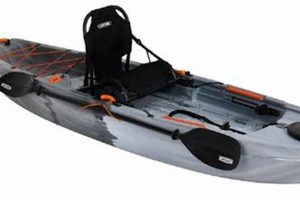
Kayaks designed with a biomimetic fish shape leverage the hydrodynamic efficiency observed in nature. This design often features a pointed bow, a wider midsection, and a tapered stern, mimicking the body form of a fish. Such designs can be seen in various kayak types, including recreational, fishing, and even some racing models. A kayak built in this way is an example of this concept.
The streamlined form offers several potential advantages. Reduced drag can lead to increased speed and improved tracking, requiring less effort from the paddler for longer distances. This efficiency can be particularly beneficial in touring or fishing kayaks, where covering substantial distances or maintaining position with minimal exertion is desirable. Historically, indigenous cultures have utilized this naturally efficient design in their watercraft. The modern application continues this tradition, using advanced materials and construction techniques to further enhance performance.
Further exploration will delve into the specific design characteristics, the science behind their effectiveness, and their impact on various kayaking disciplines. This includes analysis of hull design variations, material selection considerations, and the influence of these factors on speed, stability, and maneuverability.
Tips for Selecting and Using Biomimetic Kayaks
Choosing and utilizing a kayak designed with a fish-like profile requires careful consideration of several factors. These tips offer guidance for maximizing the benefits of this specialized design.
Tip 1: Consider Intended Use: The specific shape requirements vary based on the intended activity. Fishing kayaks prioritize stability, while touring kayaks benefit from enhanced tracking and speed. Choosing a design aligned with the primary activity enhances performance.
Tip 2: Evaluate Hull Design: Variations in hull shape within the fish-form category influence performance characteristics. A flatter hull provides greater initial stability, while a more rounded hull improves maneuverability.
Tip 3: Assess Material and Construction: Material selection impacts weight, durability, and performance. Lighter materials enhance speed and portability, while more robust materials prioritize impact resistance.
Tip 4: Consider Length and Width: Longer kayaks generally track better, while shorter kayaks offer improved maneuverability. Wider kayaks enhance stability, while narrower kayaks reduce drag.
Tip 5: Factor in Paddler Size and Weight: Kayak volume should be appropriate for the paddler’s size and weight to ensure proper buoyancy and performance. Overloading a kayak can negatively impact stability and efficiency.
Tip 6: Test Paddle Before Purchase (If Possible): A test paddle provides valuable insights into the kayak’s handling characteristics and suitability for individual paddling style and preferences.
Tip 7: Understand Maintenance Requirements: Different materials and construction methods require specific maintenance procedures. Regular maintenance ensures the longevity and performance of the kayak.
Careful consideration of these factors allows for informed decisions regarding kayak selection and optimized use. Understanding design characteristics, materials, and their influence on performance ensures a positive and efficient kayaking experience.
By understanding these elements, one can confidently select and effectively utilize a kayak suited to their specific needs and achieve optimal performance on the water.
1. Hydrodynamic Efficiency

Hydrodynamic efficiency is paramount in kayak design, directly impacting speed, maneuverability, and energy expenditure. In fish form kayaks, this principle is central, drawing inspiration from nature’s most efficient swimmers to optimize performance in the water. This exploration delves into the key facets contributing to hydrodynamic efficiency in these specialized kayaks.
- Reduced Drag:
Minimizing drag, the resistance encountered when moving through water, is a primary goal. The streamlined, fish-like profile of these kayaks, characterized by a tapered bow and stern, reduces form dragthe resistance created by the object’s shape pushing water aside. This allows the kayak to slice through the water more easily, requiring less effort from the paddler.
- Laminar Flow:
A smooth, uninterrupted flow of water along the hull, known as laminar flow, is crucial for minimizing frictional drag. Disruptions in the water flow create turbulence, increasing resistance. The smooth contours of a fish form kayak promote laminar flow, further enhancing efficiency. Maintaining a clean hull, free of debris or protrusions, also contributes to maintaining laminar flow.
- Wetted Surface Area:
The portion of the hull in contact with the water contributes to frictional drag. While the fish form inherently reduces form drag, optimizing the wetted surface area is also crucial. Designs that minimize unnecessary contact with the water while maintaining stability contribute to overall hydrodynamic efficiency.
- Aspect Ratio:
The relationship between a kayak’s length and width, known as its aspect ratio, influences its performance. Longer, narrower kayaks generally exhibit lower drag and higher potential speeds, aligning with the fish form principle. However, this must be balanced with stability considerations, as narrower hulls can be less stable. The specific aspect ratio chosen depends on the intended use of the kayak.
These interconnected factors highlight the importance of hydrodynamic efficiency in fish form kayak design. By minimizing drag, promoting laminar flow, optimizing wetted surface area, and considering aspect ratio, these kayaks achieve enhanced performance, allowing paddlers to cover greater distances with less effort and experience improved maneuverability on the water. The synergy of these elements results in a craft optimized for efficient movement through its intended environment.
2. Biomimetic Design

Biomimetic design, the practice of emulating nature’s time-tested solutions in engineering and design, plays a crucial role in the development of fish form kayaks. By mimicking the efficient forms and functions observed in aquatic life, specifically fish, these kayaks achieve enhanced performance and maneuverability in their intended environment. This exploration delves into the facets of biomimetic design related to these specialized watercraft.
- Form and Function:
The most apparent connection lies in the form itself. Fish, through millennia of evolution, have developed body shapes optimized for movement through water. The fusiform body shape, tapering at both ends, minimizes drag and maximizes propulsion efficiency. Fish form kayaks replicate this shape, featuring a pointed bow and stern, mirroring the hydrodynamic efficiency found in nature. This shape facilitates smoother passage through water, reducing resistance and enhancing speed.
- Stability and Maneuverability:
Fish utilize fins for stability and maneuverability. While kayaks don’t replicate fins directly, design elements like the hull shape and keel placement contribute to similar functions. A wider hull provides greater initial stability, while a defined keel enhances tracking and directional control, analogous to the function of a fish’s dorsal fin. The biomimetic approach considers these aspects, seeking to replicate the balance of stability and maneuverability observed in aquatic life.
- Surface Texture and Materials:
While less immediately apparent, the surface texture of fish skin, often featuring microscopic scales or slime, reduces friction and enhances laminar flow. Kayak design, while not replicating these features directly, considers smooth surfaces and specialized coatings to minimize drag. Material selection also plays a role, with lightweight yet durable materials contributing to overall efficiency, echoing the lightweight yet strong skeletal structures of fish.
- Propulsion Mechanisms:
Fish propel themselves through the water using rhythmic body movements and fin adjustments. Kayaks, while propelled by paddles, benefit from the hydrodynamic efficiency afforded by the fish form design. The streamlined shape minimizes resistance to forward motion, allowing the paddler’s efforts to translate into efficient propulsion. The biomimetic approach acknowledges this interaction, designing the hull to work in harmony with the paddling motion.
These interconnected facets highlight the profound influence of biomimetic design on fish form kayaks. By emulating the form, function, and principles observed in nature, these kayaks achieve a level of performance and efficiency exceeding traditional designs. This approach underscores the power of drawing inspiration from the natural world to solve engineering challenges and create innovative solutions optimized for specific environments. The fish form kayak stands as a testament to the potential of biomimicry in enhancing human interaction with the aquatic world.
3. Reduced Drag

Reduced drag is a critical performance characteristic of fish form kayaks, directly influencing speed, efficiency, and paddling experience. The connection between the kayak’s shape and drag reduction stems from fundamental principles of fluid dynamics. The fish-like profile, with its tapered bow and stern, minimizes form dragthe resistance created as the kayak displaces water. This streamlined shape allows water to flow more smoothly around the hull, reducing turbulence and energy loss. Consider a traditional, wider kayak: its blunt shape creates greater water displacement and turbulence, resulting in higher drag. Conversely, the fish form kayak’s design, inspired by nature’s efficient swimmers, minimizes this resistance, enabling more efficient movement through the water. This efficiency translates into increased speed with the same paddling effort, or conversely, maintaining speed with reduced exertion. Consider a long-distance paddling scenario: the cumulative effect of reduced drag over an extended period leads to significant energy savings and an overall improved paddling experience.
The practical significance of reduced drag in fish form kayaks extends beyond speed and efficiency. Improved tracking, the kayak’s ability to maintain a straight course, is another direct benefit. Reduced drag minimizes lateral forces acting on the hull, allowing the kayak to track more effectively. This is particularly advantageous in challenging conditions, such as crosswinds or currents, where maintaining course stability can be demanding. Furthermore, reduced drag contributes to improved maneuverability in certain situations. With less resistance hindering movement, the kayak responds more readily to paddle strokes, facilitating precise adjustments and turns. This responsiveness can be crucial in navigating intricate waterways or responding to changing conditions. The decreased resistance to forward motion, combined with enhanced directional stability, empowers paddlers to navigate more effectively and confidently.
In summary, reduced drag is not merely a desirable feature of fish form kayaks; it is a defining characteristic intrinsically linked to the biomimetic design. This reduction in resistance translates into tangible benefits, including increased speed, improved tracking, enhanced maneuverability, and reduced paddler fatigue. Understanding the connection between the kayak’s form and its hydrodynamic performance underscores the importance of design considerations in optimizing the interaction between the vessel and its aquatic environment. The resulting gains in efficiency and control contribute significantly to a more enjoyable and effective paddling experience.
4. Improved Tracking

Improved tracking, the ability of a kayak to maintain a straight course with minimal corrective steering, is a significant advantage offered by the fish form design. This characteristic stems directly from the hydrodynamic efficiency inherent in the biomimetic shape. By minimizing drag and promoting laminar flow, fish form kayaks experience reduced lateral forces, enabling them to hold their course more effectively. This exploration delves into the key facets contributing to improved tracking in these specialized kayaks.
- Reduced Yaw:
Yaw, the rotational movement of a kayak around its vertical axis, is a primary impediment to straight-line tracking. The streamlined form of a fish form kayak, minimizing resistance at both the bow and stern, reduces the tendency to yaw. This stability allows the kayak to maintain its intended direction with less corrective paddling, conserving energy and enhancing efficiency. Consider paddling in windy conditions: a kayak prone to yaw requires constant adjustments to stay on course, whereas a fish form kayak, with its inherent stability, remains largely unaffected.
- Keel Effect:
Many fish form kayaks incorporate a keel or a defined ridge along the bottom of the hull. This design element enhances directional stability, acting as a stabilizing force against lateral movement, much like the fin of a fish. The keel provides resistance to sideways drift, promoting straight-line tracking, particularly noticeable in crosscurrents or when paddling against waves. The size and shape of the keel vary depending on the kayak’s intended use, balancing tracking performance with maneuverability.
- Influence of Hull Design:
The specific shape of the hull, even within the fish form category, influences tracking. A longer, narrower hull generally tracks better than a shorter, wider one due to its increased resistance to turning. However, this enhanced tracking can come at the expense of maneuverability. Designers carefully balance these factors to create kayaks suited to specific paddling styles and conditions. A touring kayak, prioritizing efficient long-distance paddling, typically features a longer, narrower hull for optimal tracking, whereas a recreational kayak might prioritize maneuverability over absolute tracking performance.
- Impact of Paddling Technique:
While the kayak’s design plays a crucial role, paddling technique also influences tracking. A consistent and balanced paddling stroke minimizes unnecessary yaw and maximizes the inherent tracking capabilities of the fish form design. Proper paddle placement and a smooth, controlled stroke contribute to maintaining a straight course, particularly on longer paddles. Conversely, an inconsistent or unbalanced stroke can introduce unwanted yaw, even in a kayak designed for optimal tracking.
These interconnected elements highlight the synergy between design and performance in achieving improved tracking in fish form kayaks. The streamlined hull, often augmented by a keel, minimizes yaw and lateral movement, enabling the kayak to hold its course effectively. This characteristic, combined with a balanced paddling technique, contributes significantly to efficient and enjoyable paddling experiences, especially in challenging conditions or over long distances. The enhanced tracking performance allows paddlers to focus on their surroundings and the journey itself, rather than constantly correcting their course.
5. Enhanced Speed
Enhanced speed is a prominent advantage associated with fish form kayaks, directly linked to the hydrodynamic efficiency derived from their biomimetic design. This characteristic is not merely about achieving higher top speeds, but also about efficient cruising speeds, requiring less energy expenditure for maintaining a desired pace. The following facets explore the underlying principles and practical implications of enhanced speed in these specialized kayaks.
- Reduced Drag:
The primary contributor to enhanced speed is the reduction of drag. The streamlined, fish-like profile minimizes both form drag and frictional drag, allowing the kayak to move through the water with less resistance. This reduction translates directly into higher speeds achievable with the same paddling effort, or conversely, maintaining a given speed with reduced exertion. For instance, a fish form kayak encounters significantly less resistance compared to a wider, flatter-hulled kayak, leading to a noticeable difference in speed, especially over longer distances.
- Efficient Energy Transfer:
The streamlined hull of a fish form kayak facilitates efficient transfer of energy from the paddler to the water. With minimal energy lost to overcoming drag, each paddle stroke propels the kayak forward more effectively. This efficient energy transfer contributes to both higher speeds and reduced fatigue over extended paddling sessions. Consider a racing kayak, where efficient energy transfer is paramount for maximizing performance; the fish form design principles are often incorporated to enhance speed and endurance.
- Laminar Flow:
The smooth contours of a fish form kayak promote laminar flow, a smooth, uninterrupted flow of water along the hull. Laminar flow minimizes frictional drag, further contributing to enhanced speed. Disruptions in the water flow, creating turbulence, increase resistance and reduce speed. The fish form design, by minimizing these disruptions, optimizes the interaction between the hull and the water, facilitating efficient and speedy movement. This effect is particularly noticeable at higher speeds, where maintaining laminar flow becomes crucial for maximizing performance.
- Impact of Water Conditions:
While the kayak’s design plays a primary role, water conditions also influence speed. Calm, flat water provides the ideal environment for maximizing the speed potential of a fish form kayak. In contrast, rough water or strong currents can introduce additional resistance, impacting speed. However, even in challenging conditions, the inherent efficiency of the fish form design offers advantages in terms of maintaining speed and control compared to less streamlined kayak designs.
These interconnected factors demonstrate the significant role of design in achieving enhanced speed in fish form kayaks. The reduced drag, efficient energy transfer, and promotion of laminar flow, all stemming from the biomimetic shape, contribute to higher speeds and reduced paddling effort. This enhanced speed, coupled with improved tracking and maneuverability, makes fish form kayaks a compelling choice for paddlers seeking efficient and enjoyable experiences on the water, whether for recreational paddling, touring, or racing. The ability to cover greater distances with less effort, or maintain higher speeds with reduced exertion, underscores the performance benefits of this specialized design.
6. Stability Considerations
Stability is a critical factor in kayak design, especially concerning the fish form, which prioritizes speed and efficiency. The inherent trade-off between a streamlined hull for reduced drag and a wider hull for enhanced stability presents a design challenge. A narrower hull, while minimizing resistance and promoting speed, inherently reduces initial stabilitythe resistance to tipping when at rest. Conversely, a wider hull increases initial stability but at the cost of increased drag, reducing speed and efficiency. This delicate balance necessitates careful consideration of design elements to optimize both performance and stability.
Several design features address stability concerns in fish form kayaks. A wider beam, though increasing drag, can enhance stability. A flatter hull design, especially in the center section, provides greater initial stability. Hard chines, the angled edges where the hull sides meet the bottom, improve secondary stabilitythe resistance to tipping when the kayak is leaned. Features like bilge keels or strategically placed fins can also enhance stability, particularly in rough water conditions. Consider a fishing kayak designed with a fish form hull: the need for stability when casting and reeling necessitates a design that balances the streamlined profile with sufficient width and hull features for stability. Similarly, recreational kayaks prioritizing stability for novice paddlers often incorporate wider beams and flatter hull sections, even within the fish form category.
Understanding the interplay between hull design and stability is crucial for selecting and effectively using a fish form kayak. The intended use of the kayak heavily influences the design priorities. Touring kayaks prioritize speed and efficiency, often accepting a lower initial stability for enhanced tracking and performance. Recreational kayaks, conversely, prioritize stability for ease of use and confidence-building for less experienced paddlers. Fishing kayaks demand a balance, requiring stability for casting and reeling while maintaining sufficient efficiency for navigating various water conditions. Ultimately, the appropriate level of stability depends on the paddler’s skill level, intended use, and expected water conditions. Careful consideration of these factors ensures a safe and enjoyable paddling experience.
Frequently Asked Questions
This section addresses common inquiries regarding kayaks designed with a fish-like profile, offering concise and informative responses.
Question 1: Are all fish form kayaks designed for speed?
While the streamlined shape contributes to speed potential, not all such kayaks prioritize speed exclusively. Designs vary, balancing speed with stability and other performance characteristics depending on the intended use, such as fishing or recreational paddling.
Question 2: How does the fish form impact maneuverability?
The impact on maneuverability depends on specific design elements within the fish form category. While the streamlined profile can enhance tracking, factors like hull length and rocker influence turning performance. Shorter kayaks with more rocker generally offer greater maneuverability.
Question 3: Are fish form kayaks suitable for beginners?
Suitability for beginners depends on the specific design and the paddler’s comfort level. Some fish form kayaks, particularly recreational models, prioritize stability, making them suitable for beginners. However, narrower, higher-performance designs may require more experience.
Question 4: What are the key advantages of a fish form kayak over traditional designs?
Key advantages include potential improvements in speed, tracking, and efficiency due to reduced drag. The streamlined profile allows the kayak to move through the water with less resistance, requiring less effort from the paddler.
Question 5: How does material selection influence performance in fish form kayaks?
Material selection significantly impacts weight, durability, and performance. Lighter materials, like composites, enhance speed and portability, while more robust materials, like polyethylene, prioritize impact resistance and affordability.
Question 6: Are there any disadvantages associated with the fish form design?
Potential disadvantages include reduced initial stability in some designs, particularly those prioritizing speed. Narrower hulls can feel less stable than wider, flatter-hulled kayaks, requiring more experience and balance from the paddler.
Understanding these aspects allows for informed decisions regarding kayak selection and usage. Matching the kayak’s design to individual needs and skill levels ensures an optimal paddling experience.
Further exploration of specific fish form kayak types, including their design features and performance characteristics, follows.
Conclusion
Kayaks designed with a fish-like form represent a significant evolution in kayak design, leveraging biomimicry to achieve enhanced hydrodynamic performance. This exploration has highlighted the core principles underlying this design approach, emphasizing the interconnectedness between form and function. Reduced drag, improved tracking, and enhanced speed potential are key advantages stemming from the streamlined profile, minimizing resistance and maximizing efficiency in the water. However, stability considerations remain crucial, necessitating careful design choices to balance performance with stability requirements for various paddling disciplines. Material selection and construction further influence performance characteristics, impacting weight, durability, and overall efficiency.
The ongoing refinement of fish form kayak designs promises further advancements in performance and specialized applications. Continued exploration of materials, construction techniques, and hydrodynamic optimization holds the potential to unlock even greater efficiency and control on the water. Understanding the principles governing these designs empowers informed decision-making for selecting the appropriate kayak for specific needs and paddling styles, ultimately enhancing the human-water interface.