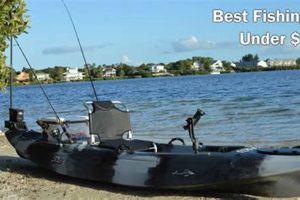
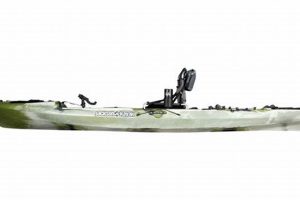
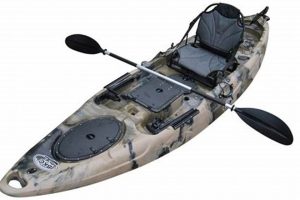
A premium, steadiness-focused watercraft designed for angling offers a secure and balanced platform ideal for casting, reeling, and landing fish. This type of kayak prioritizes stability features, such as a wider hull and a lower center of gravity, to minimize tipping and maximize angler comfort and safety. Imagine a rock-solid platform from which to enjoy a day of fishing, unhampered by worries of capsizing, even in choppy water or when wrestling with a sizable catch.
Enhanced stability significantly improves the angling experience. It allows for greater freedom of movement while casting and retrieving, reducing the risk of accidental falls overboard. A stable platform also provides a more comfortable and less fatiguing fishing experience, especially during long hours on the water. Historically, fishing kayaks have evolved from less stable designs to incorporate features that prioritize steadiness, reflecting the growing understanding of the importance of balance and security for anglers. This evolution has led to designs specifically tailored to enhance the angler’s experience, from initial casting to the triumphant landing of a fish.
This exploration will further delve into key characteristics to consider when selecting a fishing kayak optimized for stability, including hull design, length, weight capacity, and additional features like rod holders and storage compartments. Understanding these aspects will help anglers make informed decisions and choose the perfect vessel to enhance their fishing pursuits.
Tips for Choosing a Stability-Focused Fishing Kayak
Selecting a kayak optimized for fishing stability requires careful consideration of various factors. These tips provide guidance for choosing a vessel that maximizes both safety and fishing performance.
Tip 1: Prioritize Hull Design: Consider wider, flatter hulls (pontoon or tunnel designs) for maximum stability, particularly in calm waters. A wider base provides enhanced resistance to tipping.
Tip 2: Evaluate Length and Width: Shorter kayaks generally offer greater stability than longer, narrower models. Longer kayaks track better in open water, but a shorter length can be advantageous in confined areas and provides enhanced maneuverability.
Tip 3: Consider Weight Capacity: Ensure the kayak’s weight capacity comfortably accommodates the angler’s weight, plus gear, and potential catches. Exceeding the capacity compromises stability and performance.
Tip 4: Assess the Center of Gravity: A lower center of gravity contributes to greater stability. Consider kayaks with a lower seat position or wider hulls which naturally lower the center of gravity.
Tip 5: Inspect Features for Anglers: Look for integrated features like rod holders, storage compartments, and anchor trolleys designed specifically for fishing. These features enhance the overall fishing experience and contribute to a stable and organized platform.
Tip 6: Test Before Purchasing: If possible, test the kayak on the water before purchasing. This allows one to experience its stability firsthand and assess suitability for individual needs and fishing styles.
Tip 7: Research and Compare: Thoroughly research different models and compare their stability features, angler reviews, and expert recommendations. This informed approach ensures a well-suited choice.
By considering these tips, anglers can choose a kayak that prioritizes stability, enhancing safety, comfort, and overall fishing success. A stable platform ensures an enjoyable and productive fishing experience, allowing anglers to focus on their technique and the thrill of the catch.
The following section will summarize the key elements to consider when selecting a stability-focused fishing kayak and offer concluding thoughts on the importance of choosing the right vessel for a rewarding fishing experience.
1. Wide, Flat Hull Design

Wide, flat hull designs play a crucial role in kayak stability, a paramount feature for anglers. The increased surface area contacting the water creates greater buoyancy and resistance to tipping, particularly during activities like casting and reeling, or when encountering unexpected waves or currents. This design inherently lowers the center of gravity, further enhancing stability. Think of a barge versus a canoe; the barge, with its wider, flatter hull, remains significantly more stable. Similarly, a kayak designed with a wider, flatter hull provides a more secure platform for fishing activities. This stability translates to increased angler confidence and safety, enabling focus on fishing technique and enjoyment.
The practical significance of a wide, flat hull becomes particularly apparent when navigating challenging water conditions or engaging with larger fish. The increased stability minimizes the risk of capsizing, allowing anglers to maintain balance and control even when facing unexpected movements or strong pulls from a hooked fish. For instance, kayak anglers targeting larger species in open water benefit immensely from the stability offered by a wider hull. This stability also proves advantageous in rivers or near-shore ocean environments where currents and chop can present stability challenges. While this design may sacrifice some speed and maneuverability compared to narrower hulls, the enhanced stability provides a significantly more secure and comfortable fishing platform, especially for anglers prioritizing stability over speed.
In summary, the wide, flat hull design directly contributes to increased stability, a critical factor in selecting a fishing kayak. This design choice offers significant advantages in terms of safety and performance, enabling anglers to confidently navigate various water conditions and focus on the fishing experience. While trade-offs in speed and maneuverability might exist, the enhanced stability prioritizes safety and control, particularly crucial when engaging with larger fish or navigating challenging waters. Understanding the relationship between hull design and stability empowers informed decision-making for anglers seeking the optimal fishing kayak.
2. Shorter Kayak Length

Shorter kayak length contributes significantly to stability, a critical factor in fishing kayak selection. A shorter hull reduces the tendency to tip, offering a more stable platform, particularly beneficial for anglers engaged in activities like casting, reeling, and landing fish. This stability enhancement stems from the shorter hull’s reduced responsiveness to changes in weight distribution and external forces like wind and waves. Imagine a seesaw; a shorter seesaw requires more force to tip compared to a longer one. Similarly, a shorter kayak hull exhibits greater resistance to tipping motions, contributing to enhanced stability. This principle allows anglers to maintain balance and control, even when making sudden movements or encountering unexpected disturbances on the water. For novice anglers or those fishing in challenging conditions, a shorter kayak length offers a reassuring level of stability, contributing to a more confident and enjoyable fishing experience.
The practical advantages of shorter kayak length extend beyond enhanced stability. Shorter kayaks offer increased maneuverability, enabling anglers to navigate tight spaces in rivers, creeks, and along shorelines more effectively. This agility proves particularly advantageous when exploring shallow waters or areas with dense vegetation, where precise maneuvering is essential for accessing prime fishing spots. Moreover, shorter kayaks are generally easier to transport and store, simplifying logistical aspects of the fishing experience. While longer kayaks excel in tracking and speed across open water, the maneuverability and ease of transport afforded by shorter kayaks often outweigh these benefits for anglers prioritizing stability and access to confined fishing locations. Consider a scenario where an angler frequently fishes in narrow, winding creeks. A shorter kayak allows for effortless navigation through tight turns and shallow areas, providing access to otherwise unreachable fishing spots. This maneuverability, coupled with the enhanced stability, significantly contributes to a more productive and enjoyable fishing experience.
In summary, shorter kayak length directly influences stability and maneuverability, crucial factors in selecting a fishing kayak. While longer kayaks offer advantages in speed and tracking, shorter hulls prioritize stability and agility, particularly beneficial for anglers fishing in confined spaces, shallow waters, or challenging conditions. The inherent stability of a shorter hull provides a secure platform for casting, reeling, and landing fish, while enhanced maneuverability allows exploration of diverse fishing locations. Understanding this relationship between kayak length, stability, and maneuverability empowers informed decision-making, enabling anglers to choose a kayak that aligns perfectly with their individual fishing style and target environments.
3. Sufficient Weight Capacity

Sufficient weight capacity is a critical factor in ensuring the stability and safety of a fishing kayak. A kayak’s weight capacity dictates the maximum combined weight of the angler, gear, and any potential catch it can safely support. Exceeding this limit compromises stability, increasing the risk of capsizing, and negatively impacts performance. Understanding the importance of sufficient weight capacity is crucial for anglers seeking a stable and safe fishing platform.
- Impact on Stability
Weight capacity directly influences kayak stability. A kayak loaded beyond its capacity sits lower in the water, reducing freeboard and increasing susceptibility to swamping or capsizing, particularly in rough conditions. Conversely, a kayak with ample weight capacity for its load maintains higher freeboard and exhibits enhanced stability. Consider an angler with a substantial amount of fishing gear. Choosing a kayak with a higher weight capacity ensures adequate freeboard and maintains stability, even with the added weight of the equipment.
- Safety Considerations
Sufficient weight capacity is fundamental to kayak fishing safety. A kayak overloaded beyond its specified limit becomes unstable, increasing the risk of capsizing, especially in challenging conditions. This can lead to dangerous situations, particularly in open water or swift currents. Imagine an angler hooking a large fish in a kayak loaded beyond its capacity. The combined weight of the angler, gear, and fish could exceed the kayak’s limits, increasing the risk of capsizing during the fight. Prioritizing sufficient weight capacity mitigates this risk, enhancing angler safety.
- Performance Implications
Weight capacity impacts kayak performance. An overloaded kayak sits lower in the water, creating greater drag and reducing maneuverability. This makes paddling more strenuous and impacts tracking, especially in windy conditions. A kayak operating within its weight capacity moves more efficiently through the water, requiring less effort and providing enhanced responsiveness. Consider an angler paddling against a current. A kayak loaded to its capacity limit will experience significantly greater resistance, making progress difficult. Choosing a kayak with ample weight capacity for the intended load ensures optimal performance and efficient paddling.
- Calculating Total Load
Accurately calculating the total load is essential. This includes the angler’s weight, all gear (rods, reels, tackle boxes, coolers, etc.), and an estimated average weight for potential catches. Adding a safety margin to this calculation ensures the chosen kayak’s weight capacity provides ample reserve buoyancy and stability. For example, an angler might weigh 175 lbs, carry 50 lbs of gear, and anticipate catching fish averaging 10 lbs. Adding a 25 lb safety margin results in a total estimated load of 260 lbs. Choosing a kayak with a weight capacity exceeding 260 lbs ensures safe and stable operation.
In conclusion, sufficient weight capacity is essential for stability, safety, and performance in a fishing kayak. Understanding the impact of weight capacity on these crucial aspects enables informed decisions, ensuring angler safety and a positive fishing experience. Choosing a kayak with ample weight capacity for the anticipated load, including a safety margin, provides a stable and secure platform for enjoying time on the water.
4. Low Center of Gravity

A low center of gravity is paramount in kayak design, particularly for fishing, directly influencing stability and performance. It refers to the point where the kayak’s weight is concentrated and acts as the pivot point for rotational forces. Understanding the relationship between a low center of gravity and stability is essential for selecting a fishing kayak optimized for safety and performance. A kayak with a low center of gravity resists tipping, providing a stable platform for anglers engaged in activities like casting and reeling.
- Impact on Stability
A lower center of gravity enhances stability by reducing the kayak’s tendency to tip. A lower center of gravity creates a more stable base, minimizing the effect of external forces like wind, waves, and the angler’s movements. Consider a rocking chair versus a stool; the rocking chair, with its higher center of gravity, tips easily, while the stool, with its lower center of gravity, remains firmly planted. Similarly, a kayak designed with a lower center of gravity provides a more stable platform, reducing the likelihood of tipping.
- Design Considerations
Kayak design significantly influences the center of gravity. Wider hulls and lower seat positions naturally lower the center of gravity, contributing to enhanced stability. Features like integrated rod holders and strategically placed storage compartments can also influence weight distribution and lower the center of gravity. Think of a wide, flat-bottomed boat compared to a tall, narrow sailboat. The wider boat’s lower center of gravity contributes significantly to its stability. Similarly, kayak designers employ design principles that lower the center of gravity to enhance stability.
- Effect on Performance
While stability is paramount, the center of gravity also influences performance. A lower center of gravity generally improves tracking and reduces the kayak’s susceptibility to being pushed off course by wind or currents. This enhanced stability translates to a more predictable and controlled paddling experience, allowing anglers to maintain their intended course more efficiently. Imagine paddling a kayak in strong crosswinds. A kayak with a lower center of gravity will be less affected by the wind, maintaining its course more effectively than a kayak with a higher center of gravity.
- Relationship to Angling Activities
The benefits of a low center of gravity are particularly evident during fishing activities. Casting, reeling, and landing fish often involve dynamic movements that can shift weight distribution and potentially destabilize the kayak. A low center of gravity minimizes the impact of these movements, maintaining stability and reducing the risk of capsizing. Consider an angler battling a large fish. The sudden movements and changes in weight distribution during the fight can challenge stability. A kayak with a low center of gravity provides a more secure platform, reducing the likelihood of tipping and ensuring the angler can focus on landing the fish safely.
A low center of gravity is fundamental to stability and performance in a fishing kayak. This characteristic significantly influences the kayak’s resistance to tipping, enabling anglers to maintain balance and control, particularly during dynamic fishing activities. Choosing a kayak designed with a low center of gravity enhances safety and performance, contributing to a more confident and enjoyable fishing experience.
5. Integrated Fishing Features

Integrated fishing features distinguish specialized fishing kayaks from recreational models, contributing significantly to angler efficiency, organization, and overall fishing success. These purpose-built features enhance the kayak’s functionality as a fishing platform, transforming it into a well-equipped and stable angling vessel.
- Rod Holders
Rod holders, essential components of fishing kayaks, secure fishing rods, freeing anglers’ hands for other tasks like paddling, navigating, or handling bait and tackle. Multiple rod holders accommodate diverse fishing techniques and allow anglers to switch between setups quickly. Consider a scenario where an angler trolls with one rod while having another rigged for casting. Dedicated rod holders secure both rods, preventing loss or damage and keeping them readily accessible. This exemplifies how integrated rod holders contribute to efficient fishing practices.
- Storage Compartments
Storage compartments, strategically integrated into fishing kayaks, offer designated spaces for tackle boxes, gear, and personal items, promoting organization and accessibility. Dry storage compartments protect sensitive electronics and personal belongings from water damage, crucial for maintaining equipment functionality and angler comfort. Imagine an angler needing quick access to a specific lure. Well-organized storage compartments facilitate efficient retrieval, minimizing disruption and maximizing fishing time. This demonstrates the practical value of integrated storage in maintaining order and efficiency on the water.
- Anchor Trolleys
Anchor trolleys, specialized features on fishing kayaks, enable controlled anchoring and positioning. They allow anglers to adjust anchor position from the seated position, crucial for maintaining desired location in changing currents or wind conditions. Consider an angler fishing a specific structure or drop-off. An anchor trolley facilitates precise positioning and controlled drift, maximizing fishing effectiveness. This highlights the strategic advantage offered by integrated anchor trolleys for optimizing fishing locations.
- Other Specialized Features
Further specialized features might include paddle parks, fish finders, livewells, or mounting plates for accessories. These features enhance convenience, functionality, and fishing success. A paddle park secures the paddle while fishing, preventing loss and freeing the angler’s hands. Integrated fish finders provide real-time underwater insights, aiding in locating fish. Livewells maintain the health of caught fish for later release or consumption. These specialized features exemplify the comprehensive approach to functionality and angler needs addressed by well-designed fishing kayaks.
Integrated fishing features contribute significantly to transforming a standard kayak into a dedicated fishing platform. They enhance efficiency, organization, and overall fishing success by providing specialized functionalities that cater specifically to the needs of anglers. These features, ranging from rod holders and storage compartments to anchor trolleys and other specialized additions, contribute to a more comfortable, productive, and enjoyable fishing experience.
6. Thorough Pre-Purchase Testing

Thorough pre-purchase testing represents a crucial step in selecting a fishing kayak optimized for stability. Practical, on-the-water evaluation provides invaluable insights beyond specifications and online reviews. This hands-on experience allows potential buyers to assess stability firsthand, ensuring the kayak’s performance aligns with individual needs and fishing styles. Consider an angler accustomed to fishing in calm lakes. Testing various kayak models in similar conditions allows direct comparison of stability characteristics, revealing subtle differences that might not be apparent from specifications alone. This informed approach minimizes the risk of purchasing a kayak that feels unstable or unsuitable for the intended fishing environment.
Testing stability involves more than simply sitting in a stationary kayak. It requires replicating anticipated fishing activities, such as casting, reeling, and even simulated fish fights. These dynamic movements shift weight distribution and challenge stability, providing a realistic assessment of the kayak’s performance under typical fishing conditions. For instance, an angler planning to target larger fish should test how the kayak responds to sudden movements and changes in weight distribution, simulating the forces experienced during a fight. This practical evaluation provides crucial insights into the kayak’s stability under stress, empowering informed purchasing decisions.
Thorough pre-purchase testing offers significant practical advantages. It allows anglers to assess comfort, maneuverability, and features like rod holders and storage compartments in a real-world setting. This comprehensive evaluation ensures compatibility between angler and kayak, maximizing fishing enjoyment and effectiveness. Furthermore, testing in various water conditionscalm lakes, moving rivers, or even coastal watersprovides a comprehensive understanding of the kayak’s stability characteristics across diverse environments. This practical approach empowers informed decision-making, minimizing post-purchase regrets and maximizing long-term satisfaction with the chosen fishing kayak.
7. Comprehensive Model Research
Comprehensive model research forms the cornerstone of selecting a fishing kayak optimized for stability. Diligent research bridges the gap between marketing claims and real-world performance, empowering informed decisions aligned with individual angler needs and fishing styles. Understanding the nuances of hull design, weight capacity, features, and manufacturer reputation proves essential in identifying the “best” fit. Consider an angler seeking a stable platform for fishing in coastal waters. Thorough research reveals specific hull designs, such as those with pronounced chines or a shallow-V shape, excel in these conditions. This targeted approach, driven by research, ensures the selected kayak performs optimally in the intended environment.
Practical significance emerges through the application of research findings. Comparing specifications, analyzing angler reviews, and consulting expert resources provide a comprehensive understanding of a kayak’s stability characteristics. This knowledge translates into confident purchasing decisions, minimizing the risk of acquiring an unsuitable vessel. For instance, an angler prioritizing stability above speed might discover through research that shorter, wider kayaks offer superior stability compared to longer, narrower models. This informed perspective, derived from research, guides the selection process toward kayaks prioritizing stability, enhancing safety and enjoyment on the water.
In conclusion, comprehensive model research constitutes a critical component in selecting the optimal fishing kayak. It empowers informed decisions by providing insights into design features, performance characteristics, and manufacturer reputations. This informed approach maximizes the likelihood of acquiring a kayak that excels in stability, aligns with individual fishing styles, and provides years of enjoyable and productive fishing experiences. Failing to conduct thorough research can lead to mismatched purchases and diminished satisfaction, underscoring the importance of research in achieving the desired outcome.
Frequently Asked Questions
This section addresses common inquiries regarding stability-focused fishing kayaks, providing concise and informative responses to facilitate informed decision-making.
Question 1: How does kayak width affect stability?
Wider kayaks generally offer greater initial stability, meaning they resist tipping more effectively when stationary or moving slowly. However, excessive width can compromise maneuverability and tracking.
Question 2: What hull design features enhance stability?
Flatter hulls, tunnel hulls, and pontoon-style designs prioritize stability. These designs maximize water displacement, creating a broader base and lower center of gravity.
Question 3: Does kayak length influence stability?
Shorter kayaks tend to be more stable than longer kayaks due to their reduced tendency to tip. Longer kayaks typically track better in open water but sacrifice maneuverability and stability.
Question 4: How does weight capacity relate to stability?
Exceeding a kayak’s specified weight capacity compromises stability and increases the risk of capsizing. Calculating total load, including angler weight, gear, and potential catch, is crucial.
Question 5: What role does the center of gravity play in kayak stability?
A lower center of gravity enhances stability. Kayak design elements, such as hull shape and seat position, influence the center of gravity.
Question 6: How does one assess kayak stability before purchase?
On-the-water testing provides the most accurate assessment of kayak stability. Replicating anticipated fishing activities during the test provides valuable insights.
Understanding these key aspects of kayak stability facilitates informed selection, ensuring angler safety and a rewarding fishing experience.
The subsequent section will offer concluding remarks on selecting a stability-focused fishing kayak and provide final recommendations for ensuring a safe and enjoyable fishing experience.
Conclusion
Optimal selection hinges on a comprehensive understanding of factors influencing on-the-water stability. Hull design, length, weight capacity, and specialized features contribute significantly to a secure and balanced fishing platform. Wider, shorter kayaks with ample weight capacity and a lower center of gravity generally offer enhanced stability. Integrated features such as rod holders, storage compartments, and anchor trolleys optimize functionality for angling. Pre-purchase testing and thorough model research provide crucial insights into real-world performance, ensuring informed decisions aligned with individual angler needs and preferences.
Prioritizing stability in fishing kayak selection significantly enhances safety and enjoyment. A stable platform empowers anglers to focus on fishing techniques and the thrill of the chase, fostering a more confident and rewarding experience. Investing time in understanding stability principles and conducting thorough research yields significant long-term benefits, ensuring a safe and productive partnership between angler and kayak for years to come. The right kayak contributes not only to successful fishing trips but also to a deeper appreciation of the sport and the natural world.