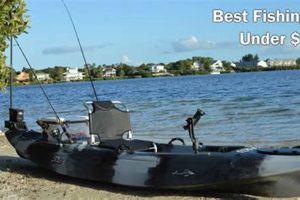
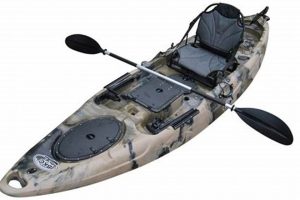
A high-quality fishing rod designed for kayak angling offers a blend of specialized features. These features typically include a shorter length for easier maneuverability in the confined space of a kayak, a robust construction to handle larger fish species, and sensitivity for detecting subtle bites in various water conditions. An example would be a seven-foot medium-heavy power rod with a fast action tip, ideal for targeting species like bass or walleye from a kayak.
Selecting an appropriate rod dramatically enhances angling success and overall enjoyment on the water. A shorter, well-balanced rod improves casting accuracy and control, crucial when fishing from a moving platform. The correct rod and reel combination also minimizes fatigue during long fishing trips and allows for effective fish fighting in close quarters. Historically, kayak anglers adapted existing fishing equipment, but the increasing popularity of the sport has driven the development of specialized rods designed specifically for kayak fishing, leading to significant improvements in performance and user experience.
This article will further explore the key factors to consider when selecting a fishing rod for kayak angling, including rod length, power, action, materials, and recommended models for various target species and fishing styles.
Tips for Selecting a Kayak Fishing Rod
Choosing the right fishing rod significantly impacts kayak angling success. Consider these essential tips to ensure optimal performance and enjoyment on the water.
Tip 1: Prioritize Rod Length. Shorter rods, typically between six and seven-and-a-half feet, are recommended for kayak fishing. This length provides greater control and maneuverability within the limited space of a kayak. Longer rods can be cumbersome and difficult to manage effectively.
Tip 2: Match Rod Power to Target Species. Rod power refers to the rod’s lifting strength. Lighter power rods are suitable for smaller fish like panfish and trout, while heavier power rods are necessary for larger species such as bass, pike, or saltwater fish. Selecting the appropriate power ensures effective hooksets and control during the fight.
Tip 3: Consider Rod Action. Rod action describes how much the rod bends. Fast action rods bend primarily at the tip, offering greater sensitivity and casting accuracy. Moderate action rods bend further down the blank, providing more casting distance and a forgiving feel. Slow action rods bend throughout their length, offering excellent shock absorption for fighting larger fish.
Tip 4: Evaluate Rod Material. Graphite rods are lightweight, sensitive, and offer excellent casting performance. Fiberglass rods are more durable and affordable but generally heavier. Composite rods combine graphite and fiberglass to balance performance and durability.
Tip 5: Factor in Reel Compatibility. Ensure the chosen rod is compatible with the intended fishing reel type and line weight. Balance is crucial for comfortable and efficient casting and retrieving.
Tip 6: Consider Two-Piece Rods for Transport. Two-piece rods offer greater portability and convenience for transporting and storing, making them ideal for kayak anglers.
Tip 7: Research Rod Guides. Quality guides, such as stainless steel or ceramic, minimize friction and improve line flow, contributing to longer casts and smoother retrieves.
By carefully considering these factors, anglers can select a rod that enhances their kayak fishing experience, improving casting accuracy, fish-fighting capabilities, and overall enjoyment on the water.
The next section will discuss specific rod recommendations for various kayak fishing applications and target species.
1. Length

Rod length significantly influences kayak angling effectiveness. Shorter rods, generally between six and seven-and-a-half feet, are preferred for kayak fishing due to the confined space and the need for increased maneuverability. Longer rods, while advantageous for casting distance in open areas, become cumbersome and difficult to manage within the close quarters of a kayak. A shorter rod facilitates more accurate casts around overhanging branches or other obstacles commonly encountered in kayak fishing environments. For example, a seven-foot rod provides ample casting distance for most kayak fishing scenarios while maintaining optimal control for precise presentations and effective hooksets. Conversely, a nine-foot rod, while excellent for surfcasting, would be impractical and unwieldy from a kayak.
The relationship between rod length and kayak dimensions is crucial. Kayak width and cockpit size restrict casting movements. A shorter rod allows for a full casting arc without interference from the kayak’s gunwales or other gear. This becomes particularly relevant when fighting a fish close to the kayak, where a longer rod would be challenging to control. Consider a kayak angler targeting bass in a narrow creek. A shorter rod enables precise casts beneath overhanging vegetation, while a longer rod would likely become entangled. Furthermore, shorter rods facilitate vertical jigging or dropping baits directly beneath the kayak, techniques frequently employed in kayak fishing.
Optimizing rod length for kayak fishing enhances casting accuracy, fish-fighting control, and overall angler comfort. The reduced length minimizes fatigue during long fishing days and allows for quicker reactions to fish strikes. While personal preference plays a role, understanding the impact of rod length on kayak angling performance is essential for maximizing success and enjoyment on the water. Careful selection of rod length, tailored to the specific kayak and fishing style, is a critical component of effective kayak angling equipment.
2. Power
Rod power, a critical factor in selecting a kayak fishing rod, refers to its lifting strength and ability to handle fish of varying sizes and fighting strengths. This characteristic directly influences an angler’s ability to effectively hook, control, and land a fish, particularly within the confined environment of a kayak. Matching rod power to the target species is essential for optimizing performance and preventing break-offs or lost fish. For instance, a light power rod, ideal for panfish or trout, would be inadequate for handling a powerful saltwater fish like a redfish or snook. Conversely, using a heavy power rod designed for larger species to target small crappie would result in a lack of sensitivity and diminished fighting enjoyment.
The relationship between rod power and fishing line strength is also crucial. A rod’s power rating should align with the line weight used to avoid either overloading the rod, leading to breakage, or underutilizing its capabilities. For example, a medium-heavy power rod typically pairs well with 10-20 pound test line, a suitable range for targeting species like bass or walleye. Using a lighter line with a heavy power rod risks snapping the line during a hookset or fight, while using a heavier line on a light power rod could overload and damage the rod. Furthermore, kayak anglers often encounter stronger currents and heavier cover than shore-based anglers, necessitating a rod with sufficient power to effectively manage these conditions.
Selecting the appropriate rod power contributes significantly to a successful and enjoyable kayak fishing experience. Careful consideration of target species, fishing line strength, and potential fishing conditions ensures the chosen rod possesses the necessary power to handle the challenges of kayak angling. This understanding allows anglers to confidently hook, fight, and land fish while minimizing the risk of equipment failure and maximizing the thrill of the catch. Ultimately, selecting a rod with appropriate power, alongside other key factors such as length, action, and material, forms the foundation for a well-optimized kayak fishing setup.
3. Action
Rod action, a critical element in selecting the optimal fishing rod for kayak angling, describes the rod’s bending characteristics and how it responds to pressure. This factor significantly influences casting distance, accuracy, lure presentation, and hook-setting power. Understanding the nuances of rod action is crucial for selecting a rod that complements specific fishing techniques and target species within the dynamic environment of kayak fishing.
- Fast Action
Fast action rods bend primarily in the top third of the blank. This characteristic provides greater sensitivity, allowing anglers to detect subtle bites and maintain precise control over lure presentations. Fast action rods excel in situations requiring accurate casts and quick hooksets, such as targeting bass in heavy cover or presenting finesse baits for wary fish. The rapid recovery rate of the tip also aids in generating powerful hooksets, particularly advantageous when fishing from a moving kayak.
- Moderate Action
Moderate action rods bend in the top half of the blank, offering a balance between sensitivity and casting distance. This action provides a more forgiving feel, absorbing shock and reducing the risk of pulling the hook during the fight. Moderate action rods are versatile choices for various kayak fishing applications, suitable for targeting a range of species from smaller panfish to medium-sized predators. The moderate bend also assists in casting lighter lures or baits greater distances, a benefit when covering larger areas of water from a kayak.
- Slow Action
Slow action rods bend throughout most of their length, providing maximum shock absorption and a parabolic bend during the fight. This action excels in absorbing the powerful runs of larger fish, minimizing the risk of line breakage or hook pulls. Slow action rods are often preferred for targeting larger freshwater species like pike or muskie, as well as saltwater gamefish. The deep bend also aids in casting heavier lures and baits, crucial when fishing in windy conditions or strong currents from a kayak.
- Extra-Fast Action
Extra-fast action rods, sometimes referred to as ultra-fast, exhibit an even more pronounced tip flex than fast action rods. This characteristic allows for exceptionally quick hooksets and precise lure control, ideal for techniques requiring pinpoint accuracy and immediate reaction to strikes. While offering exceptional sensitivity, extra-fast action rods may sacrifice some casting distance compared to moderate or slow action rods. This action proves particularly advantageous in kayak fishing scenarios requiring rapid hooksets in close quarters, such as flipping or pitching jigs in heavy cover. The responsive tip allows for immediate detection of subtle takes and facilitates powerful, efficient hooksets.
Selecting the appropriate rod action significantly influences kayak angling success. Careful consideration of target species, fishing techniques, and the surrounding environment ensures the chosen rod complements individual fishing styles and maximizes performance on the water. By understanding the nuances of each action type and its impact on lure presentation, hooksets, and fish-fighting capabilities, kayak anglers can refine their equipment choices and enhance their overall fishing experience.
4. Material

Rod material significantly influences the performance, durability, and overall feel of a kayak fishing rod. The choice of material directly impacts sensitivity, weight, strength, and resistance to corrosion, factors crucial for successful kayak angling. Understanding the properties of different rod materials allows anglers to select the optimal rod for their specific needs and fishing style.
- Graphite
Graphite, a popular material for kayak fishing rods, offers a combination of lightweight sensitivity and excellent casting performance. Its inherent stiffness transmits even the slightest vibrations from the line to the angler’s hand, allowing for detection of subtle bites and improved lure control. The lighter weight of graphite reduces fatigue during long fishing days, a significant advantage in kayak angling. Higher-modulus graphite increases sensitivity and responsiveness but often comes at a higher price point. However, graphite rods can be more susceptible to breakage if mishandled or subjected to high-impact stresses, a factor to consider in the demanding environment of kayak fishing.
- Fiberglass
Fiberglass rods are known for their durability and affordability. They offer excellent strength and resistance to impact, making them well-suited for targeting larger, more powerful fish. Fiberglass is also more forgiving than graphite, absorbing shock and reducing the risk of line breakage during a fight. While generally heavier than graphite, advancements in fiberglass technology have led to lighter and more sensitive fiberglass rods. However, fiberglass rods typically lack the sensitivity and crisp action of graphite, potentially hindering performance in finesse fishing applications.
- Composite
Composite rods combine the benefits of both graphite and fiberglass, offering a balance of sensitivity, durability, and affordability. These rods often blend different modulus graphite with fiberglass to achieve specific performance characteristics. The combination allows manufacturers to tailor rod performance for specific fishing techniques and target species. For example, a composite rod might incorporate a higher modulus graphite tip for sensitivity and a fiberglass butt section for increased power and durability, a combination well-suited for kayak anglers targeting larger fish in heavier cover.
- Other Materials
Other materials, such as boron or Kevlar, are sometimes incorporated into rod construction to enhance specific performance characteristics. Boron, for example, adds strength and stiffness without significantly increasing weight, while Kevlar enhances impact resistance. These materials are often used in combination with graphite or fiberglass to create specialized rods designed for specific fishing applications. However, rods incorporating these advanced materials typically come at a premium price point.
The choice of rod material significantly impacts kayak fishing performance. Careful consideration of target species, fishing style, and budget allows anglers to select a rod material that optimizes sensitivity, durability, and overall fishing experience. While graphite offers sensitivity and lightweight performance, fiberglass prioritizes durability and affordability, and composite blends seek a balance between the two. Ultimately, understanding the advantages and disadvantages of each material empowers kayak anglers to make informed decisions and select the optimal rod for their individual needs and preferences.
5. Portability

Portability represents a critical factor in selecting a kayak fishing rod. Kayak anglers frequently transport their equipment over various terrains, often requiring compact and easily manageable gear. Rod portability directly influences ease of transport, storage, and overall kayak maneuverability. A cumbersome, unwieldy rod complicates movement and potentially compromises safety when navigating challenging environments. For example, a multi-piece rod breaks down into smaller sections, simplifying transport and storage within a kayak’s limited space, unlike a one-piece rod that demands more careful handling. This consideration becomes particularly relevant when traversing rugged shorelines, dense vegetation, or when securing the kayak onto a vehicle.
The impact of rod portability extends beyond transport and storage. Within the confined cockpit of a kayak, a shorter, more manageable rod significantly enhances angler maneuverability and casting efficiency. A longer, less portable rod restricts casting arcs and increases the risk of entanglement with surrounding gear or obstacles. Consider an angler navigating a narrow, mangrove-lined creek. A portable, easily stowed rod allows for quick adjustments and efficient casting in tight spaces, maximizing fishing opportunities and minimizing frustration. Conversely, a lengthy, unwieldy rod hinders movement and restricts access to prime fishing spots, ultimately diminishing angling success.
Prioritizing portability in rod selection contributes significantly to a streamlined and efficient kayak fishing experience. The ability to easily transport, store, and maneuver a fishing rod within the confines of a kayak enhances angler safety, maximizes fishing opportunities, and contributes to overall enjoyment on the water. Selecting a rod designed with portability in mind, such as a telescopic or multi-piece model, proves a worthwhile investment for any serious kayak angler. This thoughtful consideration allows for seamless transitions between locations and ensures the angler remains focused on the primary objective: pursuing fish from a kayak.
6. Durability
Durability stands as a paramount attribute in a kayak fishing rod, given the demanding conditions inherent in the sport. Kayak angling often involves navigating challenging environments, from rocky shorelines to dense vegetation, exposing equipment to potential impacts, abrasion, and exposure to the elements. A durable rod ensures consistent performance over time, minimizing the risk of breakage or failure during critical moments, thus maximizing the longevity of the investment. This characteristic directly influences the rod’s ability to withstand the rigors of kayak fishing, contributing to a reliable and enjoyable experience on the water.
- Material Strength
The inherent strength of the rod material dictates its ability to resist breakage under stress. High-quality materials, such as high-modulus graphite or robust fiberglass composites, exhibit superior resistance to impacts and bending forces encountered during fish fights or accidental collisions. For instance, a rod constructed with a high-strength composite material withstands the strain of battling a powerful fish in strong currents more effectively than a rod made with a lower-grade material. This material strength translates to fewer breakages, reduced repair costs, and prolonged rod lifespan, crucial for kayak anglers who frequently subject their equipment to demanding conditions.
- Guide Durability
Rod guides play a vital role in line management and casting performance. Durable guides, constructed from materials like stainless steel or ceramic, resist corrosion and wear from braided fishing lines. High-quality guides maintain smooth line flow, minimizing friction and preventing premature line wear. For example, stainless steel guides with corrosion-resistant coatings withstand the harsh saltwater environment, ensuring consistent performance over extended periods. Investing in rods with durable guides minimizes line damage and maintains optimal casting efficiency, essential for kayak anglers who frequently encounter abrasive conditions and rely on smooth line flow for successful fishing.
- Handle Construction
A durable handle provides a secure and comfortable grip, crucial for maintaining control during casting and fighting fish. High-quality cork or EVA foam handles resist wear and tear, providing a consistent grip even when wet or exposed to prolonged sunlight. For instance, a well-constructed cork handle, treated with a sealant, resists cracking and deterioration from repeated exposure to saltwater and UV radiation, maintaining its integrity and providing a comfortable grip throughout numerous fishing trips. A durable handle enhances angler comfort and control, contributing to a more enjoyable and productive kayak fishing experience.
- Overall Rod Construction
The overall construction of the rod, including the blank’s reinforcement, joint connections in multi-piece rods, and the quality of the bonding agents, significantly influences its long-term durability. Reinforced ferrules and robust bonding techniques enhance the rod’s ability to withstand stress and prevent separation during casting or fish fighting. For example, a well-constructed multi-piece rod with reinforced ferrules and high-quality bonding agents maintains its structural integrity even after repeated assembly and disassembly, ensuring consistent performance and minimizing the risk of failure at critical stress points. Careful attention to these construction details ensures a durable and reliable rod capable of withstanding the demands of kayak fishing.
Investing in a durable kayak fishing rod ultimately contributes to a more rewarding and cost-effective angling experience. A rod built to withstand the rigors of kayak fishing minimizes downtime due to repairs or replacements, allowing anglers to focus on enjoying their time on the water. Prioritizing durability ensures the rod remains a reliable tool, capable of handling the challenges of kayak angling and contributing to successful fishing trips for years to come. By understanding the factors that contribute to rod durability, anglers can make informed decisions and select equipment that aligns with their needs and budget, ultimately maximizing their investment and enhancing their overall kayak fishing experience.
7. Sensitivity
Sensitivity in a kayak fishing rod refers to its ability to transmit vibrations and feedback from the fishing line to the angler’s hand. This characteristic plays a crucial role in detecting subtle bites, feeling the nuances of the underwater environment, and maintaining optimal lure control. A highly sensitive rod allows anglers to perceive slight changes in line tension, indicating a fish’s interest in the lure, even in challenging conditions such as strong currents or deep water. This heightened awareness significantly enhances angling success, particularly when targeting wary fish or employing finesse fishing techniques from a kayak, where subtle presentations are often critical.
- Blank Material and Construction
The rod blank’s material and construction significantly influence its sensitivity. High-modulus graphite, known for its stiffness and lightweight properties, excels in transmitting vibrations. Rods constructed with higher-modulus graphite generally exhibit greater sensitivity than those made with lower-modulus graphite or fiberglass. Furthermore, blank construction techniques, such as the use of thinner wall thicknesses and specialized resins, can further enhance sensitivity by reducing weight and maximizing vibrational transfer. For example, a rod crafted from high-modulus graphite with a thin-wall construction transmits the subtle tap of a light-biting fish more effectively than a thicker-walled fiberglass rod, providing the angler with a critical advantage in detecting and reacting to these often-missed strikes.
- Rod Action and Length
Rod action and length also contribute to overall sensitivity. Fast action rods, which bend primarily in the tip section, offer enhanced sensitivity compared to slower action rods. The concentrated flex in the tip amplifies vibrations, making them more perceptible to the angler. Shorter rod lengths generally enhance sensitivity further due to the reduced overall weight and increased directness of force transmission from the line to the hand. For instance, a seven-foot, fast-action rod provides greater sensitivity than a nine-foot, moderate-action rod, allowing for more precise lure control and detection of subtle bites in close-quarters kayak fishing scenarios.
- Guide Type and Placement
Guide type and placement influence line management and sensitivity. Lightweight, low-friction guides, such as those constructed from titanium or ceramic, minimize resistance and allow for smoother line movement, enhancing the transmission of vibrations from the line to the blank. Strategic guide placement further optimizes line flow and reduces vibrational dampening, maximizing sensitivity. For example, a rod equipped with micro-guides placed in a strategic configuration enhances sensitivity and casting distance compared to a rod with larger, more widely spaced guides, allowing the angler to feel even the slightest nuances in line tension and lure action.
- Handle Material and Design
Handle material and design contribute to the angler’s ability to perceive vibrations transmitted through the rod blank. High-density EVA foam or premium cork handles transmit vibrations effectively while providing a comfortable and secure grip. Handle design, including length and shape, also influences how vibrations are perceived by the angler. A well-designed handle maximizes contact with the blank, facilitating the transfer of subtle vibrations to the angler’s hand. For instance, a rod featuring a high-density EVA handle with a contoured design allows the angler to maintain a firm grip and effectively perceive subtle vibrations transmitted through the blank, enhancing sensitivity and bite detection.
Sensitivity plays a pivotal role in successful kayak fishing. A sensitive rod empowers anglers to detect faint bites, maintain precise lure control, and gain a deeper understanding of the underwater environment. By carefully considering factors such as blank material, rod action, guide configuration, and handle design, kayak anglers can select a rod that maximizes sensitivity and enhances their ability to connect with fish, ultimately contributing to a more rewarding and productive fishing experience.
Frequently Asked Questions
This section addresses common inquiries regarding the selection and use of fishing rods designed for kayak angling.
Question 1: What rod length is optimal for kayak fishing?
Rods between six and seven-and-a-half feet are generally recommended for kayak fishing. This length balances maneuverability within the confined space of a kayak with adequate casting distance.
Question 2: How does rod power influence kayak fishing?
Rod power dictates the rod’s lifting strength. Selecting a power appropriate for the target species ensures effective hooksets and fish-fighting control. Lighter power rods suit smaller fish, while heavier power rods handle larger species.
Question 3: Which rod action is most versatile for kayak angling?
Moderate action rods offer versatility for kayak fishing. They provide a balance between sensitivity for detecting bites and casting distance for covering water effectively. Fast action rods excel in accuracy, while slow action rods offer superior shock absorption for larger fish.
Question 4: What are the advantages of two-piece fishing rods for kayak use?
Two-piece rods offer enhanced portability for kayak anglers. Their ability to break down into smaller sections simplifies transport and storage within a kayak’s limited space.
Question 5: Does rod material affect sensitivity when kayak fishing?
Rod material significantly influences sensitivity. Graphite rods offer excellent sensitivity, transmitting subtle bites effectively. Fiberglass rods prioritize durability, while composite rods blend both attributes.
Question 6: How does guide quality impact kayak fishing rod performance?
High-quality guides, constructed from materials like stainless steel or ceramic, minimize friction and line wear. This enhances casting distance, improves line management, and contributes to a smoother overall fishing experience, particularly important with braided lines.
Careful consideration of these frequently asked questions empowers anglers to make informed decisions when selecting a kayak fishing rod optimized for their individual needs and target species.
The following section will delve into specific rod recommendations tailored to various kayak fishing applications.
Conclusion
Optimal fishing rod selection for kayak angling necessitates careful consideration of several interconnected factors. Rod length, power, action, material, portability, durability, and sensitivity all contribute significantly to on-the-water performance. Balancing these attributes, tailored to specific fishing styles and target species, ensures a harmonious blend of functionality and enjoyment. Shorter rods enhance maneuverability, while appropriate power matches target species and fishing conditions. Rod action influences casting performance and fish-fighting dynamics, while material selection dictates sensitivity, durability, and weight. Prioritizing portability simplifies transport and storage, crucial for kayak anglers. Durable construction withstands the rigors of the sport, ensuring longevity, and heightened sensitivity allows for the detection of subtle bites, maximizing angling success.
Ultimately, informed rod selection empowers anglers to navigate the diverse challenges and opportunities inherent in kayak fishing. A well-chosen rod becomes an extension of the angler’s skill, enhancing precision, control, and connection with the underwater world. This deliberate approach to equipment selection elevates the kayak fishing experience, fostering deeper appreciation for the sport and a greater likelihood of success on the water. The pursuit of the ideal kayak fishing rod represents an ongoing journey, shaped by individual preferences and evolving techniques, driving innovation and enhancing the connection between angler and environment.