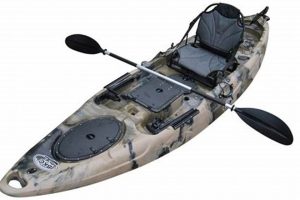
Acquiring a kayak designed for fishing at a competitive price point involves considering various factors, including the vessel’s features, construction materials, and retailer promotions. For example, a high-quality fishing kayak offered at a discounted price due to a seasonal sale or clearance event represents an advantageous purchase. Understanding the market and available options is crucial for making informed decisions.
Securing an optimal price on a suitable watercraft allows anglers to allocate more resources towards other essential equipment, such as rods, reels, and tackle. Historically, fishing kayaks were expensive, specialized items, but increased market competition and manufacturing advancements have made them more accessible to a wider range of consumers. This affordability has expanded recreational fishing opportunities significantly.
The following sections will delve into specific strategies for identifying high-value fishing kayaks, exploring reputable retailers, understanding pricing fluctuations, and recognizing key features that contribute to both performance and long-term value.
Tips for Finding Exceptional Deals on Fishing Kayaks
Locating a quality fishing kayak at a competitive price requires strategic planning and informed decision-making. The following tips offer guidance for navigating the market effectively.
Tip 1: Compare Prices Across Multiple Retailers: Researching prices from various online and brick-and-mortar stores provides a comprehensive overview of available options and helps identify the most competitive offers. Utilizing price comparison websites can streamline this process.
Tip 2: Consider Off-Season Purchases: Retailers often offer significant discounts on kayaks during the off-season (typically fall and winter). Purchasing during these periods can yield substantial savings.
Tip 3: Explore Used Kayak Options: Reputable marketplaces for used sporting goods can offer well-maintained kayaks at significantly reduced prices. Thoroughly inspect any used kayak before purchase.
Tip 4: Sign Up for Retailer Newsletters: Subscribing to email lists from kayak retailers provides access to exclusive sales, promotions, and discount codes.
Tip 5: Factor in Shipping Costs and Additional Accessories: The total cost of a kayak should include shipping fees, taxes, and any necessary accessories like paddles, life vests, or rod holders.
Tip 6: Research Kayak Features and Specifications: Understanding the desired features, such as weight capacity, stability, and storage options, ensures a suitable purchase. Researching specific models helps narrow down options and prioritize value.
Tip 7: Look for Package Deals: Some retailers offer package deals that bundle kayaks with essential accessories at a discounted price. These packages can offer significant value.
Tip 8: Don’t Compromise on Quality: While price is a crucial factor, prioritize quality construction and materials to ensure durability and long-term performance.
By following these guidelines, consumers can effectively navigate the market and secure a high-quality fishing kayak at a price that aligns with their budget. Careful consideration of these factors contributes to informed purchasing decisions and long-term satisfaction.
These strategies empower consumers to find not just a good deal, but the optimal balance of quality and affordability. The next section will provide concluding thoughts and summarize key takeaways for maximizing value in fishing kayak purchases.
1. Research

Thorough research forms the foundation of securing advantageous pricing on fishing kayaks. Informed purchasing decisions rely on a comprehensive understanding of market dynamics, product specifications, and retailer pricing strategies. Research empowers consumers to identify optimal opportunities and avoid costly mistakes.
- Kayak Types and Features
Understanding the diverse range of fishing kayaks available is crucial. Researching hull designs (sit-on-top, sit-inside), length, width, weight capacity, and specialized features like rod holders, storage compartments, and rudder systems enables consumers to select a kayak that aligns with individual fishing styles and needs. For instance, anglers fishing in calm lakes prioritize stability, while those navigating rivers require maneuverability. This knowledge allows for targeted searches and prevents purchasing an unsuitable craft, regardless of price.
- Retailer Comparison
Exploring various retailers, both online and brick-and-mortar, reveals pricing disparities and promotional offers. Comparing prices, shipping costs, warranty policies, and customer reviews provides insights into overall value. Specialized kayak retailers might offer expert advice and bundled deals, while larger online marketplaces may present competitive pricing. Researching retailer reputations helps ensure a positive purchasing experience.
- Pricing Trends and Seasonality
Kayak prices often fluctuate based on seasonal demand and manufacturer promotions. Researching historical pricing trends and understanding seasonality allows for strategic purchase timing. Acquiring a kayak during the off-season, when demand is lower, often yields substantial discounts. Monitoring clearance sales and special promotions also contributes to securing advantageous pricing.
- Used Kayak Market
Exploring the used kayak market offers opportunities for substantial cost savings. Researching online classifieds, auction sites, and local consignment shops can uncover well-maintained kayaks at significantly reduced prices. However, diligent research into the specific model’s history, condition, and any potential repairs is essential to mitigate risks associated with purchasing used equipment. Understanding fair market value for used kayaks prevents overpaying.
These facets of research converge to empower informed decision-making in the pursuit of high-value fishing kayaks. Investing time in research ultimately saves money and ensures a satisfying purchase aligned with individual angling needs and budgetary constraints. A well-researched purchase decision leads to long-term satisfaction and enhanced on-the-water experiences.
2. Comparison Shopping

Comparison shopping forms a cornerstone of securing optimal value in fishing kayak acquisition. The process directly correlates with finding the best deals, as it allows consumers to evaluate multiple offers concurrently, considering not only price but also features, retailer reputation, and shipping costs. This informed approach mitigates the risk of impulse purchases and ensures that budgetary allocations align with both needs and available market options.
For example, a consumer seeking a specific fishing kayak model with integrated rod holders and a rudder system might find varying prices and package deals across different retailers. One retailer may offer a lower base price, but charge exorbitant shipping fees, while another might include essential accessories like a paddle and life vest in a competitively priced bundle. Thorough comparison shopping reveals these nuances, empowering consumers to make informed decisions based on overall value rather than solely on the initial price tag. Furthermore, comparison shopping extends beyond pricing to encompass retailer reputation, warranty terms, and customer reviews, contributing to a holistic understanding of the purchase landscape. Consider a scenario where two retailers offer the same kayak model at identical prices. Comparison shopping could reveal that one retailer has consistently poor customer service reviews and a restrictive return policy, while the other boasts excellent customer support and flexible returns. This information proves invaluable in making a purchase decision aligned with long-term satisfaction.
Failing to compare options can lead to overspending or acquiring a kayak that inadequately meets individual needs. The interconnected nature of features, pricing, and retailer policies necessitates a comprehensive evaluation process. Comparison shopping empowers informed decision-making, ensuring that the final purchase represents the optimal balance of quality, features, and price, ultimately contributing to a satisfying and value-driven acquisition experience.
3. Timing
Timing plays a crucial role in securing advantageous pricing on fishing kayaks. Purchase timing significantly influences the availability of discounts, clearance sales, and promotional offers. Strategic timing aligns purchasing decisions with periods of lower demand or specific retailer promotions, maximizing potential cost savings. For instance, purchasing a fishing kayak during the off-season, typically fall and winter, often yields substantial discounts as retailers clear out inventory to make way for newer models. Conversely, purchasing during peak season, spring and summer, often results in higher prices due to increased demand. Recognizing these seasonal fluctuations allows for informed purchase timing and optimized budgetary allocation.
Beyond seasonal considerations, specific sales events, such as holiday promotions, clearance events, and manufacturer rebates, present opportunities for substantial savings. Monitoring retailer websites and subscribing to email newsletters provides advance notice of these time-sensitive opportunities. Furthermore, understanding product life cycles within the fishing kayak market allows for anticipating potential price reductions. For example, when a newer model of a popular fishing kayak is released, retailers often discount older models to clear inventory. Awareness of these product cycles empowers informed consumers to capitalize on price reductions. Conversely, delaying a purchase in anticipation of future price drops carries the risk of limited availability or discontinued models.
Effectively leveraging timing requires proactive monitoring of market trends and retailer promotions. Balancing immediate needs with the potential for future price reductions presents a strategic decision-making challenge. However, understanding the influence of timing on pricing dynamics empowers consumers to navigate the market effectively and secure optimal value in fishing kayak purchases. This strategic approach contributes significantly to maximizing budgetary efficiency and obtaining desired equipment at the most competitive price points.
4. Condition
Kayak condition directly influences value and consequently, the potential for securing a “best deal.” A pristine, unused kayak commands a higher price than a used kayak exhibiting wear and tear. Discerning the relationship between condition and price is crucial for maximizing value. For example, a minor scratch on a new kayak might lead to a discounted price, representing a potential bargain for a buyer unconcerned with cosmetic imperfections. Conversely, significant damage, such as a cracked hull or faulty rudder system, necessitates careful evaluation of repair costs and potential long-term performance issues, even if offered at a heavily reduced price. A used kayak with normal wear, like minor scuffs and fading, may offer substantial savings while remaining fully functional, presenting a strong value proposition for budget-conscious buyers. Understanding the spectrum of condition and its corresponding impact on pricing empowers informed purchase decisions.
Evaluating kayak condition requires meticulous inspection. Examining the hull for cracks, dents, or deep scratches is crucial. Assessing the integrity of seating systems, hatches, and hardware ensures functionality and longevity. For inflatable kayaks, checking for leaks and seam integrity is paramount. Scrutinizing the condition of included accessories, like paddles and life vests, contributes to a comprehensive evaluation of overall value. Furthermore, researching the specific model’s known weaknesses or common points of failure informs the inspection process, allowing for targeted assessments. For instance, if a particular model is known for rudder cable issues, careful inspection of the rudder system becomes a priority. Thorough evaluation of condition safeguards against unforeseen repair costs and ensures that the purchased kayak aligns with expectations and intended usage.
Condition assessment serves as a critical component of informed purchasing decisions. Balancing desired features, budget constraints, and acceptable condition levels empowers consumers to identify genuine “best deals.” Recognizing that price and condition exist in dynamic interplay allows for strategic decision-making. A lower price for a kayak in less-than-perfect condition might represent a worthwhile investment for a buyer willing to undertake minor repairs. Conversely, prioritizing pristine condition justifies a higher price point for buyers seeking a turnkey experience. Understanding this relationship optimizes resource allocation and ultimately contributes to a satisfying and value-driven purchase experience.
5. Features
The correlation between features and securing advantageous pricing on fishing kayaks presents a complex interplay. While a feature-rich kayak may appear more expensive initially, it can represent a superior value proposition in the long run. Evaluating features in the context of overall cost and intended usage is crucial for discerning genuine “best deals.” For example, a kayak equipped with integrated rod holders, adjustable seating, and a built-in rudder system might command a higher price than a basic model. However, these features enhance fishing functionality and comfort, potentially eliminating the need for costly aftermarket accessories. This integrated approach can ultimately result in long-term cost savings and a more streamlined fishing experience. Conversely, a budget-conscious angler focusing on stillwater fishing might find a basic model without premium features perfectly adequate, thus representing a better value proposition given their specific needs.
Prioritizing essential features necessitates careful consideration of individual fishing styles and preferences. An angler targeting specific species or fishing techniques benefits from features tailored to those pursuits. For instance, a kayak angler targeting large game fish benefits from a stable platform with ample storage for tackle and equipment, potentially justifying a higher initial investment in a feature-rich model. Conversely, an angler prioritizing portability and ease of transport might prioritize lightweight construction and compact design over extensive features, potentially securing a “best deal” on a smaller, simpler kayak that aligns perfectly with their individual needs. Understanding the interplay between features, personal requirements, and budget constraints empowers consumers to make informed purchasing decisions.
Discerning between essential features and superfluous additions prevents overspending on unnecessary complexities. A feature-rich kayak loaded with rarely used gadgets might appear appealing but ultimately represents a poor value proposition if those features do not contribute directly to the angler’s on-the-water experience. Focusing on core functionality and essential features ensures that budgetary allocations align with practical utility and maximize long-term satisfaction. Effectively evaluating features in the context of intended usage and overall cost is essential for navigating the market and securing a fishing kayak that represents both a “best deal” and a valuable asset for years to come.
6. Budget

Budgetary constraints significantly influence the pursuit of advantageous pricing on fishing kayaks. A predefined budget serves as a crucial parameter, guiding purchasing decisions and ensuring that expenditures align with available resources. Establishing a realistic budget requires careful consideration of not only the kayak’s price but also associated costs such as paddles, life vests, safety equipment, transportation, and potential upgrades or modifications. For example, a budget of $500 might necessitate exploring used kayaks or entry-level models, while a budget of $1500 expands options to include higher-end kayaks with advanced features. Clearly defined budgetary limits prevent overspending and facilitate focused searches for kayaks within the designated price range. Furthermore, a well-defined budget empowers consumers to negotiate effectively with retailers or explore alternative purchasing avenues like online marketplaces or consignment shops.
Balancing desired features with budgetary limitations often requires strategic compromise. A limited budget may necessitate prioritizing essential features over premium options. For instance, an angler operating within a tight budget might opt for a kayak with fewer integrated features but prioritize stability and durability, accepting the potential need for aftermarket accessory purchases down the line. Conversely, a larger budget allows for greater flexibility in selecting kayaks equipped with advanced features like integrated fish finders, GPS systems, and specialized storage compartments. Recognizing the trade-offs between features and cost within the context of a predefined budget empowers informed decision-making. Furthermore, budgetary considerations extend beyond initial purchase price to encompass long-term maintenance and storage costs. Factoring these ongoing expenses into the overall budget ensures sustainable ownership and avoids unexpected financial burdens.
Effective budgeting empowers consumers to navigate the diverse landscape of fishing kayak options and identify genuine “best deals” within their financial constraints. A well-defined budget serves as a compass, guiding purchasing decisions and maximizing value. Understanding the relationship between budget, desired features, and long-term ownership costs is essential for securing a fishing kayak that aligns with both financial resources and angling aspirations. This informed approach ensures a satisfying purchase experience and facilitates years of enjoyable on-the-water adventures.
Frequently Asked Questions (FAQ)
This section addresses common inquiries regarding the acquisition of fishing kayaks at competitive price points. Understanding these frequently raised concerns facilitates informed purchasing decisions and clarifies potential misconceptions.
Question 1: What constitutes a “best deal” on a fishing kayak?
A “best deal” encompasses not only price but also the kayak’s features, condition, and retailer reputation. A competitively priced kayak lacking essential features or exhibiting significant wear might not represent optimal value. A true “best deal” balances cost with quality, condition, and desired features.
Question 2: When is the optimal time to purchase a fishing kayak for maximum savings?
Typically, the off-season (fall and winter) presents the best opportunities for discounts and clearance sales. Retailers often reduce prices to clear out inventory and make way for newer models. Monitoring retailer websites and subscribing to email newsletters provide alerts regarding sales events.
Question 3: Are used fishing kayaks a viable option for budget-conscious buyers?
Used kayaks offer significant cost savings. However, thorough inspection is crucial to assess condition and identify potential repairs. Reputable used sporting goods marketplaces and online classifieds offer avenues for exploring used kayak options.
Question 4: How does one differentiate between essential features and unnecessary additions?
Essential features directly contribute to the angler’s on-the-water experience. Focusing on core functionality, like stability, maneuverability, and storage capacity, ensures that budgetary allocations align with practical utility. Unnecessary additions increase cost without enhancing performance or enjoyment.
Question 5: What are the potential pitfalls of solely focusing on the lowest price?
Focusing solely on the lowest price can lead to compromising on quality, durability, or essential features. A significantly discounted kayak might require extensive repairs or lack necessary features, resulting in higher long-term costs and reduced satisfaction. Balancing price with quality ensures a worthwhile investment.
Question 6: How can one research the reputation of a kayak retailer?
Online customer reviews, ratings from consumer advocacy groups, and feedback from local angling communities offer insights into retailer reputation. Understanding retailer policies regarding returns, warranties, and customer service helps ensure a positive purchasing experience.
Careful consideration of these frequently asked questions clarifies common concerns and empowers informed purchasing decisions. Strategic planning and thorough research contribute significantly to securing the best deals on fishing kayaks.
The following section will offer concluding remarks and summarize key takeaways for maximizing value in fishing kayak acquisitions.
Conclusion
Acquiring a fishing kayak at an optimal price point requires a multifaceted approach. Diligent research, encompassing product specifications, retailer comparisons, and market dynamics, forms the foundation of informed purchasing decisions. Strategic timing, aligned with seasonal sales and promotional events, maximizes cost savings. Thorough condition assessments, particularly for used kayaks, mitigate potential risks. Prioritizing essential features ensures that budgetary allocations align with on-the-water needs. A well-defined budget serves as a guiding parameter, preventing overspending and facilitating focused searches. These elements converge to empower informed consumers and maximize value in fishing kayak acquisitions.
The pursuit of advantageous pricing necessitates a balanced perspective, weighing cost against quality, features, and long-term ownership considerations. Informed decision-making ensures not merely a low price, but genuine value and enduring satisfaction. Strategic planning and a comprehensive understanding of market dynamics empower anglers to secure fishing kayaks that enhance on-the-water experiences for years to come.