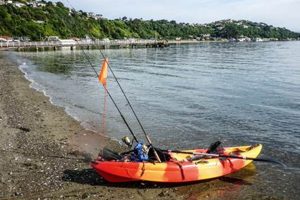
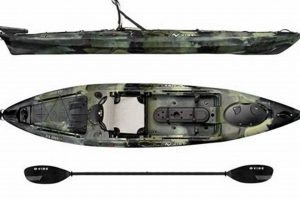
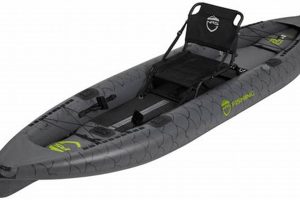
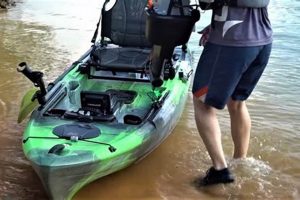
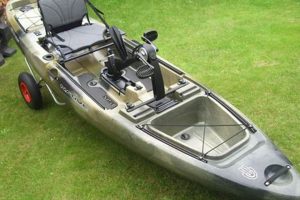
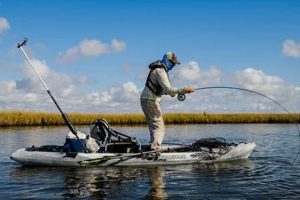
This sit-on-top vessel, a specific model within a popular line, is designed for angling in marine environments. It typically features specialized components such as rod holders, storage compartments for tackle and gear, and a stable hull design to facilitate casting and reeling. These features cater to anglers seeking a dedicated platform for fishing in open waters.
A craft of this type offers advantages over generic recreational kayaks due to its purpose-built design. Enhanced stability improves safety and comfort while fishing, dedicated storage keeps gear organized and accessible, and specialized features like rod holders free the angler’s hands. This focus on functionality contributes to a more productive and enjoyable fishing experience, particularly in challenging ocean conditions. The evolution of such specialized watercraft reflects the growing popularity of kayak fishing and the increasing demand for equipment tailored to this activity.
Further exploration will cover specific design elements, performance characteristics, user experiences, and potential comparisons with similar fishing kayaks. This detailed analysis will provide a comprehensive understanding of the vessel’s capabilities and its suitability for various fishing styles and environments.
Tips for Utilizing a Sit-On-Top Fishing Kayak in Ocean Environments
Proper preparation and technique enhance safety and fishing success in a marine environment. The following tips offer guidance for maximizing the utility of a fishing kayak designed for ocean use.
Tip 1: Understand Paddling Techniques: Mastering efficient paddling strokes conserves energy and improves maneuverability in challenging conditions. Practice various strokes, including forward, reverse, and sweep strokes, to navigate effectively.
Tip 2: Prioritize Safety Equipment: Always wear a personal flotation device (PFD) and carry essential safety gear, including a whistle, signaling mirror, and VHF radio. A leash connecting the paddle to the kayak prevents loss in rough waters.
Tip 3: Plan and Check Weather Conditions: Before embarking, thoroughly research weather forecasts, tides, and currents. Avoid venturing out in adverse conditions, and always inform someone of your planned route and return time.
Tip 4: Secure Gear Properly: Utilize onboard storage compartments and bungee cords to secure all equipment, including rods, tackle boxes, and personal belongings. Prevent gear loss by ensuring everything is firmly fastened.
Tip 5: Practice Self-Rescue Techniques: Familiarize oneself with re-entry procedures in case of capsizing. Practice these techniques in calm water before venturing into open ocean environments.
Tip 6: Respect Wildlife and the Environment: Maintain a safe distance from marine life and avoid disturbing their natural habitat. Adhere to Leave No Trace principles and dispose of waste responsibly.
Tip 7: Understand Navigation and Chart Reading: Carry nautical charts or electronic navigation devices and learn how to interpret them effectively. This knowledge is crucial for safe navigation, especially in unfamiliar waters.
Adhering to these guidelines promotes a safe and successful fishing experience while minimizing environmental impact. Careful preparation and mindful practices contribute significantly to enjoyable outings on the water.
By incorporating these tips into one’s kayaking practices, anglers can enhance their overall experience and ensure preparedness for various situations encountered in open water.
1. Sit-on-top Design
The sit-on-top design is a defining characteristic of the Ocean Kayak Trident 11, significantly influencing its suitability for fishing in ocean environments. This design distinguishes it from traditional sit-inside kayaks and offers distinct advantages for anglers.
- Self-Bailing and Stability:
Scupper holes allow water to drain continuously, preventing the kayak from becoming swamped in rough conditions or after a wave washes over the deck. This self-bailing feature enhances stability and reduces the risk of capsizing, a crucial safety consideration in open water. Anglers can confidently navigate choppy seas and focus on fishing without constantly managing water inside the hull.
- Ease of Entry and Exit:
The open deck allows for easy entry and exit from the kayak, even in deep water. This is particularly beneficial for anglers who may need to quickly re-enter the kayak after a swim or adjust their position while fishing. The unobstructed design also facilitates casting and landing fish.
- Enhanced Mobility and Comfort:
The sit-on-top design offers greater freedom of movement than traditional sit-inside kayaks. Anglers can easily shift their weight, stand up for casting, or reposition themselves for optimal comfort during long fishing trips. This increased mobility improves casting range and overall fishing experience.
- Storage Accessibility:
Sit-on-top kayaks generally offer ample deck space and readily accessible storage compartments. This design facilitates the organization and retrieval of fishing gear, ensuring essential equipment is within easy reach. The open design also allows for larger items, such as tackle boxes and coolers, to be secured on deck.
These combined facets of the sit-on-top design contribute significantly to the Ocean Kayak Trident 11’s practicality and effectiveness as a fishing platform in ocean environments. The inherent stability, ease of access, and enhanced mobility make it well-suited for the demands of open-water angling.
2. Fishing-Specific Features

The Ocean Kayak Trident 11 distinguishes itself from recreational kayaks through the integration of specialized features designed to enhance the angling experience. These purpose-built components contribute significantly to its effectiveness as a fishing platform, particularly in demanding ocean environments.
- Rod Holders:
Multiple flush-mounted and adjustable rod holders allow anglers to keep rods secure and readily accessible while paddling or tending lines. This hands-free convenience enables anglers to troll, manage multiple lines, or simply relax while waiting for a bite. Dedicated rod holders also minimize the risk of rods being lost or damaged in rough seas. Typically, a Trident 11 will offer a combination of angled flush-mount rod holders behind the seat and adjustable rod holders within easy reach.
- Tackle Storage:
Purpose-built compartments and storage wells accommodate tackle boxes, lures, and other fishing essentials. Dry storage hatches protect sensitive gear from water damage, while open storage areas provide quick access to frequently used items. Dedicated tackle storage keeps gear organized and readily available, maximizing fishing efficiency. The layout often includes a large tankwell behind the seat suitable for a crate or tackle bag, along with smaller compartments for quick access to tools and lures.
- Anchor Trolley System:
An anchor trolley system allows anglers to control the kayak’s position and maintain the desired angle relative to wind or current. This is especially useful for fishing in specific locations or presenting bait effectively in moving water. The trolley system enables quick and easy anchor deployment and retrieval, enhancing fishing versatility. This feature allows the anchor point to be adjusted along the side of the kayak, maintaining optimal boat positioning in varying wind and current conditions.
- Gear Tracks and Mounts:
Integrated gear tracks and mounting points offer flexibility for customizing the kayak with fish finders, GPS units, cameras, and other accessories. This modularity allows anglers to tailor the kayak to their specific fishing style and preferences. These mounting options enhance the kayak’s overall utility and adaptability to various fishing techniques. Common examples include side-mounted rails for attaching rod holders, fish finders, or camera mounts.
These integrated features contribute directly to the Ocean Kayak Trident 11’s effectiveness as a dedicated fishing platform. The combination of rod management systems, specialized storage, positioning aids, and accessory mounting options differentiates it from recreational kayaks and significantly enhances its utility for anglers in ocean environments. The strategic placement and design of these features reflect a focus on optimizing fishing functionality and performance.
3. Eleven-foot length

The eleven-foot length of the Ocean Kayak Trident 11 represents a deliberate design choice balancing competing performance characteristics relevant to ocean kayaking and fishing. This length influences maneuverability, tracking, stability, and storage capacity, factors crucial for effective angling in open water. Shorter kayaks are generally more maneuverable, facilitating navigation in tight spaces and quick turns. Longer kayaks tend to track straighter and glide more efficiently, covering greater distances with less effort. The Trident 11’s eleven-foot length positions it within a moderate range, offering a compromise between agility and straight-line performance suitable for navigating ocean currents and covering distances between fishing spots.
Consider an angler targeting reef structures several hundred yards offshore. The eleven-foot length provides sufficient glide efficiency to reach the destination without excessive paddling effort. Once at the reef, the moderate length allows for reasonable maneuverability around the structure, facilitating targeted casting and retrieval. Conversely, a significantly shorter kayak might require greater exertion to reach the reef, while a much longer kayak could prove cumbersome when navigating the reef’s contours. The eleven-foot length, therefore, caters to the practical demands of this fishing scenario.
The length also influences storage capacity. The Trident 11’s eleven-foot hull accommodates sufficient storage for rods, tackle boxes, and other fishing gear without compromising stability or performance. While longer kayaks might offer more storage space, this could come at the expense of maneuverability, a critical factor in ocean environments. The eleven-foot length represents a balance between storage capacity and agile handling, a compromise relevant to anglers operating in dynamic ocean conditions who require both gear storage and responsive maneuverability.
4. Ocean Stability

Ocean stability, in the context of the Ocean Kayak Trident 11 fishing kayak, refers to the hull’s resistance to tipping or capsizing in the dynamic conditions of open water. This stability is crucial for angler safety and effective fishing. Several factors contribute to the Trident 11’s stability, including hull design, width, and weight distribution. A wider hull generally provides greater initial stability, resisting tipping when subjected to lateral forces such as waves or wind gusts. The Trident 11’s hull incorporates design features that enhance stability without compromising maneuverability, allowing anglers to confidently navigate challenging conditions.
Consider an angler fishing offshore in moderate swells. A stable kayak allows the angler to focus on fishing, rather than constantly bracing to maintain balance. This enhanced stability facilitates casting, retrieving, and landing fish, particularly larger species that might exert significant force. The Trident 11’s design prioritizes this stability, enhancing the angler’s experience and increasing safety margins in unpredictable ocean environments. For instance, a flatter hull section contributes to primary stability, minimizing rocking during calm conditions or when at rest. Features like chinesthe angled edges where the hull sides meet the bottomaffect secondary stability, influencing how the kayak behaves when leaning or encountering waves. The Trident 11 balances these design elements to provide a stable platform suitable for ocean fishing.
Understanding the factors contributing to ocean stability is crucial for selecting appropriate kayaking equipment and practicing safe paddling techniques. Anglers venturing into open water must prioritize stability to mitigate risks associated with unpredictable conditions. The Ocean Kayak Trident 11’s design reflects this prioritization, providing a balance of stability and maneuverability suitable for ocean fishing. Selecting the right kayak and practicing safe paddling techniques tailored to ocean conditions enhances safety and contributes significantly to a more enjoyable and productive fishing experience.
5. Kayak Angler Utility

Kayak angler utility encapsulates the overall effectiveness of a kayak as a fishing platform. In the case of the Ocean Kayak Trident 11 fishing kayak, this translates to a design optimized for angling in ocean environments. The connection between “kayak angler utility” and the “Ocean Kayak Trident 11” is direct; the kayak’s features and design choices directly impact its practicality and effectiveness for fishing. Cause and effect relationships are evident: the inclusion of rod holders, for instance, directly increases the angler’s ability to manage multiple lines, thus improving fishing efficiency. Similarly, the sit-on-top design enhances stability, a key factor contributing to angler safety and comfort in ocean conditions. Without these design considerations, the kayak’s utility for fishing would be significantly diminished. The Trident 11’s utility as a fishing platform is a defining characteristic, setting it apart from recreational kayaks. Its design prioritizes functionality essential for anglers.
Consider a scenario where an angler needs to navigate through kelp beds to reach a promising fishing spot. The Trident 11’s maneuverability, a component of its overall utility, becomes crucial. A less maneuverable kayak might struggle in such conditions, limiting access to productive fishing areas. Similarly, the integrated storage compartments allow the angler to carry necessary tackle and equipment, further enhancing the kayak’s utility. Without sufficient storage, the angler’s fishing effectiveness would be hampered. These practical examples underscore the importance of “kayak angler utility” as a core component of the Ocean Kayak Trident 11’s design and purpose. Each feature contributes to the overall goal of providing a functional and effective fishing platform.
Understanding the concept of “kayak angler utility” provides valuable insights into the Ocean Kayak Trident 11’s suitability for various fishing styles and environments. Recognizing the direct relationship between design choices and practical application allows anglers to make informed decisions about equipment selection. While other kayaks might offer certain advantages, the Trident 11’s design prioritizes specific features that cater to the needs of ocean anglers. Evaluating these features through the lens of “kayak angler utility” clarifies the kayak’s strengths and its suitability for specific fishing scenarios. Challenges such as limited storage space compared to larger vessels are offset by the advantages of maneuverability and stability in challenging ocean conditions. Ultimately, the Ocean Kayak Trident 11’s focus on angler-specific features positions it as a practical and effective platform for fishing in diverse marine environments.
Frequently Asked Questions
This section addresses common inquiries regarding the Ocean Kayak Trident 11 fishing kayak, providing concise and informative responses.
Question 1: What differentiates the Ocean Kayak Trident 11 from recreational kayaks?
The Trident 11 incorporates fishing-specific features like rod holders, tackle storage, and an anchor trolley system, absent in standard recreational kayaks. Its design prioritizes stability and functionality for angling.
Question 2: Is the Trident 11 suitable for beginners?
While manageable for beginners, the eleven-foot length and ocean-oriented design might present challenges for inexperienced paddlers in certain conditions. Prior paddling experience is recommended.
Question 3: What is the weight capacity of the Trident 11?
Weight capacity varies slightly between model years but generally falls within the 325-400 pound range, encompassing angler weight, gear, and potential catch.
Question 4: Can the Trident 11 accommodate a fish finder or GPS?
Yes, integrated gear tracks and mounting points facilitate the installation of fish finders, GPS units, and other electronic accessories, enhancing navigational and fishing capabilities.
Question 5: What are the maintenance requirements for the Trident 11?
Routine rinsing with fresh water after each use, especially following saltwater exposure, and periodic inspection of hull and fittings are essential for maintaining optimal condition.
Question 6: What types of fishing are best suited to the Trident 11?
Its stability, storage capacity, and open-water design make the Trident 11 suitable for various fishing styles, including trolling, bottom fishing, and inshore jigging or casting.
Addressing these frequently asked questions provides a clearer understanding of the Ocean Kayak Trident 11’s characteristics and capabilities, allowing potential users to assess its suitability for individual needs and fishing preferences. Specific details, including exact weight capacity and dimensions, should be verified through manufacturer specifications for current models.
The following section delves into advanced techniques for utilizing the Trident 11 in specific ocean fishing scenarios, building upon the foundational information presented thus far.
Ocean Kayak Trident 11 Fishing Kayak
This exploration of the Ocean Kayak Trident 11 fishing kayak encompassed key features, design elements, and performance characteristics relevant to its utility in marine environments. The analysis highlighted the sit-on-top design’s advantages for stability and accessibility, the significance of fishing-specific features like rod holders and storage compartments, and the balance achieved by its eleven-foot length between maneuverability and tracking performance. Ocean stability considerations, crucial for angler safety and confidence, were examined in relation to hull design and weight distribution. The concept of kayak angler utility underscored the Trident 11’s purpose-built nature, highlighting its effectiveness as a dedicated fishing platform.
The Ocean Kayak Trident 11 represents a notable option within the fishing kayak market, offering anglers a platform designed for navigating and fishing in ocean environments. Careful consideration of individual needs, fishing styles, and target environments remains essential for informed equipment selection. Further research and practical experience will enhance understanding and proficiency in utilizing this specialized watercraft.