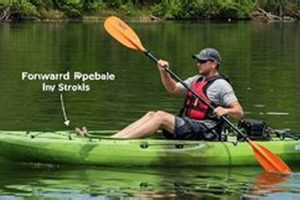
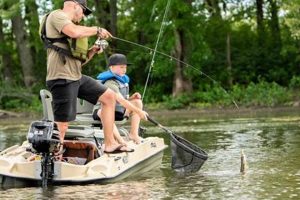
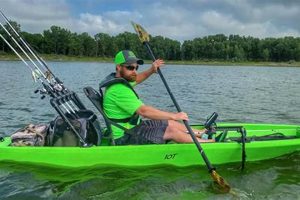
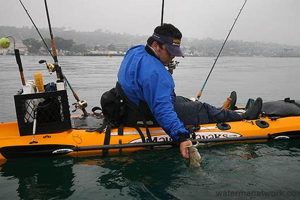
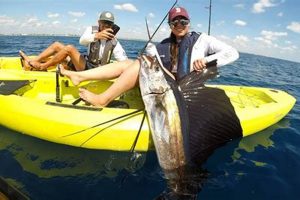
Specialized kayaks designed for angling are often sought by enthusiasts at sporting goods retailers. Dunham’s Sports, a prominent chain, is one potential source for these vessels. These watercraft typically feature specialized storage for tackle and gear, rod holders, and comfortable seating designed for extended periods on the water. For example, a typical angling kayak might include a built-in livewell for keeping catches fresh and strategically placed mounting points for fish finders and other electronic accessories.
The popularity of kayak angling stems from its accessibility and versatility. Kayaks allow anglers to reach shallow waters and navigate narrow waterways inaccessible to larger boats, expanding fishing opportunities. The stability and specialized design of these kayaks contribute to a more comfortable and productive fishing experience. Historically, fishing from small, human-powered vessels has been a common practice across cultures, but modern materials and designs have revolutionized the angling kayak into a highly specialized and effective sporting tool.
This discussion will further explore the key considerations for selecting an appropriate kayak for angling, including hull design, size, and features. Additional topics will include an overview of essential accessories, safety guidelines, and popular fishing locations accessible by kayak.
Tips for Selecting and Using Angling Kayaks
Choosing and utilizing a specialized kayak for fishing requires careful consideration of various factors to ensure safety, comfort, and success on the water.
Tip 1: Consider Hull Design: Kayak hulls are designed for specific water conditions. A flat-bottomed hull offers stability in calm waters, ideal for still lakes or slow-moving rivers. A V-shaped hull provides better tracking and performance in rougher conditions, suited for open water or coastal fishing.
Tip 2: Choose the Right Size: Kayak length and width impact stability and maneuverability. Longer kayaks track better in open water, while shorter kayaks offer superior maneuverability in tight spaces. Wider kayaks provide greater stability but sacrifice speed.
Tip 3: Evaluate Storage Capacity: Adequate storage is crucial for tackle, gear, and personal items. Consider built-in compartments, tank wells, and bungee cords for securing equipment.
Tip 4: Prioritize Comfort and Ergonomics: Comfortable seating and adjustable footrests are essential for long hours on the water. A well-designed seat back and padding can significantly reduce fatigue.
Tip 5: Invest in Essential Accessories: A paddle leash, personal flotation device (PFD), and bilge pump are crucial safety items. Rod holders, fish finders, and anchors enhance the fishing experience.
Tip 6: Practice Paddling and Maneuvering: Before venturing onto open water, practice basic paddling strokes and maneuvering techniques in a controlled environment. Familiarize oneself with the kayak’s handling characteristics.
Tip 7: Check Local Regulations and Obtain Necessary Permits: Research local fishing regulations, licensing requirements, and any permits needed for specific bodies of water or species.
Careful consideration of these factors will contribute to a safer, more comfortable, and ultimately more successful angling experience from a kayak. Selecting the right vessel and equipment, combined with adequate preparation, allows anglers to maximize their time on the water.
The following section will offer further resources and information for enhancing one’s kayak fishing endeavors.
1. Kayak Selection

Kayak selection is paramount when considering a purchase from a retailer like Dunham’s Sports. The appropriate fishing kayak significantly impacts angling success and overall experience. Evaluating key features and understanding individual needs ensures a suitable vessel tailored to specific fishing styles and environments.
- Hull Design
Hull design dictates stability and maneuverability. Flat-bottomed hulls offer stability for calm waters, ideal for lake fishing. V-shaped hulls track efficiently in currents, benefiting river or coastal anglers. Choosing the correct hull at Dunham’s ensures optimal performance in intended fishing locations.
- Length and Width
Kayak dimensions influence handling and capacity. Longer kayaks track straighter, advantageous in open water. Shorter kayaks provide maneuverability in tight spaces, suitable for navigating streams or mangroves. Wider kayaks offer increased stability but compromise speed. Dunham’s selection provides various sizes to match angler preferences and fishing environments.
- Storage Capacity
Ample storage accommodates tackle, gear, and personal items. Dedicated compartments, tank wells, and bungee systems secure equipment. Evaluating storage needs and examining available options at Dunham’s guarantees sufficient space for essential fishing gear.
- Seating and Comfort
Ergonomic seating promotes comfort during prolonged fishing trips. Adjustable backrests and footrests minimize fatigue and enhance stability. Evaluating seating comfort at Dunham’s ensures enjoyable and productive fishing experiences.
Careful consideration of these facets during kayak selection at Dunham’s Sports ensures a well-matched vessel, optimizing fishing performance and enjoyment. Balancing individual needs with kayak characteristics results in a suitable craft tailored to specific fishing styles and environments. Evaluating these factors enhances long-term satisfaction and promotes successful angling experiences.
2. Dunham's Inventory
Dunham’s Sports’ inventory directly influences consumer access to suitable fishing kayaks. A comprehensive inventory, including a variety of brands, models, and sizes, caters to diverse angler needs and preferences. Conversely, a limited inventory restricts choices, potentially hindering anglers from finding appropriate vessels. For instance, a Dunham’s store located near coastal waters might stock a wider selection of saltwater-specific kayaks compared to a store in an inland region. This inventory alignment with local fishing conditions enhances customer satisfaction and purchasing potential.
The availability of specific features and accessories within Dunham’s inventory further impacts the overall fishing kayak experience. Stocking essential accessories like paddles, life vests, and rod holders streamlines the purchasing process, allowing anglers to equip their kayaks efficiently. Furthermore, offering specialized accessories, such as fish finders and anchor trolleys, caters to more experienced anglers seeking advanced equipment. For example, a Dunham’s store with a robust inventory of kayak fishing accessories could become a one-stop shop for anglers, fostering customer loyalty and increasing sales.
Understanding Dunham’s inventory is crucial for anglers seeking appropriate fishing kayaks. Inventory diversity directly impacts consumer choice and satisfaction. Aligning inventory with local fishing conditions and stocking essential accessories enhances the purchasing experience and supports angler success. Researching Dunham’s inventory online or contacting local stores beforehand enables informed purchasing decisions, ensuring anglers acquire the appropriate equipment for their specific needs.
3. Pricing and Budget

Affordability plays a crucial role in acquiring a fishing kayak from Dunham’s Sports. Balancing desired features with budgetary constraints requires careful consideration of pricing structures and available options. Understanding the relationship between price and quality, and exploring potential cost-saving strategies, empowers informed purchasing decisions.
- Kayak Price Ranges
Fishing kayaks at Dunham’s typically fall within various price ranges, influenced by factors such as brand, size, features, and materials. Entry-level kayaks offer basic functionality at lower price points, while higher-end models incorporate advanced features and premium materials, commanding higher prices. Recognizing these price variations allows anglers to target kayaks within their budget.
- Sales and Promotions
Dunham’s frequently offers sales and promotions, providing opportunities to acquire fishing kayaks at discounted prices. Seasonal sales, clearance events, and promotional discounts can significantly reduce costs. Monitoring these opportunities and timing purchases strategically maximizes budget efficiency.
- Financing Options
Dunham’s may provide financing options, enabling customers to purchase kayaks through installment payments. Financing can make higher-priced kayaks more accessible, spreading the cost over time. Understanding financing terms and interest rates is crucial for responsible budgeting.
- Used Kayaks
Exploring the availability of used kayaks at Dunham’s or through other reputable sellers presents a cost-effective alternative to purchasing new. Used kayaks often come at lower prices, allowing anglers to access desirable features while minimizing expenses. Thorough inspection and assessment of condition are crucial when considering used kayaks.
Successfully acquiring a fishing kayak from Dunham’s requires aligning budgetary constraints with available options. Understanding kayak price ranges, leveraging sales and promotions, exploring financing options, and considering used kayaks enables informed purchasing decisions. Balancing cost with desired features ensures a satisfying purchase within budgetary limitations, enabling anglers to enjoy the sport without overspending.
4. Accessories Availability

Accessory availability significantly influences the practicality and enjoyment of kayak fishing, particularly for those purchasing kayaks from retailers like Dunham’s Sports. A comprehensive selection of accessories at the point of sale streamlines the equipping process, allowing anglers to acquire essential gear conveniently. Conversely, limited accessory availability necessitates sourcing equipment from multiple vendors, potentially delaying time on the water and increasing overall cost. For instance, an angler purchasing a fishing kayak from Dunham’s might require a paddle, personal flotation device (PFD), rod holders, and a dry bag. Ready access to these items at Dunham’s simplifies the outfitting process. However, if these accessories are unavailable, the angler must seek them elsewhere, potentially encountering compatibility issues or delays.
Furthermore, the availability of specialized accessories at Dunham’s caters to diverse fishing styles and angler preferences. Offering advanced electronics like fish finders, GPS units, and anchor trolleys enhances the angling experience, enabling more sophisticated techniques and improved catch rates. For example, an angler targeting specific fish species might require a transducer compatible with their kayak model. Availability of this specialized accessory at Dunham’s streamlines the setup and improves the chances of angling success. Conversely, the absence of such specialized accessories limits anglers’ options and potentially necessitates costly modifications or compromises.
In conclusion, robust accessory availability at Dunham’s Sports complements the purchase of a fishing kayak, enhancing convenience and overall angler satisfaction. Providing a wide range of essential and specialized accessories streamlines the equipping process, caters to diverse fishing styles, and maximizes the potential for successful angling experiences. The lack of readily available accessories, however, can create logistical challenges, increase expenses, and potentially limit the angler’s ability to utilize the kayak effectively. Evaluating accessory availability should be a key consideration when purchasing a fishing kayak from any retailer, including Dunham’s.
5. Store Location & Access

Store location and accessibility significantly influence the feasibility of acquiring a fishing kayak from Dunham’s Sports. Conveniently located stores with ample parking and accessible entry points facilitate kayak transportation and purchase. Conversely, remote locations or stores with limited accessibility present logistical challenges, particularly considering the size and weight of kayaks. For example, a Dunham’s store located near a major highway with dedicated kayak loading areas simplifies transport. However, a store situated in a congested urban area with limited parking and narrow doorways complicates kayak acquisition, potentially deterring customers.
Furthermore, store proximity to suitable fishing locations enhances the overall kayak ownership experience. A Dunham’s store situated near lakes, rivers, or coastal areas allows anglers to quickly deploy their newly acquired kayaks. This convenient proximity fosters immediate use and reinforces the purchase’s value. In contrast, a store located far from suitable fishing destinations necessitates additional transportation efforts, potentially delaying the kayak’s inaugural launch and diminishing customer enthusiasm. For instance, a Dunham’s store adjacent to a popular fishing lake benefits both the customer and the retailer, creating a synergistic relationship between product and location.
In summary, strategic store location and accessibility are crucial components of the fishing kayak purchase experience at Dunham’s Sports. Conveniently located stores with accessible features simplify transport and encourage immediate use, positively impacting customer satisfaction and purchase value. Conversely, poorly located stores with limited accessibility create logistical barriers, potentially hindering sales and diminishing customer enthusiasm. Therefore, considering store location and access is essential for optimizing the overall fishing kayak acquisition process from Dunham’s.
6. Transportation Logistics
Transporting a fishing kayak purchased from Dunham’s Sports requires careful logistical planning. Kayak dimensions and weight necessitate appropriate transportation solutions, impacting both immediate transport from the store and subsequent journeys to fishing destinations. Overlooking these logistical considerations can create difficulties, ranging from minor inconveniences to significant safety hazards.
- Vehicle Compatibility
Kayak dimensions must be compatible with the chosen transport vehicle. Roof racks, trailers, or truck beds are common transport methods. A compact car might accommodate a smaller kayak on a roof rack, while larger kayaks necessitate a trailer or truck bed. Assessing vehicle compatibility at Dunham’s before purchase prevents transport complications. For example, attempting to transport a lengthy kayak in a compact car without appropriate equipment poses safety risks and potential vehicle damage.
- Loading and Securing
Proper loading and securing procedures are crucial for safe kayak transport. Roof rack straps, tie-down ropes, and cam buckles secure the kayak to the vehicle, preventing shifting or detachment during transit. Incorrect securing techniques risk damaging the kayak and surrounding vehicles. Dunham’s staff can provide guidance on securement methods, minimizing transport risks.
- Distance to Destination
Transport distance influences logistical considerations. Short distances might allow for simpler transport methods, while longer journeys necessitate more robust solutions. Fuel efficiency and potential overnight stays become relevant for extended transport. For instance, transporting a kayak across several states requires more planning than a short trip to a local lake. Considering distance allows for appropriate vehicle and route selection.
- Local Regulations
Adhering to local transport regulations ensures legal and safe kayak transport. Regulations might dictate maximum overhang lengths, requiring permits for oversized loads. Ignoring these regulations can result in fines or accidents. Researching local transport laws before transporting a kayak purchased from Dunham’s prevents legal issues and promotes safe transit.
Successful kayak transport from Dunham’s to the desired fishing location hinges on careful logistical planning. Evaluating vehicle compatibility, employing proper loading and securing techniques, considering transport distance, and adhering to local regulations ensures safe and efficient kayak transport. Overlooking these logistical elements can negatively impact the overall fishing experience, potentially causing damage, delays, or legal complications. Therefore, addressing transportation logistics is crucial for a seamless transition from purchase at Dunham’s to enjoyable kayak fishing.
Frequently Asked Questions
This section addresses common inquiries regarding the acquisition and utilization of fishing kayaks, specifically within the context of Dunham’s Sports.
Question 1: What types of fishing kayaks does Dunham’s Sports typically offer?
Dunham’s Sports generally offers a range of fishing kayaks, including sit-on-top and sit-inside models, designed for various fishing environments and experience levels. Specific models and brands can vary by location and season.
Question 2: How does one determine the correct kayak size for individual needs?
Appropriate kayak size depends on factors such as angler weight, intended fishing location, and storage requirements. Longer kayaks offer better tracking, while shorter kayaks provide enhanced maneuverability. Wider kayaks enhance stability. Consulting with Dunham’s staff can assist in determining appropriate sizing.
Question 3: Are essential accessories like paddles and life vests included with kayak purchases at Dunham’s Sports?
Paddles and life vests are typically sold separately. It’s essential to confirm inclusion or purchase these items separately to ensure safety and proper kayak operation.
Question 4: What is the typical price range for fishing kayaks available at Dunham’s Sports?
Fishing kayak prices at Dunham’s can vary significantly based on brand, features, and materials. Entry-level models are generally more affordable, while higher-end kayaks equipped with advanced features command higher prices. Checking current inventory and pricing online or in-store provides the most accurate information.
Question 5: Does Dunham’s Sports offer financing options for kayak purchases?
Financing options may be available, subject to Dunham’s current policies and individual creditworthiness. Contacting a local Dunham’s store or checking their website provides details on available financing programs.
Question 6: What transportation options are recommended for transporting a fishing kayak purchased from Dunham’s Sports?
Transportation options depend on kayak size and vehicle type. Roof racks, trailers, and truck beds are common methods. Ensuring proper securing and adhering to local transport regulations are crucial for safe transportation. Consulting Dunham’s staff can provide guidance on appropriate transport methods.
Careful consideration of these frequently asked questions facilitates informed decisions regarding fishing kayak purchases at Dunham’s Sports. Addressing these common inquiries ensures a smooth acquisition process and a positive kayaking experience.
For further assistance, contacting a local Dunham’s Sports store or visiting their website is recommended.
Fishing Kayak Dunham’s
Careful consideration of factors such as kayak selection, Dunham’s inventory, pricing, accessory availability, store accessibility, and transportation logistics are essential for a successful fishing kayak acquisition. Understanding the interplay of these elements empowers informed purchasing decisions, maximizing angler satisfaction and on-the-water performance. Prioritizing research and preparation ensures appropriate kayak selection tailored to individual needs and fishing environments.
Successful angling experiences hinge on informed equipment choices and logistical preparedness. Investing time in research and planning streamlines the acquisition process, allowing anglers to focus on the enjoyment and rewards of kayak fishing. A well-chosen fishing kayak, acquired through a seamless process, serves as a gateway to rewarding experiences on the water, fostering a deeper connection with nature and the pursuit of angling success.