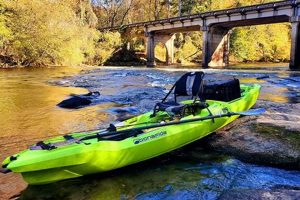
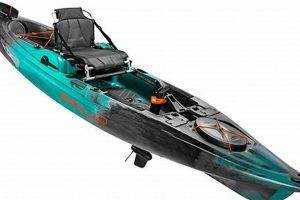
Kayaks designed specifically for angling saw significant advancements in design and technology throughout the year 2022. These specialized vessels typically incorporate features like rod holders, tackle storage, and often, pedal or motor-driven propulsion systems, catering to the needs of anglers seeking enhanced stability and hands-free fishing experiences. An example would be a sit-on-top kayak with integrated GPS and fish finder, along with ample storage for fishing gear.
The development of these specialized watercraft reflects a growing trend in recreational fishing, offering improved accessibility and maneuverability compared to traditional boats. Anglers benefit from the stability afforded by wider hulls and the shallow draft allowing access to secluded fishing spots. The evolution of designs in 2022 addressed previous limitations, leading to more comfortable and efficient fishing experiences. This period also saw a rise in eco-conscious manufacturing practices within the industry.
The following sections will delve into specific advancements introduced in 2022, including innovations in hull design, propulsion systems, and integrated technology, providing a detailed overview of the key features and benefits offered by the latest generation of fishing kayaks.
Tips for Selecting a 2022 Fishing Kayak
Choosing the right fishing kayak requires careful consideration of individual needs and preferences. Several factors influence optimal performance and overall satisfaction on the water.
Tip 1: Prioritize Stability: Hull design significantly impacts stability. Wider, flatter hulls offer greater initial stability, beneficial for anglers who stand frequently. However, these designs may sacrifice maneuverability. Consider the intended fishing environment and personal balance preferences.
Tip 2: Evaluate Propulsion Options: Paddle kayaks offer excellent exercise and maneuverability in shallow water. Pedal-driven systems free hands for fishing, while motor-driven kayaks cover greater distances quickly. Evaluate physical capabilities and target fishing locations.
Tip 3: Assess Storage Capacity: Ample storage for tackle, gear, and potential catches is crucial. Consider the duration of typical fishing trips and the amount of equipment typically carried. Integrated storage solutions contribute to organization and efficiency.
Tip 4: Consider Comfort and Ergonomics: A comfortable seating system promotes endurance during long fishing expeditions. Adjustable seating and footrests enhance comfort and accommodate various body types. Test seating comfort before making a purchase.
Tip 5: Factor in Weight and Portability: Kayak weight impacts transportation and launch ease. Consider available vehicle capacity and physical strength limitations. Lightweight materials enhance portability but may come at a premium.
Tip 6: Research Specific Features: Features like rod holders, fish finders, and live wells enhance the fishing experience. Consider specific angling needs and the types of fish targeted. Evaluate the practicality and integration of various features.
Selecting a kayak suited to individual needs enhances fishing enjoyment and efficiency. Careful evaluation of these factors leads to informed decisions and ultimately, a more rewarding experience on the water.
By considering these tips, anglers can confidently choose a kayak tailored to their specific requirements, maximizing their fishing potential and enjoyment on the water. The next section will delve into a comprehensive review of top-rated fishing kayak models from 2022.
1. Advanced Hull Designs

Advanced hull designs played a pivotal role in the evolution of fishing kayaks in 2022. These innovations directly addressed performance limitations of previous generations, resulting in enhanced stability, maneuverability, and speed. The development of multi-chine hulls, for instance, improved tracking and reduced unwanted side-to-side movement, allowing anglers to maintain course more efficiently in challenging conditions. Tunnel hulls, on the other hand, maximized stability by creating a wider base, enabling anglers to stand and cast with increased confidence, particularly in calmer waters. The integration of displacement hulls offered improved speed and efficiency for covering longer distances, benefiting anglers exploring larger bodies of water.
The practical significance of these advancements is evident in the improved on-the-water experience. Consider an angler navigating a shallow, winding creek. A kayak with a multi-chine hull allows precise maneuvering through tight turns and narrow passages, maximizing access to prime fishing spots. In contrast, an angler fishing in open, choppy water benefits from the stability of a tunnel hull design. This stability is critical not only for casting but also for landing fish, ensuring a safer and more successful fishing experience. Furthermore, the integration of displacement hulls in longer touring-style fishing kayaks enabled anglers to reach distant fishing grounds more quickly, expanding their angling opportunities.
In summary, the advancements in fishing kayak hull designs in 2022 provided significant benefits to anglers. These advancements catered to diverse fishing styles and environments, offering improved stability, maneuverability, and speed. By understanding the nuances of these designs, anglers can select a kayak optimized for their specific needs, maximizing their on-the-water performance and overall fishing experience. The connection between hull design and fishing performance reinforces the importance of these innovations in the continuous evolution of fishing kayak technology.
2. Integrated Propulsion Systems

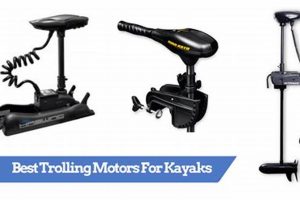
Integrated propulsion systems significantly impacted the functionality of fishing kayaks in 2022. These systems, primarily pedal drives and electric motors, offered anglers alternatives to traditional paddling, resulting in several key advantages. Pedal drives provided a hands-free fishing experience, allowing anglers to maintain position and focus on fishing rather than paddling. Electric motors offered increased speed and range, enabling access to distant fishing locations and reducing fatigue during longer trips. These advancements addressed limitations of paddle propulsion, opening up new possibilities for anglers.
The impact of integrated propulsion is evident in practical applications. Consider an angler fishing in a river with a moderate current. A pedal-powered kayak allows the angler to maintain a desired position upstream or downstream without constant paddling adjustments, enhancing lure presentation and increasing fishing efficiency. In larger lakes or coastal areas, an electric motor expands the angler’s reachable fishing grounds, conserving energy for the actual fishing activity. For example, an angler targeting offshore reefs could utilize an electric motor to travel quickly to the desired location and then switch to pedal power for precise maneuvering around the reef structure. This combination of propulsion systems optimizes both travel and fishing effectiveness.
Adoption of integrated propulsion systems introduced design considerations. Kayak manufacturers incorporated these systems into hull designs, impacting stability and maneuverability. Integration of pedal drives often necessitated a wider hull for increased stability, while electric motors required battery storage and wiring solutions. These design considerations influenced the overall performance and functionality of fishing kayaks in 2022. While these systems offer substantial benefits, they also increase complexity and cost. The selection of a propulsion system requires careful consideration of individual fishing styles, target environments, and budget constraints. Understanding the practical implications of each system is crucial for informed decision-making.
3. Enhanced Stability Features

Enhanced stability features played a crucial role in the evolution of fishing kayaks in 2022. These design advancements directly addressed the need for a secure and balanced platform, enabling anglers to confidently stand, cast, and land fish. Improved stability also enhanced safety, particularly in challenging conditions. This section explores the key stability features introduced and refined in 2022 fishing kayaks.
- Wider Hulls
Wider hulls provided a larger base of support, significantly increasing initial stability. This design characteristic benefited anglers who prefer to stand while fishing, allowing for greater freedom of movement and improved casting accuracy. A wider hull also reduced the tendency to tip, particularly when shifting weight or encountering unexpected waves or currents. While wider hulls enhance stability, they can sometimes compromise maneuverability in tight spaces or fast-moving water. The trade-off between stability and maneuverability became a key consideration in kayak selection, depending on the intended fishing environment.
- Outriggers and Stabilizers
Outriggers and stabilizers offered additional support beyond the main hull. These removable or retractable extensions increased the overall beam of the kayak, enhancing stability, particularly in rough conditions. Deployable outriggers allowed anglers to customize their stability based on the current environment. For example, an angler fishing in calm waters might retract the outriggers for improved maneuverability, then deploy them when encountering choppier conditions or when standing to cast. This adaptability enhanced both safety and fishing effectiveness.
- Flatter Hull Designs
Flatter hull designs in the center section of the kayak, often combined with a slight rocker at the bow and stern, contributed to increased primary stability. This design approach offered a more stable platform for standing and casting, while maintaining adequate maneuverability. Kayaks designed with this feature provided anglers with a balanced combination of stability and maneuverability, suitable for a variety of fishing environments.
- Weight Distribution and Center of Gravity
Careful consideration of weight distribution and center of gravity played a crucial role in enhancing stability. Designers strategically positioned seating, storage compartments, and other features to optimize balance and minimize the risk of tipping. Lower seating positions and strategically placed ballast tanks contributed to a lower center of gravity, improving stability in rough water or when making sudden movements. This focus on weight management became a key differentiator in higher-end fishing kayaks designed for challenging conditions.
These enhanced stability features in 2022 fishing kayaks contributed significantly to improved angler safety, comfort, and fishing effectiveness. The innovations in hull design, outrigger systems, and weight distribution reflect a focus on providing a stable and balanced platform for diverse fishing styles and environments. By understanding the implications of these features, anglers can select a kayak optimized for their specific needs and preferences, ultimately maximizing their on-the-water experience.
4. Specialized Storage Solutions
Specialized storage solutions became a defining feature of fishing kayaks in 2022, reflecting a growing emphasis on organization and efficiency on the water. These integrated storage systems catered specifically to the needs of anglers, offering designated compartments and mounting points for rods, reels, tackle boxes, and other essential gear. Efficient storage contributes directly to a more streamlined and productive fishing experience, minimizing clutter and maximizing access to essential equipment.
- Rod Holders and Management Systems
Integrated rod holders transitioned from basic fixtures to sophisticated management systems. Flush-mounted rod holders minimized interference with paddling and casting, while adjustable rod holders accommodated various rod lengths and angling techniques. Secure rod storage during transport and trolling became a key design consideration. These advancements ensured rods remained readily accessible while preventing damage or loss.
- Tackle Storage Compartments
Tackle storage evolved beyond simple open compartments. Sealed, waterproof compartments protected sensitive electronics and tackle from water damage. Modular tackle box systems offered customizable organization, allowing anglers to tailor storage to specific needs. Designated compartments for specific items like lures, hooks, and weights streamlined access and reduced time spent searching for gear. This improved organization contributed directly to increased fishing efficiency.
- Dry Storage and Waterproof Hatches
Dry storage compartments and waterproof hatches provided secure storage for personal items like phones, wallets, and keys, as well as essential gear vulnerable to water damage. These compartments often incorporated airtight seals and latches, ensuring contents remained dry even in challenging conditions. The integration of dry storage enhanced peace of mind, allowing anglers to focus on fishing without concern for their valuables.
- Integrated Gear Tracks and Mounting Points
Integrated gear tracks and mounting points offered versatile customization options. These systems allowed anglers to attach accessories like fish finders, GPS units, cameras, and additional rod holders, tailoring their kayak to specific needs and preferences. Standardized track systems ensured compatibility with a wide range of aftermarket accessories, maximizing customization potential. This modularity offered a level of personalization previously unavailable in traditional fishing kayaks.
The advancements in specialized storage solutions in 2022 fishing kayaks significantly enhanced organization, efficiency, and overall fishing performance. By integrating dedicated storage for rods, tackle, and personal items, manufacturers addressed the practical needs of anglers, promoting a more streamlined and productive on-the-water experience. These innovations contributed to the broader trend of increased specialization and customization within the fishing kayak industry, catering to diverse angling styles and preferences.
5. Technological Integrations

Technological integrations played a transformative role in the evolution of fishing kayaks in 2022. These integrations, ranging from fish finders and GPS systems to integrated lighting and motor control systems, significantly enhanced the angling experience, providing anglers with advanced tools and capabilities previously unavailable in traditional kayaks. The integration of these technologies reflects a broader trend of increased sophistication and specialization within the recreational fishing industry.
Fish finders and GPS systems became increasingly common features. Fish finders provided real-time underwater mapping, identifying fish locations, depth contours, and bottom structure. GPS systems enabled precise navigation, waypoint marking, and tracking of fishing routes. These technologies offered a significant advantage, allowing anglers to target specific areas with greater efficiency. For example, an angler seeking deep-water drop-offs could utilize a fish finder to identify the desired structure, then use the GPS to mark the location and navigate back to it precisely. Integrated lighting systems enhanced safety during low-light conditions, enabling anglers to navigate safely and extend fishing hours. Motorized kayaks benefited from integrated motor control systems, providing precise speed control, battery management information, and often, integration with GPS for automated navigation.
The integration of these technologies presented design and usability challenges. Power management became a critical consideration, requiring efficient batteries and power distribution systems. User interfaces needed to be intuitive and accessible in a marine environment, often requiring waterproof designs and simplified controls. Effective integration of these technologies required careful consideration of ergonomics and user experience. The successful integration of technology enhanced angling effectiveness, safety, and overall enjoyment. However, it also introduced complexity and cost considerations. Anglers needed to evaluate the practical benefits of each technology against its cost and complexity. This understanding became crucial for informed decision-making in the selection and utilization of fishing kayaks in 2022.
6. Eco-Conscious Manufacturing
Eco-conscious manufacturing gained prominence within the fishing kayak industry in 2022, reflecting a growing awareness of environmental responsibility and sustainability. Consumers increasingly sought products aligned with their environmental values, prompting manufacturers to adopt more sustainable practices in the design, production, and distribution of fishing kayaks. This shift towards eco-consciousness influenced material selection, manufacturing processes, and waste management strategies.
- Recycled and Sustainable Materials
Utilization of recycled and sustainable materials became a key focus. Manufacturers incorporated recycled plastics, bio-resins, and other eco-friendly materials into kayak construction. The use of recycled plastics reduced reliance on virgin materials, minimizing the environmental impact of plastic production. Bio-resins, derived from plant-based sources, offered a renewable alternative to petroleum-based plastics. These material choices reduced the overall carbon footprint of kayak production.
- Reduced Material Consumption and Waste
Minimizing material consumption and waste became a priority. Manufacturers implemented lean manufacturing principles, optimizing production processes to reduce waste generation. Precise material cutting and molding techniques minimized scrap material. Recycling programs for production waste further reduced environmental impact. These practices contributed to a more sustainable manufacturing cycle, minimizing resource depletion and landfill waste.
- Energy-Efficient Manufacturing Processes
Adoption of energy-efficient manufacturing processes aimed to reduce energy consumption during production. Optimized production layouts, energy-efficient machinery, and waste heat recovery systems minimized energy usage. These initiatives lowered the overall environmental impact of kayak manufacturing by reducing greenhouse gas emissions and reliance on non-renewable energy sources.
- Sustainable Packaging and Distribution
Sustainable packaging and distribution practices complemented eco-conscious manufacturing. Manufacturers reduced packaging material usage, opting for recycled and biodegradable packaging options. Optimized shipping routes and logistics minimized transportation fuel consumption and associated emissions. These practices extended the sustainability focus beyond the manufacturing process itself, encompassing the entire product lifecycle.
The adoption of eco-conscious manufacturing practices in 2022 marked a significant shift within the fishing kayak industry. By embracing sustainable materials, reducing waste, and optimizing energy efficiency, manufacturers responded to consumer demand for environmentally responsible products. This trend contributed not only to a reduction in the environmental impact of kayak production but also to a broader shift in consumer awareness and industry responsibility towards environmental sustainability. The increasing prevalence of eco-conscious manufacturing practices positions the fishing kayak industry as a participant in the larger movement towards a more sustainable future.
Frequently Asked Questions
This section addresses common inquiries regarding fishing kayaks manufactured or significantly updated in 2022. The aim is to provide clear and concise information to assist consumers in making informed purchasing decisions.
Question 1: What were the key advancements in fishing kayak hull designs in 2022?
2022 witnessed advancements in hull designs, including multi-chine hulls for improved tracking, tunnel hulls for enhanced stability, and displacement hulls for increased speed and efficiency. These designs catered to diverse fishing styles and environments.
Question 2: How did integrated propulsion systems evolve in 2022 fishing kayaks?
Pedal drives and electric motors offered hands-free fishing and extended range, respectively. These advancements reduced angler fatigue and expanded access to fishing locations. Integration of these systems influenced hull design and overall kayak performance.
Question 3: What stability enhancements were introduced in 2022 models?
Wider hulls, outriggers, flatter hull designs, and optimized weight distribution contributed to enhanced stability. These features enabled anglers to stand and cast more confidently, improving safety and fishing effectiveness.
Question 4: How did storage solutions improve in fishing kayaks during 2022?
Specialized storage solutions included integrated rod holders, tackle compartments, dry storage hatches, and gear tracks. These features enhanced organization, efficiency, and overall fishing experience by providing dedicated storage for essential gear.
Question 5: What technological advancements were integrated into 2022 fishing kayaks?
Fish finders, GPS systems, integrated lighting, and motor control systems enhanced angling effectiveness and safety. These technologies provided real-time information, navigation assistance, and improved visibility in low-light conditions.
Question 6: How did eco-conscious manufacturing influence 2022 fishing kayak production?
The use of recycled and sustainable materials, reduced material consumption, energy-efficient manufacturing processes, and sustainable packaging reduced the environmental impact of kayak production and reflected a growing industry commitment to sustainability.
Understanding these key aspects of 2022 fishing kayaks provides valuable insights for prospective buyers. Careful consideration of individual needs and preferences, alongside the information presented here, should enable informed decisions and ultimately, a more rewarding fishing experience.
The subsequent section provides a comprehensive overview of the top-rated fishing kayak models of 2022, offering detailed reviews and comparisons to further assist in the selection process.
Fishing Kayaks 2022
Fishing kayaks in 2022 showcased significant advancements across various aspects of design, technology, and manufacturing. Hull designs optimized stability, maneuverability, and speed, catering to diverse fishing environments and preferences. Integrated propulsion systems offered enhanced efficiency and range, while specialized storage solutions maximized organization and accessibility of essential gear. Technological integrations, including fish finders, GPS, and integrated lighting, further enhanced angling effectiveness and safety. Furthermore, a growing emphasis on eco-conscious manufacturing reflected an industry commitment to sustainability.
The innovations introduced in 2022 represent a pivotal point in the evolution of fishing kayaks, establishing a foundation for future advancements. These developments underscore a continued focus on enhancing the angling experience through improved performance, increased functionality, and a deeper consideration of environmental responsibility. Careful evaluation of these advancements empowers anglers to make informed decisions, selecting equipment best suited to individual needs and contributing to a more sustainable and rewarding fishing experience.