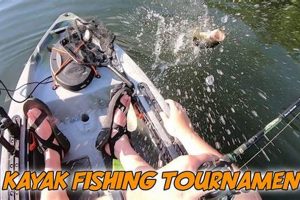
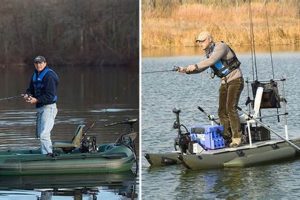
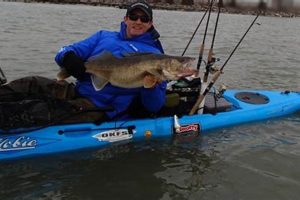
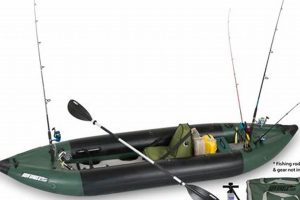
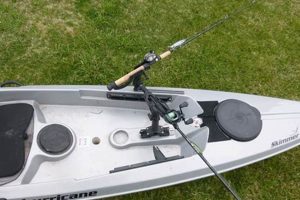
Specialized angling equipment designed for use in kayaks offers anglers a unique blend of portability and performance on the water. These shorter, more robust tools enable maneuverability within the confined space of a kayak while maintaining the strength and sensitivity required to target various fish species. For instance, a shorter rod allows for easier casting and retrieval in a seated position, while a medium-heavy power rating provides the backbone to handle larger fish.
The development of purpose-built equipment for kayak angling reflects the growing popularity of this fishing style. It offers several advantages over shore or boat fishing, including access to shallow, secluded waters and increased stealth when approaching fish. The right gear contributes significantly to a successful and enjoyable kayak fishing experience, minimizing tangles and maximizing control. Historically, kayak anglers adapted existing equipment, but the increasing demand has driven manufacturers to create rods specifically designed for the challenges and opportunities of this specialized pursuit.
This article will delve further into the specific features, materials, and selection criteria relevant to selecting optimal equipment for kayak angling, covering topics such as rod length, action, power, and material composition. It will also explore the relationship between target species and appropriate gear choices, empowering anglers to make informed decisions and enhance their on-the-water success.
Tips for Choosing Kayak Fishing Rods
Selecting appropriate equipment is crucial for a successful kayak fishing experience. These tips offer guidance on choosing the right rod for various needs and target species.
Tip 1: Consider Rod Length. Shorter rods (typically between 6 and 7.5 feet) are generally preferred for kayak fishing due to the limited space and the need for close-quarters casting. Shorter lengths also enhance maneuverability and control.
Tip 2: Choose the Right Power and Action. Rod power refers to the rod’s strength and ability to handle heavier lines and lures, while action describes the rod’s bending curve. A medium-heavy power with a fast action is a versatile choice for many kayak fishing scenarios.
Tip 3: Evaluate Rod Material. Graphite rods are lightweight and sensitive, making them ideal for detecting subtle bites. Fiberglass rods are more durable and affordable but heavier. Composite rods blend the properties of both materials.
Tip 4: Match the Rod to the Target Species. Lighter rods are suitable for smaller fish like panfish and trout, while heavier rods are necessary for larger species like bass or saltwater fish.
Tip 5: Factor in Kayak Width and Height. Wider, sit-on-top kayaks may allow for slightly longer rods. Higher seat positions might also necessitate adjustments in rod length.
Tip 6: Test the Rod Before Purchase (If Possible). Holding and simulating casting motions with the rod can provide valuable insights into its balance and feel.
Tip 7: Consider a Two-Piece or Collapsible Rod. These rods offer convenient storage and transportation options, especially important for kayak anglers.
By carefully considering these factors, anglers can choose equipment that enhances their kayak fishing experience and increases their chances of success. Optimal rod selection allows for efficient casting, effective fish fighting, and ultimately, a more enjoyable time on the water.
These tips provide a foundation for selecting appropriate equipment. The following sections will explore specific rod models and accessories to further enhance kayak angling performance.
1. Length

Rod length is a critical factor in kayak fishing, directly impacting casting ease, maneuverability, and overall fishing effectiveness. The confined space of a kayak necessitates shorter rods compared to those used in shore or boat fishing. Choosing the appropriate length optimizes performance and angler comfort.
- Maneuverability in Tight Spaces
Kayaks offer limited space for casting and maneuvering. Shorter rods, typically between 6 and 7.5 feet, are ideal for these close-quarters environments. Longer rods can become cumbersome and increase the risk of tangling lines or hooking obstacles. A shorter rod allows for precise casts around overhanging branches or other obstructions commonly encountered in kayak fishing.
- Casting Control and Accuracy
Shorter rods provide increased casting control, particularly in windy conditions or when using lighter lures. The reduced swing radius facilitates accurate casts, placing lures precisely in targeted areas. This control is essential for techniques like flipping and pitching, commonly employed in kayak fishing.
- Fish Fighting Leverage and Control
While shorter rods might offer less leverage than longer rods when battling large fish, they provide increased control during the fight. This control minimizes the risk of the fish wrapping the line around the kayak or other obstacles. Furthermore, shorter rods allow for quicker adjustments in rod angle and pressure, crucial for managing powerful fish in close proximity.
- Storage and Transportation
Shorter rods offer practical advantages for kayak anglers concerning storage and transportation. They fit more easily within the confines of a kayak and are simpler to transport to and from the launch site. This convenience becomes particularly important when kayaking through challenging terrain or when using smaller vehicles for transportation.
In summary, rod length significantly influences the effectiveness and enjoyment of kayak fishing. A shorter rod length, typically within the 6 to 7.5-foot range, optimizes maneuverability, casting accuracy, fish-fighting control, and overall convenience. Careful consideration of these factors allows anglers to select a rod length that aligns with their specific needs and fishing style.
2. Action
Rod action, referring to the rod’s bending curve under load, plays a crucial role in kayak fishing effectiveness. Action influences casting distance, lure presentation, hook setting power, and the ability to manage fish effectively within the confined space of a kayak. Understanding the nuances of rod action empowers anglers to make informed choices based on target species and fishing techniques.
Rod action is typically categorized as slow, moderate, or fast. A slow action rod bends throughout its length, offering increased casting distance and a softer presentation, ideal for smaller fish and lighter lines. Moderate action rods bend in the top two-thirds, providing a balance between casting distance and sensitivity. Fast action rods bend primarily in the tip, delivering greater sensitivity, faster hooksets, and more power for controlling larger fish. For instance, a fast action rod is advantageous when targeting bass in heavy cover, allowing for quick hooksets and preventing the fish from escaping into obstacles. Conversely, a slow action rod might be preferred when fishing for trout with delicate presentations.
Matching rod action to fishing style and target species significantly impacts success. Selecting the appropriate action optimizes lure presentation, hook setting power, and overall fish-fighting control. While fast action rods offer advantages in many kayak fishing scenarios due to their sensitivity and power, slower action rods can be beneficial for specific techniques or when targeting smaller, more delicate fish. Understanding the influence of rod action allows anglers to refine their equipment choices and maximize their chances of success on the water.
3. Power

Rod power, a measure of a fishing rod’s lifting strength, is a critical consideration in kayak angling. It dictates the size and weight of lures and lines that can be effectively used, influencing the target species and fishing techniques employed. Selecting the appropriate power ensures efficient casting, effective hooksets, and the ability to manage fish effectively from a kayak.
Rod power is typically categorized as ultralight, light, medium-light, medium, medium-heavy, heavy, and extra-heavy. Ultralight rods are designed for small fish and light lines, while extra-heavy rods handle larger game fish and heavier tackle. In kayak fishing, medium to medium-heavy power rods are often preferred due to their versatility. A medium-heavy power rod can handle a range of lures and line weights, enabling anglers to target various species commonly encountered in kayak fishing environments, such as bass, walleye, and inshore saltwater species. For example, a medium power rod might be suitable for targeting panfish with lighter lures, while a medium-heavy rod provides the necessary backbone for handling larger bass or battling strong currents.
Choosing the appropriate rod power significantly impacts angling success from a kayak. Matching rod power to target species and fishing conditions ensures effective casting, hook setting, and fish fighting. While medium to medium-heavy power rods provide versatility for many kayak fishing situations, understanding the nuances of rod power allows anglers to refine their tackle choices and maximize their chances of a successful outing. Selecting a rod with inadequate power can lead to rod breakage or lost fish, while an overly powerful rod sacrifices sensitivity and casting performance with lighter lures. Therefore, careful consideration of rod power is essential for optimizing kayak fishing effectiveness.
4. Material
Rod material significantly influences performance characteristics crucial for kayak fishing. Material choice affects weight, sensitivity, durability, and action, all of which impact an angler’s ability to effectively cast, detect bites, and manage fish from a kayak. Selecting the appropriate material enhances the overall fishing experience and increases the likelihood of success on the water.
- Graphite
Graphite rods are prized for their lightweight nature and exceptional sensitivity. The reduced weight minimizes fatigue during long fishing sessions, while the high sensitivity transmits even the subtlest bites, crucial for detecting cautious fish in challenging conditions. Higher-modulus graphite offers increased sensitivity and responsiveness but often at a higher price point. For example, a high-modulus graphite rod allows anglers to feel the subtle tap of a crappie nibbling on a small jig, increasing hookup rates. However, graphite is generally less durable than fiberglass, requiring careful handling to avoid breakage, especially in the confined space of a kayak.
- Fiberglass
Fiberglass rods offer excellent durability and affordability, making them a suitable choice for anglers seeking robust equipment. Their inherent strength withstands impacts and rough handling, a valuable attribute in the demanding environment of kayak fishing. Fiberglass rods are also more forgiving than graphite, tolerating occasional bumps and scrapes against rocks or other obstacles. However, fiberglass is heavier than graphite and less sensitive, potentially hindering the detection of subtle bites. A fiberglass rod might be a practical choice for anglers targeting larger, more aggressive species in heavy cover, where sensitivity is less critical.
- Composite
Composite rods blend the properties of graphite and fiberglass, aiming to combine the benefits of both materials. These rods often incorporate a graphite core for sensitivity and a fiberglass outer layer for durability. This combination creates a rod with a balanced performance profile, offering reasonable sensitivity while maintaining a robust construction. For instance, a composite rod could be a versatile choice for kayak anglers targeting a variety of species in diverse conditions, providing adequate sensitivity for detecting bites while withstanding the rigors of kayak fishing.
- Other Materials
While less common, other materials like bamboo and other specialized composites find application in niche kayak fishing scenarios. Bamboo rods offer a classic aesthetic and unique action, while specialized composites may offer enhanced performance characteristics in specific fishing situations. For instance, a travel rod constructed with multiple sections might utilize specialized materials to maintain strength and performance while providing exceptional portability.
Choosing the appropriate rod material significantly influences kayak fishing success. Carefully considering factors such as target species, fishing style, and budget allows anglers to select a rod material that optimizes their on-the-water experience. While graphite offers sensitivity and lightness, fiberglass provides durability, and composites offer a balance between the two. Ultimately, understanding the advantages and disadvantages of each material empowers anglers to make informed decisions and enhance their fishing performance from a kayak.
5. Portability

Portability is a paramount consideration when selecting fishing rods for kayak angling. The compact nature of kayaks and the often challenging logistics of transporting them necessitate equipment that is easy to manage and stow. Rod portability directly impacts both the convenience and safety of the kayak fishing experience.
- Compact Rod Designs
Two-piece and telescoping rods offer significant advantages in portability for kayak anglers. These designs reduce the overall length of the rod for transport and storage, allowing them to fit easily within a kayak’s limited space or be transported in a vehicle without difficulty. A multi-piece rod can be broken down into smaller sections, making it significantly easier to manage when launching or landing a kayak in challenging locations. For example, a 7-foot two-piece rod breaks down to roughly 3.5 feet, simplifying storage and transport.
- Lightweight Construction
Rod weight significantly contributes to portability and overall angler fatigue. Lighter rods are easier to handle and maneuver within the confines of a kayak, reducing strain during long fishing trips. Materials like graphite and other lightweight composites offer significant weight reductions compared to traditional fiberglass, enhancing both portability and on-the-water comfort. A lighter rod also facilitates more precise casting and reduces fatigue when fishing for extended periods.
- Storage and Transportation Solutions
Dedicated rod holders, sleeves, and storage systems further enhance portability in kayak fishing. Rod holders secure rods within the kayak, preventing damage or loss during transport. Rod sleeves protect rods from scratches and tangles, while specialized storage systems maximize space utilization within the kayak. These solutions contribute to a more organized and efficient kayak fishing setup, minimizing clutter and maximizing space for other essential gear.
- Balance with Kayak Dimensions
The overall dimensions of the kayak itself influence portability considerations related to rod choice. Smaller kayaks necessitate shorter, more compact rods, while larger kayaks may accommodate slightly longer rods. Balancing rod length with kayak dimensions ensures both effective fishing and ease of movement within the vessel. For instance, a shorter rod is essential for maintaining maneuverability and preventing entanglement in a smaller, sit-inside kayak.
Optimized rod portability significantly enhances the kayak fishing experience. Compact rod designs, lightweight construction, dedicated storage solutions, and consideration of kayak dimensions contribute to easier transport, increased on-the-water efficiency, and a safer, more enjoyable angling experience. Prioritizing portability in rod selection allows kayak anglers to focus on fishing rather than managing cumbersome equipment.
6. Durability

Durability is a critical attribute for fishing rods used in kayak angling. The demanding environment, characterized by frequent contact with water, exposure to the elements, and the potential for impacts against the kayak or other gear, necessitates robust construction. A durable rod withstands these rigors, minimizing the risk of breakage and ensuring consistent performance over time. For instance, a rod constructed with reinforced guides and a robust blank material better withstands accidental impacts against the kayak’s hull or surrounding rocks, extending its lifespan and maintaining its functionality. Conversely, a less durable rod might suffer guide damage or blank fractures under similar circumstances, compromising its performance and potentially leading to equipment failure during a critical moment.
The practical significance of rod durability in kayak fishing extends beyond mere longevity. A durable rod contributes to angler confidence, allowing focus to remain on fishing rather than worrying about equipment failure. This confidence is particularly important when battling strong fish or navigating challenging conditions. Furthermore, durable construction often translates to enhanced sensitivity and responsiveness, improving bite detection and hookset success. For example, a rod built with a high-quality reel seat and robust handle components maintains its structural integrity under pressure, maximizing sensitivity and transmitting subtle vibrations from the line to the angler’s hand. This enhanced sensitivity allows for quicker reactions to bites, increasing hookup rates and overall fishing success.
In summary, durability is a non-negotiable characteristic for kayak fishing rods. The challenging environment necessitates robust construction to withstand potential impacts, exposure to the elements, and the stresses of battling fish. Investing in a durable rod not only extends its lifespan but also enhances angler confidence, improves sensitivity, and contributes to a more successful and enjoyable kayak fishing experience. Choosing a rod with adequate durability ensures reliable performance and minimizes the risk of equipment failure in critical moments, allowing anglers to focus on the pursuit of fish and the enjoyment of the sport.
7. Sensitivity
Sensitivity in kayak fishing rods refers to the rod’s ability to transmit vibrations and feedback from the fishing line to the angler’s hand. This critical attribute allows for the detection of subtle bites, underwater structures, and changes in lure action. In the confined space and often challenging conditions of kayak fishing, sensitivity plays a vital role in maximizing angling success. A highly sensitive rod allows anglers to perceive the faintest nibble of a cautious fish or the subtle change in resistance as a lure encounters submerged vegetation, providing crucial information for effective hooksets and lure manipulation. This enhanced perception significantly improves the chances of detecting and reacting to bites, ultimately increasing catch rates.
- Bite Detection
A sensitive rod transmits even the slightest touch of a fish, allowing anglers to detect bites that might otherwise go unnoticed. This heightened sensitivity is crucial when targeting finicky fish or fishing in challenging conditions like murky water or heavy current. For example, a sensitive rod allows an angler to discern the delicate peck of a panfish in still water or the subtle take of a walleye in a fast-flowing river, providing the opportunity for a timely hookset. Without sufficient sensitivity, these subtle bites could be missed, resulting in lost opportunities.
- Lure Control and Feedback
Sensitivity allows anglers to feel the movement and action of their lures underwater. This tactile feedback provides crucial information about the lure’s depth, its interaction with the bottom or underwater structures, and any changes in its movement caused by current or fish interaction. For instance, a sensitive rod allows an angler to detect when a crankbait is bumping along the bottom or when a soft plastic lure is being subtly inhaled by a fish, enabling adjustments in retrieval speed or technique to optimize lure presentation and trigger strikes.
- Structure Detection
A sensitive rod transmits vibrations from the line as it comes into contact with underwater structures like rocks, submerged logs, or vegetation. This feedback allows anglers to map the underwater terrain, identify potential fish-holding areas, and avoid snags. By feeling the subtle tap of a jig against a submerged rock or the change in resistance as a line brushes against weeds, kayak anglers can gain valuable insights into the underwater environment and make informed decisions about lure placement and retrieval strategies.
- Line Management
Sensitivity aids in detecting subtle changes in line tension, facilitating effective line management and preventing break-offs. A sensitive rod transmits the feeling of a fish taking line or the increased tension caused by a snag, allowing anglers to react quickly and make necessary adjustments. For instance, a sensitive rod allows an angler to feel the initial run of a hooked fish, enabling a smooth drag adjustment and minimizing the risk of line breakage. Similarly, it helps detect when the line is caught on an underwater obstacle, enabling careful maneuvering to free the lure without snapping the line.
In the specialized context of kayak fishing, sensitivity plays a crucial role in maximizing angling success. The ability to detect subtle bites, monitor lure action, identify underwater structures, and manage line tension effectively contributes significantly to increased hookup rates and overall catch success. The limited space and often challenging conditions inherent in kayak fishing amplify the importance of a sensitive rod, making it an essential tool for anglers seeking to enhance their performance on the water.
Frequently Asked Questions
This section addresses common inquiries regarding the selection and utilization of fishing rods specifically designed for kayak angling.
Question 1: What is the ideal length for a kayak fishing rod?
Rod length is crucial for kayak angling. Lengths between 6 and 7.5 feet generally provide optimal balance between castability and maneuverability within a kayak’s limited space. Shorter rods offer better control in close quarters and reduce the risk of tangling, while longer rods may be suitable for specific techniques or larger kayaks.
Question 2: Does rod action significantly affect kayak fishing performance?
Rod action, the rod’s bending curve, significantly influences lure presentation, hook setting power, and fish-fighting control. Fast action rods are generally preferred for kayak fishing due to their quick hooksets and increased sensitivity. Moderate or slow action rods may be suitable for specific techniques or target species.
Question 3: Which rod power is recommended for kayak fishing?
Medium to medium-heavy power is often the most versatile choice for kayak fishing. This power range handles a variety of lures and line weights, allowing anglers to target a broader range of species commonly encountered in kayak fishing environments.
Question 4: Are graphite or fiberglass rods better for kayak fishing?
Both graphite and fiberglass offer advantages. Graphite rods are lighter and more sensitive, enhancing bite detection and casting accuracy. Fiberglass rods are more durable and affordable, withstanding the rigors of kayak fishing. Composite rods combine characteristics of both materials, offering a balance between sensitivity and durability.
Question 5: Are two-piece rods essential for kayak fishing?
Two-piece or collapsible rods greatly enhance portability and storage convenience in kayak fishing. Their compact design simplifies transportation and allows for easier maneuvering on and off the water. While not strictly essential, they are highly recommended for most kayak anglers.
Question 6: What features should be prioritized when choosing a kayak fishing rod?
Prioritize length, action, power, material, and portability when selecting a kayak fishing rod. Consider target species, fishing techniques, and the specific environment to determine the optimal combination of features. A well-chosen rod significantly enhances kayak fishing success and overall enjoyment.
Careful consideration of these factors contributes significantly to selecting the most suitable equipment for individual needs and kayak fishing styles.
This FAQ section provides a foundational understanding. Further exploration of specific rod models and manufacturers will be presented in the subsequent sections.
Conclusion
Optimal equipment selection significantly impacts kayak angling effectiveness. This article has explored critical factors influencing rod choice, including length, action, power, material, portability, durability, and sensitivity. Each characteristic contributes to overall performance in the unique kayak fishing environment, affecting casting accuracy, fish-fighting control, and the ability to detect subtle bites. Understanding the interplay of these factors empowers anglers to make informed decisions tailored to specific needs and target species.
The evolving landscape of kayak fishing continues to drive innovation in specialized equipment design. As technology advances and angling techniques refine, the importance of selecting appropriate gear remains paramount. Careful consideration of these factors ensures not only enhanced fishing success but also increased enjoyment and safety on the water. By prioritizing informed equipment choices, anglers unlock the full potential of kayak fishing, embracing the unique challenges and rewards this specialized pursuit offers.