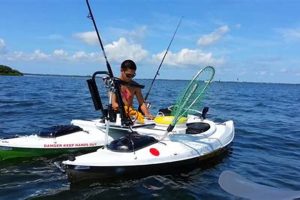
Efficient paddle placement is crucial for anglers in kayaks. Several options exist depending on fishing style and conditions. Storing the paddle horizontally across the deck, just in front of the angler, allows for quick access and minimal interference with casting. Alternatively, securing the paddle alongside the kayak, using bungee cords or dedicated paddle holders, keeps the deck clear and reduces the chance of the paddle drifting away. Some kayaks also feature integrated paddle parks or clips for streamlined storage.
Proper stowage prevents the paddle from becoming an obstacle during fishing activities. A misplaced paddle can obstruct casting, interfere with retrieving lines, and even create a safety hazard in the event of a sudden maneuver. Effective paddle management contributes to a more organized and productive fishing experience, allowing anglers to focus on the task at hand. Securing the paddle also minimizes the risk of loss or damage, especially in rough waters or during transport.
This article will further explore various paddle storage techniques in detail, considering different kayak types and fishing scenarios. Topics covered will include the pros and cons of each method, recommended equipment for secure storage, and tips for maximizing efficiency and safety on the water.
Paddle Placement Tips for Kayak Fishing
Efficient paddle management is essential for a successful kayak fishing experience. These tips offer practical guidance for secure and convenient paddle storage, enhancing both safety and fishing performance.
Tip 1: Utilize Deck Lines: Most fishing kayaks feature deck lines or bungee cords. These are ideal for securing the paddle horizontally across the deck, within easy reach. Ensure the paddle is positioned so it does not interfere with casting or reeling.
Tip 2: Consider Paddle Holders: Dedicated paddle holders, often mounted on the gunwales, provide a secure and out-of-the-way storage solution. These free up deck space and minimize the risk of the paddle dislodging.
Tip 3: Leverage Built-in Storage: Some kayaks offer integrated paddle parks or clips. Familiarize yourself with these features and utilize them whenever possible for streamlined storage.
Tip 4: Prioritize Balance: When storing the paddle, consider its impact on the kayak’s balance. Distributing weight evenly can improve stability, especially in challenging conditions.
Tip 5: Account for Fishing Style: Paddle placement needs may vary based on fishing techniques. For instance, trolling may require different storage compared to casting or still fishing. Adapt paddle placement accordingly.
Tip 6: Securely Fasten the Paddle: Regardless of the chosen method, ensure the paddle is firmly secured to prevent loss or interference with fishing activities. Double-check attachments before entering the water.
Tip 7: Practice Paddle Retrieval: Regularly practice retrieving the paddle from its stored position to ensure quick and efficient access when needed.
By implementing these strategies, anglers can maintain a clutter-free deck, enhance safety, and focus on the task at hand: catching fish. Proper paddle management contributes significantly to a more enjoyable and productive kayak fishing experience.
This discussion on paddle placement sets the stage for a broader exploration of essential kayak fishing techniques and equipment choices.
1. Deck Lines

Deck lines play a crucial role in paddle management for kayak anglers. These strategically placed cords, typically made of bungee or similar elastic material, offer a versatile solution for securing gear, including paddles. When considering paddle placement, leveraging deck lines provides a balance between accessibility and security. A paddle secured horizontally across the deck lines, positioned just in front of the angler, allows for rapid deployment when needed for repositioning or navigating unexpected obstacles. This placement also keeps the paddle within easy reach for quick adjustments during changing water conditions. For example, in a sudden shift in wind or current, immediate access to the paddle is paramount for maintaining control and stability.
The elasticity of deck lines offers an additional advantage: accommodating various paddle lengths and blade shapes. This adaptability proves particularly useful for anglers using specialized paddles or those sharing kayaks with different paddle preferences. Furthermore, securing the paddle with deck lines minimizes the risk of losing it overboard, particularly in rough water or during unexpected maneuvers. Consider a scenario where an angler hooks a large fish; the rapid movements and potential for sudden shifts in weight distribution highlight the importance of a securely stowed paddle. A loose paddle in such a situation could easily become entangled in fishing lines or obstruct critical movements.
While deck lines offer a convenient and adaptable solution for paddle storage, proper technique is essential. Anglers should ensure the paddle is firmly secured and does not obstruct casting or reeling. Additionally, the placement of the paddle should not compromise the kayak’s stability or balance. Understanding the interplay between paddle placement, kayak balance, and fishing technique optimizes efficiency and safety on the water. Ultimately, mastering the use of deck lines for paddle management contributes to a more streamlined and productive fishing experience.
2. Paddle Holders

Paddle holders offer a dedicated solution to the question of paddle placement while kayak fishing. These specialized mounts, typically affixed to the kayak’s gunwales or deck, provide secure storage, minimizing interference with fishing activities. Cause and effect are directly linked: employing paddle holders eliminates the potential for a loose paddle to obstruct casting, tangle fishing lines, or create an imbalance. The importance of paddle holders as a component of efficient paddle management is paramount. They transform the paddle from a potential hazard into a securely stowed piece of equipment, readily accessible when needed. Consider a scenario where an angler needs to quickly navigate through a narrow passage or around submerged obstacles; a securely held paddle, instantly retrievable, becomes essential for maintaining control and avoiding collisions. Alternatively, when fighting a strong fish, a misplaced paddle could interfere with critical maneuvers and potentially lead to capsizing.
Various paddle holder designs exist, each offering specific advantages. Some feature adjustable straps or clips to accommodate different paddle sizes and shapes, while others employ a more rigid cradle design. Selecting the appropriate paddle holder depends on factors such as kayak type, fishing style, and personal preference. For instance, anglers frequently navigating tight spaces might prioritize a low-profile holder that minimizes the paddle’s outward projection. Conversely, those fishing in calmer waters might opt for a holder that prioritizes ease of access. Regardless of the chosen design, proper installation and secure fastening are crucial for ensuring the paddle remains firmly in place throughout the fishing trip. A loose or improperly installed holder can negate the benefits of dedicated paddle storage, potentially leading to paddle loss or creating an even greater hazard.
Effective paddle storage contributes significantly to a safer and more productive kayak fishing experience. Paddle holders provide a dedicated solution, transforming potential obstacles into securely stowed and readily accessible equipment. Choosing the right paddle holder and ensuring proper installation are essential steps in optimizing kayak configuration for efficient and enjoyable angling. This focus on paddle management lays the groundwork for addressing other essential aspects of kayak fishing, such as tackle organization and fish handling techniques.
3. Integrated Storage

Integrated storage solutions represent a significant advancement in kayak design, directly addressing the challenge of paddle management while fishing. These purpose-built compartments, recesses, or clips offer a streamlined approach to stowing paddles, maximizing deck space and minimizing interference with angling activities. A cause-and-effect relationship exists: incorporating integrated storage eliminates the need for aftermarket accessories or improvised solutions, resulting in a cleaner, more efficient cockpit. The importance of integrated storage as a component of effective paddle management is evident in its impact on both safety and fishing performance. Imagine an angler needing to execute a quick maneuver to avoid a submerged obstacle; a paddle readily accessible from its integrated storage position allows for an immediate and controlled response. Conversely, a loose paddle could obstruct movement, potentially leading to a collision or capsize.
Several types of integrated storage exist. Recessed compartments within the hull provide secure storage while minimizing the paddle’s profile, reducing the risk of entanglement with fishing lines or gear. Paddle clips, strategically positioned on the deck or gunwales, offer quick access while maintaining a low profile. Some kayaks even feature specialized paddle parks, designed to cradle the paddle securely while minimizing its impact on deck space. The choice of integrated storage often depends on the specific kayak model and its intended use. Fishing kayaks designed for open water may prioritize secure, recessed storage to protect the paddle from waves and spray. River-running kayaks might utilize clips for quick access during maneuvering in currents. Understanding the nuances of each system allows anglers to select kayaks best suited to their fishing style and environment. Consider a fly fisherman wading in a shallow river; integrated storage allows them to quickly and securely stow the paddle while transitioning to wading, maintaining a streamlined and efficient setup.
Integrated storage solutions offer a significant advantage in paddle management for kayak anglers. By eliminating clutter and ensuring quick access, these features contribute to a safer and more productive fishing experience. Selecting a kayak with appropriate integrated storage aligns with a broader strategy of optimizing equipment and technique for enhanced performance on the water. This understanding of paddle storage sets the stage for exploring other critical elements of kayak fishing, such as tackle organization and fish handling strategies.
4. Horizontal Placement

Horizontal paddle placement is a prevalent strategy in kayak fishing, offering a balance between accessibility and deck space management. Understanding the nuances of this placement method is crucial for optimizing efficiency and safety on the water. This section explores the key facets of horizontal paddle placement within the context of kayak fishing.
- Accessibility and Casting Interference
Positioning the paddle horizontally, typically across the deck lines just in front of the angler, prioritizes rapid deployment. This is advantageous for quick maneuvers and adjustments in changing water conditions. However, this placement can potentially interfere with casting, particularly for overhead or sidearm casts. Anglers employing this method must consider paddle position relative to casting motions to minimize interference and prevent snagging fishing lines. For instance, a fly fisherman might find horizontal placement directly in front problematic, while a troller might find it ideal for quick adjustments to boat speed.
- Deck Space and Gear Management
Horizontal placement occupies a portion of the deck space. While readily accessible, this can restrict space for other essential gear, such as tackle boxes, fish finders, or cameras. Effective organization and prioritization of deck space are essential when employing horizontal paddle placement. Anglers using smaller kayaks or those carrying substantial gear might find this method less suitable. Conversely, anglers with larger kayaks or minimalist setups might find the trade-off acceptable given the rapid paddle access. Consider a kayak angler targeting large pelagic fish; the need for heavy tackle and specialized equipment may necessitate alternative paddle storage to maintain a clear and functional deck.
- Security and Stability
Securing the paddle horizontally requires careful consideration of stability and the potential for dislodgement. Utilizing deck lines, bungee cords, or specialized paddle holders is crucial for preventing the paddle from shifting during movement or being lost overboard in rough conditions. Improperly secured paddles can create both a safety hazard and an impediment to fishing activities. For example, a loose paddle can shift unexpectedly during a hookset, potentially impacting balance or even causing the angler to capsize. Conversely, a securely fastened paddle contributes to a stable and predictable fishing platform.
- Adaptation to Kayak Design
Horizontal paddle placement interacts directly with kayak design. Kayak width, deck layout, and the presence of integrated storage solutions all influence the practicality and effectiveness of horizontal placement. Anglers should consider their kayak’s specific features when deciding on paddle storage strategies. For example, a wider kayak offers more deck space, potentially making horizontal placement more viable. Alternatively, a kayak with integrated paddle holders or recessed compartments might offer superior storage options compared to horizontal placement on deck lines. Consider a sit-on-top kayak designed for surf launching; securing the paddle horizontally might not be feasible due to the risk of wave wash dislodging it. In such scenarios, alternative storage solutions become essential.
Horizontal paddle placement offers a viable option in many kayak fishing scenarios, provided anglers carefully consider its implications for accessibility, deck space management, security, and kayak design. Balancing these factors contributes to a more efficient and enjoyable fishing experience.
5. Weight Distribution
Weight distribution plays a critical role in kayak stability, directly influencing paddle placement decisions. Paddle placement alters the kayak’s center of gravity, impacting balance and maneuverability. Understanding this cause-and-effect relationship is crucial for safe and efficient kayak fishing. Consider a paddle stored horizontally across the deck behind the angler; this shifts weight towards the stern, potentially raising the bow and increasing susceptibility to wind and waves. Conversely, storing the paddle alongside the hull distributes weight more evenly, enhancing stability. The importance of weight distribution as a component of paddle placement is amplified in scenarios involving rough water or challenging fishing conditions. Imagine an angler battling a strong current; proper weight distribution, influenced by paddle placement, becomes crucial for maintaining control and preventing capsize. A poorly balanced kayak, with weight unevenly distributed due to improper paddle placement, significantly increases the risk of instability and hinders maneuverability.
Practical application of weight distribution principles informs paddle placement strategies. Anglers carrying heavier gear towards the stern might compensate by storing the paddle further forward, maintaining balance. Similarly, those fishing in windy conditions might prioritize lower paddle placement to reduce windage and enhance stability. Consider a kayak angler fishing in shallow, weedy waters; a paddle stored high on the deck increases the risk of entanglement, whereas a lower placement minimizes this risk. Specific fishing techniques also influence paddle placement decisions relative to weight distribution. Trolling requires a balanced kayak for tracking straight, while sight casting necessitates quick access to the paddle for maneuvering into position. Understanding these nuances allows anglers to tailor paddle placement for specific fishing scenarios, optimizing both stability and efficiency.
Effective paddle placement, informed by weight distribution principles, contributes significantly to kayak control, stability, and overall fishing performance. Addressing weight distribution challenges through strategic paddle placement enhances safety and allows anglers to focus on the task at hand: catching fish. This understanding of weight distribution as a key factor in paddle placement sets the stage for exploring other essential aspects of kayak fishing, such as efficient paddling techniques and navigation strategies.
6. Accessibility
Paddle accessibility represents a critical factor in kayak fishing, directly impacting angler efficiency and safety. Rapid access to the paddle is essential for maneuvering, adjusting position, and responding to changing conditions or unexpected events. Paddle placement must balance convenient retrieval with minimizing interference during fishing activities. This section explores key facets of paddle accessibility within the context of kayak fishing.
- Immediate Retrieval Needs
Certain fishing scenarios demand immediate paddle access. Navigating tight spaces, swift currents, or sudden changes in wind require rapid deployment of the paddle for maintaining control and stability. Consider a scenario where an angler hooks a large fish that makes a sudden run; immediate access to the paddle is crucial for maneuvering the kayak and preventing line breakage or capsize. Paddle placement strategies must account for such situations, prioritizing rapid retrieval when necessary.
- Frequency of Use and Fishing Style
Paddle accessibility needs vary depending on fishing style and individual preferences. Anglers frequently repositioning or making small adjustments require more readily accessible paddles compared to those remaining stationary for extended periods. Trolling, for example, might necessitate less frequent paddle use than sight casting or fly fishing, where precise boat control is paramount. Paddle placement should align with anticipated usage frequency, optimizing accessibility for the chosen fishing style.
- Trade-off Between Access and Obstruction
Paddle placement presents a trade-off between accessibility and potential obstruction of fishing activities. While readily accessible paddles facilitate quick deployment, they can also interfere with casting, reeling, and landing fish. Consider a paddle placed horizontally across the deck; while easily grasped, it might obstruct overhead casts or tangle fishing lines. Conversely, a paddle secured alongside the hull minimizes interference but might require more time to retrieve. Optimizing paddle placement involves finding a balance that minimizes obstruction while maintaining sufficient accessibility for the given fishing scenario.
- Impact of Kayak Design and Storage Solutions
Kayak design and integrated storage solutions influence paddle accessibility. Kayaks with dedicated paddle holders or recessed compartments offer more streamlined storage options compared to relying solely on deck lines. These features influence paddle placement decisions, impacting both accessibility and deck space management. Consider a kayak with integrated paddle clips positioned near the cockpit; these provide quick access while minimizing interference with fishing activities. Conversely, a kayak lacking such features might necessitate placing the paddle horizontally across the deck, potentially compromising casting space or increasing the risk of entanglement. Understanding the interplay between kayak design and storage solutions is essential for optimizing paddle accessibility.
Effective paddle placement hinges on prioritizing accessibility without compromising fishing efficiency or safety. Balancing immediate retrieval needs with the potential for obstruction, while considering fishing style and kayak design, contributes to a more streamlined and productive fishing experience. This focus on paddle accessibility lays the groundwork for exploring other critical aspects of kayak fishing, such as tackle management and fish handling techniques.
7. Security
Paddle security is paramount in kayak fishing, directly impacting both safety and the preservation of essential equipment. An unsecured paddle risks loss, creating a hazardous situation, particularly in challenging conditions or when angler attention is focused on fishing activities. Securing the paddle effectively safeguards against unexpected dislodgement, minimizing distractions and maximizing angler preparedness. This section explores key facets of paddle security within the context of kayak fishing.
- Environmental Factors
Wind, waves, and currents pose significant threats to paddle security. These environmental forces can dislodge improperly secured paddles, leading to loss or creating hazardous floating debris. Consider a paddle resting unsecured on the deck of a kayak navigating choppy water; a sudden wave or gust of wind could easily sweep the paddle overboard. Conversely, a securely fastened paddle remains in place, regardless of environmental conditions. Anglers operating in dynamic environments must prioritize secure paddle storage to mitigate these risks.
- Interaction with Fishing Activities
Fishing activities, such as casting, fighting fish, and retrieving lines, can inadvertently dislodge a poorly secured paddle. Sudden movements, changes in weight distribution, and entanglement with fishing gear all contribute to the risk of paddle loss. Imagine an angler setting the hook on a powerful fish; the sudden jolt and subsequent struggle can easily dislodge a loosely placed paddle. Conversely, a securely stowed paddle remains in place, allowing the angler to focus on the fish without distraction or safety concerns. Effective paddle storage solutions minimize interference with fishing activities, enhancing both efficiency and safety.
- Storage Methods and Equipment Choices
Various storage methods and equipment choices directly influence paddle security. Deck lines, bungee cords, specialized paddle holders, and integrated storage compartments each offer different levels of security. Consider a paddle secured horizontally across the deck using only bungee cords; while convenient for access, this method might prove insufficient in rough conditions. Conversely, a dedicated paddle holder or recessed compartment provides enhanced security, minimizing the risk of dislodgement regardless of environmental factors or angler movements. Selecting appropriate storage solutions is crucial for maximizing paddle security.
- Long-Term Considerations and Prevention
Paddle security extends beyond immediate fishing trips, encompassing long-term considerations such as transportation and storage. Properly securing the paddle during transport prevents damage and loss. Similarly, storing the paddle securely when not in use protects it from accidental damage or misplacement. Consider a paddle stored loosely inside a vehicle during transport; shifting cargo or sudden stops can damage the paddle or cause it to become a projectile. Conversely, securing the paddle during transport and storage preserves its integrity and ensures its availability for future fishing trips. Adopting a proactive approach to paddle security minimizes long-term risks and contributes to responsible equipment management.
Prioritizing paddle security contributes significantly to a safer and more efficient kayak fishing experience. Secure storage methods mitigate the risk of paddle loss, minimizing distractions and enhancing angler preparedness. Considering environmental factors, interaction with fishing activities, and appropriate storage solutions ensures the paddle remains readily available when needed, while minimizing the potential for hazards. This focus on paddle security sets the stage for exploring other essential aspects of kayak fishing, such as navigation strategies and emergency preparedness.
Frequently Asked Questions
Proper paddle placement is crucial for a safe and efficient kayak fishing experience. This FAQ section addresses common queries regarding paddle storage and management, offering practical insights for anglers of all skill levels.
Question 1: What are the primary risks of improper paddle placement?
Improper paddle placement can lead to interference with casting and reeling, entanglement with fishing lines, compromised kayak stability, and potential paddle loss. These factors can disrupt fishing activities, create safety hazards, and necessitate premature termination of fishing trips.
Question 2: What factors influence the choice of paddle placement method?
Kayak design, fishing style, environmental conditions, and individual preferences all influence paddle placement decisions. Anglers should consider these factors to optimize accessibility, security, and minimize interference with fishing activities.
Question 3: Are there specific paddle placement recommendations for different types of fishing kayaks?
Sit-on-top kayaks often benefit from horizontal placement across deck lines or dedicated paddle holders. Sit-inside kayaks might utilize paddle parks or interior storage compartments. Ultimately, paddle placement should align with the specific kayak’s design and the angler’s fishing style.
Question 4: How does paddle placement impact kayak stability and maneuverability?
Paddle placement influences weight distribution, affecting the kayak’s center of gravity. Proper placement maintains balance and maneuverability, while improper placement can compromise stability, particularly in challenging conditions such as wind or current.
Question 5: What are the advantages of using dedicated paddle holders compared to deck lines?
Dedicated paddle holders offer enhanced security and minimize interference with fishing activities compared to deck lines. They provide a designated storage location, reducing the risk of paddle dislodgement and freeing up deck space.
Question 6: How can anglers ensure their chosen paddle placement method remains secure throughout a fishing trip?
Regularly checking paddle security, especially after navigating rough water or encountering strong currents, is crucial. Ensuring proper fastening and utilizing appropriate storage equipment minimizes the risk of paddle loss or dislodgement.
Strategic paddle placement contributes significantly to a safer, more efficient, and ultimately more enjoyable kayak fishing experience. Understanding the factors influencing paddle placement and employing appropriate storage techniques allows anglers to focus on their primary objective: catching fish.
This FAQ section provides a foundation for understanding paddle management in kayak fishing. The next section will delve into advanced techniques for maneuvering a kayak efficiently while maintaining optimal paddle control.
Conclusion
Effective paddle placement is integral to efficient and safe kayak angling. This article explored various storage solutions, including deck lines, dedicated paddle holders, and integrated kayak compartments. Analysis considered the impact of paddle placement on stability, maneuverability, and accessibility, emphasizing the importance of balancing these factors based on individual fishing styles and environmental conditions. Proper paddle security emerged as a crucial safety consideration, highlighting the need for appropriate storage methods to prevent loss or interference with fishing activities.
Strategic paddle management empowers anglers to maximize fishing efficiency and minimize potential hazards. Continued exploration of advanced paddling techniques and kayak outfitting strategies further enhances on-the-water performance and safety. Ultimately, mastering paddle placement contributes to a more streamlined and rewarding kayak fishing experience.