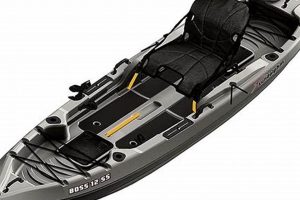
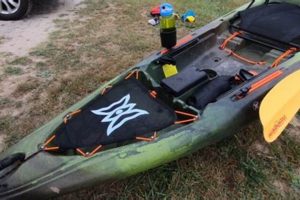
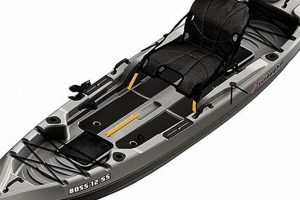
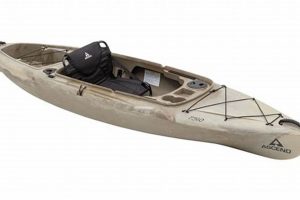
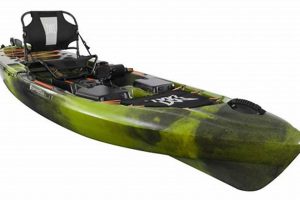
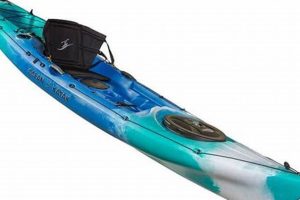
This term refers to a specific type of kayak designed for angling. These kayaks feature an open deck, allowing the angler to sit above the waterline, offering increased stability and ease of entry and exit. The “10” likely designates either a 10-foot length or a classification related to size or capacity. This style contrasts with traditional sit-inside kayaks, providing a different experience and advantages for fishing.
Open-deck kayaks provide several benefits for fishing. The elevated seating position improves visibility for spotting fish and casting. Their inherent stability makes them ideal for standing and casting, and the self-draining design ensures they won’t swamp. The wider, flatter hulls of many fishing-oriented models enhance stability further. The evolution of these specialized kayaks reflects the growing popularity of kayak fishing and the demand for vessels tailored to its unique requirements.
The following sections will explore specific features, popular models, and essential accessories for those interested in this style of kayak fishing. Factors such as hull design, weight capacity, storage options, and propulsion systems will be examined to provide a comprehensive understanding of the choices available.
Tips for Kayak Fishing
Careful planning and preparation contribute significantly to a successful and enjoyable kayak fishing experience. The following tips offer guidance for both novice and experienced anglers.
Tip 1: Prioritize Stability: Kayak stability is paramount, especially when fishing. Consider a wider, flatter hull design for enhanced stability, particularly in rougher waters or when standing to cast.
Tip 2: Choose Appropriate Propulsion: Paddle propulsion offers maneuverability and quiet movement, ideal for shallow water or stealth approaches. Pedal-powered kayaks provide hands-free fishing and faster speeds for covering larger areas.
Tip 3: Organize Gear Strategically: Efficient gear organization maximizes space and accessibility. Utilize storage compartments, tackle boxes, and gear tracks to keep essential items within easy reach while maintaining balance and stability.
Tip 4: Dress for the Elements: Appropriate attire ensures comfort and safety. Consider lightweight, quick-drying clothing, layers for changing conditions, and personal flotation devices. Sun protection, including hats and sunscreen, is essential.
Tip 5: Understand Local Regulations: Research and adhere to all local fishing regulations, including licensing requirements, catch limits, and permitted fishing areas. Respect wildlife and leave no trace.
Tip 6: Practice Essential Safety Procedures: Familiarize oneself with basic kayak safety procedures, including self-rescue techniques and emergency communication protocols. Inform someone of fishing plans and expected return time.
Tip 7: Select Appropriate Fishing Gear: Choose rods, reels, and tackle appropriate for the target species and fishing environment. Consider shorter rods for maneuverability in a kayak and tackle designed for specific fishing techniques.
By implementing these tips, anglers can enhance safety, improve fishing success, and maximize enjoyment on the water. Preparation and awareness contribute significantly to a positive and rewarding experience.
These preparatory steps lay the groundwork for successful kayak fishing excursions. The following section will delve into specific techniques and strategies for various fish species and environments.
1. Stability

Stability is a critical factor in kayak fishing, especially in sit-on-top models often denoted with a “10” for length. A stable platform allows anglers to cast, reel, and land fish effectively, even in challenging conditions. The following facets explore the key components contributing to stability in these kayaks.
- Hull Design:
Hull design significantly influences stability. Wider, flatter hulls generally provide greater primary stability (initial resistance to tipping). A shallow-V hull offers a good balance between stability and maneuverability, while a pontoon-style hull maximizes stability, often at the expense of speed and tracking. A 10-foot kayak’s hull design needs careful consideration based on intended fishing environments.
- Center of Gravity:
A lower center of gravity enhances stability. Sitting closer to the waterline improves stability. Distributing weight evenly within the kayak further contributes to balance. Adding weight low in the hull can also increase stability, particularly helpful in windy conditions. Anglers in 10-foot kayaks should be mindful of weight distribution, especially when standing.
- Kayak Width and Length:
Wider kayaks generally offer increased stability compared to narrower models. A 10-foot length offers a balance between maneuverability and stability. Shorter kayaks may be more maneuverable but less stable in open water, while longer kayaks track better but can be harder to turn. The 10-foot length represents a common compromise for stability and maneuverability.
- Water Conditions:
Calm water allows for greater stability compared to rougher conditions. Wind, waves, and currents can significantly impact stability, requiring greater attention to balance and positioning. A stable platform becomes even more critical in challenging conditions, highlighting the importance of stability in sit-on-top fishing kayaks, often around 10 feet in length.
By understanding these factors, anglers can select a sit-on-top fishing kayak, particularly those around 10 feet long, that provides the appropriate level of stability for their needs and fishing style. Prioritizing stability ensures a safe and enjoyable fishing experience, allowing anglers to focus on their technique and catch, rather than constantly battling to maintain balance.
2. Fishing Features

Specialized fishing features distinguish a sit-on-top fishing kayak, often around 10 feet in length, from recreational models. These features directly impact angling effectiveness and overall experience. Rod holders, strategically placed for easy access and varied fishing techniques, are essential. Integrated tackle storage systems maintain organization and prevent gear loss, crucial in the limited space of a kayak. Other features, such as anchor trolleys for controlled drift fishing, further enhance fishing-specific functionality. For instance, recessed rod holders protect rods during transport, while adjustable rod holders accommodate different fishing styles.
The presence and quality of these features significantly influence a kayak’s suitability for fishing. A well-equipped 10-foot fishing kayak offers a dedicated platform for angling, increasing efficiency and enjoyment. Dedicated storage compartments protect tackle from water damage and keep essential gear readily available. Built-in fish finders and transducer mounts provide real-time underwater insights, increasing the likelihood of success. For example, a kayak with multiple rod holders allows for trolling while simultaneously jigging or bottom fishing, expanding fishing versatility. These specialized features transform a basic kayak into a dedicated fishing platform.
Understanding the purpose and effective utilization of these features is crucial for maximizing fishing success. Proper rod holder placement minimizes line tangling and facilitates quick reactions to strikes. Efficient tackle organization reduces time spent searching for gear and increases time spent fishing. Integrating these features streamlines the fishing process and improves overall performance. Challenges may arise in balancing the number of features with the kayak’s overall weight and maneuverability. Ultimately, the selection of a 10-foot sit-on-top kayak should prioritize fishing features that align with individual angling styles and target species.
3. Ten-foot length
The “10” in “sit on top fishing kayak 10” frequently denotes a ten-foot hull length. This length represents a common compromise for sit-on-top fishing kayaks, balancing maneuverability and stability, crucial factors for anglers. Shorter kayaks, under ten feet, offer enhanced maneuverability in tight spaces like creeks and mangroves, advantageous for navigating complex waterways. However, they may sacrifice tracking and stability in open water or challenging conditions. Kayaks exceeding ten feet typically improve tracking and stability, beneficial for larger bodies of water and rougher conditions, but may compromise maneuverability in confined areas. A ten-foot length seeks to optimize both aspects, offering reasonable maneuverability while maintaining sufficient stability for fishing activities.
This length’s prevalence stems from its suitability across diverse fishing environments. A ten-foot kayak allows anglers to navigate narrower waterways while providing adequate stability for casting and reeling in open areas. Consider a scenario: an angler fishing in a mangrove-lined estuary. A ten-foot kayak allows access to shallow, protected areas within the mangroves while maintaining stability when crossing open channels exposed to wind and currents. Conversely, a longer kayak might struggle to navigate the tight mangrove tunnels, while a significantly shorter kayak might feel unstable in the open channels. The ten-foot length, therefore, represents a versatile choice for diverse fishing environments.
Understanding the implications of kayak length, specifically the ten-foot benchmark, allows informed selection based on individual fishing needs and target environments. While maneuverability and stability represent key considerations, factors like storage capacity and weight capacity also influence the decision. Anglers targeting smaller, protected waters might prioritize maneuverability and opt for a shorter kayak. Those frequently fishing larger, open bodies of water might prioritize stability and tracking, potentially selecting a longer kayak. The ten-foot length offers a balanced approach, making it a popular and versatile choice among kayak anglers.
4. Open Deck Design

The open deck design fundamentally defines sit-on-top kayaks, distinguishing them from traditional sit-inside kayaks. This design directly influences several key aspects of the “sit on top fishing kayak 10” experience. The self-draining nature of the open deck is paramount. Scupper holes allow water to drain away, preventing water accumulation and maintaining buoyancy, even in rough conditions or after a wave washes over the deck. This feature significantly enhances safety and stability, particularly important for anglers who may be dealing with fish or changing positions. Furthermore, the open deck facilitates easier entry and exit, a significant advantage for anglers, especially in deeper water or after an accidental capsize. Consider an angler landing a large fish; the open deck provides space and flexibility for maneuvering and landing the catch without the constraints of a closed cockpit.
The open deck design also contributes to the enhanced stability often associated with sit-on-top kayaks. The higher center of gravity, inherent in the seated position above the waterline, can initially feel less stable than a sit-inside kayak. However, the open design allows for greater freedom of movement, enabling anglers to adjust their weight and maintain balance more effectively. Additionally, the wide, flat decks found on many fishing-oriented sit-on-top kayaks, especially those around 10 feet in length, contribute significantly to stability, allowing anglers to stand and cast with greater confidence. This stand-up capability provides a significant advantage for sight fishing and casting accuracy. For example, in shallow flats fishing, standing allows for a better view of the fish and the surrounding environment.
In summary, the open deck design in a “sit on top fishing kayak 10” offers key advantages for anglers. Self-draining capabilities enhance safety and prevent swamping. Ease of entry and exit improves accessibility and recovery from unexpected situations. The design contributes to stability, particularly when combined with a wider hull, allowing for stand-up fishing. While the higher center of gravity might present initial challenges, the increased freedom of movement and wider deck ultimately enhance stability for fishing activities. Understanding the interplay of these factors allows for informed decisions when selecting a kayak tailored to specific fishing needs and conditions.
5. Weight Capacity

Weight capacity represents a critical specification for sit-on-top fishing kayaks, particularly those around 10 feet in length. This specification dictates the maximum combined weight of the angler, gear, and any additional cargo the kayak can safely support. Understanding weight capacity is crucial for both safety and performance. Exceeding the specified limit compromises stability, maneuverability, and the kayak’s structural integrity, potentially leading to hazardous situations. Careful consideration of individual needs and intended use ensures appropriate selection.
- Angler Weight:
Angler weight constitutes a significant portion of the total load. Accurate assessment of personal weight is essential for determining suitable kayak capacity. Manufacturers provide weight capacity ratings based on optimal performance and safety margins. Exceeding this rating significantly reduces freeboard (the distance between the waterline and the deck), increasing the risk of swamping, especially in rough conditions. A 10-foot kayak’s weight capacity must accommodate the angler comfortably.
- Gear and Equipment:
Fishing gear, including rods, reels, tackle boxes, and other accessories, adds considerable weight. Realistically estimating the combined weight of all intended gear ensures the total load remains within the kayak’s capacity. Consideration should also be given to potential catches and their added weight. A dedicated fishing kayak, often around 10 feet, typically offers greater weight capacity than recreational models to accommodate fishing-specific gear.
- Safety and Performance:
Operating a kayak within its specified weight capacity ensures safe and optimal performance. Exceeding the limit compromises stability and maneuverability, making the kayak more susceptible to tipping or becoming difficult to control. Reduced freeboard increases the risk of taking on water, potentially leading to swamping. Adhering to the weight limit maximizes safety and ensures the kayak performs as designed. This becomes particularly crucial in a 10-foot fishing kayak where stability and maneuverability are essential for angling activities.
- Kayak Design and Materials:
Kayak design and construction materials directly influence weight capacity. Longer and wider kayaks generally offer higher weight capacities. Materials such as high-density polyethylene (HDPE) or composites like fiberglass impact weight and overall capacity. Manufacturers typically provide detailed weight capacity specifications for each model. Understanding these specifications helps align kayak choice with individual needs and intended use. For example, a 10-foot fishing kayak constructed from durable HDPE might offer a higher weight capacity compared to a similar length recreational kayak made from lighter materials.
Selecting a sit-on-top fishing kayak, especially around 10 feet, requires careful consideration of weight capacity. Accurately assessing angler weight, gear weight, and desired performance level ensures a safe and enjoyable fishing experience. Exceeding the weight capacity compromises stability and performance, potentially creating hazardous situations. Matching the kayak’s capacity to individual needs and anticipated loads ensures optimal functionality and safety on the water. This consideration becomes paramount in fishing scenarios where stability and maneuverability are essential for successful angling.
Frequently Asked Questions
This section addresses common inquiries regarding sit-on-top fishing kayaks, often designated with a “10” indicating length. Clear and concise answers aim to provide comprehensive information for informed decision-making.
Question 1: What are the primary advantages of a sit-on-top fishing kayak design?
Key advantages include enhanced stability, especially valuable for stand-up fishing; self-draining capabilities, crucial for safety in rough conditions; and ease of entry and exit, beneficial for diverse water environments and anglers of varying mobility.
Question 2: How does a 10-foot length influence a fishing kayak’s performance?
A 10-foot length generally represents a balance between maneuverability and stability. It provides adequate tracking for open water while retaining maneuverability for navigating tighter spaces, such as creeks or mangrove-lined areas.
Question 3: What weight capacity is appropriate for a sit-on-top fishing kayak around 10 feet?
Weight capacity varies by model and manufacturer. Determining appropriate capacity requires considering the combined weight of the angler, all fishing gear, and potential catches. Exceeding the specified capacity compromises stability and performance.
Question 4: What essential features should one look for in a sit-on-top fishing kayak?
Essential features include multiple rod holders, ample storage compartments for tackle and gear, a comfortable seating system, and potentially specialized features like anchor trolleys or transducer mounts depending on individual fishing styles.
Question 5: How does one choose between paddle propulsion and pedal propulsion for a fishing kayak?
Paddle propulsion offers affordability, simplicity, and quiet operation. Pedal propulsion provides hands-free fishing and increased speed but typically comes at a higher price point. The choice depends on individual fishing preferences, target species, and fishing environments.
Question 6: What safety precautions should be taken when fishing from a sit-on-top kayak?
Essential safety precautions include wearing a personal flotation device (PFD), carrying a whistle or other signaling device, informing someone of fishing plans and expected return time, checking weather conditions before embarking, and adhering to all local boating and fishing regulations.
Careful consideration of these frequently asked questions helps potential buyers make informed decisions when selecting a sit-on-top fishing kayak, specifically those around 10 feet in length. Prioritizing safety, desired features, and intended use ensures a positive and productive fishing experience.
The next section delves into specific model recommendations and comparisons within the 10-foot sit-on-top fishing kayak category.
Conclusion
Exploration of the “sit on top fishing kayak 10” designation reveals key considerations for anglers. Hull design, length, and weight capacity directly influence stability, maneuverability, and overall performance. Specialized features, including rod holders, storage compartments, and anchor trolleys, enhance fishing functionality. The open deck design, characteristic of sit-on-top kayaks, offers distinct advantages for anglers, such as self-draining capabilities, ease of entry and exit, and the potential for stand-up fishing. Understanding the interplay of these factors empowers informed decisions aligned with individual fishing styles, target species, and preferred environments. Appropriate kayak selection enhances both fishing success and overall enjoyment on the water.
The “sit on top fishing kayak 10” designation represents a versatile and popular choice among anglers. Careful consideration of individual needs and priorities, combined with a thorough understanding of kayak features and specifications, ensures a well-informed purchase decision. Continued advancements in kayak design and technology promise further enhancements to fishing-specific features, further refining the angling experience. Ultimately, successful kayak fishing hinges on thoughtful preparation, informed gear selection, and a deep respect for the aquatic environment.