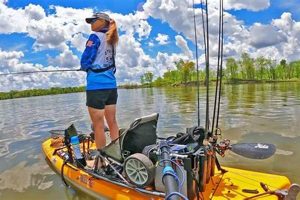
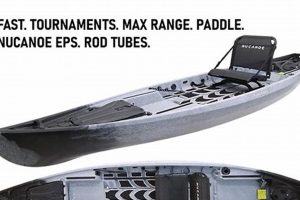
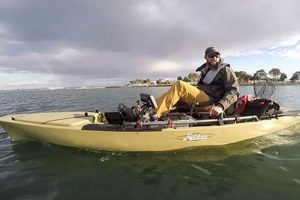
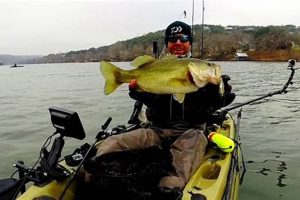
A kayak designed for angling, typically measuring approximately 2.7 meters in length, offers a compact and maneuverable vessel ideal for navigating smaller waterways. This size frequently represents a balance between stability and portability, allowing anglers to access shallow or confined fishing spots often unreachable by larger boats. These specialized watercraft usually incorporate features like rod holders, storage compartments for tackle and gear, and sometimes even anchor trolleys or fish finders.
Compact fishing vessels provide numerous advantages to anglers. Their smaller size facilitates easier transport and storage, eliminating the need for trailers or large storage spaces. This portability opens up fishing opportunities in remote locations, allowing access to secluded waters otherwise difficult to reach. Furthermore, the maneuverability of these kayaks proves beneficial in tight spaces, enabling anglers to navigate around obstacles and explore diverse fishing environments effectively. Historically, smaller watercraft played a crucial role in fishing practices across various cultures, demonstrating the enduring practicality of this vessel size.
The subsequent sections delve deeper into key considerations for selecting an appropriate fishing kayak, including hull design, materials, features, and essential safety equipment.
Tips for Selecting and Using a Compact Fishing Kayak
Choosing and utilizing a smaller fishing kayak effectively requires careful consideration of various factors to maximize on-the-water success and safety. The following tips offer guidance for anglers seeking to optimize their fishing experience.
Tip 1: Consider Hull Design: Hull design significantly impacts stability and maneuverability. A flatter hull offers enhanced stability, making it suitable for calmer waters and stand-up fishing. A V-shaped hull, conversely, provides better tracking and speed, ideal for paddling longer distances or navigating currents.
Tip 2: Evaluate Weight Capacity: Ensure the kayak’s weight capacity accommodates the combined weight of the angler, gear, and potential catch. Exceeding the limit compromises stability and safety.
Tip 3: Prioritize Comfort and Ergonomics: A comfortable seat and adjustable footrests contribute significantly to long-term comfort, especially during extended fishing trips. Test the seating and adjustability before purchasing.
Tip 4: Assess Storage Options: Adequate storage is crucial for carrying tackle, gear, and personal items. Consider the size, location, and accessibility of storage compartments.
Tip 5: Choose Appropriate Paddles: Select a paddle of appropriate length and material. Lightweight paddles reduce fatigue during longer paddling sessions. Consider a paddle leash to prevent loss.
Tip 6: Invest in Essential Safety Gear: A personal flotation device (PFD) is paramount. A whistle, signaling device, and first-aid kit are also essential safety items.
Tip 7: Practice Paddling and Maneuvering: Before venturing into open water, practice paddling and maneuvering in a controlled environment. Familiarize oneself with the kayak’s handling characteristics.
Tip 8: Check Local Regulations: Be aware of local fishing regulations and licensing requirements before embarking on a fishing trip.
By considering these tips, anglers can make informed decisions when selecting and utilizing a compact fishing kayak, leading to a safer and more productive fishing experience.
The following section concludes with a summary of key takeaways and recommendations for maximizing enjoyment on the water.
1. Length

The approximate 2.7-meter (9-foot) length of these kayaks contributes significantly to their maneuverability and ease of transport. This compact size allows for efficient navigation through narrow waterways, including shallow creeks, tight rivers, and areas dense with vegetation. Compared to longer kayaks, a shorter length reduces turning radius, enabling quicker adjustments in direction and precise navigation around obstacles. This proves advantageous when targeting fish in confined spaces or pursuing species that inhabit complex environments.
Consider a scenario where an angler navigates a small, winding creek choked with fallen logs and overhanging branches. A longer kayak would struggle to maneuver effectively, potentially hindering access to prime fishing spots. The compact nature of a 9-foot kayak, however, allows the angler to navigate these tight spaces, maximizing fishing opportunities. Similarly, transporting and storing a smaller vessel presents fewer logistical challenges. It can be easily loaded onto a car roof rack or stored in a garage without requiring specialized trailers or extensive storage space.
The compact length of a 9-foot fishing kayak directly influences its suitability for specific fishing environments. Understanding this connection allows anglers to choose a vessel appropriate for their targeted locations and fishing styles. While longer kayaks offer speed and tracking advantages in open water, the maneuverability of a shorter kayak proves invaluable in confined or obstacle-rich environments. This balance of portability and performance underscores the practical significance of the 9-foot length for anglers seeking access to diverse fishing locations.
2. Stability
Stability is a critical factor in fishing kayak performance, especially when casting. A stable platform allows for accurate and efficient casting techniques, reducing the likelihood of losing balance and potentially capsizing. In the context of a 9ft fishing kayak, stability is directly influenced by hull design, width, and weight distribution. Understanding these factors helps anglers choose a kayak suitable for their fishing style and the conditions they typically encounter.
- Primary Stability: Resistance to Initial Tipping.
Primary stability refers to the kayak’s resistance to tipping when it’s sitting flat on the water. A wider hull generally provides greater primary stability, making it ideal for calmer waters and activities like stand-up fishing. In a 9ft kayak, achieving sufficient primary stability is essential for maintaining balance while casting, particularly when using heavier lures or battling strong fish. For example, an angler standing to cast in a narrow, unstable kayak risks capsizing, whereas a wider, more stable platform enhances casting control and safety.
- Secondary Stability: Resistance to Further Tipping.
Secondary stability describes the kayak’s resistance to capsizing once it’s tilted beyond its initial stability point. This comes into play when leaning over to retrieve a fish or navigating rough water. A kayak with rounded chines (the edges where the hull meets the side) typically offers better secondary stability. In a 9ft fishing kayak, good secondary stability is crucial for recovering from unexpected movements, like a sudden shift in weight during a cast or the pull of a hooked fish. An angler in a 9ft kayak with strong secondary stability can lean further without capsizing, increasing reach and maneuverability when landing a fish.
- Hull Design and Stability.
Hull design directly influences both primary and secondary stability. Flatter hulls provide better primary stability, while more rounded or V-shaped hulls enhance secondary stability and tracking. A 9ft fishing kayak often incorporates a hybrid hull design, balancing stability and maneuverability for various fishing conditions. For example, a 9ft kayak with a slightly flatter hull is suitable for stillwater fishing, while one with a more rounded hull is better suited for maneuvering in currents or choppy water.
- Weight Distribution and Stability.
Proper weight distribution within the kayak significantly impacts stability. Centering heavier items and distributing weight evenly helps maintain balance and prevents tipping. In a 9ft fishing kayak, careful organization of tackle and gear is essential for optimizing stability. Positioning heavier items lower in the hull and distributing gear evenly enhances overall balance and control, critical for stable casting and maneuvering.
Understanding the interplay between these factors is essential for selecting a 9ft fishing kayak that provides the necessary stability for casting and overall on-the-water performance. Anglers must consider their individual needs and the conditions they expect to encounter when choosing a kayak. Prioritizing stability ensures a safe and enjoyable fishing experience, maximizing opportunities for successful casting and fish retrieval.
3. Portability
The portability of a kayak significantly influences its overall practicality, particularly for anglers with limited storage space or those seeking access to remote fishing locations. A 9ft fishing kayak offers distinct advantages in portability due to its compact size and manageable weight. This translates to easier transportation and storage compared to larger kayaks or traditional fishing boats, expanding fishing opportunities and simplifying logistical considerations.
Consider the scenario of an angler living in an apartment with limited storage. A larger kayak would present significant storage challenges, potentially requiring off-site storage or hindering ownership altogether. The compact dimensions of a 9ft kayak, however, allow for convenient storage in smaller spaces, such as a closet, balcony, or even inside a vehicle. This ease of storage eliminates the need for dedicated storage solutions and associated costs, making kayak ownership more feasible for individuals in urban environments or with limited space.
Furthermore, transporting a 9ft kayak is considerably easier than transporting larger vessels. Many 9ft kayaks can be easily loaded onto a car roof rack without requiring a trailer, reducing transportation costs and simplifying travel logistics. This allows anglers to access remote fishing spots unreachable by larger boats, expanding fishing opportunities. For instance, an angler can easily transport a 9ft kayak to a remote mountain lake or a secluded section of a river, offering access to pristine fishing grounds otherwise inaccessible with a larger, less portable vessel. The ability to bypass boat ramps and navigate shallow waters further enhances the reach and versatility offered by a portable fishing kayak.
The portability of a 9ft fishing kayak extends beyond mere convenience. It empowers anglers with greater flexibility in choosing fishing locations, eliminating the constraints imposed by larger, less manageable watercraft. This enhanced accessibility unlocks a wider range of fishing experiences, from exploring secluded coves to navigating shallow creeks, directly impacting the overall enjoyment and potential success of fishing trips. The practical significance of portability in a 9ft fishing kayak is undeniable, offering a balance between performance and logistical ease that caters to a diverse range of anglers and fishing environments. This inherent portability directly contributes to the increasing popularity of these versatile vessels among both seasoned anglers and newcomers to the sport.
4. Fishing Features

Specialized features distinguish fishing kayaks from recreational models, enhancing their practicality and angling effectiveness. In a 9ft fishing kayak, where space is at a premium, thoughtfully designed features maximize functionality without compromising stability or maneuverability. Rod holders and storage solutions are paramount, enabling anglers to carry essential gear, maintain organized tackle, and focus on the task at hand catching fish. These features directly influence fishing success and overall enjoyment on the water.
- Rod Holders.
Integrated rod holders are essential for securing fishing rods while paddling, changing lures, or landing fish. Flush-mounted rod holders offer a streamlined profile, minimizing interference while paddling, while adjustable rod holders allow for customized positioning based on fishing techniques and target species. For example, trolling requires rod holders positioned for optimal line spread, whereas casting benefits from readily accessible rod placement. A 9ft fishing kayak often incorporates multiple rod holders to accommodate diverse fishing styles, increasing versatility and efficiency on the water.
- Storage Compartments.
Storage compartments within a 9ft fishing kayak are crucial for organizing tackle, storing personal items, and protecting sensitive equipment from water damage. Dry storage hatches provide waterproof protection for electronics, wallets, and phones, while open storage areas allow for quick access to frequently used items like pliers and lures. Tank wells, often located at the stern, offer secure storage for larger items such as tackle boxes or coolers. Ample and strategically placed storage enhances efficiency and reduces clutter, allowing anglers to focus on fishing rather than managing gear.
- Tackle Management Systems.
Dedicated tackle management systems optimize organization and access to lures, hooks, and other small fishing accessories. Integrated trays, compartments, and removable tackle boxes keep essential gear within easy reach, minimizing time spent searching for specific items. Efficient tackle management contributes to a streamlined fishing experience, allowing anglers to adapt quickly to changing conditions and maximize fishing time. In a 9ft kayak, where space is limited, effective tackle management is particularly valuable.
- Other Features.
Additional features, while not always standard, can significantly enhance the functionality of a 9ft fishing kayak. These may include anchor trolleys for controlled drifting, paddle parks for securing the paddle when fishing, and gear tracks for mounting fish finders or other accessories. These features cater to specific fishing styles and preferences, further customizing the kayak to individual needs. While the core features of rod holders and storage remain fundamental, the inclusion of supplementary features can elevate the overall fishing experience and contribute to greater success on the water.
The thoughtful integration of fishing-specific features within a 9ft kayak significantly impacts its practicality and effectiveness as a fishing platform. By carefully considering the types and placement of rod holders, storage compartments, and other features, anglers can select a kayak optimized for their preferred fishing styles and target species. The strategic use of space and the inclusion of practical features directly contribute to a more organized, efficient, and ultimately, more successful fishing experience. This focus on functionality distinguishes a dedicated fishing kayak from a recreational model and underscores the importance of these features in maximizing angling potential.
5. Hull Design

Hull design significantly influences the performance of a 9ft fishing kayak, directly impacting its tracking and stability. These characteristics affect maneuverability, paddling efficiency, and overall on-the-water experience. Understanding the relationship between hull design and these performance attributes allows for informed kayak selection tailored to specific fishing environments and angler preferences.
Three primary hull designs are commonly found in kayaks: flat-bottom, V-shaped, and pontoon. Each design presents unique performance characteristics regarding tracking and stability. A flat-bottom hull offers exceptional primary stability, making it ideal for calmer waters and activities like stand-up fishing. However, it sacrifices tracking performance, requiring more frequent corrective strokes to maintain a straight course. Conversely, a V-shaped hull excels in tracking, efficiently cutting through the water and maintaining direction with minimal effort. However, this design compromises primary stability, making it less suitable for stand-up fishing or rough conditions. Pontoon hulls, characterized by two separate hulls connected by a platform, maximize stability but often exhibit reduced maneuverability compared to other designs. Many 9ft fishing kayaks utilize hybrid hull designs, incorporating elements of different hull types to balance stability and tracking performance.
Consider a scenario where an angler intends to fish in a slow-moving river with minimal current. A flat-bottom hulled 9ft kayak would provide excellent stability for casting and retrieving fish, but might require frequent adjustments to stay on course. In contrast, a V-shaped hull would track efficiently in the current, reducing paddling effort but potentially compromising stability while casting. A hybrid hull incorporating a moderate V-shape with a slightly flatter bottom could offer a compromise, providing acceptable tracking with enhanced stability compared to a pure V-shaped design. Selecting the appropriate hull design for a 9ft fishing kayak depends on the intended use and the specific balance of stability and tracking required by the angler. Understanding these performance characteristics empowers anglers to make informed decisions that optimize their on-the-water experience and maximize fishing success.
6. Weight Capacity

Weight capacity is a critical factor influencing the performance and safety of a 9ft fishing kayak. It represents the maximum combined weight of the angler, gear, and any potential catch the kayak can safely support. Exceeding this limit compromises stability, maneuverability, and potentially leads to capsizing. Understanding weight capacity and its implications is crucial for selecting an appropriate kayak and ensuring a safe and enjoyable fishing experience.
- Total Weight Calculation.
Accurately calculating the total weight to be carried is essential. This includes not only the angler’s weight but also the combined weight of all gear, including fishing rods, tackle boxes, coolers, clothing, and safety equipment. Underestimating gear weight can lead to exceeding the kayak’s capacity, negatively impacting performance and safety. For example, an angler weighing 150 lbs with 50 lbs of gear requires a kayak with a minimum weight capacity of 200 lbs. Careful consideration of all carried items ensures accurate weight calculation.
- Performance Implications.
Operating a 9ft fishing kayak near its maximum weight capacity affects performance. A heavily loaded kayak sits lower in the water, increasing drag and reducing paddling efficiency. Maneuverability is also compromised, requiring greater effort to turn and navigate. Furthermore, stability is reduced, increasing the risk of capsizing, especially in rough water or when making sudden movements. Understanding these performance implications underscores the importance of selecting a kayak with adequate weight capacity.
- Safety Considerations.
Exceeding the weight capacity of a 9ft fishing kayak poses significant safety risks. A heavily loaded kayak is more prone to capsizing, particularly in challenging conditions. Furthermore, a kayak operating near its limit may be more difficult to re-enter after a capsize. Prioritizing safety requires careful consideration of weight capacity and adherence to manufacturer recommendations. Choosing a kayak with a weight capacity exceeding anticipated needs provides a safety margin and enhances overall on-the-water security.
- Kayak Selection.
Weight capacity is a key factor in kayak selection. Anglers should assess their individual needs and anticipated gear weight to determine the appropriate weight capacity for their 9ft fishing kayak. Manufacturers provide weight capacity specifications for each model, allowing for informed decision-making. Choosing a kayak with ample weight capacity ensures safe and optimal performance, maximizing enjoyment and minimizing risks on the water. Prioritizing weight capacity during the selection process contributes significantly to a positive and secure kayaking experience.
Weight capacity is intrinsically linked to the overall performance and safety of a 9ft fishing kayak. Understanding its implications and making informed decisions based on individual needs and anticipated gear weight are essential for a positive and secure kayaking experience. Prioritizing weight capacity ensures optimal performance, minimizes risks, and allows anglers to focus on the enjoyment of fishing.
7. Material

Material selection significantly influences the durability, weight, and cost of a 9ft fishing kayak. The chosen material affects the kayak’s resistance to impact, abrasion, and UV degradation, as well as its overall portability and affordability. Understanding the properties of common kayak materials allows for informed decision-making based on individual needs and budget constraints.
- Polyethylene (PE).
Polyethylene is a common material for recreational and entry-level fishing kayaks due to its affordability, durability, and impact resistance. Rotational molding (roto-molded) PE kayaks are particularly robust, capable of withstanding significant abuse. However, PE kayaks are generally heavier than those constructed from other materials. For example, a 9ft roto-molded PE kayak might weigh between 40 and 60 pounds. This weight can impact portability, especially for individuals transporting the kayak on their own.
- High-Density Polyethylene (HDPE).
High-Density Polyethylene (HDPE) offers enhanced durability and UV resistance compared to standard PE. HDPE kayaks are slightly more expensive but offer increased longevity, making them a worthwhile investment for anglers seeking a robust and reliable vessel. While HDPE kayaks are still relatively heavy, their increased resistance to wear and tear can offset the weight penalty for long-term use.
- Thermoformed ABS/ASA.
Thermoformed ABS/ASA (acrylonitrile butadiene styrene/acrylic styrene acrylonitrile) kayaks offer a balance between durability, weight, and cost. This material is lighter and stiffer than PE, resulting in improved performance and easier portability. Thermoformed kayaks are generally more expensive than roto-molded PE kayaks but offer a performance advantage. The reduced weight can be particularly beneficial for anglers who frequently transport their kayaks or paddle longer distances.
- Composite Materials (Fiberglass, Carbon Fiber).
Composite materials like fiberglass and carbon fiber offer superior performance and lighter weight compared to plastic kayaks. These materials allow for thinner hull construction, reducing weight and enhancing paddling efficiency. However, composite kayaks are significantly more expensive and require greater care to prevent damage. For anglers prioritizing performance and willing to invest in a premium kayak, composite construction offers significant advantages. The reduced weight and increased stiffness translate to improved speed, maneuverability, and responsiveness on the water.
The choice of material directly impacts the overall performance, durability, and cost of a 9ft fishing kayak. Selecting the appropriate material depends on individual priorities, budget constraints, and intended usage. Anglers seeking a durable and affordable option often choose roto-molded PE, while those prioritizing performance and portability might opt for thermoformed ABS/ASA or composite construction. Carefully considering material properties ensures a well-informed decision that aligns with individual needs and maximizes long-term satisfaction with the kayak.
Frequently Asked Questions
This section addresses common inquiries regarding kayaks designed for angling, approximately 2.7 meters in length.
Question 1: What are the advantages of a compact fishing kayak compared to a larger vessel?
Compact fishing kayaks offer enhanced maneuverability in tight spaces, improved portability for easier transport and storage, and generally lower costs compared to larger boats. These advantages make them ideal for accessing shallow waters, navigating confined areas, and simplifying logistical considerations.
Question 2: How is stability affected by kayak length?
While length influences stability, it is not the sole determining factor. Width, hull design, and weight distribution play significant roles. Shorter kayaks can be stable, especially those with wider beams and flatter hulls, while longer kayaks can be less stable if narrow or improperly weighted. Stability in a 9ft kayak is often a design compromise balancing maneuverability and a secure platform.
Question 3: What features should one look for in a fishing kayak of this size?
Essential features include rod holders, storage compartments for tackle and gear, and a comfortable seat. Additional features like anchor trolleys, paddle parks, and gear tracks enhance functionality but are not always standard. Prioritizing features aligned with individual fishing styles and needs is crucial.
Question 4: How does one choose the right paddle for a compact kayak?
Paddle selection depends on kayak width and individual paddling style. Generally, a shorter paddle is suitable for narrower kayaks. Paddle length also considers torso height and arm length. Lightweight paddles reduce fatigue during extended paddling sessions. Testing different paddle lengths and styles can determine the optimal choice.
Question 5: Are these kayaks suitable for ocean use?
While some compact kayaks can handle calm ocean conditions, they are generally better suited for protected waters like lakes, rivers, and bays. Ocean use requires careful consideration of weather conditions, tides, and currents. Kayaks designed specifically for ocean use typically possess features enhancing stability and seaworthiness, often absent in compact models.
Question 6: What safety precautions should be taken when using a compact fishing kayak?
Wearing a personal flotation device (PFD) is paramount. Carrying a whistle, signaling device, and first-aid kit is also essential. Checking weather forecasts before embarking on a fishing trip and informing someone of the intended location and return time are crucial safety practices. Understanding basic paddling techniques and self-rescue procedures enhances safety awareness and preparedness on the water.
Choosing a kayak involves careful consideration of individual needs and intended usage. Prioritizing safety, stability, and appropriate features ensures a positive and productive fishing experience.
The following section offers concluding remarks and recommendations.
Conclusion
Exploration of the 9ft fishing kayak reveals a compelling balance of portability, maneuverability, and fishability. Compact dimensions facilitate easy transport and storage, while specialized features like rod holders and storage compartments cater to angling needs. Understanding hull design, weight capacity, and material selection empowers informed purchasing decisions aligned with individual fishing styles and target environments. Consideration of stability and tracking performance ensures optimal on-the-water experiences.
The 9ft fishing kayak represents a versatile and accessible entry point for individuals seeking to explore kayak angling. Its compact nature expands fishing opportunities in diverse environments, while its specialized design enhances fishing effectiveness. Careful evaluation of individual needs and kayak characteristics ensures a rewarding and productive pursuit of angling adventures. The future of kayak fishing continues to evolve, with ongoing innovations enhancing performance and accessibility for anglers of all skill levels.